Systematic literature reviews and academic research
Buying guide · 24 tools ranked
Best AI Tools for Academics & Researchers
Finding the literature, screening it without losing a month to it, and actually understanding what you found. The tools we rate highest for research work, including the systematic-review platforms general AI tools cannot replace.
Ranked by our score, worked out from each vendor’s own pages.How we score →
Our top 3 AI Tools for Academics & Researchers
Systematic review researchers, academics, healthcare professionals, and research institutions
Researchers, PhD candidates, biopharma teams, clinical practitioners, and R&D engineers who need accurate, cited AI answers across large document libraries
Best AI tools for academics to find and assess papers
6 picks#ToolScorePriceWhy pick it
01 Elicit#1 of 11 literature search tools7.8Score 7.8 out of 10From $19free planSystematic literature reviews and academic researchVisit site ↗DetailsCloseShow more about Elicit
Elicit#1 of 11 literature search tools
7.8Score 7.8 out of 10From $19free planSystematic literature reviews and academic researchVisit site ↗DetailsClose
- Semantic search across 138 million academic papers means users don't need exact keyword phrasing to find relevant literature.
- Built specifically for rigorous, citation-dependent research workflows rather than general-purpose AI use.
- Not designed for general-purpose AI queries, so users expecting quick answers or tidy summaries will be disappointed.
From $20free planResearchers, clinicians, students, and faculty conducting literature reviews
Visit site ↗DetailsClose02 Consensus#4 of 11 literature search tools6.7Score 6.7 out of 10From $20free planResearchers, clinicians, students, and faculty conducting literature reviewsVisit site ↗DetailsCloseShow more about Consensus
From $20free plan
Researchers, clinicians, students, and faculty conducting literature reviews
Visit site ↗DetailsClose
Consensus#4 of 11 literature search tools
6.7Score 6.7 out of 10From $20free planResearchers, clinicians, students, and faculty conducting literature reviewsVisit site ↗DetailsClose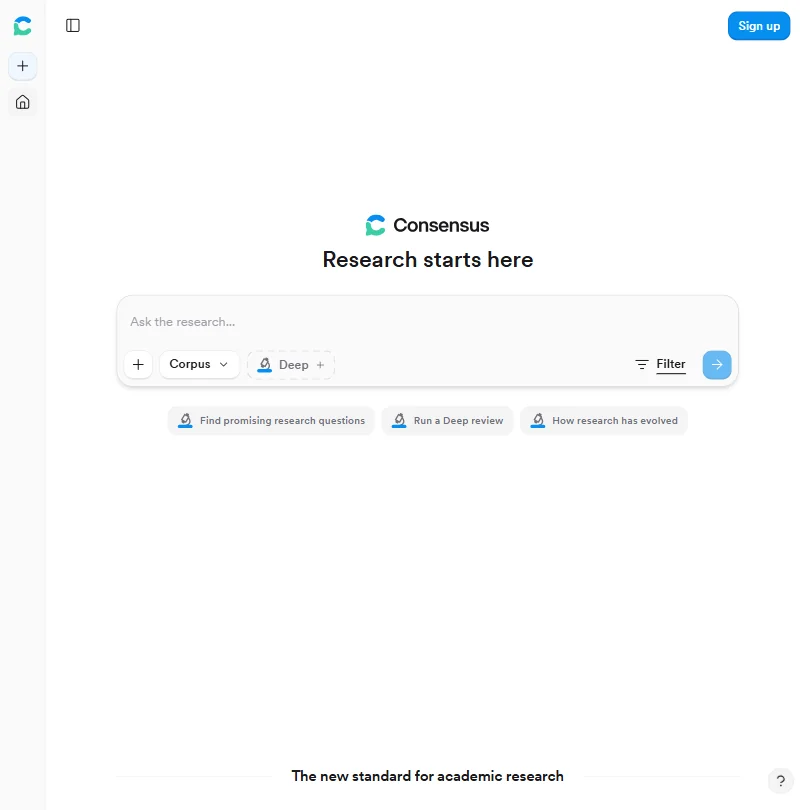
- Pulls answers from over 220 million peer-reviewed papers, not blogs or news articles, ensuring high-quality academic sources.
- The Consensus Meter provides a visual summary of how strongly existing evidence supports or contradicts a claim, saving synthesis time.
- No mobile app exists, which is a significant gap for clinicians needing quick literature checks away from their desk.
FreeResearchers and academics seeking AI-powered literature discovery and citation analysis
Visit site ↗DetailsClose03 Semantic Scholar#6 of 11 literature search tools6.0Score 6.0 out of 10FreeResearchers and academics seeking AI-powered literature discovery and citation analysisVisit site ↗DetailsCloseShow more about Semantic Scholar
Free
Researchers and academics seeking AI-powered literature discovery and citation analysis
Visit site ↗DetailsClose
Semantic Scholar#6 of 11 literature search tools
6.0Score 6.0 out of 10FreeResearchers and academics seeking AI-powered literature discovery and citation analysisVisit site ↗DetailsClose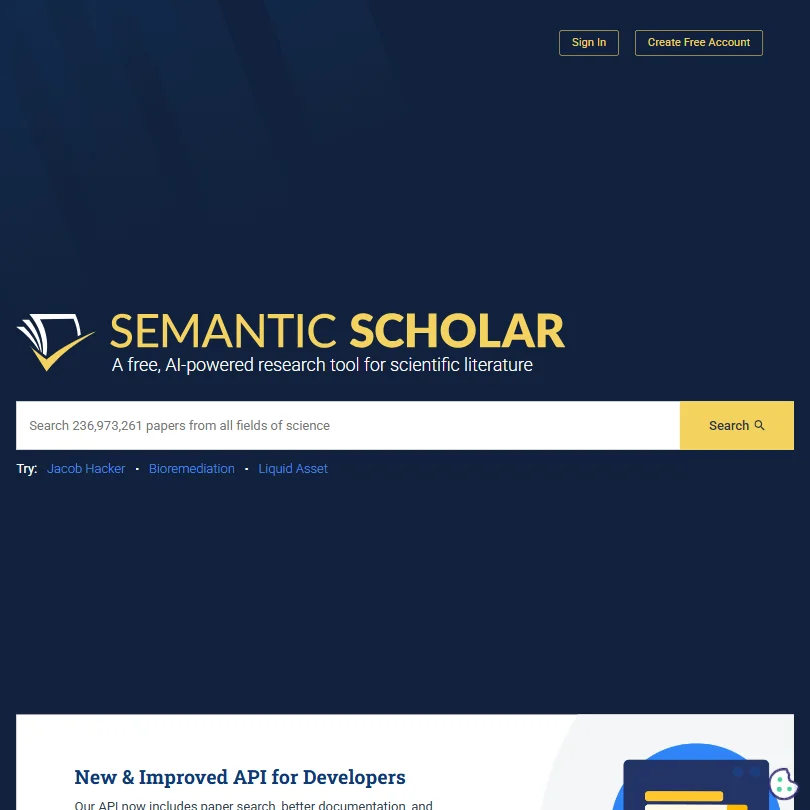
- Completely free with no paywalls, paid plans, or enterprise pricing tiers — the entire tool is accessible without any cost.
- Indexes over 200 million papers across STEM, social sciences, and humanities, making it one of the largest academic search databases available.
- As a free, nonprofit tool, it likely lacks the customer support infrastructure and dedicated account management that paid enterprise tools offer.
From $20free planIndividual researchers, labs, and small teams doing deep research
Visit site ↗DetailsClose04 Scite#7 of 11 literature search tools5.8Score 5.8 out of 10From $20free planIndividual researchers, labs, and small teams doing deep researchVisit site ↗DetailsCloseShow more about Scite
From $20free plan
Individual researchers, labs, and small teams doing deep research
Visit site ↗DetailsClose
Scite#7 of 11 literature search tools
5.8Score 5.8 out of 10From $20free planIndividual researchers, labs, and small teams doing deep researchVisit site ↗DetailsClose
- Smart Citations tag exactly how each paper was treated by later research — supported, contradicted, or mentioned — giving researchers meaningful context beyond raw citation counts.
- Full-text search across 300 million+ scholarly articles, preprints, patents, and datasets rather than just metadata or abstracts.
- No mobile app is available, limiting access for researchers who work on the go.
05 Undermind#8 of 11 literature search tools5.4Score 5.4 out of 10From $20free planAcademic and serious ongoing researchVisit site ↗DetailsCloseShow more about Undermind
Undermind#8 of 11 literature search tools
5.4Score 5.4 out of 10From $20free planAcademic and serious ongoing researchVisit site ↗DetailsClose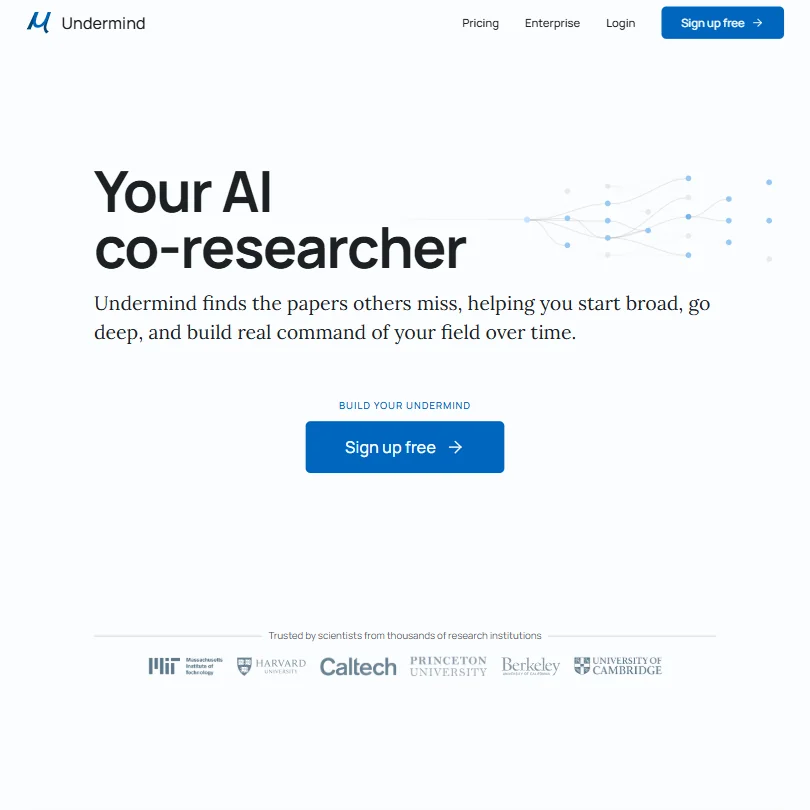
- Traceable inline citations allow every claim in a generated report to be verified by clicking through to the original source paper.
- The system reads papers at full-text level rather than just abstracts, enabling deeper comprehension than most literature search tools.
- Undermind is English-only, limiting its usefulness for researchers working in or across other languages.
From $12.50free planResearchers conducting literature reviews and citation network discovery
Visit site ↗DetailsClose06 ResearchRabbit#10 of 11 literature search tools4.0Score 4.0 out of 10From $12.50free planResearchers conducting literature reviews and citation network discoveryVisit site ↗DetailsCloseShow more about ResearchRabbit
From $12.50free plan
Researchers conducting literature reviews and citation network discovery
Visit site ↗DetailsClose
ResearchRabbit#10 of 11 literature search tools
4.0Score 4.0 out of 10From $12.50free planResearchers conducting literature reviews and citation network discoveryVisit site ↗DetailsClose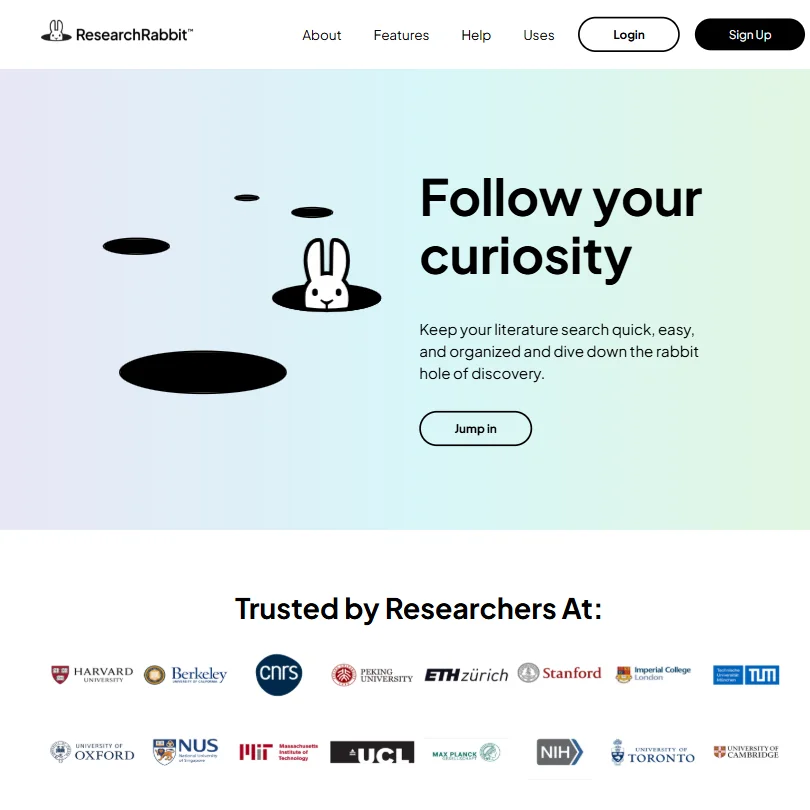
- Visual citation mapping gives research a spatial shape rather than a flat list, making it easier to spot clusters and connections.
- Zotero integration is genuinely well-built, syncing collections automatically without manual exports between tools.
- The free tier caps seed articles at 50, which may limit users working on large-scale systematic reviews.
Best AI tools for academics running systematic reviews
6 picks#ToolScorePriceWhy pick it
From $8.33free planSystematic review researchers, academics, healthcare professionals, and research institutions
Visit site ↗DetailsClose07 Rayyan#1 of 4 systematic review platforms8.2Score 8.2 out of 10From $8.33free planSystematic review researchers, academics, healthcare professionals, and research institutionsVisit site ↗DetailsCloseShow more about Rayyan
From $8.33free plan
Systematic review researchers, academics, healthcare professionals, and research institutions
Visit site ↗DetailsClose
Rayyan#1 of 4 systematic review platforms
8.2Score 8.2 out of 10From $8.33free planSystematic review researchers, academics, healthcare professionals, and research institutionsVisit site ↗DetailsClose
- The Systematic Auto-Resolver deduplicates references quickly using a configurable protocol, solving one of the most tedious parts of multi-database systematic reviews.
- ResearchPilot AI provides zero-shot relevance ratings, meaning it can score reference relevance without requiring training examples from the user.
- Rayyan is not listed on G2 or Capterra, making it harder to find aggregated, verified user reviews for independent evaluation.
08Elicit#1 of 11 literature search tools7.8Score 7.8 out of 10From $19free planSystematic literature reviews and academic researchVisit site ↗DetailsCloseShow more about Elicit
Elicit#1 of 11 literature search tools
7.8Score 7.8 out of 10From $19free planSystematic literature reviews and academic researchVisit site ↗DetailsClose- Semantic search across 138 million academic papers means users don't need exact keyword phrasing to find relevant literature.
- Built specifically for rigorous, citation-dependent research workflows rather than general-purpose AI use.
- Not designed for general-purpose AI queries, so users expecting quick answers or tidy summaries will be disappointed.
09 Covidence#2 of 4 systematic review platforms6.8Score 6.8 out of 10From $339 per yearSystematic reviews and evidence synthesis teamsVisit site ↗DetailsCloseShow more about Covidence
Covidence#2 of 4 systematic review platforms
6.8Score 6.8 out of 10From $339 per yearSystematic reviews and evidence synthesis teamsVisit site ↗DetailsClose
- Purpose-built for systematic reviews and evidence synthesis, making it highly optimized for that specific academic and clinical workflow.
- Supports unlimited collaborators on every plan, enabling large research teams to work together without user-count penalties.
- No native search functionality — users must import references from external databases before any work can begin in the platform.
From $35free planAcademics, researchers, medical professionals, students, and pharma/biotech teams needing citation-backed literature reviews
Visit site ↗DetailsClose10 AnswerThis#3 of 11 literature search tools6.8Score 6.8 out of 10From $35free planAcademics, researchers, medical professionals, students, and pharma/biotech teams needing citation-backed literature reviewsVisit site ↗DetailsCloseShow more about AnswerThis
From $35free plan
Academics, researchers, medical professionals, students, and pharma/biotech teams needing citation-backed literature reviews
Visit site ↗DetailsClose
AnswerThis#3 of 11 literature search tools
6.8Score 6.8 out of 10From $35free planAcademics, researchers, medical professionals, students, and pharma/biotech teams needing citation-backed literature reviewsVisit site ↗DetailsClose
- PRISMA-compliant systematic review pipelines set it apart from lighter competitors like Consensus or Research Rabbit.
- Searches a database of over 250 million papers, giving researchers broad and deep coverage.
- Free users face PDF upload caps, limiting usability without a paid plan.
From $43 (€40)free planResearchers, academics, and scientific teams conducting systematic literature reviews
Visit site ↗DetailsClose11 Silvi#3 of 4 systematic review platforms5.5Score 5.5 out of 10From $43 (€40)free planResearchers, academics, and scientific teams conducting systematic literature reviewsVisit site ↗DetailsCloseShow more about Silvi
From $43 (€40)free plan
Researchers, academics, and scientific teams conducting systematic literature reviews
Visit site ↗DetailsClose
Silvi#3 of 4 systematic review platforms
5.5Score 5.5 out of 10From $43 (€40)free planResearchers, academics, and scientific teams conducting systematic literature reviewsVisit site ↗DetailsClose
- Built specifically for systematic literature reviews, covering the full review pipeline from search to data extraction and synthesis.
- Database imports from PubMed, OpenAlex, and ERIC are supported, though search happens on each database's own site before importing into Silvi; Zotero import is also supported.
- No mobile app, limiting flexibility for researchers whose workflow moves across devices or contexts.
From $50free planResearchers, academic institutions, and organizations conducting systematic literature reviews and document data extraction
Visit site ↗DetailsClose12 Sysrev#4 of 4 systematic review platforms5.1Score 5.1 out of 10From $50free planResearchers, academic institutions, and organizations conducting systematic literature reviews and document data extractionVisit site ↗DetailsCloseShow more about Sysrev
From $50free plan
Researchers, academic institutions, and organizations conducting systematic literature reviews and document data extraction
Visit site ↗DetailsClose
Sysrev#4 of 4 systematic review platforms
5.1Score 5.1 out of 10From $50free planResearchers, academic institutions, and organizations conducting systematic literature reviews and document data extractionVisit site ↗DetailsClose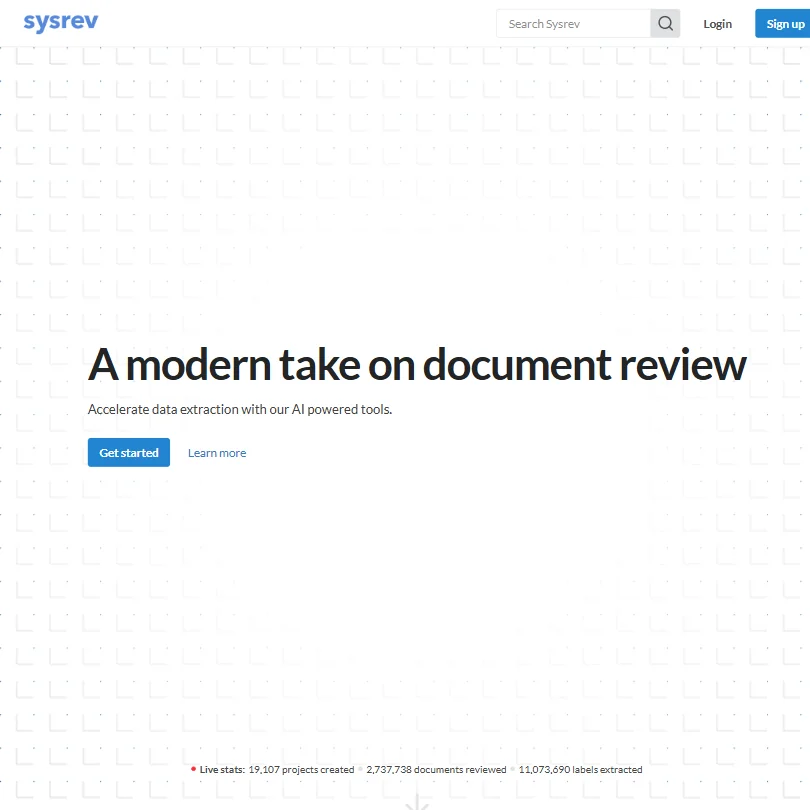
- Supports a wider range of input formats than most competitors, including PDFs, title-abstract pairs, plain text, and structured JSON.
- The AI Auto Labeler automates document labeling, reducing manual workload for large document sets.
- No general web search, though PubMed and OpenAlex search are built in, for other sources, users must supply their own documents.
Best AI tools for academics to read and question papers
5 picks#ToolScorePriceWhy pick it
From $12free planResearchers, PhD candidates, biopharma teams, clinical practitioners, and R&D engineers who need accurate, cited AI answers across large document libraries
Visit site ↗DetailsClose13 Anara#1 of 8 paper readers7.3Score 7.3 out of 10From $12free planResearchers, PhD candidates, biopharma teams, clinical practitioners, and R&D engineers who need accurate, cited AI answers across large document librariesVisit site ↗DetailsCloseShow more about Anara
From $12free plan
Researchers, PhD candidates, biopharma teams, clinical practitioners, and R&D engineers who need accurate, cited AI answers across large document libraries
Visit site ↗DetailsClose
Anara#1 of 8 paper readers
7.3Score 7.3 out of 10From $12free planResearchers, PhD candidates, biopharma teams, clinical practitioners, and R&D engineers who need accurate, cited AI answers across large document librariesVisit site ↗DetailsClose
- Supports document libraries of up to 10,000 pages per upload, far exceeding most comparable tools.
- Every AI-generated answer is traceable back to the specific source passage, eliminating hallucinated citations.
- No presence on G2 or Capterra yet, making independent third-party reviews difficult to find and verify.
14 SciSpace#2 of 11 literature search tools6.9Score 6.9 out of 10From $20Academic research, literature review, paper discoveryVisit site ↗DetailsCloseShow more about SciSpace
SciSpace#2 of 11 literature search tools
6.9Score 6.9 out of 10From $20Academic research, literature review, paper discoveryVisit site ↗DetailsClose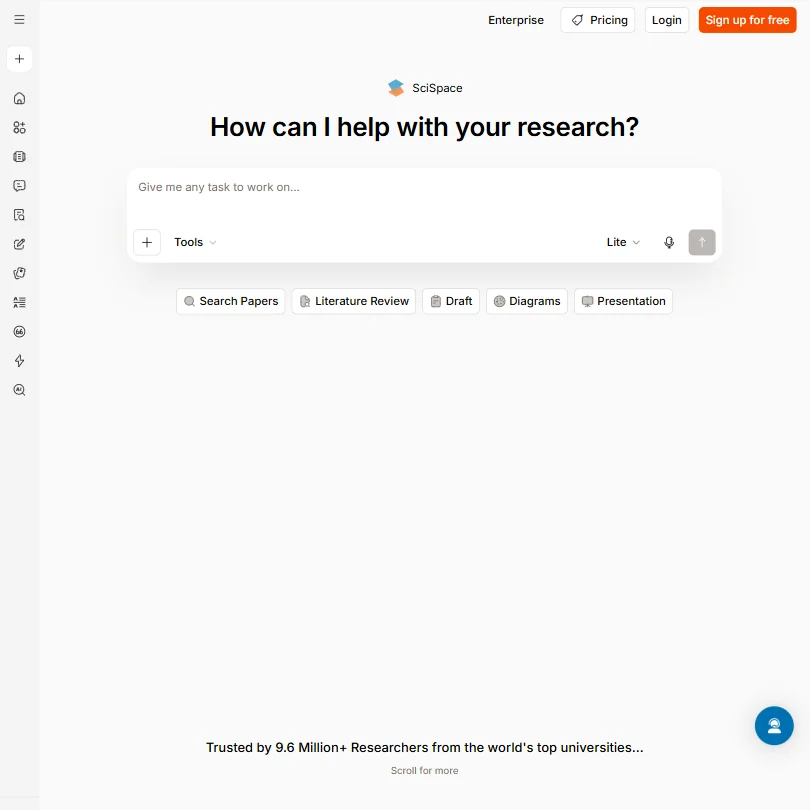
- Covers a genuinely broad feature set including PDF chat, literature review synthesis, citation generation, paraphrasing, AI writing, and data extraction in one platform.
- The Chat with PDF feature provides an intuitive entry point for researchers, allowing conversational Q&A with uploaded academic papers.
- The breadth of features raises trust concerns — a tool that does everything often does nothing particularly well.
From $10 (€8.99)free planStudents and researchers needing fast summarization and organization of academic papers
Visit site ↗DetailsClose15 Scholarcy#2 of 8 paper readers6.0Score 6.0 out of 10From $10 (€8.99)free planStudents and researchers needing fast summarization and organization of academic papersVisit site ↗DetailsCloseShow more about Scholarcy
From $10 (€8.99)free plan
Students and researchers needing fast summarization and organization of academic papers
Visit site ↗DetailsClose
Scholarcy#2 of 8 paper readers
6.0Score 6.0 out of 10From $10 (€8.99)free planStudents and researchers needing fast summarization and organization of academic papersVisit site ↗DetailsClose
- The flashcard-based summary format is specifically tailored to academic reading workflows, making it more useful than generic AI summarizers.
- The Enhance feature allows users to dial in summary depth, from a single-sentence overview to a detailed researcher-level breakdown.
- Scholarcy is not a discovery engine — it cannot search academic databases or find papers for you, limiting its utility in the research workflow.
16 Google NotebookLM#4 of 8 paper readers4.9Score 4.9 out of 10Pricing N/Afree planResearch, analysis, and learning from uploaded sourcesVisit site ↗DetailsCloseShow more about Google NotebookLM
Google NotebookLM#4 of 8 paper readers
4.9Score 4.9 out of 10Pricing N/Afree planResearch, analysis, and learning from uploaded sourcesVisit site ↗DetailsClose
- The free tier is genuinely capable, handling up to 50 sources per notebook without requiring a paid subscription.
- Responses are constrained strictly to user-uploaded sources, with citations pointing back to the exact document and passage, making outputs verifiable.
- Output formats like slide decks and infographics feel outside the tool's core identity and may reflect feature sprawl rather than focused improvement.
From $9.99free planSmall to large professional teams needing document processing
Visit site ↗DetailsClose17 Humata#7 of 8 paper readers3.5Score 3.5 out of 10From $9.99free planSmall to large professional teams needing document processingVisit site ↗DetailsCloseShow more about Humata
From $9.99free plan
Small to large professional teams needing document processing
Visit site ↗DetailsClose
Humata#7 of 8 paper readers
3.5Score 3.5 out of 10From $9.99free planSmall to large professional teams needing document processingVisit site ↗DetailsClose
- Inline citations link directly back to the exact source page, making claim verification fast and reliable.
- Cross-document querying allows users to actively compare and search across multiple files simultaneously, not just read them in parallel.
- No web search capability whatsoever — if the answer isn't in an uploaded file, Humata cannot find it.
Best AI writing tools for academics and researchers
4 picks#ToolScorePriceWhy pick it
From $12free planIndividuals, teams, and enterprises seeking AI-powered writing assistance, grammar checking, and tone improvement
Visit site ↗DetailsClose18 Grammarly#1 of 6 AI writing assistants8.3Score 8.3 out of 10From $12free planIndividuals, teams, and enterprises seeking AI-powered writing assistance, grammar checking, and tone improvementVisit site ↗DetailsCloseShow more about Grammarly
From $12free plan
Individuals, teams, and enterprises seeking AI-powered writing assistance, grammar checking, and tone improvement
Visit site ↗DetailsClose
Grammarly#1 of 6 AI writing assistants
8.3Score 8.3 out of 10From $12free planIndividuals, teams, and enterprises seeking AI-powered writing assistance, grammar checking, and tone improvementVisit site ↗DetailsClose
- Grammarly works across an impressive range of platforms including Chrome, Safari, Firefox, Edge, Windows, Mac, iOS, Android, Microsoft Word, and Google Docs.
- The plagiarism checker is built directly into the editor rather than being a separate export tool, a useful workflow for academic and content marketing use.
- The free plan is significantly limited, though it does include tone detection and 100 AI prompts a month alongside basic grammar, spelling, and punctuation; most meaningful features still require a paid Pro subscription.
From $7.52free planAcademic researchers, PhD students, university professors, and scientific authors preparing manuscripts for journal submission
Visit site ↗DetailsClose19 Paperpal#1 of 2 academic writing tools8.2Score 8.2 out of 10From $7.52free planAcademic researchers, PhD students, university professors, and scientific authors preparing manuscripts for journal submissionVisit site ↗DetailsCloseShow more about Paperpal
From $7.52free plan
Academic researchers, PhD students, university professors, and scientific authors preparing manuscripts for journal submission
Visit site ↗DetailsClose
Paperpal#1 of 2 academic writing tools
8.2Score 8.2 out of 10From $7.52free planAcademic researchers, PhD students, university professors, and scientific authors preparing manuscripts for journal submissionVisit site ↗DetailsClose
- Built specifically for academic and research writing, trained on scholarly literature and journal submission standards rather than general web content.
- Offers over 30 journal-specific readiness checks in a single pre-submission workflow, a feature rarely found in competing tools.
- Highly specialized focus means it is not useful for general-purpose writing tasks outside academia.
From $19.95free planStudents, academics, professionals, and content creators needing paraphrasing, grammar checking, and AI writing assistance
Visit site ↗DetailsClose20 QuillBot#2 of 6 AI writing assistants7.3Score 7.3 out of 10From $19.95free planStudents, academics, professionals, and content creators needing paraphrasing, grammar checking, and AI writing assistanceVisit site ↗DetailsCloseShow more about QuillBot
From $19.95free plan
Students, academics, professionals, and content creators needing paraphrasing, grammar checking, and AI writing assistance
Visit site ↗DetailsClose
QuillBot#2 of 6 AI writing assistants
7.3Score 7.3 out of 10From $19.95free planStudents, academics, professionals, and content creators needing paraphrasing, grammar checking, and AI writing assistanceVisit site ↗DetailsClose
- Offers ten paraphrasing modes, which is significantly more than most competitors that typically offer three or four.
- Comprehensive feature set includes grammar checker, plagiarism detector, citation generator (APA, MLA, Chicago), AI Detector, Summarizer, and Translator covering 50+ languages.
- Pricing is almost entirely invisible on the homepage, making it difficult to evaluate cost before committing.
From $30free planAcademic researchers, PhD students, and scientific writers needing cited, source-grounded writing
Visit site ↗DetailsClose21 Jenni AI#2 of 2 academic writing tools6.0Score 6.0 out of 10From $30free planAcademic researchers, PhD students, and scientific writers needing cited, source-grounded writingVisit site ↗DetailsCloseShow more about Jenni AI
From $30free plan
Academic researchers, PhD students, and scientific writers needing cited, source-grounded writing
Visit site ↗DetailsClose
Jenni AI#2 of 2 academic writing tools
6.0Score 6.0 out of 10From $30free planAcademic researchers, PhD students, and scientific writers needing cited, source-grounded writingVisit site ↗DetailsClose
- Grounded autocomplete cites real, traceable academic sources rather than fabricating references like general chatbots do.
- Over 10,000 citation styles supported, covering virtually every journal format a researcher could encounter.
- Not suitable for marketing teams, SEO writers or content creators, with no brand voice controls or bulk generation.
Best AI data analysis tools for researchers
2 picks#ToolScorePriceWhy pick it
From $8free planTeams who want a spreadsheet that pulls live data from databases and ad platforms, with AI analysis in the grid
Visit site ↗DetailsClose22 Rows#1 of 2 AI data analysts9.1Score 9.1 out of 10From $8free planTeams who want a spreadsheet that pulls live data from databases and ad platforms, with AI analysis in the gridVisit site ↗DetailsCloseShow more about Rows
From $8free plan
Teams who want a spreadsheet that pulls live data from databases and ad platforms, with AI analysis in the grid
Visit site ↗DetailsClose
Rows#1 of 2 AI data analysts
9.1Score 9.1 out of 10From $8free planTeams who want a spreadsheet that pulls live data from databases and ad platforms, with AI analysis in the gridVisit site ↗DetailsClose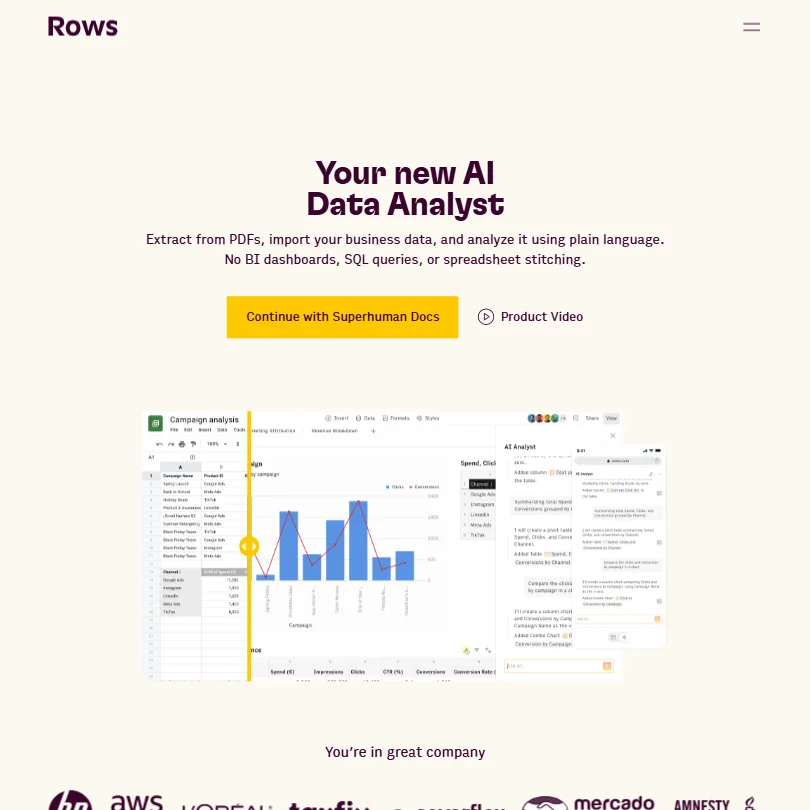
- Rows connects directly to databases and warehouses such as Snowflake, Amazon Redshift, MySQL, PostgreSQL and BigQuery.
- Rows is SOC 2 Type II certified, audited every year, and GDPR compliant.
- AI Tasks are capped at 5 a month on Free and only 200 a month on Plus, the cheapest paid plan.
From $20free planAnalysts who want answers from their databases and files with the code behind each result, rerun on a schedule
Visit site ↗DetailsClose23 Julius AI#2 of 2 AI data analysts8.9Score 8.9 out of 10From $20free planAnalysts who want answers from their databases and files with the code behind each result, rerun on a scheduleVisit site ↗DetailsCloseShow more about Julius AI
From $20free plan
Analysts who want answers from their databases and files with the code behind each result, rerun on a schedule
Visit site ↗DetailsClose
Julius AI#2 of 2 AI data analysts
8.9Score 8.9 out of 10From $20free planAnalysts who want answers from their databases and files with the code behind each result, rerun on a scheduleVisit site ↗DetailsClose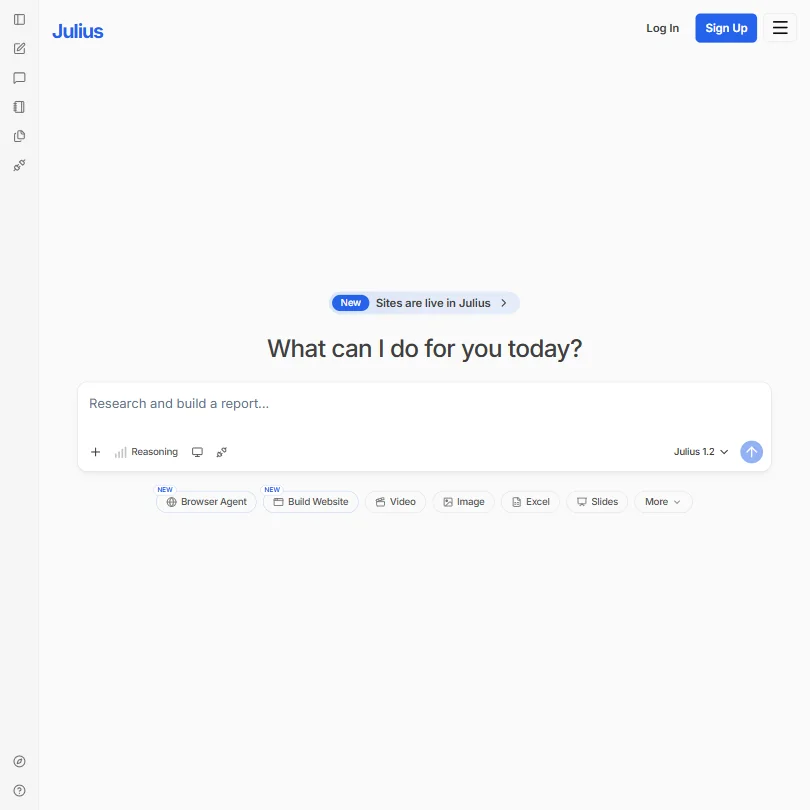
- Every insight comes with the underlying code Julius used to reach it.
- Julius connects directly to databases and warehouses including Postgres, BigQuery, Snowflake, MySQL, SQL Server and Supabase.
- The free plan is capped at 5 messages a month with Julius's most advanced AI model.
Best AI research workspaces for academics
3 picks#ToolScorePriceWhy pick it
From $12free planResearchers, PhD candidates, biopharma teams, clinical practitioners, and R&D engineers who need accurate, cited AI answers across large document libraries
Visit site ↗DetailsClose24Anara#1 of 8 paper readers7.3Score 7.3 out of 10From $12free planResearchers, PhD candidates, biopharma teams, clinical practitioners, and R&D engineers who need accurate, cited AI answers across large document librariesVisit site ↗DetailsCloseShow more about Anara
From $12free plan
Researchers, PhD candidates, biopharma teams, clinical practitioners, and R&D engineers who need accurate, cited AI answers across large document libraries
Visit site ↗DetailsClose
Anara#1 of 8 paper readers
7.3Score 7.3 out of 10From $12free planResearchers, PhD candidates, biopharma teams, clinical practitioners, and R&D engineers who need accurate, cited AI answers across large document librariesVisit site ↗DetailsClose- Supports document libraries of up to 10,000 pages per upload, far exceeding most comparable tools.
- Every AI-generated answer is traceable back to the specific source passage, eliminating hallucinated citations.
- No presence on G2 or Capterra yet, making independent third-party reviews difficult to find and verify.
From $12free planResearchers needing AI-assisted literature discovery, writing, and publishing tools
Visit site ↗DetailsClose25 R Discovery#5 of 11 literature search tools6.5Score 6.5 out of 10From $12free planResearchers needing AI-assisted literature discovery, writing, and publishing toolsVisit site ↗DetailsCloseShow more about R Discovery
From $12free plan
Researchers needing AI-assisted literature discovery, writing, and publishing tools
Visit site ↗DetailsClose
R Discovery#5 of 11 literature search tools
6.5Score 6.5 out of 10From $12free planResearchers needing AI-assisted literature discovery, writing, and publishing toolsVisit site ↗DetailsClose
- Covers a massive database the vendor claims includes 300 million articles, giving broad literature access.
- AI-generated summaries help researchers quickly triage papers and decide what is worth reading in full.
- AI summaries are useful for triage only and do not capture what a paper actually argues at a deeper level.
26 Avidnote#6 of 8 paper readers3.8Score 3.8 out of 10From $19free planResearchers and students managing academic papersVisit site ↗DetailsCloseShow more about Avidnote
Avidnote#6 of 8 paper readers
3.8Score 3.8 out of 10From $19free planResearchers and students managing academic papersVisit site ↗DetailsClose
- All-in-one research workspace keeps PDF reading and note-taking in the same window, eliminating constant context switching.
- Automatic interview transcription supports numerous languages and delivers transcripts in minutes from uploaded audio files.
- Avidnote has no presence on G2, Capterra, or Trustpilot, making independent user validation nearly impossible to find.
How we picked
Every tool here is ranked by its score, and each score is worked out from the vendor’s own published pages: pricing, plans, features and terms. No score is adjusted by hand. All 24 tools have enough published facts to be scored, and on average 97% of each score comes from facts the vendor publishes. The facts behind these scores were checked between 14 September 2026 and 26 September 2026.
Scores compare tools that do the same job, which is why the list is grouped by job: a video editor and a grammar checker are never ranked against each other.
| Ranked as | On this page | What we score | Scoring guide |
|---|---|---|---|
| Literature search tools11 reviewed | 9 | 6 criteria, 29 checked facts: finding papers, reading and analysing papers, systematic reviews, pricing, citing and writing, access | How we score these → |
| Paper readers8 reviewed | 5 | 6 criteria, 29 checked facts: finding papers, reading and analysing papers, systematic reviews, pricing, citing and writing, access | How we score these → |
| Systematic review platforms4 reviewed | 4 | 6 criteria, 27 checked facts: running the review, extraction and analysis, teams, pricing, finding papers, citing and exports | How we score these → |
| AI writing assistants6 reviewed | 2 | 5 criteria, 20 checked facts: what it helps with, pricing, where it works, teams and control, privacy and security | How we score these → |
| Academic writing tools2 reviewed | 2 | 5 criteria, 17 checked facts: research and citations, checking your work, pricing, where you write, privacy and security | How we score these → |
| AI data analysts2 reviewed | 2 | 4 criteria, 17 checked facts: what it does with your data, where it works, pricing, privacy and trust | How we score these → |