

What is AnswerThis?
Academic research tools are everywhere right now. AnswerThis is not trying to be all of them. Built specifically for researchers who need to find, screen, and synthesize scientific literature, the product positions itself for academics, PhD students, medical professionals, and pharma and biotech teams. That's a tight focus. It mostly holds.
The core loop: you ask a research question, the tool searches a database of over 250 million papers, and it drafts a citation-backed literature review with traceable, line-by-line sources. You can upload PDFs into a personal library. That's it, more or less.
Y Combinator backed them. Founded date isn't public. Neither is their headquarters, which we kept noticing and couldn't resolve. A little unusual, though not disqualifying.
AnswerThis Features: Search, Synthesis & Research Capabilities

Dense feature set. Deliberately so.
PRISMA-compliant systematic review pipelines are the headline differentiator, and we don't say that lightly. Most competitors in this space, including Consensus and Research Rabbit, don't go near formal systematic review compliance. AnswerThis does. Full-text AI screening and risk-of-bias assessments come with it, which moves the tool meaningfully past the lighter-weight options on the serious-research end.
The AI Writer synthesizes multiple papers into coherent summaries. Not just dropped abstracts. Follow-up questions let you push further into a topic without starting from scratch, and automatic citation formatting is included.
Library side: free users cap at 50 PDFs, Pro gets 200, Research gets 1,000, and Max unlocks unlimited. Zotero and Mendeley sync is available from the free plan upward, capped at the same paper counts as the library. No browser extension, though. No mobile app either. Honestly, for systematic reviews, that's probably fine. Nobody's doing PRISMA compliance from their phone.
Export options include PDF and formatted citation outputs. API access is undocumented publicly, which is a gap if you're trying to fold this into a larger research pipeline. We cross-referenced the feature pages and the docs and came up empty on that front.
AnswerThis Research Quality: How Accurate and Trustworthy Is It?
The question that actually matters.
Getting a citation wrong in an academic context isn't a minor inconvenience. It's a credibility problem. What we found across user discussions on Reddit and Product Hunt threads is generally positive on this front. The line-by-line citation approach is structurally sounder than tools that synthesize first and attach sources loosely at the end. Every claim traces to a specific paper. That reduces hallucination risk by design, not just by intent.
We're not saying it's error-free. No AI research tool is.
The Max plan, at $250 a month, runs on extended thinking AI, the same applies to the Research tier at $75. Pro at $35 uses what they describe as a standard model. Lower tiers aren't publicly explained in much detail, and that gap might matter if you're deciding between the $75 Research plan and the $250 Max plan and trying to work out whether the model difference justifies more than tripling your monthly cost.
We're skeptical of the "50% increase in research productivity" stat on their homepage. Vendor claim, no visible methodology. We'd ignore it.
AnswerThis Source Coverage: What Does It Actually Search?
Over 250 million papers. Big number. English is the primary language for interface and outputs, and the vendor makes no separate multilingual search claim.
Less clear is the exact breakdown of which databases feed the index. PubMed? Semantic Scholar's corpus? Crossref? Something proprietary? The docs don't spell it out in a way that would satisfy a serious librarian or a systematic review team with strict source requirements. Semantic Scholar publishes its corpus coverage quite openly, for comparison. AnswerThis is vaguer on this point, and that vagueness comes up in researcher discussions.
Genuinely useful for anyone tracking a fast-moving field in pharma or biotech.
Is AnswerThis Easy to Use for Researchers and Professionals?
Based on what we aggregated from user discussions, the interface is reasonably clean. Researchers comfortable with academic tools don't seem to struggle. Early-career researchers and students are frequently mentioned as a natural audience, and the free tier being functional helps them evaluate without committing.
The AI Writer included on all plans is a genuine perk, even on the free tier. That's a better deal than several competitors offer at equivalent price points.
Where it gets murkier is on the enterprise and Max side. Shared libraries, collaborative workspaces, SSO and SAML support, dedicated account management. These features exist, but the documentation on them is thin. We couldn't get a clear picture of how the team collaboration features actually work day to day. That's a gap worth probing before you sign an enterprise deal.
No live chat anywhere. Email response times range from 48 hours on the $35 Pro plan to a stated 4-hour turnaround on the $250 Max plan. Fair. That scales with price. But 48 hours stings when something breaks mid-deadline.
AnswerThis Pricing: Is It Worth It vs Free Alternatives?
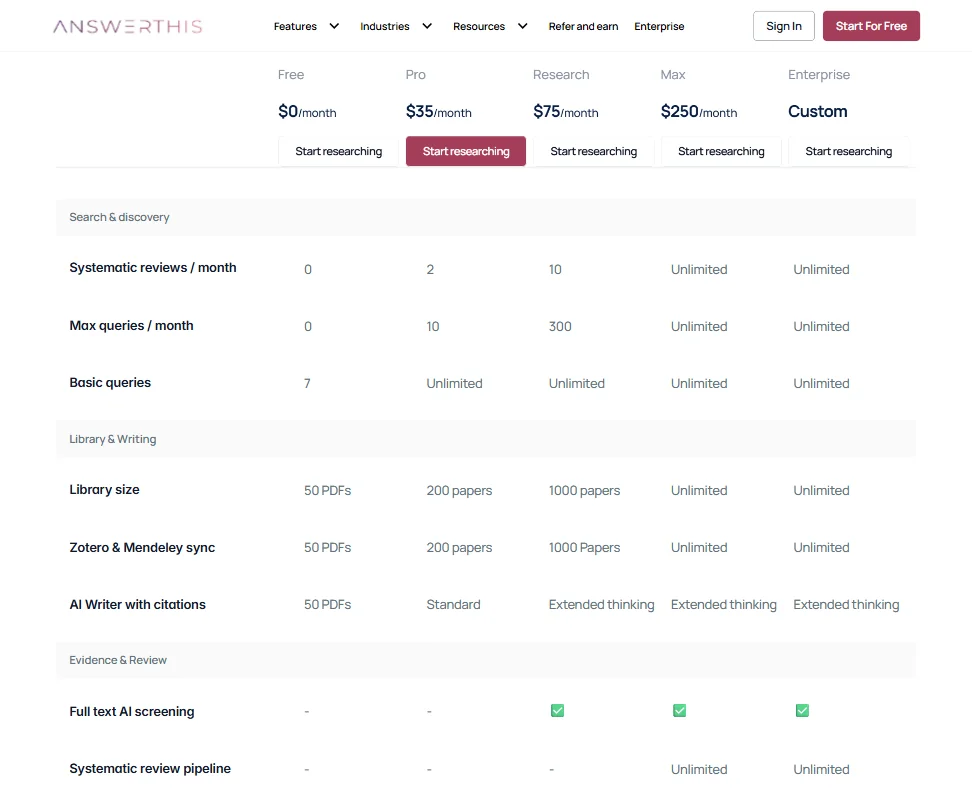
Free gets you 7 basic queries, a 50-PDF library, and the AI Writer. Not 5, as some older sources suggest. The free tier doesn't expire, which is the right call. Trial-gated free plans are annoying.
Pro at $35 a month gives you 10 max queries, 2 systematic reviews, 200 papers in the library, and Mendeley and Zotero sync capped at 200 papers. Research at $75 steps up to 300 max queries, 10 systematic reviews, 1,000-paper library, and extended thinking on the AI Writer. Max at $250 unlocks unlimited everything and faster support. Enterprise is custom pricing.
The jump from Research to Max is steep. More than 3x for unlimited queries, extended support response times, and a handful of additional features. Whether that math works depends entirely on volume and whether your work demands the extra headroom.
No public refund policy that we could find. Not great. At $250 a month, that's a real concern, and we'd ask directly before subscribing to Max for a team.
AnswerThis vs Elicit: Which AI Research Tool Is Better?
These two come up in the same breath constantly. Both are serious about academic research. Both go well past simple paper search.
Elicit tends to land with policy analysts and systematic review teams who want structured data extraction across large paper sets. AnswerThis leans harder into literature review drafting and PRISMA-compliant workflows. That's a meaningful difference depending on whether your output is a written review or a structured data table.
Elicit publishes more transparent documentation about its data sources. AnswerThis has a more generous free tier and includes the AI Writer at every plan level, which Elicit doesn't match cleanly. Elicit's pricing is also clearly documented. Neither tool has a browser extension.
For pharma and biotech teams running formal systematic reviews, AnswerThis has the structural edge. For researchers who want something closer to a data extraction pipeline, Elicit fits better. Neither wins cleanly in every case.
Who Should Use AnswerThis? (And Who Shouldn't)
Academic researchers running systematic reviews. Clearest fit, full stop.
Medical professionals who need evidence-backed answers with traceable citations. The architecture supports that well.
PhD students. The free tier is honest, the AI Writer is included, and 250 million papers is a real database.
Teams that need deep integrations with their existing stack. API access is undocumented, there's no browser extension, and collaboration features are thin below Enterprise. Real gap there.
General-purpose research users. This product is built for scientific literature. Outside that context, you're paying for features that don't apply to you.
AnswerThis Review Verdict
The citation-backed synthesis is structurally sound. PRISMA compliance is a genuine differentiator. The free tier is honest about what it offers rather than dangling features behind a paywall.
What gives us pause is the opacity. No public refund policy at $250 a month. No clear documentation of which databases feed the index. API access is an open question for teams trying to build around this tool. The Max plan pricing is hard to justify without a clearer explanation of what the standard model on Pro is actually missing compared to extended thinking on Research and above.
This is a tool that earned its user base by solving a real problem well. The enterprise layer feels underbuilt relative to what research teams would expect from a $250 monthly commitment. The gap between the solid core product and the infrastructure around it is real.
Worth evaluating seriously. Eyes open on the pricing jump and the missing documentation.
How AnswerThis compares
AnswerThis scores 6.8 out of 10 among the literature search tools we rate. These three do the same job and are the closest to it, compared on what each vendor publishes.
Elicit
AnswerThis costs $35 a month on its academic plan; Elicit's academic entry plan is $19 a month and adds automatic reference deduplication, alerts on saved searches, and reading of figures and tables, none of which AnswerThis offers. AnswerThis answers back with a built in AI Writer that drafts abstracts, outlines and full papers with citations added, something Elicit does not do, and it includes a risk of bias assessment for systematic reviews that Elicit lacks.
Pick Elicit if you want reference deduplication, figure reading and alerts.
Pick AnswerThis if you want an AI Writer that drafts your paper and adds citations.
Consensus
Consensus costs $20 a month for its cheapest paid plan; AnswerThis's cheapest paid plan is $35 a month. That extra cost buys systematic review features Consensus does not have: screening with include and exclude decisions, a PRISMA flow diagram, and a risk of bias assessment. Consensus answers back with a metered API, 500 uses included on its $20 plan, and Pro Analysis responses in languages other than English, both missing from AnswerThis.
Pick Consensus if you want a cheaper plan with API access and non-English support.
Pick AnswerThis if you are running a systematic review with screening and risk of bias.
SciSpace
SciSpace reads figures and tables inside papers, something AnswerThis cannot do, and its cheapest paid plan, Premium, costs $20 a month against AnswerThis's $35. SciSpace also ships a mobile app and works in more than 75 languages, both absent from AnswerThis. AnswerThis pulls ahead for a systematic review: it screens papers with include and exclude decisions, builds a PRISMA flow diagram and runs a risk of bias assessment, none of which SciSpace offers.
Pick SciSpace if you need figure reading, a mobile app or non-English support.
Pick AnswerThis if you need PRISMA and risk of bias for a systematic review.
Frequently Asked Questions
Does AnswerThis have a free plan?
Yes, and it's genuinely usable rather than just a teaser. Free users get 7 basic queries a month and a 50-PDF personal library, with the AI Writer included. The free tier doesn't expire, which matters. That said, 7 basic queries a month is a hard ceiling for anyone doing regular research work, so you'll hit it fast.
Is AnswerThis suitable for systematic reviews?
It's one of the few AI research tools that explicitly supports PRISMA-compliant systematic review workflows. Full-text AI screening and risk-of-bias assessments are part of the feature set from the Research tier upward. For pharma, biotech, or academic teams running formal reviews, that's a meaningful capability that most competitors don't offer. Not great that it's not available on Pro, worth noting if you're evaluating the $35 plan specifically.
How does AnswerThis handle citation accuracy?
The tool generates line-by-line citations tied to specific papers rather than summarizing loosely and attaching sources afterward. That structural choice reduces the risk of AI-generated claims drifting from their evidence base. We can't guarantee it's error-free, no AI tool is, but the approach is more rigorous than what most competitors are doing. User feedback across Reddit and Product Hunt generally backs that up.


