
Our research on Covidence started with the vendor's own documentation, then moved outward into university library guides, academic Reddit threads, and the kind of forum posts where systematic reviewers tend to be usefully blunt. What we kept seeing was a tool that has earned genuine loyalty from a specific audience. It also costs real money, handles AI differently than most people now expect, and is nearly useless if you're outside its target workflow.

The Covidence systematic review platform has been around since 2013. Melbourne-based. Over 536,000 researchers and students on it. More than 480 universities and hospitals in their client list. Those numbers are hard to manufacture, and we didn't try.
What is Covidence?
Not a general-purpose research assistant. The basic loop is this: you import references from a database, reviewers screen titles and abstracts, the team resolves conflicts, full texts get pulled in, data gets extracted, then you export into something like RevMan. Covidence manages every step of that process without trying to be anything else.
The Single plan starts at $339 per year, covers one review, and allows unlimited collaborators. The Package plan runs $907 per year and covers up to three reviews, also with unlimited collaborators. Organizational licensing is custom and requires contacting their sales team directly. That tiered structure makes the audience pretty clear.
Universities and hospitals are where Covidence concentrates its energy, and that shows in the product design. Solo reviewers can get in at the Single tier, but the platform scales toward institutional workflows. Honestly, that's fine. A tool that serves one audience well is not a problem. It just means you have to be honest about whether you're that audience.
Covidence Features: Search, Synthesis & Research Capabilities
No native search. That's the first thing. You're not opening Covidence and typing into a search box. You pull records from PubMed or your institutional database first, export in RIS, CSV, or PubMedXML, then import into Covidence. The platform manages what happens after that.
Screening is where most reviewers live, and Covidence has clearly invested there. Title and abstract screening feels fast. Mobile browser screening exists, which matters when a co-reviewer is traveling or reviewing between meetings. Conflict resolution workflows are built in and, based on user reports across academic forums, they work the way they're supposed to.
Collaboration is genuinely well built. Unlimited collaborators on both the Single and Package plans, a centralized data view, structured conflict workflows. We cross-referenced university library writeups and researcher Reddit posts and kept finding the same observation: distributed teams found the collaboration side worth the cost on its own.
The reference manager integrations cover the tools that actually matter in this space. EndNote and Zotero get named most often, alongside Mendeley, RefWorks, and RevMan. These are native connections, not workarounds.
Where things get murkier is AI. Covidence's documentation doesn't describe a single general-purpose proprietary AI model. What they've published is more specific than that: most-relevant sorting uses an active-learning classifier developed by EPPI-Centre, RCT identification uses separate classifiers, and extraction suggestions use existing LLMs to populate fields from uploaded full-text PDFs. They also publish intended uses, safeguards, evaluation results, and stated limitations for those features. That's more transparency than most competitors offer. Not great at communicating it publicly, though.
Covidence Research Quality: How Accurate and Trustworthy Is It?
This category works differently for Covidence than it does for something like Elicit. Covidence isn't generating answers. It's managing a process. So accuracy here means: does the platform preserve the integrity of your screening decisions, handle conflicts correctly, and return clean data at the end?
From what we found, yes. Reviewers in academic and clinical contexts consistently report that the screening workflow is reliable. The platform doesn't inject errors into your process. It surfaces disagreements clearly. That's the job, and it does the job.
The "35% average time reduction" claim on their homepage is bold, and we're mildly skeptical of single-stat marketing figures. But the directional claim tracks with what users describe: less coordination overhead, fewer spreadsheets, faster full-text stages. That mechanism is at least plausible. We've seen worse marketing claims than this one.
Covidence Source Coverage: What Does It Actually Search?
It doesn't search. Worth being direct about that.
Covidence is downstream of your database searches. You go to PubMed or your institutional resources, pull your records, export in a compatible format, and import into Covidence. The platform then manages what you do with those records. This is not a weakness in context. Systematic review methodology requires you to document exactly where your records came from, and a tool that searched on your behalf would complicate that audit trail. The import-only approach is a deliberate design choice.
What Covidence handles well is the ingestion step itself, specifically deduplication and getting a clean starting point set up for your screening team. When you're working with 5,000 records pulled from overlapping databases, that matters more than it sounds.
Is Covidence Easy to Use for Researchers and Professionals?
The support setup is genuinely unusual. 24/7 live chat, staffed by people described as qualified systematic review professionals, not a generic help desk. We dug into this across user reports and didn't find significant pushback on the claim. Users appear to actually reach support and get useful answers. That's rare enough to say plainly.
The learning curve for screening is low. Covidence Academy and their monthly webinar series give new users structured onboarding without leaving them to figure things out alone. Personalized live training exists for organizational accounts.
Where it reportedly gets harder is data extraction. Several Reddit threads from researchers pointed to extraction forms as fiddly and less intuitive than the screening side. Real note. Not a dealbreaker, but teams should plan for a ramp-up period there.
Fair.
Covidence Pricing: Is It Worth It vs Free Alternatives?
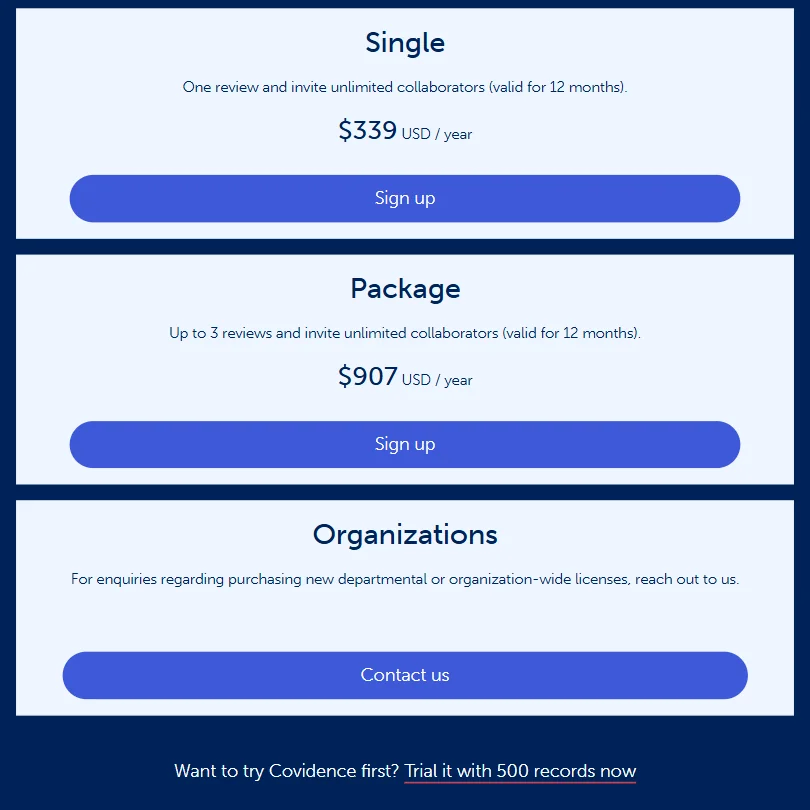
Single plan: $339 per year, one review, unlimited collaborators, valid for 12 months. Package plan: $907 per year, up to three reviews, unlimited collaborators, also valid for 12 months. Organizations contact sales.
No free plan. The free trial caps at 500 records with no stated time limit. That's enough to test the screening workflow, but it won't get you through a large-scale review end to end.
The refund policy is not publicly stated anywhere we could find, which is annoying. For a $339 annual purchase, researchers deserve to know what happens if the tool doesn't fit their project before they commit. We'd want that answered before buying.
Rayyan exists and is free. Abstrackr is free. For budget-constrained researchers or students running a one-off review, those are real alternatives. Covidence's answer to that is quality, support, and scale. Whether that's worth $339 depends entirely on your use case and whether your institution already has a site license.
Covidence vs Rayyan: Which AI Research Tool Is Better?
Rayyan handles title and abstract screening competently, has a mobile app, and costs nothing. For a solo student doing a small review, it covers the need.
Where Covidence pulls ahead is everything after screening. Full-text review, data extraction, RevMan integration, and the collaboration layer for larger teams. Rayyan's free tier has limits that show up fast once a team scales. Covidence also has markedly better support, based on what we found in community forums. Rayyan's support is considerably thinner. That gap matters when a methodology question comes up mid-review and your timeline is fixed.
DistillerSR and EPPI-Reviewer compete mostly at the institutional level. Both are more expensive and carry steeper learning curves. Nested Knowledge is newer and leaning harder into AI-assisted synthesis, which is territory Covidence hasn't staked a clear public claim on yet.
Who Should Use Covidence? (And Who Shouldn't)
Systematic review teams at hospitals and universities. That's the core fit.
Researchers conducting clinical guideline work, evidence syntheses for policy, or Cochrane-style reviews will find the workflow genuinely useful. The collaboration tools, the methodology-aligned structure, and support from people who understand review protocols make Covidence worth its cost at scale.
Solo students running a one-time dissertation review. Probably not at $339 a year. Rayyan or another free tool is the more sensible starting point.
Researchers who want AI to summarize literature or synthesize findings across papers should look elsewhere. Scite handles citation-grounded literature analysis. Covidence handles process management. Different jobs.
Covidence Review Verdict
Covidence does what it says it does. That's actually the highest compliment we give a niche tool. It manages systematic review workflows reliably, and it backs that up with support from people who know the methodology, not just the software.
The AI picture is more nuanced than their public-facing marketing suggests. The most-relevant sorting, RCT classifiers, and LLM-assisted extraction suggestions are distinct systems with documented safeguards and stated limitations, which is more rigorous than most competitors bother to publish. What's missing is plain-language communication of all that to prospective buyers. Researchers evaluating the tool in 2025 are asking AI questions first, and the homepage doesn't answer them clearly.
Pricing is defensible for institutional buyers. Harder to justify for individuals. The missing refund policy is a small but real frustration. Solid tool, loyal user base, loyalty that's been earned. We'd just like clearer public documentation on the AI features before calling it the obvious long-term choice.
How Covidence compares
Covidence scores 4.1 out of 10 among the systematic review platforms we rate. These three do the same job and are the closest to it, compared on what each vendor publishes.
Rayyan
Covidence costs $339 a year, billed annually with no monthly option; Rayyan's cheapest paid plan is $8.33 a month, billed quarterly. Rayyan also has a mobile app and, on its Enterprise tier, an API, neither of which Covidence offers. Covidence answers back with automatic reference deduplication and a PRISMA flow diagram generated for every review, both included from its cheapest plan, plus support for six reference managers including RevMan and CRS for Cochrane style reviews, where Rayyan names none.
Pick Rayyan if you want a mobile app and cheaper quarterly billing.
Pick Covidence if you need Cochrane style reference manager support built in.
Sysrev
Sysrev searches PubMed and OpenAlex directly inside the app; Covidence only imports references you already found elsewhere, through EndNote or Zotero, for instance. Covidence answers back with automatic reference deduplication, an auto-generated PRISMA flow diagram, and a risk of bias assessment built into every review, none of which Sysrev offers. Sysrev's cheapest paid plan is $50 a month per member and includes a documented API on its Premium and Enterprise tiers; Covidence costs $339 a year with unlimited collaborators included but no API at all.
Pick Sysrev if you want to search PubMed and OpenAlex without importing first.
Pick Covidence if you need automatic deduplication, PRISMA and risk of bias built in.
Silvi
Covidence costs $339 a year; Silvi's cheapest paid plan, Rapid, is 40 euros a month. Both only import references you already found elsewhere rather than searching a paper database themselves. Covidence includes AI assisted screening and unlimited collaborators from its cheapest plan, while Silvi holds AI screening back until Rapid and only adds team collaboration on the pricier Rapid Plus plan at 59 euros a month. Silvi does have a browser extension, which Covidence lacks.
Pick Silvi if you want a browser extension and don't need collaboration yet.
Pick Covidence if you want AI screening and unlimited collaborators from the start.
Frequently Asked Questions
Does Covidence use AI to help with screening?
Yes, but not through a single general-purpose model. Most-relevant sorting uses an active-learning classifier developed by EPPI-Centre. RCT identification uses separate classifiers. Extraction suggestions use existing LLMs to populate fields from uploaded full-text PDFs. Covidence publishes intended uses and limitations for these features in their documentation, though the homepage doesn't surface that detail clearly. If AI-assisted screening is a priority, ask their team directly about current capabilities before purchasing.
Can you use Covidence for free?
No permanent free plan. The free trial gives you 500 records and no stated time limit. That's enough to test the screening workflow, but not enough to run a large review end to end. Rayyan is the most commonly cited free alternative for researchers on tight budgets.
Is Covidence worth it for a solo researcher?
At $339 per year for the Single plan, it's a real spend for an individual. The platform is genuinely good, but its strongest features, specifically team collaboration and conflict resolution workflows, shine brightest with multiple reviewers. Solo researchers running a single review will likely find a free tool sufficient. Covidence makes more sense if you're running reviews regularly or working within an institution that hasn't already purchased a site license.


