

Our research into Scite started with a skeptical tab open next to the vendor's homepage. We pulled from their documentation, user reports across Reddit and academic forums, and third-party coverage. No hands-on testing. What we kept seeing was a tool that earns serious attention, not because of the AI layer on top, but because of what's underneath it.
Founded in 2018, based in Henderson, Nevada, Scite has built something genuinely different from the wave of AI research tools that appeared after 2022. The core idea isn't new search. It's accountability.
What is Scite?
Scite is an AI research platform built around Smart Citations, a system that classifies how later research has treated a given paper. Not just "cited by 47 papers." More specifically: supported by 12, contradicted by 3, mentioned in passing by 32. That distinction matters more than it sounds.
Most AI research tools scrape abstracts and generate confident-sounding summaries. Scite reads full text, tracks what the scientific community actually said about a finding, and surfaces that context in its answers. The AI Assistant then uses those same signals to ground its responses in verifiable evidence, not synthesis from memory.
Over 2 million researchers use it. That's a real number for an academic tool.
Scite Features: Search, Synthesis & Research Capabilities

The search index covers more than 300 million scholarly articles, preprints, patents, and datasets. Full-text search, not just abstracts. That's the part worth pausing on. Most competitors, including tools with slicker interfaces, are searching metadata. Scite is searching the paper itself.
The AI Assistant handles follow-up questions, and you can query iteratively, which matters when you're narrowing in on a specific claim. Answers come with citations attached. Each citation links back to the specific sentence in the source that generated it. We've seen tools claim that. Scite appears to actually do it.
The platform also runs inside Claude and ChatGPT via MCP integration. A Chrome extension exists, and so does a Zotero plugin for researchers who already have a reference workflow they don't want to abandon. MCP credits are capped by plan tier: 250 per month on Basic, 2,500 on Pro, and 2,500 per user on Team. API access sits behind the Pro tier at $50 per month.
No mobile app. Worth knowing upfront.
Scite Research Quality: How Accurate and Trustworthy Is It?
Honestly, this is where Scite separates from most of the category.
Smart Citations aren't generated by a language model guessing at the relationship between papers. They're drawn from a database of 1.6 billion indexed citation contexts. A deep-learning model automatically classifies each context as supporting, contrasting or mentioning, with a confidence score attached. That's a different process than what Elicit or Consensus are doing.
Scite is built on direct agreements with Wiley, SAGE and more than 30 other publishers. That's not scraping. That's licensed full-text access. The distinction changes what the model is actually reading.
What we kept seeing across Reddit threads from researchers and PhD students is that Scite's citations hold up. The tool surfaces contradicting evidence instead of papering over it. That matters in a category where tools routinely hallucinate references and fabricate DOIs.
We're cautious about overstating this. We haven't stress-tested the edge cases ourselves. But the structural design, reading and indexing full text rather than generating from memory, is the right architecture for an accuracy-first tool. The Smart Citation system is the part that would be hardest for a competitor to replicate.
Scite Source Coverage: What Does It Actually Search?
The database extends beyond journal articles. Patents are in there. Clinical trial records. Grants. Preprints. That matters if you're tracing an idea from early funding through to a published result and then into a commercial filing. The Pro plan and above get access to patent and clinical trial search specifically, which Basic skips.
The publisher relationships are the real asset here. When a competing tool hits a paywall, it works with whatever the abstract says. Scite, through those 30-plus licensed agreements, reads the paper. That gap in source access isn't a small difference in practice. It changes what you find.
Coverage is primarily English. Worth flagging for researchers working across non-English literature.
Is Scite Easy to Use for Researchers and Professionals?
The platform runs on web. The Chrome extension adds Smart Citation overlays while you browse. Zotero integration keeps it inside an existing reference workflow, and for researchers who already live in Zotero, that's a reasonable entry point.
The MCP integrations with Claude and ChatGPT are newer additions and suggest Scite is positioning itself as a data layer for other AI tools, not just a standalone product. That's a smart move. It means researchers can work in the assistant they already prefer while pulling from Scite's database.
We didn't find widespread complaints about interface complexity. The academic user base skews toward people comfortable with technical tools. Fair. That might explain some of the tolerance.
Scite provides a searchable help centre with tutorials and detailed guides covering its primary features, including Smart Citations, Reference Check and literature-review workflows. Not bare-bones. The absence of a mobile experience is still the clearest ease-of-use miss, and no amount of documentation fixes that gap.
Scite Pricing: Is It Worth It vs Free Alternatives?
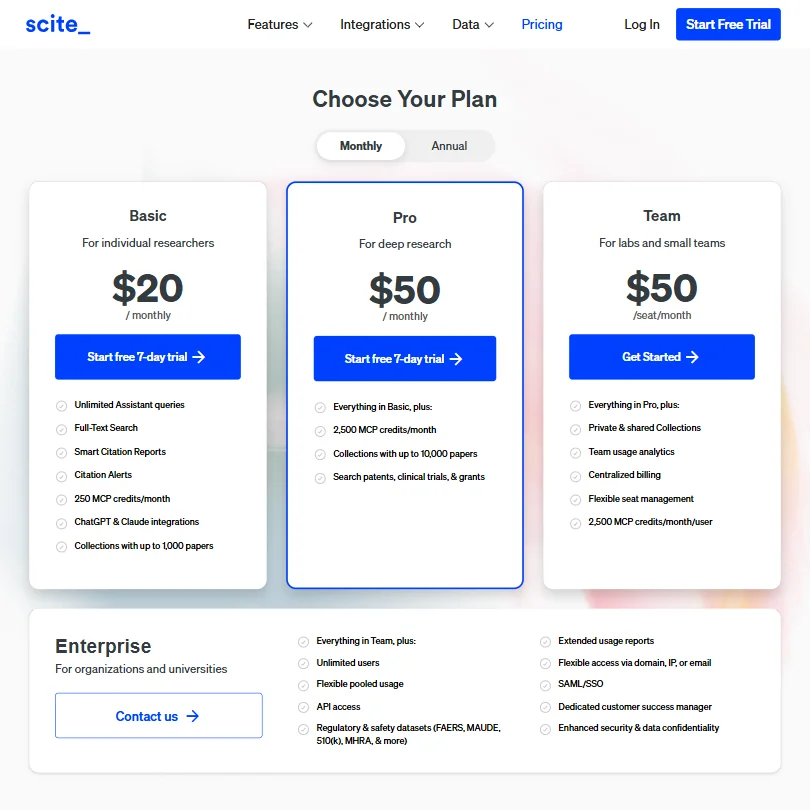
No free plan. A 7-day trial exists on the paid tiers, and there's also a free Connect plan (25 MCP credits per month via ChatGPT, Claude, and other AI assistants, no credit card required). After that, Basic runs $20 per month, Pro runs $50 per month, and the Team plan is $50 per seat per month. Enterprise is custom, handled through sales.
The comparison to Semantic Scholar is unavoidable. Semantic Scholar is free, indexed over 200 million papers, and doesn't require a credit card. That's a real alternative for researchers whose budget is zero.
What Scite offers over Semantic Scholar is full-text access, the Smart Citation quality distinction, and the AI Assistant. Collections on Basic cap at 1,000 papers. Pro bumps that to 10,000. Whether the jump from Basic to Pro is justified depends on how many papers you're actually managing at once.
Scite's terms state that subscription payments are non-refundable, although users can cancel future renewals at any time. That's a real thing to know before starting a trial. The $50 Pro tier is where most serious individual researchers will end up, and at that price it needs to save real hours. Based on what we read from active users, it generally does.
Scite vs Semantic Scholar: Which AI Research Tool Is Better?
Different tools for different needs. Semantic Scholar is free and well-indexed. It's the right answer if budget is the constraint and basic citation lookup is the job. No argument there.
Scite is better if you need to know whether the science behind a paper actually held up. The Smart Citation layer adds something Semantic Scholar doesn't have. For researchers doing systematic reviews or checking the durability of a specific finding, that distinction is the whole point.
Elicit is worth mentioning here too. It's designed around structured literature reviews and has a strong following among researchers running large, methodical searches. Scite is stronger on citation integrity. Elicit is stronger on structured extraction across a large result set. We don't think there's one winner. The overlap depends on what part of the research process you're in.
Who Should Use Scite? (And Who Shouldn't)
PhD students and academic researchers. That's the obvious fit. The tool is built for people who need to know whether evidence is solid, not just voluminous.
Research institutions running competitive intelligence in pharma or biotech will find the database depth worth the seat cost at the Team tier.
Journalists or content writers who want AI-generated summaries of science topics. Not for them. This isn't that tool.
Researchers on a zero budget should start with Semantic Scholar and evaluate whether the gaps are significant enough to justify paying. Many will find they are.
Scite Review Verdict
Most AI research tools are wrappers around a search index with a chatbot layered on top. Scite built the foundation differently. The Smart Citation architecture, the licensed full-text agreements, the 1.6 billion citation contexts sitting underneath the AI layer: those are structural advantages that don't show up in a feature comparison table but matter enormously in practice.
The gaps are real too. No mobile app. The non-refundable payment policy is worth reading before you commit. And for researchers whose work doesn't require citation-level accountability, the free tools are genuinely competitive.
Scite does one specific thing better than anything else in the category, and that thing is telling you whether a finding has been supported or challenged by subsequent research. If that's your problem, the $20 Basic entry point is reasonable. The $50 Pro tier is easy to justify if you're working at any kind of volume.
How Scite compares
Scite scores 5.8 out of 10 among the literature search tools we rate. These three do the same job and are the closest to it, compared on what each vendor publishes.
Semantic Scholar
Semantic Scholar is free, with no paid plan; Scite's cheapest paid plan, Basic, is $20 a month. Scite answers back with Smart Citations that state whether a later paper supported, contradicted or merely mentioned the one you're reading, a classification Semantic Scholar does not make. Semantic Scholar counters with a free, documented API and free citation alerts on saved searches, where Scite charges $20 a month just to get alerts at all.
Pick Semantic Scholar if you want free alerts and a documented API.
Pick Scite if you need to know if later papers support or contradict one.
Elicit
Scite and Elicit charge close to the same to start, $20 and $19 a month. Scite tells you whether later papers supported, contradicted or merely mentioned a paper, a citation classification Elicit does not offer. Elicit counters with systematic review tools Scite lacks: screening with include and exclude decisions, automatic reference deduplication, and PRISMA grade accuracy on its Enterprise tier, though Elicit also exports to RIS, CSV, BibTeX, PDF and DOCX where Scite has no stated export format.
Pick Elicit if you need systematic review screening, dedup and full export formats.
Pick Scite if you need to know if later papers support or contradict one.
Consensus
Smart Citations are Scite's signature move: they state whether later papers supported, contradicted or merely mentioned the one you're reading, a feature Consensus does not have. Consensus counters with a visual map of connected papers and a metered API included on its $20 plan, where Scite's API costs an extra $50 a month on its Pro tier. Both charge $20 a month to start.
Pick Consensus if you want a paper map and API access on the entry plan.
Pick Scite if you need to know if later papers support or contradict one.
Frequently Asked Questions
Does Scite have a free plan?
No free plan exists. Scite offers a free Connect plan (25 MCP credits per month via ChatGPT, Claude, and other AI assistants, no credit card required) plus a 7-day free trial of the paid tiers, after which Basic runs $20 per month. Researchers who need a no-cost option should look at Semantic Scholar, which covers a large portion of the same academic literature without requiring a subscription.
What makes Smart Citations different from regular citations?
A regular citation tells you that Paper B referenced Paper A. A Smart Citation tells you whether Paper B supported, contradicted, or just mentioned the finding in Paper A. That's a meaningful distinction. Knowing a paper has been cited 200 times tells you nothing about whether the finding held up. Smart Citations give you that signal, drawn from extracted citation contexts and classified automatically by a deep-learning model.
Is Scite useful for non-academics?
It depends on what you're doing. Pharma and biotech teams, clinical practitioners, and R&D professionals doing competitive analysis have found real value in the database depth. For general business research or content work, the tool is more than most people need. The citation integrity layer is specifically useful when the scientific validity of a finding actually matters to the work.


