
Academics don't tend to evangelize search tools. So when we kept seeing Semantic Scholar come up in r/MachineLearning threads and PhD forums, not as a recommendation but as a default, that caught our attention. Researchers weren't describing it as a discovery. They were describing it as the thing they already use.
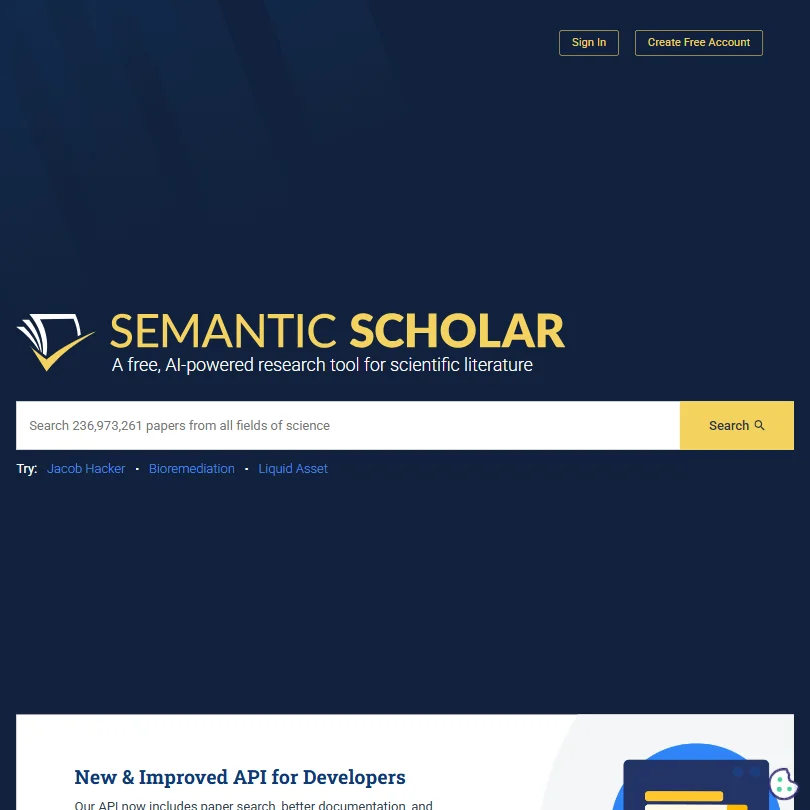
Built by the Allen Institute for AI, a nonprofit out of Seattle, launched in 2015. No paid plan. No enterprise tier. No trial period, because there's nothing gated to trial. The whole product is free, and not in the sense of free-until-you-hit-a-wall. Just free.
That framing matters, because most of what we review in this category costs money. A lot of it.
What is Semantic Scholar?
Calling it a search engine for scientific literature is technically accurate and practically misleading. The AI layer is doing real work. When we cross-referenced their documentation with how researchers describe it across forums, what comes up consistently is that the search understands what you're asking even when the query is loose. You don't need perfect keywords. That's not a small thing.
The index covers over 200 million papers across STEM, social sciences, and humanities. Papers come with extracted citation data, reference linking, and AI-generated summaries through a feature called Semantic Reader. Scholar's Hub handles organization and sharing. The corpus itself is sourced from publisher partnerships, other data providers, and web crawling, and Semantic Scholar publicly documents those publisher relationships, with named partners including Wiley and Wolters Kluwer, and a few others.
Honestly, the nonprofit angle changes how we read the product decisions here. There's no upsell to protect. The API is public. That's a different posture than most tools in this category, and it shows.
Semantic Scholar Features: Search, Synthesis & Research Capabilities
The search is where this starts. Type in a concept rather than a keyword, and results surface papers that match the idea. We read multiple accounts of researchers finding papers through Semantic Scholar that Google Scholar missed on identical queries. Not a marginal improvement.
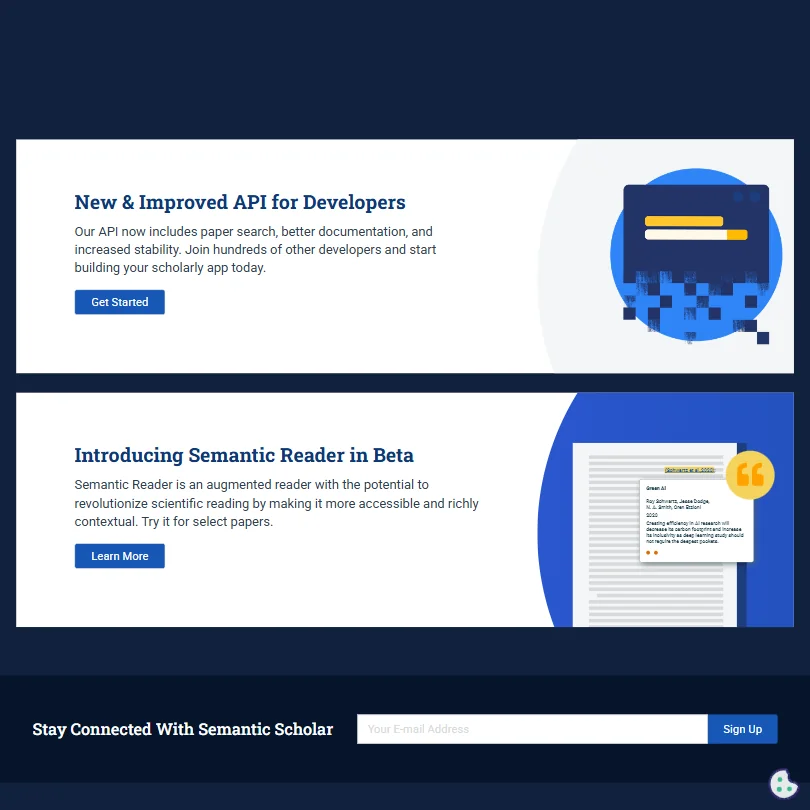
Semantic Reader sits on top of a paper and generates AI summaries. It also surfaces inline context for citations so you're not chasing every reference manually, which is genuinely useful for literature reviews. Worth noting: it's still in beta and doesn't apply to every paper in the index. Not great, but not a dealbreaker either.
Scholar's Hub covers basic organization and sharing. It's not Zotero and it's not trying to be. For casual organization without leaving the platform, it covers the basics.
The REST API is legitimately good. Documentation is clean, paper search is built in, and third-party developers have shipped tools on top of it, which is a reasonable signal of reliability. Anyone building a scholarly app or a research workflow should look at it seriously.
What's missing is also worth naming. No document upload. No browser extension. No mobile app. Export is available directly from the interface via a citation pop-up offering BibTeX, EndNote, MLA, APA, or Chicago formats. These aren't devastating gaps, but they constrain the workflow in ways that add up daily.
Semantic Scholar Research Quality: How Accurate and Trustworthy Is It?
The team building this tool is inside the scientific community, not adjacent to it. Ai2 publishes its own research. That changes what "accuracy" means for them, and it shows in the design choices.
AI summaries in Semantic Reader pull from actual paper content. Not scraped abstracts, not guesses. The complaint we saw in researcher accounts, when it came up, was that summaries can run shallow on complex methodological papers. Fair. That's a genuinely hard problem, not a product failure.
Reference linking is real, not approximate. Researchers consistently report that the extracted citation and reference data is one of the most useful things for tracing how a concept has developed over time. That tracks. The tool is built to connect literature, not just index it, and the citation and reference linking is where that shows most clearly.
We didn't find credible reports of hallucination in the core search results. The model isn't generating claims. It's retrieving and surfacing. That's a deliberate design choice, and for a scientific tool, it's the right one. More than we can say for some AI research tools we've reviewed.
Semantic Scholar Source Coverage: What Does It Actually Search?
200 million papers is the headline. The real question is whether the papers you need are in there.
STEM coverage is strong. Computer science, biomedical research, and physics are well-represented. Social sciences are covered but patchier. Humanities coverage exists, and some researchers in those fields report finding less than they expected. English is the primary language for the interface and AI features, but papers in other languages are indexed.
Preprints are included. Important for fast-moving fields like machine learning where arXiv papers circulate before peer review. For biomedical researchers, PubMed content is indexed within the platform.
One thing we kept seeing in researcher discussions: Semantic Scholar surfaces older, foundational papers that other engines tend to de-prioritize. For building a proper literature review, that's useful. You're not just getting the last two years of results.
Not great on very recent publications, though. Reddit threads from 2024 flagged occasional indexing delays on new papers. Not a dealbreaker for most use cases, but worth knowing if recency matters for your field.
Is Semantic Scholar Easy to Use for Researchers and Professionals?
The search interface is minimal. One box. No learning curve. Most users are productive immediately on basic search.
Semantic Reader takes slightly more orientation. The inline citation expansion is powerful but not immediately obvious. Several researchers described a short adjustment period before it clicked, and the reaction after that was consistently positive. Scholar's Hub is simple enough, functions like a lightweight reading list with sharing, no steep onboarding.
The API requires technical knowledge. That's not a knock. That's just what an API is.
What we don't love: the browser extension is limited to search and one-click navigation. Competing tools let you save papers while browsing publisher sites. Semantic Scholar doesn't. The lack of a save-while-browsing feature in that extension is one of the bigger daily usability gaps we found across user feedback, and it came up enough to take seriously.
Support is light. Contact form and a basic FAQ. No live chat, no community forum. For a free nonprofit tool, we understand the resourcing. We're not going to pretend that makes it less frustrating when something breaks.
Semantic Scholar vs Google Scholar: Which AI Research Tool Is Better?
The comparison that comes up constantly. We've read enough threads on this to have a clear read.
Google Scholar wins on raw coverage in some disciplines, particularly humanities and grey literature. It also indexes new papers faster. The Google index is larger and faster-moving. Those are real advantages.
Semantic Scholar wins on understanding what you're actually asking. The semantic search is meaningfully better for concept-based queries. It also wins on the reading experience. Semantic Reader has no equivalent in Google Scholar. The citation and reference data is richer. Scholar's Hub gives you something to organize around.
For researchers who do anything beyond keyword search, Semantic Scholar is the better daily tool. That's our read after going through dozens of direct comparisons from researchers in threads going back to 2022. The Google Scholar loyalists tend to be in fields where Semantic Scholar's coverage is thinner. That's a fair point, not a dismissal.
If you need AI-assisted synthesis layered on top of your search, neither tool fully delivers that alone. For claim-level citation analysis, something like Scite goes further than either.
Who Should Use Semantic Scholar? (And Who Shouldn't)
Researchers doing literature reviews. Clearest fit. The combination of semantic search and Semantic Reader is well-suited to anyone who needs to understand a body of literature, not just retrieve a list of papers.
Developers building scholarly applications. The API is good enough to build on. That's not a provisional statement.
PhD students and academics in STEM fields. Coverage is strongest there, and the citation graph is genuinely useful for tracing research lineage.
Humanities researchers needing deep coverage of non-STEM literature will find the index thinner than they'd like. Anyone needing document upload to query against their own library. That feature doesn't exist here. Researchers who need tight integrations with reference managers or note-taking tools will hit walls quickly.
Corporate R&D teams doing competitive intelligence might find it useful for the literature side of things, but the lack of document upload and integrations will push them toward more complete tooling eventually.
Semantic Scholar Review Verdict
One of the better free tools in this category. Not conditionally better. Actually better than much of what costs money, on the specific things it does.
The search quality is real. Semantic Reader is genuinely useful. The API is built for people who want to build on it. The nonprofit structure means no dark patterns, no paywall creep, no pricing changes driven by investor pressure.
The gaps are real too. The browser extension's narrow scope, search and navigation only, is still a daily friction point. No document upload limits how you can use it with your own materials. The AI synthesis doesn't go as deep as purpose-built tools for systematic review work. Support is minimal.
But free changes the math entirely. When we compare this against tools charging $20 to $50 a month for similar or weaker search quality, the question stops being whether Semantic Scholar is perfect. The question becomes what you're actually buying with the paid alternatives. For most researchers, the honest answer is: not much more than what this gives you for nothing.
We'd point STEM researchers and developers here first. We'd tell humanities researchers to verify coverage before committing workflows to it. We'd tell anyone needing systematic review extraction to run something like Elicit alongside it, not instead of it.
That's the call.
How Semantic Scholar compares
Semantic Scholar scores 5.9 out of 10 among the literature search tools we rate. These three do the same job and are the closest to it, compared on what each vendor publishes.
ResearchRabbit
Semantic Scholar is free, with no paid plan at all; ResearchRabbit's cheapest paid plan is $12.50 a month. Semantic Scholar answers back with a free, documented API, per paper summaries in computer science, biology and medicine, and a chat feature for asking questions of a single paper, none of which ResearchRabbit has. ResearchRabbit's own strength is a visual map of connected papers, the core of its product, which Semantic Scholar does not offer.
Pick ResearchRabbit if you want a visual map of how papers connect.
Pick Semantic Scholar if you want free access with an API and paper summaries.
Elicit
A free, documented API, the most substantial in the category, and free citation alerts on saved searches come with Semantic Scholar's $0 price tag, no paid plan needed. Elicit charges $19 a month for its academic plan instead. That money buys things Semantic Scholar does not offer: a written, cited answer to a research question synthesized across the literature, screening with include and exclude decisions, and reading of figures and tables inside papers.
Pick Elicit if you need systematic review screening and figure reading.
Pick Semantic Scholar if you want free access with a full API and no cost.
Consensus
A free, documented API and free citation alerts on saved searches come with Semantic Scholar's $0 price tag; Consensus charges $20 a month and offers neither. Consensus spends that $20 a month on a visual map of connected papers, a table that pulls study details across many papers, and a full literature review draft, none of which Semantic Scholar offers. Semantic Scholar's own paper summaries, where it does offer them, are limited to computer science, biology and medicine.
Pick Consensus if you want a paper map and a written literature review.
Pick Semantic Scholar if you want free access with a documented API and alerts.
Frequently Asked Questions
Is Semantic Scholar actually free, or does it have hidden limits?
Fully free with no hidden tiers. Search, Semantic Reader, Scholar's Hub, and API access are all available without payment. No premium plan exists, and no usage cap is published for general search. The API has its own terms and rate limits in the license agreement, but for researchers using the web interface, there's no wall.
How does Semantic Scholar differ from PubMed?
PubMed is biomedical-focused and curated by the National Library of Medicine. Semantic Scholar covers all fields of science and adds an AI layer on top of the index. For biomedical researchers, PubMed's content is indexed within Semantic Scholar anyway. The difference is semantic search and augmented reading tools that PubMed doesn't offer.
Does Semantic Scholar work for non-English research?
The interface and AI features are built primarily around English. Papers in other languages are indexed and findable through search. But the AI-powered summaries and Semantic Reader features work best on English-language content. Researchers working extensively in non-English literature will find the AI assistance limited on those papers specifically.


