Our research on Sysrev started the same way it always does: the pricing page, the vendor docs, and whatever third-party coverage exists. Thin, in this case. Not listed on G2. Not on Capterra. No Trustpilot presence. We leaned on case studies published on their own site and what little community discussion surfaces around systematic review software in academic circles, which isn't much.
Founded in 2017 out of Baltimore. That's long enough for opinions to form, which makes the silence on review platforms genuinely strange.
What is Sysrev?
Web-based platform for processing large document collections and pulling structured data out of them. The core use case is academic and scientific: research teams, toxicologists, regulatory groups, anyone reading hundreds of papers and extracting consistent labels from each one.
The product handles PDFs and title-abstract pairs. Also plain text and structured JSON, which is a wider input range than most competitors bother supporting. Multiple reviewers can work through the same project simultaneously. The Sysrev Auto Labeler handles documents automatically when you don't want a human touching every record.
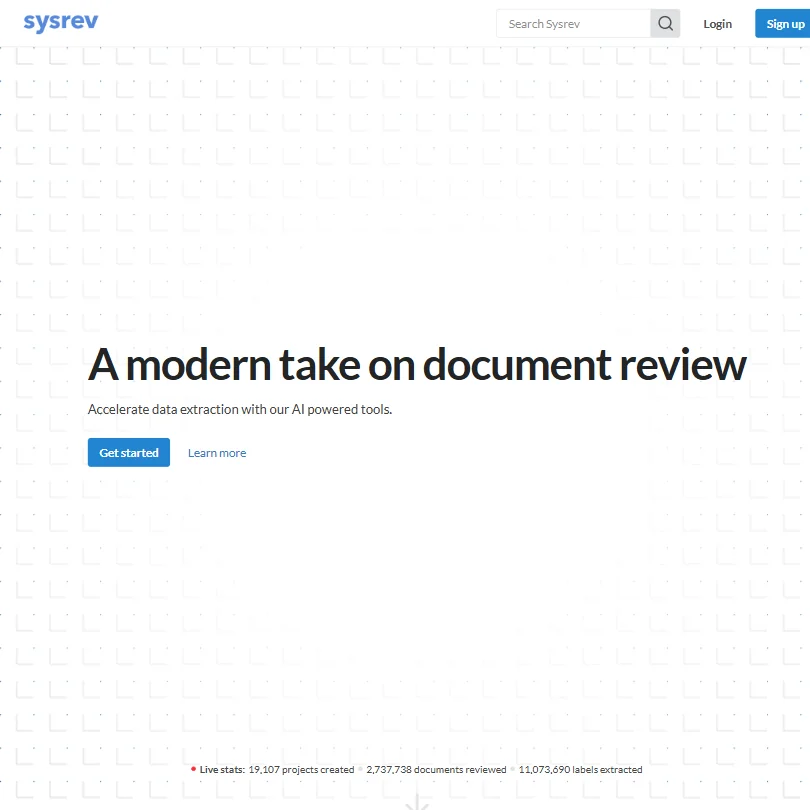
Honestly, the scope is narrower than the homepage implies. This isn't a general-purpose AI research assistant. It doesn't search the general web, though it does have built-in search of PubMed and OpenAlex. You bring the documents. Sysrev processes them.
Sysrev Features: Search, Synthesis & Research Capabilities

No web search. No academic database search built in. Both of those things matter enough to say plainly before getting into what the platform actually does.
Structured document data extraction is the core function. Boolean fields, categorical labels, string extraction, tabular data. The Auto Labeler runs through documents and applies labels without waiting for a human. Teams then review what the AI flagged, correct where needed, move on. That human-in-the-loop structure is the real differentiator from a fully automated extraction tool.
The multi-phase project setup is genuinely useful for complex reviews. Outputs from one project can feed into the next. That's not common in this category. Competitors like Covidence and DistillerSR mostly treat each review as a standalone container.
The API exists and is publicly documented. We don't know how mature it is in practice. Worth checking if your team has someone who can use it.
Sysrev Research Quality: How Accurate and Trustworthy Is It?
The case studies on the Sysrev site are the best evidence available. ToxStrategies used the Auto Labeler to cut document review time significantly. Foresight Management reportedly dropped safety data sheet processing from ten minutes per document to two. Carnegie Mellon first used Sysrev in 2021 and later expanded it across multiple research and teaching projects.
Named organizations. Specific numbers. Not vague.
What we can't find is independent corroboration. No forum threads where researchers complain the AI mislabeled records. No Reddit posts calling accuracy into question. Also no posts praising it. The absence of user reviews cuts both ways, and we're not treating silence as endorsement.
We're cautiously optimistic about the structured extraction approach. Labeling discrete fields is a narrower task than open-ended summarization, which means the AI has less room to go sideways. That tracks with how the technology generally behaves.
The case study documentation is also clear that a human reviewer verifies extracted information and makes corrections where necessary. The AI accelerates the process. It doesn't replace the person. Worth being precise about that.
Sysrev Source Coverage: What Does It Actually Search?
Nothing. That's the whole answer.
You import documents. Sysrev processes them. If you want AI-assisted literature review that searches beyond PubMed and OpenAlex for you, look elsewhere. Elicit does systematic literature reviews with broader database search built in, beyond Sysrev's built-in PubMed and OpenAlex search. Sysrev picks up after that step.
Not a criticism of the product design. A category clarification. Sysrev is a document processing tool, not a discovery tool, and that distinction matters when people are shopping.
Is Sysrev Easy to Use for Researchers and Professionals?
We genuinely don't know, and we'll say so. No hands-on testing. The review trail is too thin to aggregate reliable usability patterns. The homepage is clean. Feature descriptions are specific without being overwhelming.
What we can say: the workflow logic is documented, the project structure assumes familiarity with systematic review methodology, and the platform appears built for teams who already know what a systematic review is, not for casual users coming in cold. Someone already familiar with Covidence or DistillerSR will orient faster. Someone starting from scratch will face a steeper ramp.
Not a knock. Just a realistic expectation to set.
Sysrev Pricing: Is It Worth It vs Free Alternatives?

The free tier is real. Unlimited public projects, unlimited project reviewers, free lifetime storage for public projects. That's a genuinely open offer, not a crippled trial designed to frustrate you into upgrading.
Premium sits at $50 per member per month and adds unlimited private projects, Sysrev Analytics, the Auto Labeler, Group Labels, and free lifetime storage for private projects. For a team running multiple private reviews, that's not unreasonable. Enterprise is contact-based, which is standard for this category. Priority support, Single Sign-On for institutions, access provisioning, invoice billing, unique data sources, customized feature development, and contracted expert reviewers are all listed as Enterprise inclusions.
For context: Covidence charges per review and gets expensive quickly for active teams. DistillerSR publishes academic pricing at $19.95 per month for students and $94 per month for faculty, while larger departmental, institutional and corporate plans require a quote. On that spectrum, $50 a month for Premium looks fair. We'd still want a refund policy in writing before recommending it for institutional procurement.
No publicly stated refund policy. Worth flagging.
Sysrev vs Rayyan: Which AI Research Tool Is Better?
Rayyan is particularly well known for title-and-abstract screening but now supports much of the wider systematic-review workflow, including full-text screening, data extraction, risk-of-bias assessment and reporting. Sysrev covers structured data extraction in more depth and handles a wider range of document input types.
Rayyan wins on simplicity for screening tasks. Sysrev wins on extraction depth and flexibility for multi-phase projects. They're not really competing for the same moment in a workflow. A team running a full systematic review might use Rayyan to screen and Sysrev to extract. Or they pick one and build everything inside it.
Teams whose main bottleneck is title-abstract screening: Rayyan is probably faster to get running. Teams extracting structured data from full-text PDFs with multiple label types: Sysrev is the more appropriate tool.
Who Should Use Sysrev? (And Who Shouldn't)
Academic research teams running systematic or scoping reviews. That's the obvious fit.
Regulatory and scientific consulting firms, based on the ToxStrategies and Foresight Management case studies. Both are named, both are specific, and both describe document volumes where manual processing is genuinely painful.
Solo researchers doing a one-off public literature review should check the free tier first. Unlimited public projects, no storage cap. No reason to pay $50 a month for a single review.
General-purpose AI research assistant users. Wrong tool entirely. Anara handles document libraries with AI answers and citations for that kind of use case.
Teams that need broader database search beyond Sysrev's built-in PubMed and OpenAlex options. Also wrong tool.
Sysrev Review Verdict
Sysrev does a specific thing. Structured data extraction from document collections, with AI handling volume and humans handling judgment calls. The free tier is real and functional. The $50 Premium plan is priced reasonably against the competition.
What's missing: a meaningful public review trail, clearer independent documentation of AI accuracy, and a stated refund policy. The absence of any presence on G2 or Capterra in 2025 is a genuine problem for institutional buyers who need that kind of social proof before cutting a check.
For research teams who already know what they're looking for, Sysrev is worth evaluating. For everyone else, the homework required to vet it is higher than it should be. Fair. But not ideal.
How Sysrev compares
Sysrev scores 4.0 out of 10 among the systematic review platforms we rate. These two do the same job and are the closest to it, compared on what each vendor publishes.
Rayyan
Sysrev costs $50 a month per member; Rayyan's cheapest paid plan is $8.33 a month, billed quarterly. Sysrev answers back with in-app search of PubMed and OpenAlex, where Rayyan only imports references you already found elsewhere. Rayyan counters with automatic reference deduplication, a PRISMA flow diagram, and an announced risk of bias assessment, none of which Sysrev offers, and Rayyan also has a mobile app that Sysrev lacks.
Pick Rayyan if you want deduplication, PRISMA, risk of bias and a mobile app.
Pick Sysrev if you want to search PubMed and OpenAlex without importing first.
Covidence
In-app search of PubMed and OpenAlex is Sysrev's edge over Covidence, which only imports references you already found elsewhere, through EndNote or Zotero, for instance. Covidence counters with automatic reference deduplication, an auto-generated PRISMA flow diagram, and a risk of bias assessment built into every review, none of which Sysrev offers, though Sysrev includes a documented API on its Premium and Enterprise tiers that Covidence does not have. Sysrev costs $50 a month per member; Covidence costs $339 a year.
Pick Covidence if you need automatic deduplication, PRISMA and risk of bias built in.
Pick Sysrev if you want to search PubMed and OpenAlex without importing first.


