
Three million users. That number shows up prominently in the vendor materials, and it's not nothing. R Discovery launched in 2020 out of Bengaluru, which makes it relatively young for a tool this widely adopted in the academic space. We cross-referenced vendor documentation, app store reviews from 2024, and a handful of threads on r/GradSchool and r/AcademicPhilosophy to get a picture of what the product actually does versus what it says it does. The gap is smaller than usual. It's also not zero.

What is R Discovery?
A paper discovery and recommendation platform built by Researcher.life, aimed at academics, PhD students, and anyone who needs to track scientific literature without devoting every waking hour to database searches. The vendor claims coverage of 300 million articles. The pitch is personalization: tell the system your research interests, and it surfaces relevant papers. You read, save, export, repeat.
It sits alongside tools like Semantic Scholar, Elicit, ResearchRabbit, and Consensus in the broader AI-assisted literature category. The positioning is distinct, though. R Discovery leans harder on personalized feeds and reading-list management than on deep synthesis or citation graphing. Those are different jobs. Worth knowing before you sign up.
Mobile apps for iOS and Android exist and aren't afterthoughts, which matters for researchers who read on commutes or away from a desk. The web version remains the primary product. R Discovery also has a Chrome extension listed in the Chrome Web Store, which delivers recommendations, quick summaries, key takeaways, and research answers while you're browsing papers in Chrome. That's a useful ambient layer if you're already doing a lot of reading in the browser.
R Discovery Features: Search, Synthesis & Research Capabilities
The core loop is simple. Set your research interests, receive recommended papers, read and save them, export citations. That's the product, and it mostly works as described.
AI-generated summaries appear on individual papers and are genuinely useful for triage. Not for deep analysis. Researchers in 2024 Reddit threads were consistent about this: summaries help you decide whether a paper warrants a full read, not what the paper actually argues. Fair. That's a reasonable design choice.
Multi-source synthesis is listed as a capability. Technically true. R Discovery pulls from PubMed and arXiv, among a few others. The synthesis layer is thin, though. You're getting aggregated results with summaries attached, not structured evidence tables of the kind Elicit produces. Different tools for different depths of work.
Citation export supports CSV, Excel and XML formats, plus an unlimited auto-sync of reading lists to a reference manager on Prime. That's essentially the full integration story. The Chrome extension handles in-browser reading. Beyond that, no native connections to writing tools we could confirm.
The Prime plan, at $12 per month on monthly billing (down from the listed $19 monthly), adds unlimited access to the AI Assistant, Chat PDF, Literature Review, and Interactive Literature Maps, plus unlimited exports and paper audio with translation. Unlimited collaborators on reading lists are included too. The higher Paperpal Prime tier at $25 per month layers in academic writing tools, 20,000 language edits per month, 500 AI writing uses per month, plagiarism checks up to 10,000 words monthly, and access to 75,000-plus illustrations through Mind the Graph. That's a notably wider bundle than a pure discovery tool. Whether you need any of that depends entirely on your workflow.
R Discovery Research Quality: How Accurate and Trustworthy Is It?
R Discovery doesn't fact-check. It surfaces and summarizes. The accuracy burden sits with the researcher, as it should for a discovery tool. But some users have reported that AI summaries occasionally flatten nuance enough to mislead someone skimming without clicking through to the full paper. That's a real risk for anyone who treats summaries as substitutes rather than previews.
We cross-referenced vendor documentation with app store reviews and several subreddit threads. The pattern that came up most was about recommendation relevance. Early in a user's setup, recommendations run generic. After a few weeks of active use and some manual curation, quality improves. Normal cold-start behavior. Still worth flagging for anyone who expects the tool to perform well immediately.
We're skeptical of one thing. The vendor describes the system as learning from reading behavior over time, but users in a 2024 r/GradSchool thread said relevance improvements were slower than expected. Not broken. Just slower than the marketing implies.
R Discovery Source Coverage: What Does It Actually Search?
The 300 million article figure is the headline claim. Multidisciplinary coverage is real, with PubMed handling biomedical literature and arXiv covering physics and computer science preprints, alongside a broader index that spans most major scientific disciplines. Life sciences researchers get the strongest coverage. Humanities and some social science fields are patchier.
Compare that to Semantic Scholar, which is also free and covers overlapping territory. The difference is in surface presentation. R Discovery personalizes the output heavily. Semantic Scholar gives you more raw search control and a more developed citation graph. Different tools, different defaults.
One gap we noticed: R Discovery doesn't publish clear information about indexing lag times. For researchers in fast-moving fields where a two-month delay matters, that's an actual problem and not a minor one.
Is R Discovery Easy to Use for Researchers and Professionals?
Mobile usability gets consistent praise in 2024 app store reviews. The recommendation feed reads more like a research-specific RSS feed than a traditional database interface, which is either exactly the right design or slightly too casual, depending on what you came for.
Onboarding is light, possibly too light for researchers who want to configure a precise setup early. You pick research areas, the feed starts populating, and that's most of it. For a PhD student building early awareness of a field, that simplicity is an advantage. For someone who needs granular control immediately, it may feel undercooked.
Free-tier daily read limits showed up as a recurring complaint. Users trying to binge a topic hit a wall. Annoying, not a dealbreaker. But it's exactly the kind of friction that pushes people toward cancellation before the personalization has time to improve.
R Discovery Pricing: Is It Worth It vs Free Alternatives?
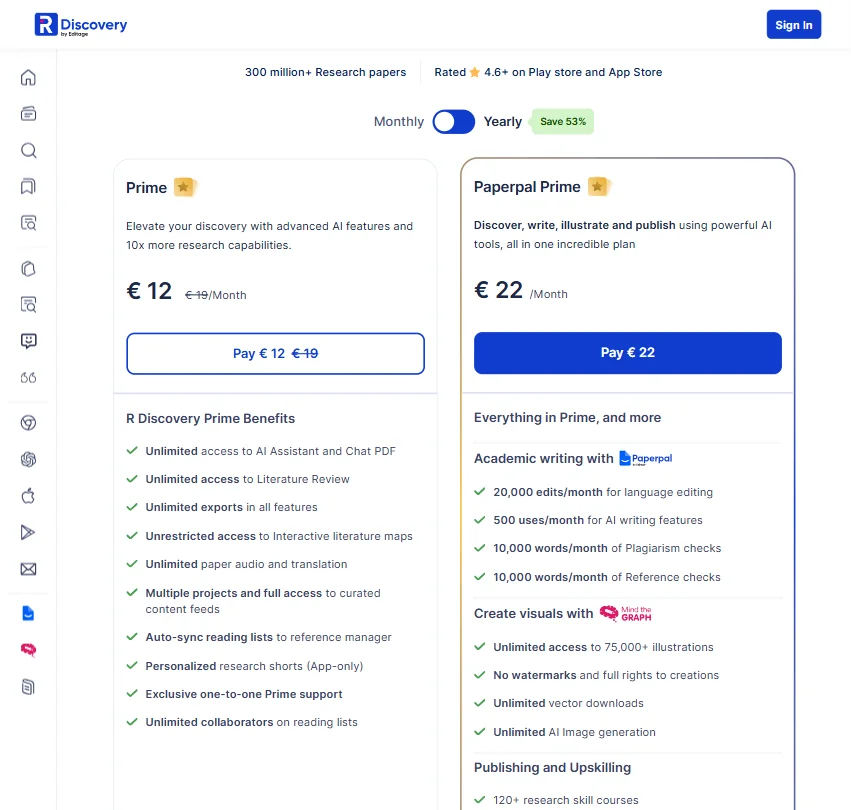
The pricing screenshot makes things clearer than the public website does. Annual billing for Prime runs about $4 per month, reduced from the $19 monthly rate, which the vendor frames as a 52 percent saving. Paperpal Prime sits at about $8 per month on annual billing. A free tier with limited daily reads and restricted AI features is available, and a meaningful number of users seem to stay on it indefinitely.
The optics on pricing transparency are still not great. The main website doesn't surface these numbers prominently enough for someone who hasn't found the pricing page. Researchers, especially students, tend to be careful evaluators with limited budgets. Requiring an account before clearly communicating costs is a friction point we see in a lot of tools and like in none of them. Not great.
Whether $12 per month is worth it compared to Semantic Scholar, which is free with no read limits, depends entirely on how much you value the personalized feed and reading list features. That's a genuine judgment call.
R Discovery vs Semantic Scholar: Which AI Research Tool Is Better?
Semantic Scholar is better for raw search power and citation graph analysis. Completely free, no read limits, strong AI summarization. Those are meaningful advantages.
R Discovery's personalization is the actual differentiator. The daily recommendation feed is more curated, the reading list management is more structured, and the mobile experience is more developed. It's built for researchers who want literature brought to them rather than researchers who arrive with a specific citation and want to trace its connections outward.
Neither is wrong. PhD students building field awareness are probably the natural R Discovery audience. Researchers starting from a known paper and mapping its citation network are probably better served by Semantic Scholar. For anyone doing systematic reviews at depth, Elicit warrants a look before committing to either.
Who Should Use R Discovery? (And Who Shouldn't)
PhD students and early-career researchers building awareness of a field fast. That's the fit. The recommendation engine and reading list tools are genuinely useful for people absorbing large amounts of new literature.
Researchers who need deep AI synthesis or structured evidence extraction. Not the right tool. The summaries are thin, the synthesis layer is basic, and there's no fact-checking function anywhere in the product.
Casual users who'll hit the free-tier daily limit and disengage before the personalization improves. They'll bounce. The tool rewards consistent use. Inconsistent users won't see the best version of it.
R Discovery Review Verdict
Decent discovery tool with a real personalization advantage and some genuine gaps. The core product works. It works better after a few weeks than it does on day one.
The independent review footprint is small, which makes external validation harder than usual. R Discovery has listings on both G2 and Capterra, but the number of published reviews on each remains limited. A handful of reviews, however positive, don't give you the sample size needed to trust them the way you'd trust a product with hundreds. App store reviews fill some of that gap. Not all of it.
The integration story is thin. CSV/Excel/XML export and Prime's reference-manager auto-sync cover reference management, the Chrome extension covers in-browser reading, and that's essentially it. Researchers embedded in a specific writing workflow will notice what's missing.
What keeps R Discovery worth considering is the mobile experience and the recommendation quality after the cold-start period resolves. The Paperpal Prime bundle adds enough adjacent functionality, academic writing edits, plagiarism checks, illustration access, that it starts to look like a broader research productivity stack rather than a single-purpose discovery tool. Whether that breadth is useful or just noise depends entirely on your workflow. For a researcher who reads on a phone, wants a curated daily feed, and writes academic papers regularly, there's not much else doing exactly this combination. Narrow value proposition. Real one.
How R Discovery compares
R Discovery scores 6.5 out of 10 among the literature search tools we rate. These three do the same job and are the closest to it, compared on what each vendor publishes.
Semantic Scholar
Semantic Scholar is free, with no paid plan; R Discovery's cheapest paid plan, Prime, is $12 a month. R Discovery answers back with things Semantic Scholar does not have: a native iOS and Android app, a written literature review draft, and unlimited translation on the Prime plan. Semantic Scholar counters with a free, documented API, the most substantial in the category, and direct integration with Zotero, Mendeley and EndNote.
Pick Semantic Scholar if you want a free plan with an API and reference manager sync.
Pick R Discovery if you want a mobile app, translation or a written review draft.
Elicit
R Discovery's cheapest paid plan, Prime, is $12 a month; Elicit's academic plan is $19 a month. R Discovery answers back with a native mobile app and unlimited translation on Prime, neither of which Elicit offers. Elicit goes further into systematic review work that R Discovery does not touch: it screens papers with include and exclude decisions, deduplicates references automatically, and reads figures and tables inside papers.
Pick Elicit if you need systematic review screening or figure reading.
Pick R Discovery if you want a mobile app and unlimited translation.
Consensus
Consensus costs $20 a month, against $12 a month for R Discovery's cheapest paid plan, Prime. R Discovery answers back with a native mobile app and a browser extension, neither of which Consensus offers. Consensus counters with a metered API, 500 uses included on its $20 plan, and a table that pulls study details like sample size and effect size across many papers at once, both missing from R Discovery.
Pick Consensus if you want API access and a cross paper comparison table.
Pick R Discovery if you want a mobile app and a browser extension.
Frequently Asked Questions
Is R Discovery free to use?
A free tier exists with daily read limits and restricted AI features. The Prime plan bills at $12 per month on monthly billing (about $4/month billed annually), and Paperpal Prime bills at $25 per month on the same monthly cycle (about $8/month billed annually). Those numbers come from the pricing page rather than being prominently advertised on the main site, which is a minor but real transparency issue. The free version is functional enough that many researchers stay on it without upgrading.
How does R Discovery compare to other AI literature tools?
The personalized recommendation feed is the main differentiator. Semantic Scholar offers more search control and a more developed citation graph, and it's completely free. Elicit is better suited for structured evidence extraction and systematic review work. R Discovery is built for daily reading habit formation around a research area, which is a narrower but legitimate use case. What stage of research you're in largely determines which of these fits.
Does R Discovery work for all academic fields?
Coverage is strongest in life sciences and quantitative fields, given the PubMed and arXiv integrations. Humanities and some social science fields exist in the index but appear patchier in practice. Indexing lag times aren't published clearly, which matters for fast-moving research areas where recency is not optional.


