
Consensus is an AI research tool that searches 220M+ peer-reviewed papers and answers with citations attached to every claim.
What is Consensus?
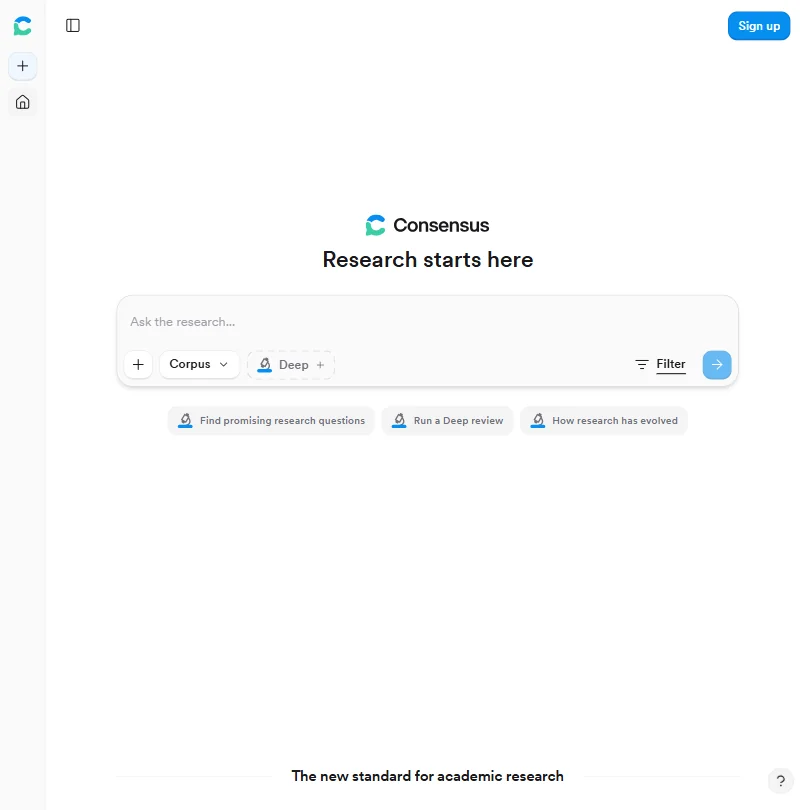
Consensus is an AI-powered academic search engine that pulls from a database of over 220 million peer-reviewed papers, including licensed full-text content from publishers. You type a question, and instead of returning a wall of links, it synthesizes findings across multiple studies and presents them with citations attached. The standout feature is the Consensus Meter, a visual indicator that shows, at a glance, how much existing evidence supports or contradicts a claim. That's a genuinely useful idea. Most literature search tools dump results on you and leave the synthesis work for you to do. Consensus at least attempts to do some of that analysis upfront. Whether the Meter is always accurate is a separate question. We're skeptical of any tool that tries to reduce contested scientific debates into a color bar, but for broad, well-studied questions it tracks reasonably well based on what we read. Beyond the Meter, there are features called Deep Review and Pro messages, tiered by plan. The Deep Review builds a more thorough research strategy across multiple sources and follows citation graphs rather than just keyword matching. AI summarization is included. Natural language follow-up queries work. There's no Chrome extension. No mobile app though, which is a real miss for clinicians doing quick literature checks away from a desk. Worth flagging on the full-text question: Consensus's index includes licensed full-text content from publishers, which is more than a lot of free tools offer. That does not mean users get access to paywalled PDFs. Open-access papers can be downloaded directly. Paywalled papers link out to the publisher or your institution's library. That's a meaningful distinction the vendor doesn't always make loudly enough.Is Consensus Easy to Use for Researchers and Professionals?
The interface is clean. That much is consistent across G2 and Capterra reviews. Researchers who describe themselves as not especially technical say they picked it up without a manual. The question-based search format helps a lot. You don't need to know Boolean logic or MeSH terms. You just type what you want to know. There's no Chrome extension, so all of this happens inside the web app. You can run queries from wherever you're already working, which reduces the friction of switching tabs during a literature review. That said, depth is where things get more complicated. The AI synthesis works best on questions with a decent volume of existing research behind them. Ask something niche or emerging, and the summaries get thin fast. Several G2 reviewers in clinical and life science roles noted this directly. The tool doesn't always know what it doesn't know, and the Consensus Meter can project more certainty than the underlying evidence warrants. Honestly, that's our biggest concern with the product. On pricing, the situation is clearer than some competitors, actually. Free gets you unlimited basic Papers searches, 10 Pro messages per month, and 3 Deep reviews per month. Pro runs $20 monthly or $144 annually, which works out to $12 a month. Deep is $65 monthly or $540 annually, equivalent to $45 a month. Teams pricing is $30 per seat per month. Enterprise is custom. The free credit reset timing is visible in account settings, which is a small but useful touch. Fair. The integration story has improved. Consensus now has a documented Zotero connection via API key, preserving collections and folder structure on import. The catch is that it's one-way and you have to repeat the import manually when new material is saved in Zotero. Export works through RIS or CSV, and bibliography formats include APA, MLA, Chicago, BibTeX and a few others. RIS files are documented as compatible with Zotero, EndNote, and Mendeley. That's a real improvement over where things stood, though the one-directional Zotero sync is still clunky compared to what tools like Elicit have started to build. Support is more substantial than the old reputation suggests. There's an in-product support chat, email contact, and a public help center with separate collections covering getting started, Deep Review, the Research Agent, Zotero workflows, exporting, and citation tools. No community forum in the traditional sense. But the live support chat does exist, so the "no live chat" characterization that floated around earlier threads is outdated.Who Should Use Consensus? (And Who Shouldn't)
Graduate students doing early-stage literature reviews. That's the clearest fit. The tool cuts hours off the process of finding out whether a research question has existing evidence behind it. Even the free tier delivers for that use case. Clinicians wanting a fast answer on whether an intervention has support in the literature. Same logic. The Consensus Meter isn't a replacement for a systematic review, but it's a useful first signal. There's also a documented academic and clinician discount, up to 40% off, available with a valid school email or NPI number for US healthcare providers. The tool is less useful for researchers working in narrow, emerging, or interdisciplinary subfields where published paper volume is lower. The AI synthesis gets visibly weaker when working with sparse data. Several Capterra reviewers in those fields noted they often had to verify findings independently anyway, which somewhat defeats the purpose. Practitioners can upload their own PDF library, up to 20 files at a time, and chat across them alongside Consensus's indexed papers. Document upload is documented: up to 20 PDF files at once, searchable and chattable alongside indexed papers. Scite.ai takes a different approach to citation analysis and has more documented depth for institution-level work. Worth a direct comparison. Teams can collaborate through shared Collections in My Library, inviting others as viewers or editors, though the pricing page doesn't say which paid tier includes it. Collections can be shared with viewer or editor roles for collaborative research, though which paid tier includes it isn't stated publicly. Not great. Marketing teams, content writers, business researchers. Not the audience. This tool was built for scientific literature. Using it for anything else is using a scalpel to open boxes.How Consensus compares
Consensus scores 6.7 out of 10 among the literature search tools we rate. These three do the same job and are the closest to it, compared on what each vendor publishes.
Elicit
Elicit and Consensus cost about the same to start, $19 and $20 a month. Elicit goes further into systematic review territory: it screens papers with include and exclude decisions, deduplicates references automatically, and reads figures and tables, none of which Consensus does. Consensus answers back with a visual map of connected papers and 500 metered API calls built into that same $20 plan, plus responses in languages other than English, features Elicit does not publish a price or capability for.
Pick Elicit if you are screening papers for a systematic review.
Pick Consensus if you want a paper map and API access included.
Semantic Scholar
Semantic Scholar is free, with no paid plan at all; Consensus starts at $20 a month. That price buys a visual map of connected papers, a table that pulls study details across many papers at once, and a full literature review draft, none of which Semantic Scholar offers. Semantic Scholar answers back with a free, documented API and citation alerts on saved searches, both absent from Consensus, though its summaries only cover computer science, biology and medicine.
Pick Semantic Scholar if you want free access with a documented API and alerts.
Pick Consensus if you want a paper map and a written literature review.
AnswerThis
AnswerThis costs $35 a month for its cheapest paid plan; Consensus costs $20 a month. AnswerThis spends that extra money on systematic review features Consensus lacks entirely: screening with include and exclude decisions, a PRISMA flow diagram, and a risk of bias assessment. Consensus answers back with a metered API included from $20 a month, 500 uses before a per use charge applies, and Pro Analysis responses in languages other than English, neither of which AnswerThis offers.
Pick AnswerThis if you are running a systematic review with screening and risk of bias.
Pick Consensus if you want a cheaper plan with API access and non-English support.
Frequently Asked Questions
Is Consensus free to use?
How accurate is the Consensus Meter?
Does Consensus work for non-English research?
Screenshots


