
Undermind was founded in San Francisco in 2023. That detail matters less than what the tool actually does, but we're correcting it here because the 2022 date circulates and it's wrong. We cross-referenced the Y Combinator profile and the official LinkedIn page. Both say 2023. What we kept seeing in our research was a tool positioned squarely at scientists, academic researchers, and R&D teams doing serious literature work. Not quick summaries. Not casual web search. Deep, citation-trail-following, find-what-others-miss literature work.
We haven't tested Undermind hands-on. We aggregated vendor documentation, Reddit threads from working researchers, third-party coverage, and the pricing data visible on the public site. That's what this review is built on.
What is Undermind?
The basic loop is this: you describe your research question, Undermind asks follow-up questions to sharpen scope, then it reads and evaluates papers at full-text level, follows citation trails, and generates a report with traceable inline citations back to source material. Every claim in a report points somewhere verifiable. That's the design that separates a useful research tool from a confident hallucination machine, and Undermind's documentation is explicit about it.
The headline claim comes from a vendor-authored benchmark of roughly 300 searches, primarily evaluated against ArXiv papers. Undermind reported ten times more relevant results than the first five pages of Google Scholar, and ten times higher density of relevant information. Vendor whitepaper. Worth keeping that context. What's harder to dismiss is the GSK deployment: over a thousand scientists at one of the world's largest pharmaceutical companies using this in active R&D workflows. That's an institutional bet, not a testimonial planted on a landing page.
A few constraints we noted. English-only, web-only, no mobile app. For a global research community, that's real. Not disqualifying for most users, but not nothing either.
Undermind Features: Search, Synthesis & Research Capabilities

The core loop is the search itself. Full-text reading rather than abstract skimming, citation trail following, iterative refinement. Beyond that, there's a brainstorming layer where you can ask the AI to generate custom tables or explore adjacent research directions. The AI co-researcher dialogue is iterative, so a poorly formed first question isn't fatal.
Pro accounts and above get unlimited workspaces, files, and paper libraries. You can upload your own documents and work across them alongside live searches. A monitoring feature tracks your research areas and flags new papers as they publish. That's genuinely useful.
What's not documented publicly: no official browser extension, no Zotero integration, and public export-format documentation is limited. Undermind does support agent connections, the free plan lets you connect Claude and ChatGPT and a few others, and enterprise customers like GSK access the system through a custom API. But no openly documented developer API exists for general use. For researchers who live in reference managers, the integration picture is thin. That's frustrating.
Undermind Research Quality: How Accurate and Trustworthy Is It?
What turns up repeatedly in user feedback isn't interface design or speed. It's the sense that the tool finds papers that other searches miss. Full-text reading is the mechanism. Abstracts miss context and miss papers that are deeply relevant but don't signal it in their titles. Citation trail following compounds that, pulling connected work that a keyword search would never surface.
Honestly, that's what a thorough grad student does manually over several days. The AI does it in minutes.
The inline citation system is the safety net. Every factual claim in a generated report ties back to a source paper you can verify. That's the right design for scientific research, where a wrong citation can matter enormously. We can't independently validate the recall figures from the whitepaper. But the GSK evidence is the strongest third-party signal we found, and pharmaceutical R&D teams do not deploy tools at scale without internal validation.
Undermind Source Coverage: What Does It Actually Search?
This is where the documentation gets thin. Undermind describes searching scientific literature databases, following citation trails, and reading full texts. What it doesn't publish clearly is which databases it actually indexes.
PubMed? bioRxiv preprints? IEEE? ACM Digital Library? We couldn't confirm from public documentation. That ambiguity is real for anyone whose work sits in a specific sub-domain. A tool that's excellent for biomedical literature might miss half the relevant papers in materials science or electrical engineering.
We'd push Undermind to be more transparent here. A clear published list of indexed databases would do significant work in building trust with researchers evaluating whether the tool covers their field. The absence isn't disqualifying. It is the kind of thing that makes a careful scientist hesitate.
Is Undermind Easy to Use for Researchers and Professionals?
The conversational onboarding is smart. No query syntax to learn. You describe your research in plain language, the system asks follow-up questions, and that exchange also forces you to sharpen your own thinking. Not a bad side effect.
Reports are structured and readable. Citations are inline. User feedback describes no steep learning curve. The interface appears clean based on everything we reviewed.
The deeper question is whether researchers will trust it enough to actually change their habits. Google Scholar has network effects. Institutional database access is already paid for. For Undermind to win time from a working scientist, it needs to visibly surface things they'd have missed. The feedback we found suggests it does that, frequently enough to matter. That's the test.
Undermind Pricing: Is It Worth It vs Free Alternatives?
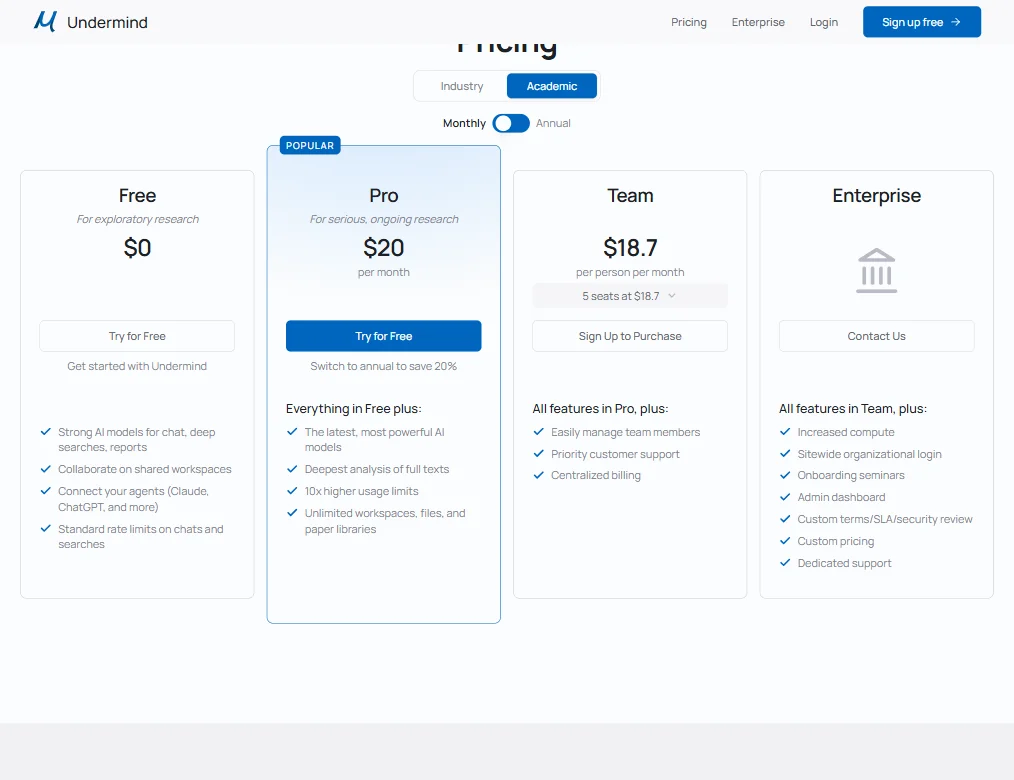
Four tiers on the academic pricing page. Free at $0, Pro at $20 per month on monthly billing (with a 20% saving if you switch to annual), Team at $20 per person per month starting at five seats (the same per-seat price as Pro, so extra seats bring no discount), and Enterprise at custom pricing with a contact form.
The free plan is real. Not a countdown trial. It includes AI models, deep searches, reports, shared workspaces, and agent connections to Claude, ChatGPT and a few others, just with standard rate limits.
Pro adds the latest AI models, deepest full-text analysis, 10x higher usage limits, and unlimited workspaces, files, and paper libraries. Team adds centralized billing and priority customer support. Enterprise adds increased compute, sitewide organizational login, onboarding seminars, an admin dashboard, custom terms and security review, and dedicated support.
Individual users primarily have access to the FAQ and direct contact email. Team and Enterprise plans add priority or dedicated support respectively. That gap matters for researchers evaluating institutional purchase.
Undermind publishes a refund and cancellation policy. Subscriptions can be cancelled through account settings at any time, access continues until the billing period ends, and payments are generally non-refundable once a billing cycle has begun, except where law requires otherwise or a billing error occurred. Worth reading before committing to an annual plan. $20 per month for a tool that demonstrably saves R&D researchers hours per literature review is not hard to justify if the tool works. The math is easy. The question is whether it works for your field.
One comparison worth making: Elicit has a similar free-to-paid structure aimed at systematic reviews, and it publishes its source coverage more explicitly. Worth considering if database transparency is a priority.
Undermind vs Elicit: Which AI Research Tool Is Better?
Both target academic and scientific research. Both use AI to synthesize across papers rather than just list results.
Elicit is more established in the systematic review space, built around structured data extraction, and explicit about its database sources. Undermind's advantage is the depth of search behavior: citation trail following, full-text reading, iterative co-researcher dialogue. Elicit feels like a structured extraction tool. Undermind feels more like an exploratory research partner.
For a researcher running a formal systematic review with a defined protocol, Elicit is probably the tighter fit. For early-stage literature exploration, before you've even formed a hypothesis, Undermind's citation trail following is the architectural differentiator. The GSK use case reinforces this. Discovery and novelty assessment, not structured data extraction.
We're skeptical of any single tool that claims to do both equally well.
Scite is worth comparing if citation context is the core need. It focuses on whether papers support or contradict each other. A different angle, genuinely complementary to what Undermind does.
Who Should Use Undermind? (And Who Shouldn't)
Scientists and R&D researchers doing early-stage literature exploration. That's the fit, full stop. The tool was built for that use case and the evidence points there.
Pharma teams, biotech labs, academic research groups. Any group where finding a paper others missed could meaningfully change a research direction.
Researchers in conference-heavy or preprint-heavy disciplines should verify coverage before committing. The source coverage question matters more for them.
Casual researchers or students wanting quick answers to general questions. They'd be paying for depth they don't need. The free plan would serve them, but simpler tools exist.
Undermind Review Verdict
Undermind is doing something specific. Full-text search, citation trail following, iterative research dialogue. The design choices are coherent and point at a real problem: finding the relevant literature in a fast-moving scientific field is hard, and most existing tools do it poorly.
The evidence for the product working is stronger than most tools at this stage. A thousand scientists at GSK is a real data point. The free plan is genuinely usable. Pro at $20 per month is reasonable for the use case.
The gaps are real but contained. Source coverage transparency needs work. Export and integration documentation needs publishing. For enterprise deployments the gaps matter less, the GSK case study suggests those are handled bilaterally. For individual researchers evaluating it, they're worth factoring in.
Try the free plan first. Standard rate limits apply, but a search or two will tell you quickly whether the tool surfaces things you'd have missed. That's the test. Run it.
How Undermind compares
Undermind scores 5.4 out of 10 among the literature search tools we rate. These three do the same job and are the closest to it, compared on what each vendor publishes.
Elicit
Undermind costs $20 a month for its academic Pro plan; Elicit's academic plan is $19 a month. Undermind includes shared team projects on its free plan, where Elicit only adds collaboration from its paid Pro tier. Elicit goes further into systematic review work that Undermind does not touch: it screens papers with include and exclude decisions, deduplicates references automatically, and exports to RIS, CSV, BibTeX, PDF and DOCX, where Undermind has no stated export format at all.
Pick Elicit if you need systematic review screening, dedup and reference export.
Pick Undermind if you want free team sharing without upgrading first.
Semantic Scholar
Semantic Scholar is free, with no paid plan; Undermind's academic Pro plan is $20 a month. Undermind answers back with a deep search that synthesizes an answer across the literature and writes it up as a report, and it reads figures and tables inside papers, none of which Semantic Scholar offers. Semantic Scholar counters with a free, documented API, the most substantial in the category, where Undermind's API is reserved for a separately priced Enterprise tier.
Pick Semantic Scholar if you want a free plan with a documented API.
Pick Undermind if you want a synthesized answer written up as a report.
Consensus
Undermind and Consensus both cost $20 a month for their cheapest paid plan. Undermind answers back with reading of figures and tables inside papers, which Consensus does not offer, and it includes shared team projects on its free plan. Consensus counters with a visual map of connected papers and a metered API included on that same $20 plan, where Undermind's API is reserved for a separately priced Enterprise tier.
Pick Consensus if you want a paper map and API access on the entry plan.
Pick Undermind if you want figure reading and free team sharing.
Frequently Asked Questions
Is Undermind free to use?
Yes. The free plan has no stated time limit. It includes AI models, deep searches, reports, shared workspaces, and agent connections, with standard rate limits applied. Pro is $20 per month on monthly billing, or 20% less on an annual plan, and adds the latest AI models, deeper full-text analysis, 10x higher usage limits, and unlimited workspaces and paper libraries.
How is Undermind different from Google Scholar?
Google Scholar indexes papers and ranks them. Undermind reads them. The system processes full texts, follows citation trails, and generates synthesized reports with traceable citations. In a vendor-authored benchmark of roughly 300 searches, primarily against ArXiv papers, Undermind reported ten times more relevant results than the first five pages of Google Scholar. We'd want independent validation of that figure. The underlying mechanism, full-text reading plus citation trail following, is a real architectural difference regardless of the exact multiplier.
Does Undermind work for non-biomedical research fields?
Genuinely unclear from public documentation. The strongest use case evidence comes from pharmaceutical and biomedical research. Which databases Undermind indexes beyond that isn't published explicitly. Researchers in other scientific disciplines should test the free plan against their own field before committing to a paid account. That's the honest answer.


