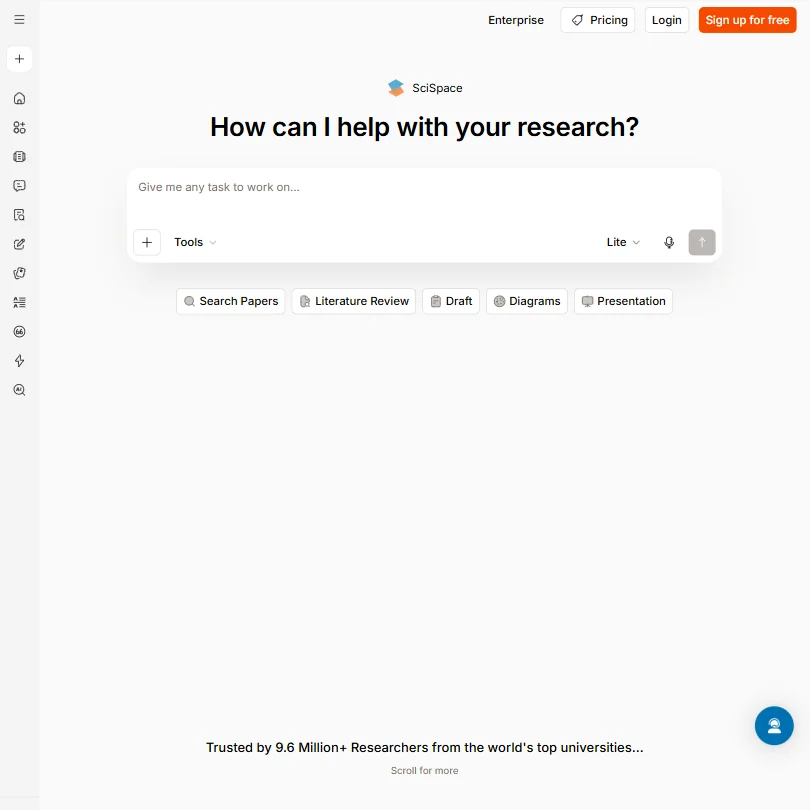
Nine million-plus researchers don't sign up for a tool that doesn't work. That's the first thing we clocked when we started pulling together this SciSpace review. But user count is a marketing number, and we've learned not to lead with it. So we went deeper. We read through Reddit threads, Product Hunt comments, and whatever third-party coverage we could find. What came back was a more complicated picture than the homepage suggests.
SciSpace launched in 2020 under PubGenius Inc., based out of Milpitas, California. The product has grown into something genuinely broad. That breadth is both its clearest strength and the thing that makes it slightly hard to trust.
What is SciSpace?
PubGenius built SciSpace as a research platform sitting somewhere between a paper search engine and an AI writing assistant. It searches academic sources, lets you upload PDFs and chat with them, synthesizes multiple papers into a literature review, and generates citations. Those are the core loops. There's also a paraphraser, an AI writer, a data extraction tool, and an AI detector bundled in.
The Chat with PDF feature is what most users seem to land on first. Upload a paper, ask it questions, get summaries with follow-up conversation baked in. That's the entry point for a lot of researchers.
Beyond that, the Literature Review tool is the more serious differentiator. It claims to pull from papers, journals, conferences, and authors, then synthesize across multiple sources. We'll get into how well that actually works below.
The platform runs on a GPT-4 based model, though proprietary is the word they use. Web, iOS, Android, and a Chrome extension. SciSpace offers multilingual support, with some tools advertising support for more than 75 languages, though availability varies by feature. The Data Extractor specifically advertises 75+ languages, while the Chrome extension lists 13. Honestly, that kind of real investment in non-English research communities is a genuine point in their favor, even if the feature-by-feature inconsistency is worth knowing going in.
SciSpace Features: Search, Synthesis & Research Capabilities
The feature list here is long. Genuinely long, in a way that raises questions.
Start with the search side. The academic search pulls from papers, journals, conferences, and author pages. It's not clear exactly which databases they index, but the breadth of user reports suggests it's substantial. The Chrome extension lets you run this from anywhere in the browser, which helps.
The Literature Review tool is the centerpiece of the pitch. You run a query, and it attempts to synthesize findings across multiple papers rather than just returning a list. That's meaningful if it works. What we kept seeing in user reports was that the synthesis is useful for getting oriented, but researchers doing serious systematic work still do significant manual checking on top of it. Fair. That's true of every AI lit review tool right now, not just SciSpace.
Chat with PDF includes conversational follow-up, so you can drill into a specific section or ask for plain-language explanations of dense methodology. The Extract Data tool goes further, pulling structured information from papers, which is useful for meta-analysis groundwork. We haven't seen many tools bundle that in at this level.
On the writing side, there's an AI writer with templates and export to PDF and Word. A paraphraser. A Citation Generator that handles multiple citation styles. That's a lot of surface area for one product.
The AI Detector is an odd inclusion. It's in there. We're not sure who the target user is for that, given that the same platform helps you write with AI. We'll leave that observation where it is.
SciSpace Research Quality: How Accurate and Trustworthy Is It?
This is where things get real.
The accuracy question is the one that matters most for a research tool. SciSpace's proprietary GPT-4 based model generates summaries and synthesis, and GPT-4 based systems hallucinate. That's not a SciSpace-specific problem, but it's the context you need when evaluating anything it produces.
Reddit threads surface a consistent pattern. Students and early-career researchers find the summaries genuinely useful for getting into a new field quickly. More experienced researchers, particularly those with domain expertise, push back harder. The model sometimes overconfidently summarizes findings, glossing over caveats that matter to the actual science. We don't buy the idea that AI synthesis is ready to replace human critical reading. SciSpace doesn't claim that, to be fair. But some users are treating it that way, and that's worth flagging.
The AI Detector inclusion is interesting here, because it signals that SciSpace is at least aware of the quality and authenticity problem in the research writing space. Whether it's accurate is a separate question we can't answer without hands-on testing.
What we didn't find was a published methodology for how SciSpace sources and verifies the claims its synthesis produces. That's a gap. If you're comparing options and citation-level accuracy is non-negotiable, Scite is built around Smart Citations, which use automated classification to show whether later papers support, contrast, or mention cited research. Worth a direct comparison before committing.
Cross-referencing vendor documentation with user reports, the tool does better on summarization than on nuanced synthesis. Good enough for orientation. Not a replacement for careful reading.
SciSpace Source Coverage: What Does It Actually Search?
The coverage question deserves its own section because SciSpace isn't entirely transparent about it.
Their site references papers, journals, conferences, and author directories. They also list a separate Data Sources page in the footer, which is more than most competitors bother with. We couldn't verify the full list without access, but the presence of a Data Sources page at all is a small credibility point. Most tools don't show that work.
User reports suggest decent coverage of major academic databases. STEM disciplines, particularly biomedical and life sciences, seem well covered. Humanities researchers in some of the forums we read had more mixed feedback, noting that niche journals and non-English sources sometimes come up short.
Not great. SciSpace claims multilingual support across its tools, which implies international source coverage. Whether the underlying index actually reflects that, or whether it's mostly English-language papers with a multilingual interface layered on top, we couldn't confirm. That distinction matters a lot for non-English-first researchers.
Compared to a tool like Elicit, which is very focused on structured evidence extraction from a more curated set of sources, SciSpace casts a wider net with less obvious curation logic. Neither approach is strictly better. Depends what you need.
Is SciSpace Easy to Use for Researchers and Professionals?
The homepage lists more than a dozen distinct tools. That's a lot to orient to.
New users frequently mention in reviews that the first experience is Chat with PDF or the basic paper search, and those are approachable. The layout doesn't seem to confuse people at the entry level. But the broader platform, including the agent features and the parallel query capabilities on higher tiers, reads more like a product that grew quickly than one that was planned around a single workflow.
The SciSpace Chrome Extension is consistently cited as one of the more useful pieces. It lets you interact with papers directly in the browser without routing back to the main app. That's practical. Small thing, but researchers hate context switching.
Mobile apps exist for iOS and Android. We rarely see academic research tools invest in mobile properly, so that's worth acknowledging. Whether the mobile experience matches the web is something we'd need to test.
Honestly, the breadth of tools is the biggest usability friction. There's a learning curve not because any single tool is complicated, but because figuring out which tool to use for which task takes time.
SciSpace Pricing: Is It Worth It vs Free Alternatives?

Three paid individual tiers, and they're priced clearly enough on the pricing page to actually compare.
Premium runs $20 a month. You get 1,200 monthly credits, Pro Model Access, Unlimited Downloads, Deep Research, Systematic Research (SLR), Generate Standard Report, Biomedical Agent Access, Unlimited Literature Review search, and 4 Parallel Agent Queries. Also includes the ability to unlock eligible full-text papers through your institution. That's a reasonable entry point for a solo researcher who needs more than the free tier but isn't running heavy multi-paper workflows.
Advanced is $90 a month and sits as the "Popular Choice" on their pricing page. 10,000 monthly credits, Expert Model Access, Generate Verified Report, and 8 Parallel Agent Queries, plus everything in Premium. The jump from 1,200 to 10,000 monthly credits between Premium and Advanced is steep enough that most individual researchers probably don't need Advanced unless they're running systematic reviews at volume. We're skeptical of that tier for solo use at that price.
Max comes in at $200 a month. Credit allowance is configurable, with 40,000 credits per month shown as the default. Adds Priority Support, 16 Parallel Agent Queries, and priority access to new features. That's an enterprise-adjacent product dressed as an individual plan.
Premium drops 40% on yearly billing (Advanced about 22%, Max 20%), and there's a flash sale running through August 1, 2026 with an additional 30% off yearly plans using code SCI30. Worth checking whether that's still live.
Team plans exist separately. Teams Premium is $25 per user monthly, or $15 annually. Teams Advanced runs $100 monthly or $75 annually. Teams Max is $220 monthly or $175 annually. Enterprise pricing is custom.
The free plan covers Chat with PDF, Literature Review, and basic search. Limited, but genuinely usable. For a student doing casual research, the free tier might hold for months without forcing a decision.
For comparison, Perplexity Pro is $20 a month and transparent about it. Semantic Scholar is entirely free. Elicit publishes its paid tier pricing clearly. SciSpace does the same now, which puts it ahead of where it was.
SciSpace vs Elicit: Which AI Research Tool Is Better?
These two come up in the same breath constantly. Different products, actually.
Elicit is narrower. It's built around structured literature search and evidence extraction, with a focus on systematic review workflows. The output is more table-like and explicit about methodology. Researchers doing formal systematic reviews tend to prefer it for that reason.
SciSpace is wider. It wraps in citation generation, paraphrasing, a full AI writer, PDF chat, and a data extraction tool alongside the literature synthesis. If you want one platform covering the whole research and writing workflow, SciSpace makes more of a case for itself than Elicit does.
The tradeoff is depth versus breadth. Elicit tends to be more rigorous in how it handles evidence. SciSpace tends to be more useful across more tasks in a single session. Neither is the obvious winner. We'd push back on anyone making a blanket recommendation without knowing what the researcher is actually trying to do.
On breadth of tools, SciSpace wins. On evidence rigor, Elicit wins. That's the honest version.
Who Should Use SciSpace? (And Who Shouldn't)
Graduate students and early-career researchers doing initial literature orientation. That's the strongest fit we see. Fast ramp-up on a new topic, quick summaries, citation help. The free tier alone might cover most of what they need.
R&D teams in biomedical and pharma contexts. SciSpace specifically calls out that vertical, and the Biomedical Agent Access appearing even at the Premium tier suggests real investment there.
Researchers who need to produce written output fast. The AI writer and paraphraser, bundled with the research tools, makes it a more complete production environment than pure search tools like Semantic Scholar.
Who shouldn't bother. Researchers who need bulletproof citation accuracy for formal academic submission without significant manual verification. The synthesis is too confident for that use case without double-checking. Domain experts who already have deep familiarity with their literature will likely find the AI summaries too surface-level to be useful.
SciSpace Review Verdict
SciSpace is a serious product. Nine million users isn't an accident, and the feature set is genuinely broad for what is still a relatively young company.
The core tools work. Chat with PDF handles a real workflow. The Literature Review tool is useful for getting oriented. The Chrome extension is practical. That's a solid foundation.
The support infrastructure is the thing that still gives us pause. SciSpace has a limited G2 review presence but a more substantial review trail on Capterra, with around 80 reviews there as of mid-2026. No official vendor-hosted community forum is clearly documented, although SciSpace has a community page on Product Hunt where users can ask questions and request features. For a 9.6 million user platform, that's thin. Email support and a help center rounding out the picture is fine for early-stage products. Less fine at this scale.
Research quality is good enough to be useful. Not good enough to replace careful reading. That caveat applies to the whole category, not just SciSpace, but it's worth repeating because the breadth of the platform can make it feel more authoritative than it is.
For individual researchers and students, this is worth trying on the free tier. For teams making a purchasing decision, the tiered pricing is now transparent enough to evaluate properly. That's progress.
How SciSpace compares
SciSpace scores 6.9 out of 10 among the literature search tools we rate. These three do the same job and are the closest to it, compared on what each vendor publishes.
Scite
SciSpace and Scite both charge $20 a month for their cheapest paid plan. Scite answers back with a feature SciSpace does not have: Smart Citations that state whether later papers supported, contradicted or merely mentioned the one you're reading. SciSpace counters with a mobile app, an AI writing editor that adds citations as you draft, and export to CSV, RIS, BibTeX, Excel or XML, where Scite has no stated export format and reads neither tables nor figures inside papers.
Pick Scite if you need to know if later papers support or contradict one.
Pick SciSpace if you want a mobile app, an AI writing editor and full exports.
Elicit
SciSpace costs $20 a month; Elicit's academic plan is $19 a month. SciSpace answers back with an AI writing editor that drafts your own paper and adds citations, a mobile app, and support for more than 75 languages, none of which Elicit offers. Elicit goes further into systematic review work instead: it screens papers with include and exclude decisions, deduplicates references automatically, and claims PRISMA grade accuracy on its Enterprise tier, capabilities SciSpace does not have.
Pick Elicit if you are screening papers for a systematic review.
Pick SciSpace if you want an AI writing editor, a mobile app and language support.
Consensus
SciSpace answers back with things Consensus does not have: an AI writing editor that adds citations to your own draft, a mobile app, and reading of tables and figures inside papers. Consensus counters with a visual map of connected papers and a metered API, 500 uses included on its $20 plan, neither of which SciSpace offers. Both charge $20 a month for their cheapest paid plan.
Pick Consensus if you want a paper map and metered API access included.
Pick SciSpace if you want an AI writing editor, a mobile app and figure reading.
Frequently Asked Questions
Is SciSpace free to use?
There's a free plan, and it covers the main tools including Chat with PDF and basic Literature Review access. It's genuinely usable for casual research, not a stripped-out teaser. Paid individual tiers start at $20 a month for Premium, $90 for Advanced, and $200 for Max, with annual billing discounts ranging from 40% on Premium down to 20% on Max. A flash sale promo code (SCI30) was active at time of writing for an additional 30% off yearly plans.
How accurate is SciSpace's AI for academic research?
Accurate enough to be useful for getting oriented in a new topic area, but not accurate enough to trust without verification. The model is GPT-4 based, and GPT-4 based systems produce confident-sounding summaries that sometimes miss nuance. User reports consistently show that domain experts catch errors that the AI misses. Use it as a starting point, not a final source.
How does SciSpace compare to Semantic Scholar?
Semantic Scholar is free, has no AI writer or PDF chat, and is focused purely on academic search and citation graphs. SciSpace does more things and costs more. If all you need is finding and tracking papers, Semantic Scholar is hard to argue with at zero dollars. SciSpace earns its place when you're also writing, summarizing, and generating citations in the same workflow.


