
We pulled this Rayyan review together from vendor documentation, academic forum threads, Reddit posts on r/AskAcademia and r/medicine, and public pricing data. Rayyan isn't listed on G2 or Capterra, which made the third-party review layer thinner than usual. What we found elsewhere, across research community discussions and academic Twitter, was consistent enough to work with. A tool a lot of people use, built for one specific job, and genuinely good at it.

What is Rayyan?
Founded in 2014 and headquartered in Cambridge, MA, Rayyan started as a way to make systematic review screening less punishing. The core problem it addresses: researchers pulling hundreds or thousands of references from multiple databases still had to decide manually which ones were relevant. Rayyan puts AI in front of that step.
Over a million researchers at more than 30,000 institutions have used it. That number tracks with what we kept seeing in academic community discussions, where Rayyan gets named constantly and without much controversy as a default for evidence synthesis workflows. It's not inflated by ghost signups.
The newer AI layer is called ResearchPilot. It handles relevance scoring, data extraction, and interactive querying of your reference set. More on that below.
Rayyan Features: Search, Synthesis & Research Capabilities
Rayyan doesn't search the web for you. Not what it does. You import references, usually from PubMed, Embase, or another external database, in RIS or BibTeX format, and Rayyan takes over from there.
The Systematic Auto-Resolver is the feature that comes up most often in user discussions. It deduplicates references using a configurable, industry-leading detection protocol. Anyone who's done a multi-database review knows how bad duplicate records get across sources. This handles it fast. Honestly, that alone justifies trying the free tier.
ResearchPilot adds zero-shot relevance ratings, meaning the AI scores reference relevance without requiring you to train it on examples first. It also includes an AI Analyzer and something called an AI Reviewer, which lets you query your reference set directly. The auto-extract data function pulls structured information from included studies, which is the piece researchers in later-stage reviews care about most.
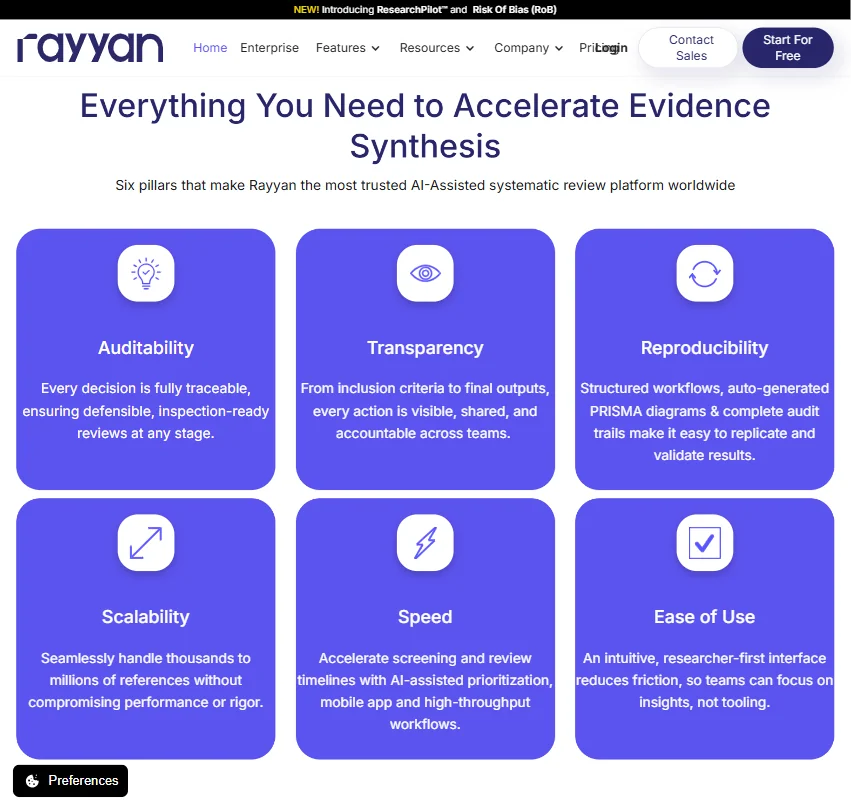
Practical additions worth naming: programmable hot keys for faster screening and auto-generated PRISMA flow diagrams. The PRISMA generation saves real hours for anyone writing up a formal review. There's also a data sampling tool for creating randomized subsets when splitting screening workload across a team.
The mobile app covers iOS and Android with offline support. Not a gimmick here. Researchers screening references between clinic sessions or on commutes is a documented real-world pattern.
Rayyan Research Quality: How Accurate and Trustworthy Is It?
The audit trail is what separates Rayyan from lighter tools. Every inclusion and exclusion decision is logged. Every reviewer action is traceable. In academic contexts where a journal or funder can demand you justify every step of your screening process, that matters enormously.
Across what we read in academic forums and research threads, the recurring theme is that the AI relevance predictions work best as a prioritization filter, not as a final screening call. Researchers who treat the scores as a first-pass tool and then apply human judgment seem to get the most out of it. That tracks with what we'd expect.
The zero-shot approach of ResearchPilot is interesting. We're a bit skeptical of it at scale. Zero-shot relevance scoring across highly specialized clinical or scientific literature is genuinely hard. The AI gets you most of the way there. The rest still needs careful human review. That's not a Rayyan-specific problem, it's an honest limitation of where AI-assisted screening sits right now across the whole category.
That said, a decade of training and product refinement is real. We've seen much worse.
Rayyan Source Coverage: What Does It Actually Search?
Direct answer. Rayyan is not a literature discovery tool. It's an evidence synthesis platform. You bring references to it. It doesn't find them for you.
If you need something that actively queries academic databases and surfaces papers, Elicit is built for that job. Different category entirely. Rayyan picks up where your database searching ends.
The import side handles RIS and BibTeX well, which covers most major database exports. Multi-database imports land in the same workspace and the deduplication layer runs across all of them. The loop is: search externally, export, import into Rayyan, deduplicate, screen.
No browser extension. Rayyan supports manual Zotero import and export through standard reference-file formats, but no direct Zotero sync is documented. The API exists but only surfaces at the Enterprise tier.
Is Rayyan Easy to Use for Researchers and Professionals?
The interface gets consistent credit in user discussions for being cleaner than older tools in this space. Compared to EPPI-Reviewer, Rayyan feels modern. Compared to a spreadsheet-based workflow, it's a significant step up.
The learning curve is real but not steep. Most researchers report being functional within a session or two. Hot keys help once you've internalized them, and the mobile app adds genuine quality-of-life improvement for high-volume reviewers.
Team collaboration runs through shared workspaces, reviewer invitations, and role assignment. Independent screening by multiple reviewers is required or recommended under major systematic-review standards like Cochrane. Rayyan supports this workflow through Blind Mode and a conflict resolution step, where co-reviewers' decisions stay hidden until Blind Mode is turned off and conflicts become available for resolution. Fair.
The free plan caps at 3 active reviews and 2 free reviewers. Tight for anything beyond solo work or a small pilot. Not great. But enough to evaluate whether the tool fits before paying anything.
Rayyan Pricing: Is It Worth It vs Free Alternatives?

Reasonable, especially relative to Covidence. The pricing structure on the screenshot we reviewed breaks down like this: Essential runs $8.33 per month billed quarterly, which comes to $24.99 per billing cycle. Advanced runs $13.33 per month billed quarterly, at $39.99 per cycle. Business/Academic is $41.67 per license per month, billed annually, starting with 5 licenses at $2,500.00, with academic discounts noted. Enterprise is custom pricing, billed annually.
Worth being specific about billing cadence. Essential and Advanced are billed quarterly. Business/Academic and Enterprise are billed annually, which affects cash flow planning for institutions with annual procurement cycles.
The main value jump happens at the Business/Academic tier, where you get 250 free invites (per what we cross-referenced in vendor materials) and access to ResearchPilot AI for accelerated screening. For a research institution buying across a team, $41.67 per license is a defensible number compared to what comparable tools charge.
The refund policy isn't publicly stated. That's a real gap for institutions with procurement processes that require documented refund terms before a purchase order goes through. We'd like to see that addressed.
The free plan is permanent, just capped. That's a better deal than a 14-day trial that vanishes.
Rayyan vs Covidence: Which AI Research Tool Is Better?
Covidence is the most direct competitor. The comparison surfaces constantly in systematic review communities. Both tools handle the same core workflow. The differences come down to price, AI capability, and institutional reach.
Covidence carries stronger name recognition in some clinical research circles and charges more for it. Rayyan is cheaper and has a larger global user base. Rayyan's deduplication is widely considered stronger, and ResearchPilot gives it an AI edge that Covidence hasn't matched publicly as of our research.
DistillerSR is worth naming for larger enterprise workflows. More configuration options, steeper price, longer onboarding. Rayyan gets you operational faster.
Abstrackr is free and open-source. Usable for small solo reviews. Not built for team workflows or high reference volumes. The gap between Abstrackr and Rayyan widens fast once your import set grows past a few hundred records.
Coming from a spreadsheet or a manual reference manager workflow? Rayyan is a clear upgrade regardless of which tier you land on.
Who Should Use Rayyan? (And Who Shouldn't)
Academic researchers running formal systematic reviews. Core fit. Clinical practitioners involved in evidence synthesis, postgraduate students doing thesis-level literature reviews, and research coordinators managing multi-reviewer teams all show up consistently in the documented user base.
Research institutions with teams running parallel reviews should be looking at the Business/Academic plan or starting an Enterprise conversation. The 5-license minimum at $2,500.00 annually sets a floor for that tier.
Solo academics doing occasional reviews can likely get by on the free plan or Essential. Worth testing before paying anything.
People who want AI to search for papers and synthesize a literature overview on demand. Wrong tool. Scite covers citation-grounded analysis if that's the actual job.
Rayyan Review Verdict
A decade of development shows. The deduplication is industry-leading per the vendor, the PRISMA diagram generation saves real charting time, and ResearchPilot adds AI capability that the systematic review category was missing until recently.
The gaps matter too. No browser extension, file-based Zotero workflows with no confirmed live sync, and an unpublished refund policy are all friction points, especially for institutions with formal procurement processes. The AI features still require human oversight on anything high-stakes, which is the honest reality of the category right now.
Pricing is fair. The free tier is more than a demo. A user base of over a million researchers isn't marketing noise.
Systematic review researchers running this kind of work regularly. Recommended. For occasional or informal literature reviews, it's probably more infrastructure than the job requires.
How Rayyan compares
Rayyan scores 6.0 out of 10 among the systematic review platforms we rate. These three do the same job and are the closest to it, compared on what each vendor publishes.
Covidence
Rayyan's cheapest paid plan is $8.33 a month, billed quarterly; Covidence costs $339 a year with no monthly option. Rayyan answers back with a mobile app and non-English language support, neither of which Covidence offers. Covidence counters with automatic reference deduplication on import and a PRISMA flow diagram generated for every review from its cheapest plan, plus support for six reference managers including RevMan and CRS for Cochrane style reviews, where Rayyan names none.
Pick Covidence if you need Cochrane style reference manager support built in.
Pick Rayyan if you want a mobile app and cheaper quarterly billing.
Sysrev
Sysrev searches PubMed and OpenAlex directly inside the app, where Rayyan only imports references you already found elsewhere. Rayyan counters with automatic reference deduplication, a PRISMA flow diagram, and an announced risk of bias assessment, none of which Sysrev offers, plus a mobile app that Sysrev lacks. Rayyan's cheapest paid plan is $8.33 a month, billed quarterly; Sysrev costs $50 a month per member.
Pick Sysrev if you want to search PubMed and OpenAlex without importing first.
Pick Rayyan if you need deduplication, PRISMA, risk of bias and a mobile app.
Silvi
A mobile app and an institutional library licence route set Rayyan apart from Silvi, which offers neither. Silvi counters with a browser extension that Rayyan does not have, though Silvi holds AI assisted screening back until its Rapid tier while Rayyan offers AI powered screening suggestions you accept or delete. Rayyan's cheapest paid plan is $8.33 a month, billed quarterly; Silvi's cheapest paid plan, Rapid, is 40 euros a month.
Pick Silvi if you want a browser extension over a mobile app.
Pick Rayyan if you want AI assisted screening from the entry plan.
Frequently Asked Questions
Does Rayyan search academic databases for you?
No. Rayyan manages and screens references you've already collected from external databases like PubMed or Embase. You export from those sources, import into Rayyan, and the tool handles deduplication, AI-assisted screening, and data extraction from there.
Is the free plan actually usable for real research?
Partially. It covers up to 3 active reviews and 2 free reviewers, which is enough for solo work or a small pilot. AI relevance predictions and duplicate detection are included at no cost, which is genuinely useful. The cap on active reviews becomes a real constraint once you're running multiple projects at the same time.
How does Rayyan compare to Covidence on price?
Rayyan is cheaper. Covidence charges at a higher rate, with institutional pricing that varies by arrangement. Rayyan's Essential plan runs $8.33 per month billed quarterly, Advanced at $13.33, and Business/Academic at $41.67 per license per month billed annually. For institutions watching research tool budgets across a team, that difference accumulates.


