Our research on Read AI started where it usually does. Marketing copy. Big claims about AI copilots, digital twins, and meeting transformation, and then we dug into actual user reports, cross-referenced vendor docs, and pulled the pricing apart. The picture is mostly good. A few genuine caveats worth flagging.
Founded in 2021 and based in San Francisco, Read AI has moved fast. It's not a simple transcription tool anymore, and that's both its strength and, occasionally, its problem. The product now spans meetings, email, and messaging, all tied together through a single AI layer. That's a wide surface area for something that started as a meeting summarizer.
What is Read AI?
At its core, Read AI records and summarizes meetings. Zoom, Google Meet, Microsoft Teams, it handles all three. But the company has pushed well beyond that.
The bigger pitch now centers on something called Ada, the Digital Twin, an AI assistant that's supposed to learn how you work and handle tasks on your behalf across meetings, emails, and messages. Bold claim. We'll get to whether users think it actually delivers.
There's also Ask Read, which lets you search across meeting history, emails, and chat threads in natural language. Enterprise search, basically, but drawing from your own communications specifically. Most user reports suggest it works well. That's useful enough to matter.
Read AI Features: Automation, AI Assistant & Workflow Capabilities
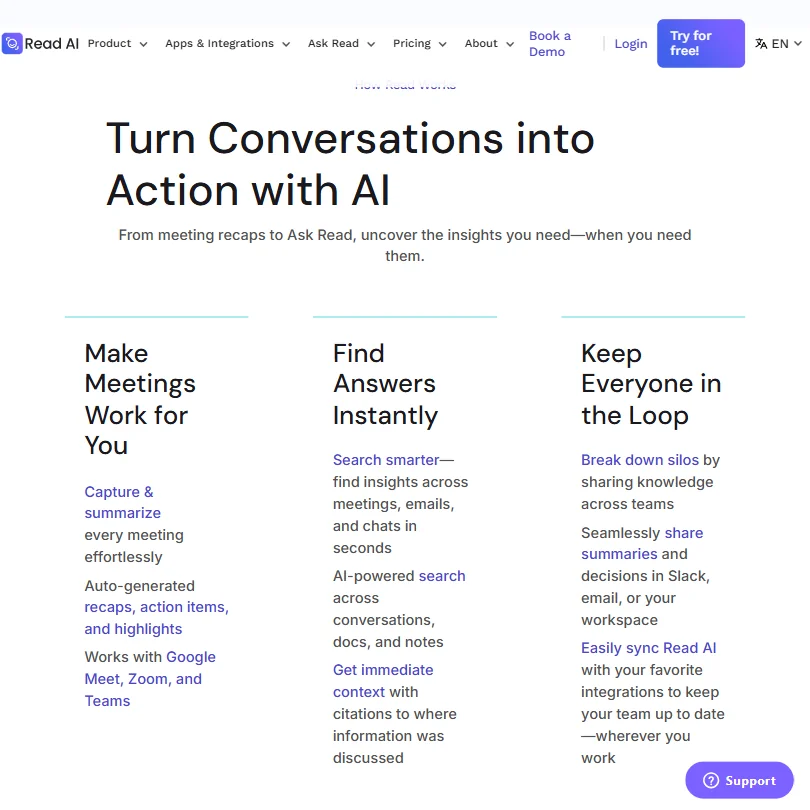
The feature set is wider than most tools in this category. Real-time AI-generated meeting notes with action items, automatic post-meeting recaps, a meeting coach that tracks talk-time ratios and engagement. That last one is either useful self-reflection or mildly unsettling depending on who's in the room. Honestly, we lean toward useful.
On the automation side, Read AI syncs action items out to Jira and pushes summaries to Slack after a call ends. It also handles email summaries for Gmail and Outlook users. Offline mode for in-person meetings is worth flagging, because most competitors skip that entirely.
Ada, the Digital Twin, is where Read AI stretches furthest. The idea is that the assistant learns your patterns over time and handles routine workflow tasks without you asking. User feedback on this is mixed. Some people find it genuinely helpful. Others describe it as a feature that works better in demos than in day-to-day use.
The Ask Read search function gets better marks. Cross-referencing meetings, emails, and messages with cited sources is the kind of capability enterprise teams actually want, and users generally report that it delivers.
Read AI AI Quality: How Smart and Useful Is the Assistant?
Read AI runs on a proprietary multi-LLM setup, meaning it pulls from more than one underlying model depending on the task. They don't specify which ones, but the product is now available as a Claude Connector and a ChatGPT app, which tells you something about the direction they're heading.
Meeting summary quality is consistently praised across user reports. People in different industries describe the recaps as accurate enough to replace manual notes entirely. That's the bar that matters. Honestly, that's not guaranteed with every tool in this space.
The meeting coach feature scores engagement and talk-time ratios. Whether it changes behavior is another question. We're a little skeptical that most people act on those scores past the first week, but having the data is better than not having it.
Where things get murkier is the Digital Twin layer. Ada is supposed to be proactive and context-aware. Reddit threads from 2024 and 2025 suggest it works well for reactive tasks, like summarizing a past meeting or answering a direct question. The more autonomous "handles it for you" behavior? Less consistent reports there. Worth noting before you buy in on that specific pitch.
Not great. But not a dealbreaker either, depending on what you're actually buying it for.
Read AI Integrations: What Does It Connect To?
The integration list is solid. Zoom and Microsoft Teams on the meeting side. Salesforce and HubSpot for CRM sync. Notion and Confluence for writing outputs, Jira for project tracking, and a few others.
Zapier access unlocks at the Pro tier at $19.75 per user per month on the annual plan, which is a reasonable place to put it. The API and MCP Server availability is a real differentiator for teams that want to build on top of the platform. Not every tool in this category offers that.
We cross-referenced the integration list with user complaints and the most common friction point is setup time. Getting Read AI properly wired into a Salesforce workflow or a Jira board takes more configuration than the onboarding implies. That tracks. "Available" and "works well out of the box" aren't the same thing, and this gap shows up in reviews often enough to flag.
For teams already deep in the Google ecosystem, the Chrome extension combined with Gmail and Google Calendar support means the tool fits in without much friction. Microsoft 365 users get Teams and Outlook coverage, which handles most enterprise environments.
Is Read AI Easy to Use?
No hands-on testing from us here. But the pattern in user feedback is consistent. Getting started is quick. The meeting bot joining calls automatically is either convenient or slightly alarming depending on who's in the room. Most people adjust fast.
The complexity shows up once you move beyond meeting summaries. Ask Read, Ada, and the CRM integrations require time to configure and more time to trust. New users report a learning curve that's not steep but isn't flat either. Fair.
The mobile apps for iOS and Android are available and functional. User reports don't single them out as a strong point, but they don't flag them as broken either. Decent. Not exceptional.
The Chrome extension gets better marks, particularly for Gmail users who want email summaries inline. That specific use case comes up often enough across reviews to be worth calling out.
Read AI Pricing: Is It Worth It vs Free Alternatives?

The free plan is genuinely functional. Five meeting transcripts per month, unlimited enterprise search, access to the meeting coach and summaries, and basic integrations. No credit card required to start. That's a real free tier, not a stripped demo.
Paid plans, on the annual billing cycle, land at $19.75 per user per month for Pro, $29.75 for Enterprise (the plan flagged as most popular), and $39.75 for Enterprise+, which requires five or more licenses. The Enterprise tier adds audio and video playback plus 200 file upload credits per month, which matters if recordings are a core part of your workflow. Enterprise+ adds HIPAA compliance and SAML/SCIM, and it requires a sales conversation to get started.
Here's where it gets a little tricky. The refund policy isn't publicly stated anywhere we could find. That's an irritant. For a product at this price point, it shouldn't require a support ticket to figure out your options.
Against something like Fathom AI Notetaker, which offers a generous free tier focused on meeting recordings and summaries, Read AI costs more but covers more. Email summaries and cross-platform search aren't in Fathom's wheelhouse. If you just need clean meeting notes and nothing else, Fathom gets the job done for less.
For teams that want the fuller workflow layer, $19.75 for Pro is defensible. Enterprise pricing is where we'd want clearer public documentation before committing a larger team.
Read AI vs Otter.ai: Which Productivity Tool Wins?
Otter.ai is the obvious comparison for most people shopping in this space. Both do meeting transcription and summaries. Both have free tiers. The similarities stop around there.
Otter focuses on transcription quality and live collaboration during meetings. It's a cleaner, simpler tool if transcription is the primary need. Read AI's pitch is the layer on top: the cross-platform search, the email summaries, Ada, and CRM sync.
Otter's pricing is comparable at entry level, but Read AI does more for roughly the same monthly cost if you're on a paid plan. The question is whether you need what Read AI adds. For individual professionals who primarily want accurate meeting notes, Otter is a reasonable alternative. For teams that need meeting outputs to flow into CRM tools and project management systems, Read AI's additional surface area matters. We'd give Read AI the edge in that scenario, but only if the team is willing to spend time on setup.
Who Should Use Read AI? (And Who Shouldn't)
Sales teams running a lot of calls and needing CRM sync. That's the clearest fit we see in user patterns, particularly for teams on HubSpot or Salesforce.
Operations and project managers who need meeting outputs to land directly in Jira or similar tools. Read AI saves a step that most tools leave manual.
Individual users on the free tier who want five summarized meetings per month. The free plan is good enough for light use.
Solo users who only care about transcription and find AI assistant features noisy. Granola is worth a look for that use case, simpler and lighter. Organizations with strict data residency requirements should dig into the privacy documentation before committing, because Read AI processes a wide footprint of sensitive conversation data and questions about this come up on Reddit with enough regularity to be worth flagging here.
Read AI Review Verdict
Read AI is doing more than most tools in this category and, mostly, pulling it off. The meeting summaries are good. Ask Read is genuinely useful. The CRM and project tool integrations work, once configured. Ada's more autonomous features are still a work in progress, based on what we're seeing in user reports.
The product earns a strong recommendation for teams that need meeting outputs to connect to the rest of their workflow. Not summaries sitting in a tab somewhere. Actual sync to Salesforce, Slack, Jira, whatever the team runs. That's where Read AI separates from simpler tools.
The caveats: the refund policy should be public, Ada's "handles it for you" promises should be scoped down in the marketing, and setup complexity for enterprise integrations is higher than the homepage implies.
For the right team, this is one of the better-rounded meeting AI tools available right now. We wouldn't talk anyone out of it.