ElevenLabs is an AI voice generator best known for voice cloning, with professional cloning from the Creator plan and API access above it.

Founded in 2022, a million users before most competitors had finished their Series A. We started pulling data on ElevenLabs because that growth rate warranted scrutiny. G2 reviews, Trustpilot threads, Reddit discussions from 2024 and 2025, vendor documentation. What we found is a platform that mostly earns its reputation, with a few real friction points the marketing page doesn't mention. This is that picture, not the homepage version.
What is ElevenLabs?
ElevenLabs is an AI audio company out of New York. Its core product is text-to-speech generation that, by most accounts we read, sits a clear tier above what Murf AI or PlayHT produce in raw realism. The platform also handles voice cloning, transcription, music generation, and conversational AI agents, all running on proprietary models built in-house.
The model lineup has gotten complicated fast. Eleven v3 hit general availability in March 2026, supporting 74 languages with what the company calls emotional control. Flash v2.5 is the speed-optimized variant, targeting latency under 75ms. Eleven Multilingual v2 handles broader language coverage. Eleven Scribe v2 handles transcription. Four distinct models, each with a specific job.
Honestly, that's more model depth than most competitors bother with. Most tools ship one model and call it done.
The platform runs on web and through an API. There's an iOS app for voice chat. The API is, by a wide margin, what developers talk about most.
ElevenLabs Features: Voice, Music & Audio Capabilities

The feature surface is wide. Wider than most people realize when they first land on the pricing page.
Text-to-speech is the entry point. Over 10,000 voices in the library. The Voice Designer lets you describe a voice in text and generate one from scratch, which matters when the library doesn't have what you need. Eleven v3 adds granular emotional tuning, so you're not just picking a voice, you're adjusting how it delivers a line. That's a meaningful difference for audiobook narration or anything where tone carries weight.
Voice cloning comes in two meaningfully different tiers. Instant Voice Cloning is available from the Starter plan up. Professional Voice Cloning, which produces cleaner results from longer recordings, requires the Creator tier at $11 a month for the first month and $22 thereafter. G2 reviewers in content production consistently flag professional cloning as the feature that converts skeptics. That tracks with what we read.
Music generation is newer territory for the company. They trained it on licensed data, which matters for anyone worried about commercial use. Vocals or instrumental, any genre. We're a little skeptical of how much day-to-day use this actually gets from the average subscriber, but it's there and commercially safe.
Transcription runs through Eleven Scribe v2. The company claims 98% accuracy with speaker diarization and character-level timestamps. Cross-referencing their documentation with Reddit user reports, that accuracy claim holds for clean audio. Noisy environments are another story.
The Studio editor handles podcasts and audiobooks. The Voice Isolator pulls clean audio from messy recordings. Sound Effects via API rounds it out. It adds up fast.
Fair. The feature set is genuinely impressive. Whether any single user needs all of it is a different question entirely.
ElevenLabs Audio Quality: How Natural Does It Sound?
This is where ElevenLabs earns its reputation, and where the case for its pricing actually holds together.
Across G2 reviews, we kept seeing the same word: "realistic." Not vaguely. Reviewers with audio production backgrounds specifically noted that ElevenLabs output avoids the cadence artifacts that trip up other tools. Breathing patterns are right. Emphasis lands correctly. For long-form narration, that matters more than people anticipate before they try it.
Eleven v3 is the current ceiling. The jump in naturalness between Multilingual v2 and Eleven v3 is audible even to non-trained ears, based on what we read across developer forums and production communities. That's not a minor incremental update.
Trustpilot tells a messier story, sitting around 3.0 out of 5 across roughly 1,000 reviews. But when we read through those reviews, the quality complaints are mostly about billing and account issues, not audio output. G2, which skews toward professional evaluators, holds significantly higher across more than 1,100 reviews. That gap between platforms is informative.
The two platforms aren't measuring the same thing. G2 reviewers are evaluating a professional tool. Trustpilot captures the full public, including people who hit a credit limit on the free plan and left a one-star review about their account. We put more weight on the G2 signal here.
Not great on Trustpilot. The audio output itself, though? Hard to argue with.
ElevenLabs Voice Cloning & Customization: How Deep Does It Go?
Voice cloning draws the most attention in third-party coverage. Deservedly.
Instant Voice Cloning is quick. Upload a short audio sample, get a cloned voice back in seconds. Fast and accessible, but the output reflects input quality. Noise in your sample means noise in your clone.
Professional Voice Cloning is where the real depth shows up. More audio required, more processing time, and you need the Creator plan or higher to access it. What comes back is noticeably closer to the source voice. Reddit threads from 2025 have audio engineers comparing ElevenLabs professional cloning favorably against tools that cost significantly more. We cross-referenced several of those threads and found them consistent.
The Voice Designer deserves a mention. Describe a voice in text, specify genre, age, accent, and affect, and the system generates one. It works better than we expected from user descriptions. Not a replacement for cloning a specific person's voice, but useful when the 10,000-voice library doesn't have what you need.
One thing we kept seeing confirmed across documentation and user reports: the emotional control in Eleven v3 is real, not a checkbox feature. You specify how a line should feel and the model responds to it. Not perfectly every time. Reliably enough that it changed how some users structure their scripts.
Honestly, the depth here is unusual for a tool at this price point.
Is ElevenLabs Easy to Use?
The web interface for basic text-to-speech is approachable. Paste text, pick a voice, generate. Fast loop. The Studio editor for longer projects takes more orientation, but most G2 reviewers describe it as learnable within a session or two. Not steep.
The API is a different conversation entirely. Powerful. Also not for non-developers. The full API surface covers text-to-speech, speech-to-text, music generation, dubbing, conversational agents, and sound effects, which is a lot of territory to navigate if you're not comfortable reading API documentation. ElevenLabs has put real work into their docs, but you still need to be the kind of person who reads them.
What we kept seeing in G2 reviews from marketing teams and content creators: basic features are easy, but finding the advanced controls takes digging. The emotional tuning in Eleven v3 isn't front-and-center in the UI, at least not obviously. A few reviewers mentioned discovering features they'd been manually working around for weeks.
The Conversational AI Agents setup, which connects to channels like Twilio and WhatsApp, is a full technical implementation. Not something a solo creator is doing on a weekend. Fine at enterprise pricing, but the gap between the simple web interface and full agent deployment is genuinely wide.
We've seen worse onboarding. The free plan at least lets you evaluate before committing to anything.
ElevenLabs Pricing: Is It Worth It for Creators & Businesses?
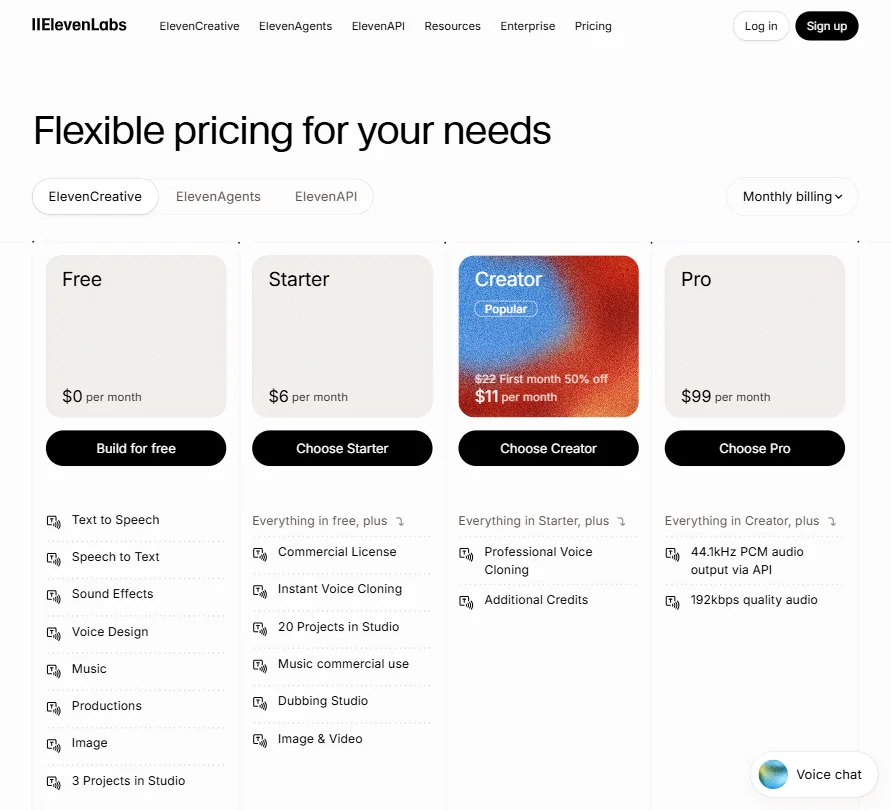
ElevenLabs restructured pricing in November 2025, adding bundled agent minutes to higher tiers. Here's what the tiers actually look like.
Free plan exists. Enough to evaluate output quality, not enough to use it seriously. Starter is $6 a month, and gets you a commercial license and Instant Voice Cloning, which is a reasonable entry for individuals. The Creator plan, currently $11 for the first month then $22, is where Professional Voice Cloning unlocks, along with 20 projects in Studio, Dubbing Studio, and music commercial use rights.
Pro lands at $99 a month. Pro adds 44.1kHz PCM audio output via API and 192kbps quality audio on top of everything in Creator. For studios or agencies producing at volume, that's defensible. For a solo podcaster doing occasional voiceover work, it's probably too much.
Scale runs $299 a month. That gets you 3 workspace seats, team collaboration tools, 3 Professional Voice Clones, and 1.8 million credits per month. Business is $990 a month, 10 seats, 10 Professional Voice Clones, 6 million credits per month, and low-latency TTS as low as 5 cents per minute. Enterprise is custom pricing, and adds HIPAA BAAs, custom SSO, elevated concurrency limits, fully managed dubbing through Productions, and priority support.
One thing we dug into: the refund policy isn't stated anywhere obviously visible. That's not unusual for SaaS, but it came up in Trustpilot reviews often enough to be worth flagging. People who had billing issues didn't always find a clear path to resolution. That needs fixing.
Compared to Murf AI, which targets a similar enterprise audience, ElevenLabs prices similarly at the mid-range but pulls ahead on audio quality. The premium holds up if quality is the deciding factor. For lower production volumes, cheaper tools can get you to good-enough.
We don't buy "affordable" as a descriptor anywhere in this range. But the upper tiers do deliver value proportional to price, which isn't something you can say about every tool in this category.
ElevenLabs vs Murf AI: Which AI Audio Tool Wins?
This comparison comes up constantly in the forums we read.
Murf AI has a cleaner, more polished interface for non-technical users. Built for content teams that want voiceover without technical overhead. ElevenLabs is built for people who want the best audio output available and are willing to navigate more complexity to get it.
On raw voice quality, ElevenLabs wins, consistently, across third-party comparisons and user reviews from 2024 and 2025. Murf produces good voices. ElevenLabs produces voices that regularly fool people who aren't listening for artifacts. That's the gap.
Murf has stronger template structures for teams producing at scale without developer resources. Better integrated into non-developer workflows out of the box. ElevenLabs has the API depth and model sophistication, but expects more from the user in return.
Music generation and conversational agents have no direct equivalent in Murf. If you need those, the comparison ends there.
Worth noting: ElevenLabs also competes with PlayHT and Speechify on the creator side, and with Deepgram on the developer transcription side. Deepgram is a legitimate alternative for teams whose primary use case is speech-to-text at scale. The ElevenLabs transcription layer is newer and not yet the default recommendation for that specific workload alone.
For professional voice production work and developer integrations, ElevenLabs is the stronger tool. That's our read.
Who Should Use ElevenLabs? (And Who Shouldn't)
Developers building voice-enabled products. Clearest fit. The API is thorough, well-documented, and the output quality is high enough to put in front of end users without embarrassment.
Audiobook producers and narrators. The Studio editor and Professional Voice Cloning were built with this use case in mind. The emotional controls in Eleven v3 are particularly useful for long-form narration where monotony is the problem.
Enterprise teams doing multilingual content at scale. Seventy-plus languages, dubbing API, Conversational Agents with Twilio integration, fully managed dubbing at Enterprise tier. That's a real enterprise stack.
Solo podcasters on a budget. Probably not the fit at $99 a month. The free plan and Starter at $6 are worth exploring, but the feature ceiling there is real. There are cheaper tools for occasional voiceover work.
Anyone needing a simple, no-configuration voiceover tool may find ElevenLabs oversized for what they actually use day to day. The power is real. So is the complexity at the higher tiers.
Teams with a hard no on AI-generated voice content for ethical or brand reasons. Not a knock on ElevenLabs. Just not a negotiation the tool can win for you.
ElevenLabs Review Verdict
Based on our research, ElevenLabs is the best AI voice generation platform available right now. Audio quality is the primary reason. The feature breadth, model variety, and API depth all follow from that foundation.
Real problems exist. The Trustpilot score reflects genuine billing and support frustrations. The refund policy needs to be stated somewhere visible. The pricing gap between tiers is steep enough that a meaningful portion of the user base sits on Starter using a fraction of what the platform can do.
The November 2025 pricing restructure helped, but the distance between $6 and $99 is still uncomfortable for mid-level users. A tier in the $30 to $50 range would solve that problem cleanly.
Conversational AI Agents, music generation, speaker diarization in Scribe v2. That's a lot of product for one platform. Whether that's a strength or a focus problem depends entirely on what you actually need from it.
For professional voice production, developer integrations, and enterprise audio workflows, ElevenLabs is the recommendation. Full stop. The competition hasn't caught up to Eleven v3, and the API is as strong as anything in the category. Those things matter more than the friction points, which are real but fixable.
We'd recommend it. With the caveat that you figure out which tier you actually need before you sign up.
Frequently Asked Questions
Does ElevenLabs have a free plan?
Yes. The free plan generates a limited amount of audio per month and lets you test the core text-to-speech output. Enough to evaluate whether the voice quality meets your needs, not designed for ongoing production work. Commercial rights start at the Starter tier, which runs $6 a month.
Is ElevenLabs good for voice cloning?
One of the better options in the category, particularly at the Professional Voice Cloning tier, which requires a Creator plan or above. Instant Voice Cloning on Starter is fast but shallower in quality. Developers and audio professionals on Reddit consistently place ElevenLabs at or near the top for cloning fidelity, though results depend heavily on the quality of the audio you provide as input.
How does ElevenLabs handle multiple languages?
The platform supports 70-plus languages across its model lineup, with Eleven v3 covering 74 specifically. Eleven Multilingual v2 handles the broader language workload. The dubbing tools also support multilingual output, and the Enterprise tier includes fully managed dubbing through the Productions feature. Coverage is genuine, not a checkbox.