Auphonic is an AI audio editor for post-production, applying loudness normalization, filler-word cutting and multitrack levelling to a finished recording automatically.

Fourteen years in, 2M+ users, and headquartered in Graz, Austria. Our research pulls from vendor documentation, G2 reviews, and Reddit threads going back several years. No hands-on testing from our side. What we kept seeing was a tool that generates almost no buzz despite a genuinely large installed base, which usually means it's doing something right for a specific audience and nothing interesting for everyone else.
What is Auphonic?
Auphonic is an automated audio post-production tool. Not an editor. Not a DAW. You upload a file, configure a preset, and AI algorithms handle the cleanup, leveling, and publishing prep. No timeline. No manual EQ knobs.
The pitch has been consistent since 2011. Audio engineers do a lot of repetitive work that doesn't require creative judgment, and the 1-click workflow automates exactly that part, not the interesting part. Podcasters, educators, and corporate trainers show up most in the reviews we aggregated. People recording regularly who don't want to spend an hour in post for every 30-minute episode.
Their own proprietary AI models handle the audio processing. Transcription runs on OpenAI Whisper. That's the architecture.
Auphonic Features: Voice, Music & Audio Capabilities

The audio enhancement layer is where most of the substance lives. Intelligent Leveler handles volume consistency across speakers. AutoEQ adjusts the frequency curve. There's also bandwidth extension, a de-esser, and a de-plosive filter, plus noise reduction covering both static hiss and dynamic noise. Reverb reduction and mic bleed removal are in there too.
On the editing side, filler word cutting and silence removal. Multitrack mixdown is supported, which matters for remote interviews arriving as separate tracks. Chapter markers get set automatically.
Transcription runs on Whisper, so you get 100+ language support. Auto-generated show notes come out of that. Honestly, for a tool that isn't primarily a transcription product, that's a solid bonus.
What it doesn't do: no text-to-speech, no voice cloning, no music generation. Worth knowing before you get deep into a trial.
Batch processing is available on paid plans. The REST API has been around long enough that it's clearly maintained and documented. Watch folders are in there too, for teams running automated ingest pipelines. That's a real workflow feature, not a checkbox item.
Auphonic Audio Quality: How Natural Does It Sound?
Across G2 reviews, the word that keeps coming up is "consistent." Not "amazing." Consistent. Reviewers describe recordings coming out at a predictable loudness level, with background noise handled well on standard home studio setups, USB mics, and conference room captures.
Where it gets complicated: noisier recordings. A few Reddit threads surface complaints about over-processing on tracks with significant background noise. Noise reduction does its job, but can leave artifacts that sound worse than the original hiss in some cases. That's a known tradeoff with any automated noise tool.
Loudness normalization to broadcast standards is where the tool earns real praise. LUFS targets, true peak limiting, the full spec. Users who've moved from manual normalization to Auphonic consistently say they don't go back. That tracks. Tedious task, automated well.
We didn't find many complaints about the leveling itself. The de-esser and de-plosive filters seem to work quietly without being heavy-handed. Harder than it sounds.
Auphonic Voice Cloning & Customization: How Deep Does It Go?
It doesn't. Full stop.
No voice cloning. No custom voice profiles. No TTS output. If you need AI voice generation, you're looking at a different tool entirely. ElevenLabs is the more obvious comparison for that use case.
What Auphonic does offer on the customization side is preset management. Build a preset with your preferred loudness target, output format, and publishing destinations, then apply it to every episode without reconfiguring. That's the version of "customization" this tool is concerned with. Preset-based configuration is the full extent of it. Fine for what it is.
Is Auphonic Easy to Use?
Pretty easy, from what we can tell. Web-only. No mobile app, which a few reviewers flag as an annoyance. The workflow is short: upload audio, pick or build a preset, start processing. Most complexity is hidden inside preset configuration, where you set which algorithms run.
G2 reviewers in educator and podcaster roles consistently say they were up and running quickly. "No audio engineering background required" shows up across multiple reviews in different words. Clearly the intent, and it mostly lands.
The API is a different story. Setting up automated pipelines via the REST API takes real technical effort, and the documentation, while comprehensive, assumes you know what you're doing. Appropriate for an API. But solo creators who saw "API access" on the features list should temper expectations slightly.
We're not concerned about the learning curve for the core web workflow. The automation depth is where it asks more of you.
Auphonic Pricing: Is It Worth It for Creators & Businesses?
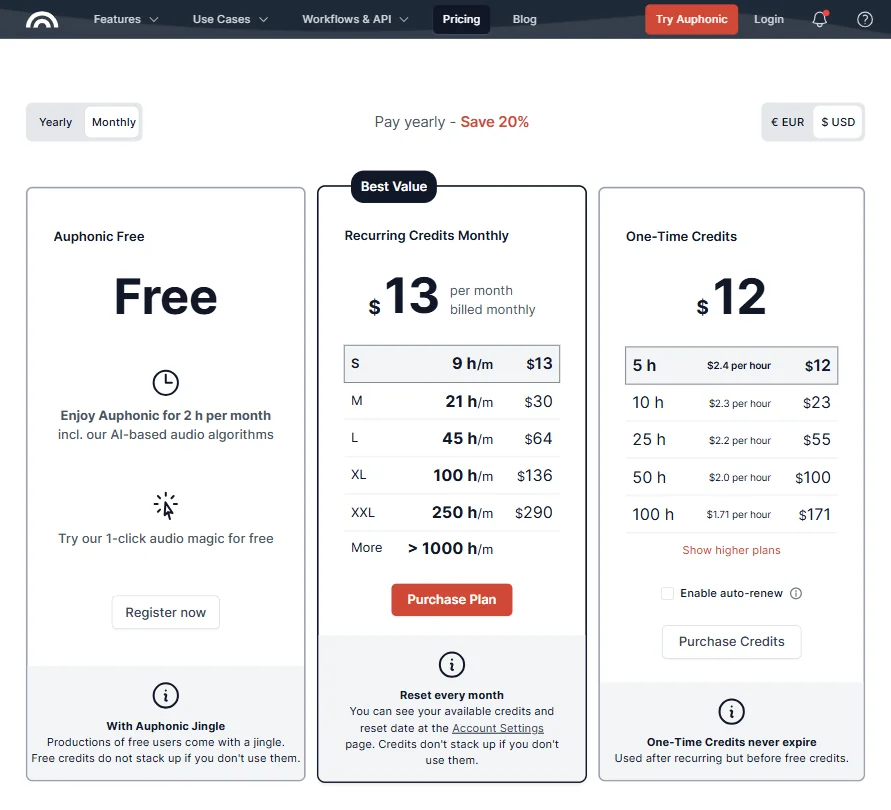
Two hours of processing per month on the free plan. No credit card required. Processed audio includes an Auphonic jingle, which is the trade. Workable for evaluation.
Monthly recurring plans start at $13 per month for the S tier, which gets you 9 hours per month. The M tier runs $30 for 21 hours. Jump to L and you're at $64 for 45 hours, XL at $136 for 100 hours, XXL at $290 for 250 hours. Business-tier pricing applies once you cross 1,000 hours per month on recurring plans. The gap between M and L is steep enough that creators outgrowing the entry tier might find themselves paying nearly double without much in between.
One-time credit purchases are also available. 250 hours runs $320 at $1.28 per hour. Volume pricing steps down from there: 500 hours at $1.09 per hour, 1,000 hours at $1.045 per hour, and 2,000 hours at $1.01 per hour. One-time credits never expire, which is genuinely useful for irregular production schedules. Purchases above 3,000 hours on the one-time credit side fall into Business territory. There's an auto-renew option you can enable on the one-time side, though it's opt-in.
The refund policy isn't publicly stated anywhere we could find. Frustrating. Not unusual for this category, but still frustrating.
For the S recurring plan, the math is defensible. For anything above L, we'd want to be doing serious volume or leaning heavily on batch processing before committing.
Auphonic vs Adobe Podcast: Which AI Audio Tool Wins?
Adobe Podcast is the comparison that surfaces most often. Both tools target non-engineers who want cleaner audio with minimal effort.
Adobe Podcast sits inside the Adobe ecosystem. Advantage if you're already there, irrelevant if you're not. Its voice enhancement is strong and the web tool is free. Auphonic's edge is depth, specifically multitrack support, batch processing, and direct publishing integrations to platforms like Libsyn, PodBean, and RSS.com. Adobe Podcast doesn't publish to your feed. Auphonic does. That's a real difference.
For a solo podcaster recording mono tracks who wants simple cleanup, Adobe Podcast is probably the faster path. For a producer handling multi-guest episodes and pushing to multiple destinations, Auphonic does more of the final mile. Genuinely different tools solving adjacent problems.
Neither is clearly better. We'd lean toward Auphonic for anyone with a regular production schedule and multiple steps after the recording session.
Who Should Use Auphonic? (And Who Shouldn't)
Regular podcasters running weekly or more. That's the core fit. The preset-and-forget workflow was built around exactly that use case.
Educators and corporate trainers recording course content show up heavily in reviews. Long-form spoken audio that needs to sound professional without a production team behind it.
Developers building media automation pipelines will find the REST API worth the investment.
Who shouldn't bother. Anyone whose primary need is voice generation or cloning. Auphonic processes what you record, it doesn't create voices. Musicians looking for production tools will find it limited. And highly occasional, one-off recording needs don't benefit from the pricing structure the way a per-minute tool might. Sonix is worth a look for users whose primary need is transcription volume rather than audio cleanup.
Auphonic Review Verdict
Fourteen years doing one thing. Automated audio post-production for spoken word content: noise removal, leveling, loudness normalization, multitrack processing, and publishing in a single configured workflow.
What it won't do is expand much beyond that. No mobile app. No voice cloning. No music tools. The feature set is deliberately narrow, and whether that reads as a limitation or a design choice depends entirely on what you need.
The free tier is genuinely useful for evaluation. The S recurring plan at $13 per month is reasonable for light production volume. Above L is where we'd run the math carefully before committing. The one-time credit option, with credits that never expire, is a genuinely smart addition for irregular producers, and we don't see that often. The missing refund policy is a small annoyance the company could fix easily.
From everything we've read, the tool works reliably for its intended use. A 2M+ user count across 14 years isn't built on hype. It's built on a workflow that a certain kind of creator finds useful and keeps coming back to. Harder to fake than a flashy feature list.
We're positive on Auphonic for its target audience. Not without reservations, but positive.
Frequently Asked Questions
Does Auphonic have a free plan?
Yes. Two hours of processing per month, no credit card required. Processed audio includes an Auphonic jingle, which is the trade-off for free access. Enough to evaluate the core workflow before committing to a paid plan.
Does Auphonic support languages other than English?
Yes, and quite broadly. Transcription runs on OpenAI Whisper, which covers 100+ languages for speech recognition. The audio processing algorithms work on any spoken language since they're analyzing audio signal rather than linguistic content.
Is Auphonic good for podcasters specifically?
It's probably the most podcast-specific tool in its category. Direct publishing integrations to Libsyn, PodBean, and RSS.com are built in. The preset system was clearly designed around weekly episode production, and multitrack support for interview formats rounds out the workflow reasonably well.