Our research on AssemblyAI started with their API docs and spread into G2 reviews, Reddit threads, and developer forums where people talk about what actually breaks. Not a hands-on test. What we're pulling together is what the public record looks like when you aggregate it honestly. The picture is genuinely impressive. Not without caveats, but impressive.
AssemblyAI was founded in 2017 and headquartered in San Francisco. They've been quietly building toward something bigger than transcription for a while now. The latest signal is the Universal-3.5 Pro model, launched with native code-switching across 18 languages. That's a real production differentiator. We'll get there.
What is AssemblyAI?
Not a consumer app. That's the first thing to understand. There's no dashboard where you drag in an audio file and download a transcript. AssemblyAI is API-first, and everything is built around that assumption.
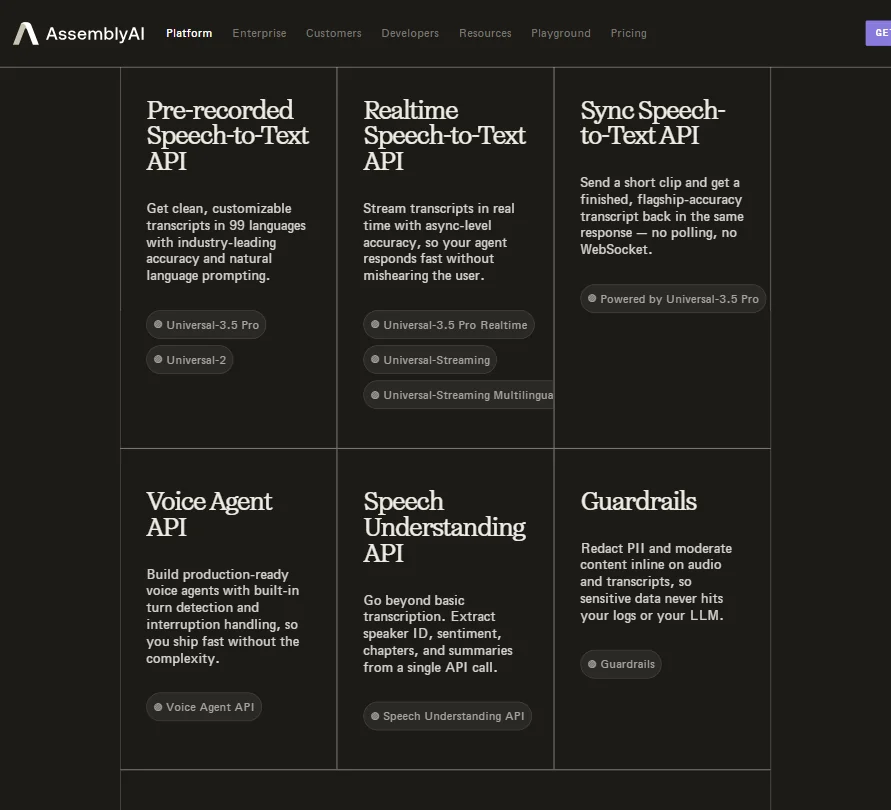
What they've built is a voice AI platform with transcription at the center and a growing set of tools around it. The Speech-to-Text API covers both pre-recorded audio and real-time streaming. Around that, they've layered speaker diarization, sentiment analysis, topic detection, and PII redaction. There's also a Voice Agent API now, plus an LLM gateway that lets you route to models like GPT or Claude from within the same pipeline. That's a lot of surface area for a single API.
The target user is a developer or engineering team building something. A transcription service. A voice agent. A call analytics tool. That tracks with every forum thread and review we read. The use cases were consistently technical, without exception.
Worth noting: they have a Medical Mode too, which suggests a deliberate push into healthcare buyers. We didn't find much user feedback specific to that feature, but it's in the docs and the product positioning.
AssemblyAI Features: Voice, Music & Audio Capabilities
No text-to-speech. No voice cloning. No music generation. Those are the immediate boundaries. AssemblyAI is firmly on the "speech in, understanding out" side of the AI audio space. Full stop.
What they offer within that lane is dense. The pre-recorded transcription API handles 99 languages via Universal-2. Universal-3.5 Pro adds real-time streaming with native code-switching across 18 supported languages. That code-switching feature is genuinely rare. Most competitors handle multilingual audio by picking a dominant language and hoping for the best. AssemblyAI can handle mid-sentence switches without losing the thread. Honestly, that surprised us when we dug into the docs.
Speaker diarization is included, separating and labeling different voices in a recording. Useful for call centers and meeting transcription tools. PII redaction lets developers strip sensitive information before it hits storage or downstream systems. Custom vocabulary support lets you weight the model toward domain-specific terms.
Batch processing is supported. The free tier gives you 185 hours of pre-recorded audio and 333 hours of streaming, no credit card required. That's a serious free tier by any standard in this category.
The LLM gateway is newer and worth watching. It positions AssemblyAI as the audio input layer while you route to your preferred language model for reasoning. Fewer vendors to manage. That's a real operational argument for teams that have dealt with multi-vendor audio pipelines.
AssemblyAI Audio Quality: How Natural Does It Sound?
"Natural" is the wrong frame. AssemblyAI doesn't generate audio. It reads it.
The quality question for a transcription API is accuracy. On that front, user reports are consistently favorable. Across G2 reviews and Reddit threads from 2025, we kept seeing accuracy holding up in noisy environments, with heavy accents, in technical domains. That's where a lot of competitors fall apart.
Developers building on OpenAI Whisper sometimes switch to AssemblyAI specifically because of accuracy differences in difficult real-world audio conditions. Not because Whisper is bad. Because AssemblyAI's Universal models appear tuned for harder inputs. We can't verify that without a head-to-head test, but the pattern in user feedback is consistent enough to take seriously.
Real-time latency is where Universal-3.5 Pro pulls ahead further. A real-time factor of 0.008x means the model processes audio roughly 125 times faster than playback speed. For live voice applications, that gap between what's spoken and what's transcribed is the whole game.
AssemblyAI Voice Cloning & Customization: How Deep Does It Go?
It doesn't. No voice cloning here.
AssemblyAI doesn't generate speech, so the cloning question is a non-starter. If that's what you're after, ElevenLabs is built specifically for that use case. Different product entirely.
What AssemblyAI offers on customization is custom vocabulary. You can feed the API a list of terms, proper nouns, or domain-specific words that the model should weight more heavily. For medical or legal products, that matters. It's not glamorous, but it's the kind of thing that separates a usable transcription integration from a frustrating one.
Beyond that, customization is mostly about how you configure the API call. Speaker labels, timestamps, confidence scores, formatting options. The surface is rich for developers. It's just not "customization" in any creative AI sense. Fair.
Is AssemblyAI Easy to Use?
Depends entirely on who's asking.
For a developer with API experience, onboarding is fast. The docs are comprehensive. SDKs exist for Python and a handful of other languages. No credit card friction on the free tier. G2 reviewers who flagged ease of use positively were almost always developers. That pattern held consistently across everything we read.
For a non-technical user, AssemblyAI offers basically no path in. No consumer interface, no drag-and-drop, no desktop app, no mobile app. Nothing. Solo podcasters or journalists looking to transcribe interviews without writing code should look elsewhere. This tool isn't built for them, and it doesn't pretend to be.
Support is a bot for live chat with email behind it. The help center is solid. There's a community presence on Reddit. Enterprise buyers get custom arrangements, presumably including more direct support channels. For indie developers or early-stage startups, that setup is probably fine. For larger teams with hard production dependencies, we'd ask about SLAs explicitly before committing.
One friction point that surfaced in a few Reddit threads: error handling around unusual audio formats. Not a showstopper, but worth knowing before you build around it.
AssemblyAI Pricing: Is It Worth It for Creators & Businesses?

Pay-as-you-go structure. No seat licenses. No feature tiers hiding core functionality behind a premium wall. That's developer-friendly by design.
Universal-2 runs at $0.15 per hour of audio. Universal-3.5 Pro is $0.21 per hour. Enterprise pricing is custom and not public. The free tier is the most generous we've seen in the category. 185 hours of pre-recorded audio and 333 hours of streaming, no credit card required. That's enough compute to build and validate a serious integration before spending anything.
At $0.21 per hour for the Pro model, the math stays manageable for most workloads. Processing a thousand hours a month runs you $210. For a product that's monetizing transcription, that's a reasonable input cost. For heavy call analytics operations, it compounds faster, but that's an enterprise conversation with custom rates anyway.
No public refund policy. Not unusual for API-first companies, but worth knowing. Prepaid credits are typically non-refundable across the industry, and AssemblyAI doesn't publicly break from that pattern.
No concurrency limits and automatic scaling are both listed as explicit features. For teams that have burned through Deepgram or Amazon Transcribe rate limits during traffic spikes, that claim is worth testing in your own environment. We've seen those promises not survive production in other tools. We're cautiously skeptical until we see it stress-tested.
AssemblyAI vs Deepgram: Which AI Audio Tool Wins?
Closest competitor in the actual market. Both are API-first. Both target developers. Both do real-time and pre-recorded transcription.
Deepgram has a well-established reputation for latency and voice AI infrastructure. AssemblyAI is competing directly with that, and Universal-3.5 Pro looks like their primary argument in that fight.
Where AssemblyAI pulls ahead, based on what we cross-referenced across user reports and docs: the Audio Intelligence layer is meaningfully broader. Sentiment analysis, topic detection, and entity recognition are built into the same API rather than requiring a separate pipeline or a different vendor. Deepgram focuses more narrowly on transcription speed and accuracy. AssemblyAI is trying to be the full understanding layer, not just the words-to-text step. That's a real architectural difference for product teams.
Pricing is close. At $0.21 per hour, Universal-3.5 Pro is competitive but not dramatically cheaper than Deepgram's comparable tiers. The decision usually comes down to which features your product actually needs. Raw transcription speed only, Deepgram is a real option. Diarization, sentiment, and entity detection without stitching together multiple APIs, AssemblyAI is the cleaner build.
Google Speech-to-Text and Amazon Transcribe carry the infrastructure trust that comes with cloud giants and integrate naturally into their respective stacks. AssemblyAI's counter-argument is accuracy and the intelligence layer. We think that argument holds, particularly for teams not already locked into a cloud ecosystem.
OpenAI Whisper is a separate case. Open-source, free to self-host, different cost conversation entirely. But running Whisper at scale requires real infrastructure investment. AssemblyAI abstracts that away entirely.
Who Should Use AssemblyAI? (And Who Shouldn't)
Developers building voice-dependent products. That's the core fit.
Engineering teams whose products ingest audio and need to produce something useful from it, call summaries, meeting notes, real-time captions, or voice agent responses, should evaluate this seriously. The free tier means you can run that evaluation without a procurement conversation first.
Enterprises building speech-to-text into their own products, especially in healthcare or legal contexts. The Medical Mode and PII redaction suggest AssemblyAI is actively trying to support regulated industries. Worth a closer look there.
Startups in voice AI who don't want to manage transcription infrastructure themselves. The no-concurrency-limit claim and automatic scaling matter when you're expecting variable or unpredictable traffic.
Not the fit: anyone who needs a consumer-facing tool. Content creators, journalists, podcasters without engineering support. Nothing here is built for that. Not even close.
Also not the fit: teams whose primary need is text-to-speech. Completely different product category.
AssemblyAI Review Verdict
AssemblyAI is doing something specific and doing it well. Not trying to be an all-in-one audio platform. Trying to be the best speech understanding API on the market. Based on what we've gathered across user reviews, developer forums, and their own documentation, they're making a credible case for that.
The accuracy reputation is real. The free tier is genuinely good. The Audio Intelligence features sit in the same API as the transcription, which saves teams real integration work. And Universal-3.5 Pro's native code-switching across 18 languages is a capability most competitors simply don't have at that depth.
The things that limit the picture are mostly category constraints rather than product failures. No text-to-speech means a significant chunk of the audio AI market isn't their customer. No consumer interface means the developer dependency is permanent. The refund policy gap is minor but worth flagging before you load credits.
If audio is part of your stack and you're building something real, AssemblyAI belongs on the shortlist. Start with the free tier. 185 hours of pre-recorded and 333 hours of streaming is enough runway to know if it fits.
Frequently Asked Questions
Does AssemblyAI have a free plan?
Yes. The free tier includes 185 hours of pre-recorded transcription and 333 hours of streaming, and no credit card is required to access it. That's a meaningful amount of compute to build and test an integration before committing to anything. Most competitors don't come close to that volume on a free tier.
What languages does AssemblyAI support?
Universal-2 covers 99 languages. Universal-3.5 Pro narrows the supported set to 18 but adds native code-switching, meaning it handles audio where speakers switch languages mid-conversation without falling apart. For multilingual products, the code-switching capability is the more interesting number, not the raw language count.
Is AssemblyAI good for non-developers?
Bluntly, no. No consumer interface, no mobile app, no GUI of any kind. Everything runs through the API. Non-technical users who need transcription would be better served by a tool with a proper interface built on top of something like this. AssemblyAI itself is the something underneath, not the finished product a non-developer reaches for.