Founded in 2023 out of San Francisco, Bland is younger than most of the tools we cover in this category. We expected competent but unremarkable. After cross-referencing their documentation with developer discussions on Reddit and pulling apart their pricing structure, what we kept seeing was a company that had made a deliberate structural bet, one that most competitors haven't made, on infrastructure ownership and predictable per-minute billing. Whether that bet actually holds up is the real question.
What is Bland?
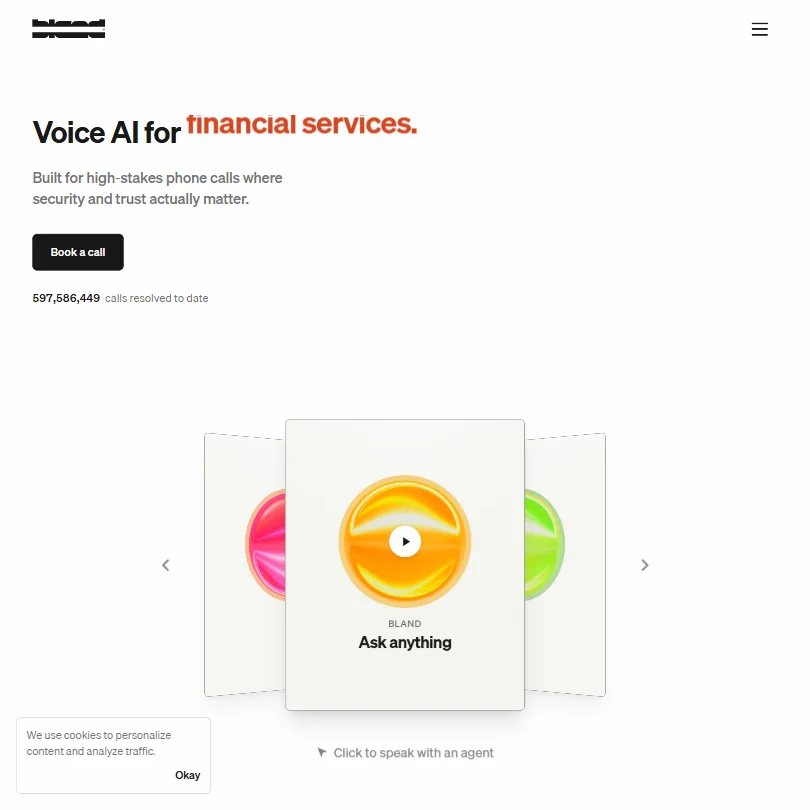
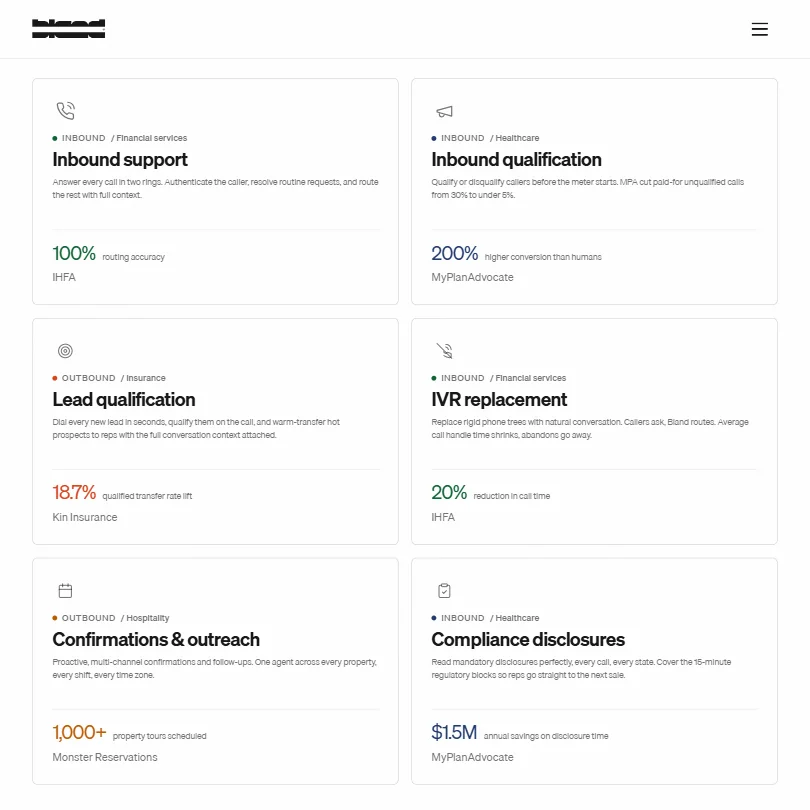
Phone agents. Not voiceover tools, not podcast editors. The kind of agents that handle inbound insurance claims or dial thousands of patients for appointment reminders. The target is explicitly regulated industries, healthcare, financial services, insurance, logistics, and the product is built around that focus rather than around general-purpose voice AI.
Their headline claim is that every model runs on their own infrastructure. No OpenAI pass-throughs, no third-party TTS calls hidden inside the invoice. The per-minute rate you see covers the language model, transcription, and voice synthesis together, which is genuinely unusual. Most competitors in this space stack those costs separately. You find out at billing.
Web and API only. No mobile app. Built for developers and enterprise teams. That's the honest fit, and they don't pretend otherwise.
Bland Features: Voice, Music & Audio Capabilities
No music generation. No podcast editing. Noise removal isn't mentioned in their documentation anywhere. Bland makes and receives phone calls, transcribes them in real time, and talks back in something that doesn't sound like a 2019 IVR system. That's the scope, intentionally.
The voice side runs on their proprietary Bland Speech v3 model, with preset voice libraries that scale by plan and voice cloning locked to Enterprise with a custom voice actor arrangement. That's not unusual for enterprise tooling, but worth knowing before you get deep into evaluation.
The omnichannel angle shows up in their docs too. Voice, SMS, iMessage, and web chat can all run through the same agent with what they call unified memory across channels. We haven't tested that in production. User reports on how well context actually carries across a channel switch are sparse, so we're treating it as an interesting claim rather than a verified capability for now.
Batch processing is real and well-documented. Outbound campaigns at scale, thousands of concurrent calls. That part isn't marketing copy, it shows up consistently in developer discussions on Reddit. Honestly, that's the feature most enterprise buyers are actually here for.
Bland Audio Quality: How Natural Does It Sound?
Bland isn't listed on G2 or Capterra. That's a gap. It means our read on audio quality relies more heavily on Reddit threads and developer forums than we'd prefer, and we're going to be upfront about that.
What we kept seeing in those threads: the voice model performs well for phone-quality audio. Lower bar than studio TTS, and Bland knows it. Phone calls compress audio. The target is clarity and naturalness at 8 to 16kHz, not broadcast fidelity. By that standard, feedback leans positive. Developers building healthcare appointment reminders and insurance claim workflows describe the output as "not jarring," which in this context is genuinely high praise.
The bigger concern we kept running into was latency. Conversational AI lives or dies on response delay. Several Reddit threads from 2024 flagged noticeable lag in complex conversation flows. Bland's documentation talks about dedicated infrastructure as a reliability feature, but latency under load is a separate problem from infrastructure ownership. We'd want to see it addressed more directly before recommending Bland for high-stakes calls where hesitation reads as a system failure.
We're skeptical of any vendor claim about voice naturalness without independent testing. The v3 model is new enough that the track record is thin. Fair caveat.
Bland Voice Cloning & Customization: How Deep Does It Go?
Voice cloning exists on Enterprise. Custom voice actor. That's the full description in their docs, with no further specifics about process, turnaround, or what "custom voice actor" actually means operationally. Not great.
Below Enterprise, you're working from the preset library. Scale gives you up to 15 voices. That's a reasonable selection, not an expansive one. If voice cloning is a core requirement and Enterprise pricing isn't realistic, ElevenLabs offers that capability at significantly lower plan tiers.
The 40-plus language support is documented and appears to be real. Genuine advantage for global deployments. We didn't find detailed reports on non-English call quality specifically, so treat "40+ languages" as a starting point for your own testing rather than a performance guarantee across all of them.
Is Bland Easy to Use?
Depends entirely on who's asking. For developers, the API is well-documented and the integration list covers the telephony and CRM stack most enterprise teams already run, including Twilio, Salesforce, HubSpot, and a few others. Broad enough for most production environments.
They've also built something called "Norm," a natural language agent builder where you describe what you want and the system drafts the agent. Low-code entry point, interesting approach. We haven't found substantial user reports on how Norm actually performs, which tells us either it's new or it's not being used heavily yet. Could be both.
The testing environment looks genuinely useful, running scenarios against an agent before it goes live, flagging failures, tracking reruns. That's the QA tooling enterprise buyers actually need, and most competitors underinvest in it. That tracks with Bland's regulated-industry focus.
Non-technical users without developer support. They'd struggle here. This isn't a point-and-click call center tool, and that's not a criticism.
Bland Pricing: Is It Worth It for Creators & Businesses?
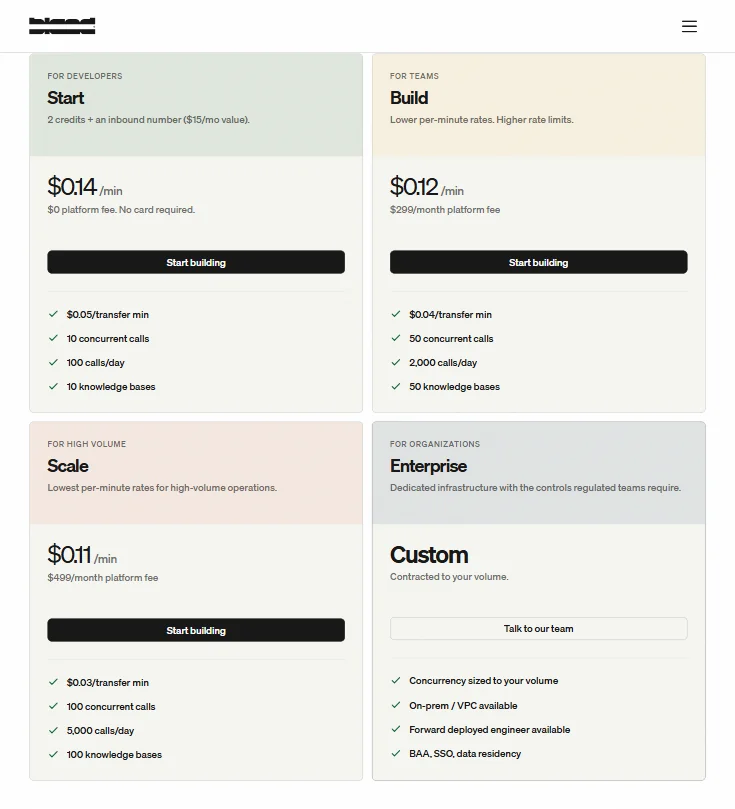
Three public tiers. Start at $0.14 per minute with no platform fee and no card required, including 2 credits and an inbound number. Build at $0.12 per minute plus $299 a month. Scale at $0.11 per minute plus $499 a month, with 100 concurrent calls, 5,000 calls per day, and 100 knowledge bases. Enterprise is custom, with dedicated infrastructure and contracted volume.
The concurrent call limits are worth flagging directly. Start caps at 10 concurrent calls and 100 calls per day. Build raises that to 50 concurrent and 2,000 per day. Those aren't numbers you want to discover mid-campaign.
For teams running meaningful call volume, the all-in per-minute rate is competitive once you factor in that STT and LLM costs aren't billed separately. That's the actual pricing argument, not the headline rate in isolation.
The Start plan is enough to build and test an agent but not enough to evaluate production performance at any real volume. Two credits gets you oriented. It doesn't get you a real read on latency or voice quality under load. Fair on-ramp, nothing more.
Refund policy isn't publicly stated anywhere we could find. Annoying. Worth asking about directly before committing to a plan.
Bland vs Vapi: Which AI Audio Tool Wins?
Vapi is the most direct comparison. Both are API-first AI phone agent platforms aimed at developers. Both charge per minute. Both target business automation.
The infrastructure argument is where Bland pushes hardest. Vapi routes through third-party model providers. Bland claims everything runs in-house. Both Bland and Vapi support SOC 2, HIPAA, and PCI workloads, although their implementation and pricing differ. Vapi lists HIPAA as a $2,000 per month add-on on their pricing page. Bland folds compliance into their Enterprise tier without publishing a specific add-on cost. For a team in healthcare or financial services where the question "where does our call data go?" has a legal answer, those differences in structure matter more than the per-minute rate.
Vapi shows up in developer communities with more user-generated tutorials and third-party integrations at this point. Bland is newer and the community is smaller. Building something fast without regulated data, Vapi's existing ecosystem might be more useful day-to-day. Strict compliance requirements, Bland has a real argument.
Retell AI and Synthflow also run in this space. None of them have a materially different pricing structure. The differentiation always comes back to compliance posture and model stability. That's where Bland is placing its bet.
Who Should Use Bland? (And Who Shouldn't)
Enterprise teams in regulated industries. Healthcare systems automating patient outreach, insurance companies routing claims calls, financial services firms handling customer service at volume. Bland was built for those environments and the compliance documentation reflects it.
Developer teams building custom voice agent pipelines. They'll find the API solid and the integration options wide enough for most production stacks.
Solo operators or small teams without developer resources. Look elsewhere. Norm is unproven enough that we wouldn't stake a small business workflow on it yet. Teams that need straightforward transcription or TTS rather than interactive agents, AssemblyAI covers that side with a developer-friendly API that's better documented for those specific use cases.
Anyone price-sensitive and running low call volume should model out the math carefully. At $0.14 per minute on Start, a hundred hours of call time runs to $840. That adds up faster than a flat subscription at comparable usage levels.
Bland Review Verdict
The all-in per-minute pricing that bundles the language model with transcription and synthesis is a legitimate structural advantage. Real. The compliance stack covering SOC 2, HIPAA, and PCI DSS is a genuine differentiator for regulated buyers, even accounting for the fact that Vapi now covers similar ground at a different price structure.
What's missing is a review record. No G2 listing, no Capterra page, minimal Trustpilot presence. For a company founded in 2023 making claims about enterprise-grade reliability, that's a gap we kept coming back to. The evidence base is thinner than we'd want for a tool at this price point, and the latency questions from 2024 Reddit threads haven't been publicly addressed.
The voice cloning story is Enterprise-only and light on detail. The refund policy is silent. None of that is fatal.
Bland is a young company with a coherent focus and a pricing model that makes sense for the use case it's targeting. For enterprise teams that need what it specifically offers, it earns a serious look. For everyone else, the case isn't there yet.
Frequently Asked Questions
Does Bland work without a developer?
Not comfortably. Bland is primarily API-first, and most documented use cases assume someone technical is doing the setup. Their Norm natural-language agent builder is designed as a lower-friction entry point, but user reports on how well it actually works in practice are sparse enough that we wouldn't rely on it for anything business-critical without a developer in the loop.
Is Bland HIPAA compliant?
Yes, according to their documentation. Bland holds SOC 2, HIPAA, and PCI DSS compliance, and their pitch to healthcare teams specifically rests on the claim that call data stays on their own infrastructure rather than passing through third-party model providers. Meaningful claim for regulated buyers. We'd still recommend confirming it directly with their enterprise team and getting a BAA in writing before going live with any protected health information.
How does Bland's pricing compare to Vapi?
Both charge per minute. Bland's Start tier runs $0.14 per minute with no platform fee. Vapi's pricing is similarly structured but varies by model and add-ons, including HIPAA compliance as a $2,000 per month add-on if that's a requirement. The more important difference isn't the headline rate. Bland bundles the language model, speech-to-text, and text-to-speech into that single per-minute figure, while Vapi's costs can stack depending on which third-party providers you're routing through. Run your expected call volume through both calculators before deciding.