What is Notevibes?
Browser-based. No mobile app. Notevibes positions itself as a full audio production environment, not just a voice generator you copy results out of. The core offer is 550+ neural AI voices across 72 languages, with emotion control being the actual differentiator rather than a checkbox feature. Most text-to-speech tools hand you a speed slider and a pitch dial and call it customization. Notevibes adds 80+ emotion tags and 44 tone modifiers on top of that.
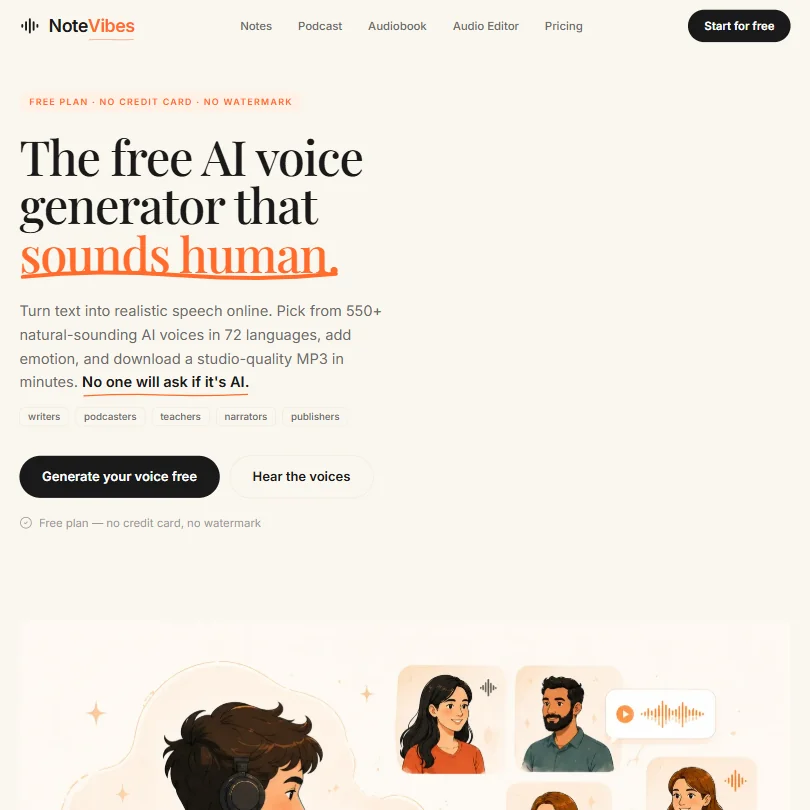
The platform also handles podcast creation through a multi-host mode, pulls in AI-generated music, and can transcribe audio. File imports work with PDFs, DOCX, and EPUB, among others. Exports go out as MP3, WAV, or OGG. The idea is one editor for the whole workflow.
Who built it? Unknown. Where are they based? Also unknown. We flagged that. It doesn't necessarily break the product, but it does affect how much trust you extend before handing over payment details.
Notevibes Features: Voice, Music & Audio Capabilities

The voice side is where Notevibes earns its keep. Eighteen voice styles, 80+ emotion tags, and 44 tone modifiers add up to more granular control than most tools at this price point will give you. Multi-host podcast mode with 12+ presets is something we don't see consistently across this category. Murf AI and ElevenLabs both support multi-voice content, but neither orientates a preset workflow specifically around podcast formats the way Notevibes does.
The AI music generation surprised us. Up to 6,000 songs on the Pro plan. Honestly, that's a lot. Tools in this category rarely touch music generation at all. Whether the quality holds across that volume is something we couldn't verify from review data alone.
Transcription is bundled into paid plans. Worth knowing. API access is not mentioned anywhere we looked, and neither is voice cloning. Those are real gaps, not minor omissions.
Notevibes Audio Quality: How Natural Does It Sound?
Across what we read on G2, Capterra, and scattered Reddit threads, quality lands as competitive for the price. Several reviewers called out the emotional range specifically, noting it felt more usable than generic TTS output. Notevibes pulls from Google and Microsoft neural voices alongside its own, which gives the library breadth without relying entirely on proprietary models. Reviewers in education and content creation flagged naturalness as a genuine strength, not just acceptable output.
That said. We're skeptical of any TTS library claiming 550+ voices without being transparent about how many are actually good. Libraries this size almost always have a handful of excellent voices and a long tail of filler. That tracks with the feedback patterns we saw.
Not bad. Not flawless.
Notevibes Voice Cloning & Customization: How Deep Does It Go?
Awkward section to write. Voice cloning isn't mentioned on their pricing page or in any feature documentation we could find, which is a meaningful omission in 2024. ElevenLabs has made cloning a baseline expectation for the category, and Notevibes simply doesn't compete there.
What it does offer is customization at the style and emotion layer. Pitch control, speed control, emphasis tags, and SSML support. For adjusting pre-built voices, that's a solid toolkit. Fine for narration work where you're shaping an existing voice rather than replicating a specific one. But brand consistency through a cloned voice? Not here. At least not yet.
Is Notevibes Easy to Use?
The web editor handles text-to-speech, podcast assembly, and music within one interface. That's a lot to hold together. Reviews suggest it's manageable, though a few users mentioned the learning curve when switching between modes. Makes sense.
SSML support is there for people who want surgical control over output. For beginners, the emotion tags and style presets are the more accessible entry point, and the free plan requires no credit card, which removes enough friction to actually try it before committing. That's the right call on their part.
No mobile app. If you're working across devices, plan around that.
Notevibes Pricing: Is It Worth It for Creators & Businesses?
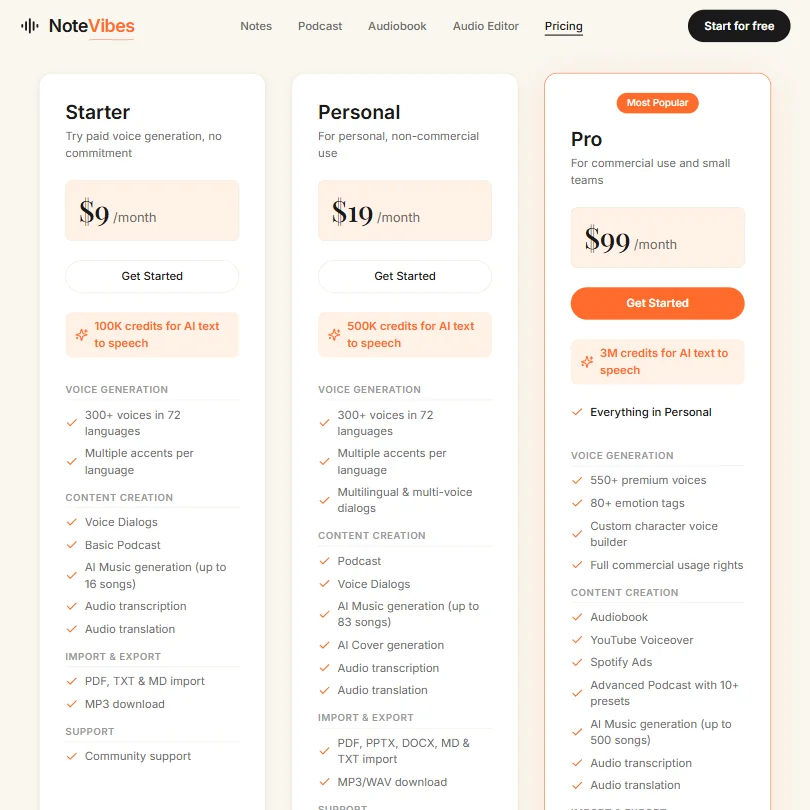
Three tiers. Starter at $8 per month billed annually. Personal at $15.83 per month. Pro at $82.50 per month. No enterprise option listed publicly. The refund policy isn't stated anywhere we could locate, which we don't love.
Commercial usage rights are locked to the Pro plan at $82.50 per month. If you're producing content for clients or selling voiceover deliverables, that's your floor. It's a real jump from the mid-tier Personal plan. Not unreasonable compared to Murf AI's commercial licensing structure, but not trivial either. Anyone budgeting for a small narration side project needs to model that before they commit.
The free plan gives limited credits with no watermark. More generous than most.
Notevibes vs ElevenLabs: Which AI Audio Tool Wins?
ElevenLabs wins on voice cloning. Not close. If replicating a specific voice is the job, ElevenLabs is the answer and Notevibes isn't really in the conversation.
Where Notevibes holds its own is breadth. Seventy-two languages against ElevenLabs' more selective offering. The podcast mode and AI music generation have no real equivalent in ElevenLabs' core product. For someone building a complete audio production workflow without a cloning requirement, Notevibes makes a reasonable case. ElevenLabs is the sharper, more focused tool. Notevibes is the wider one.
Pricing matters here too. ElevenLabs Pro runs $99 per month, or $82.50 per month on annual billing, which puts it at the same monthly equivalent as Notevibes Pro. At that price parity, ElevenLabs' cloning capability becomes a harder thing to argue around. We don't buy the "Notevibes is just cheaper" framing at the Pro level.
Who Should Use Notevibes? (And Who Shouldn't)
Podcasters and audiobook producers. Clearest fit. The multi-host mode and emotion controls serve that workflow directly, and the review patterns back that up consistently.
Teachers and e-learning creators building narrated courses also show up in the feedback with enough regularity to take seriously. That makes sense given the language breadth and the emotion toolkit.
Developers wanting an API to build products on top of. Wrong tool. Voice cloning specialists. Also wrong tool. Solo creators who need a capable all-in-one audio studio without stitching together multiple platforms will find most of what they need here, as long as cloning and integration hooks aren't on the requirements list.
Notevibes Review Verdict
More capable than you'd guess from the price. The emotional voice controls are real, not marketing language dressed up as features. The podcast mode is a genuine differentiator. AI music generation at this tier is almost unexpected.
The gaps aren't small, though. No voice cloning. No API. No mobile app. No enterprise tier. Refund policy invisible. For independent creators who want a serious audio workflow without paying enterprise prices, Notevibes is worth a real look. For anyone who needs cloning or integration hooks, those gaps will surface fast.
We've seen worse tools asking for more money. That's not a glowing endorsement. It's accurate.
Frequently Asked Questions
Does Notevibes offer a free plan?
Yes. No credit card required and no watermark on output. Credits are limited, but there's enough there to evaluate whether the voice quality meets your needs before spending anything.
Can I use Notevibes for commercial projects?
Commercial rights are only included on the Pro plan at $82.50 per month billed annually. Starter and Personal plans don't cover commercial usage. Factor that in before choosing a tier, especially if you're producing for clients or selling finished audio.
Does Notevibes support voice cloning?
Not that we could find. Nothing on their pricing page or in their documentation mentions it. The platform focuses on customizing its existing voice library through emotion controls and style presets. If cloning is a hard requirement, this isn't the right tool right now.