

The picture is mostly good. Not without caveats.
What is Metricool?
Founded in 2016 out of Madrid, Metricool has built something that a lot of tools promise and few actually deliver: a single dashboard covering scheduling, analytics, ads management, and reporting without forcing you to stitch together three separate subscriptions.
The pitch lands squarely at agencies and social media managers running more than one brand. It also works for smaller businesses that want something more capable than Buffer but can't justify Hootsuite's pricing. The free tier is genuinely usable. One brand, 20 posts a month, 30 days of analytics history, and five competitor profiles. Most free tiers in this category are bait. This one isn't.
Metricool Features: Scheduling, AI Content & Analytics
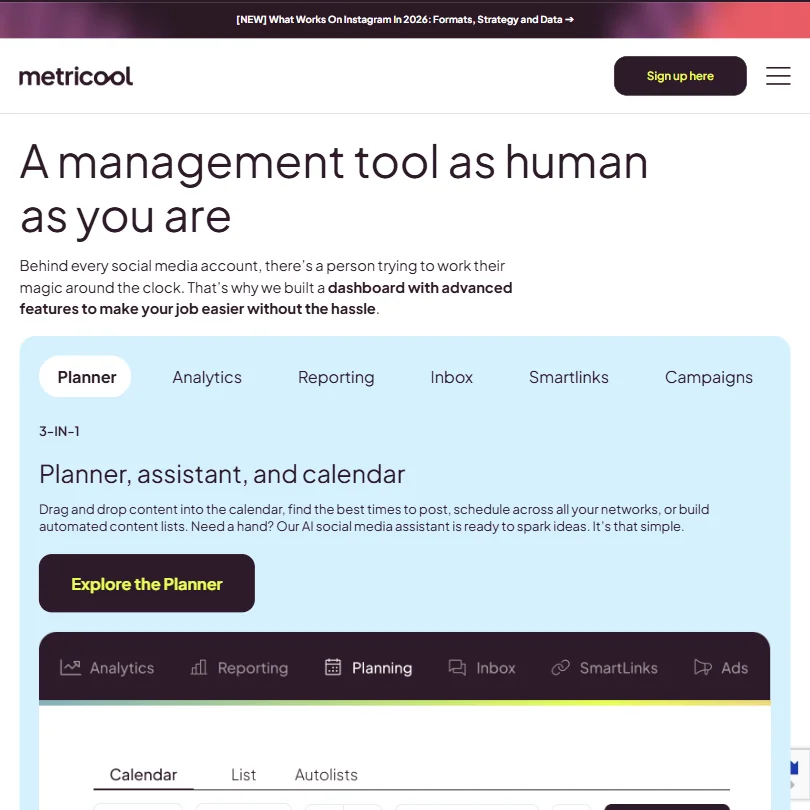
The core product covers a lot of ground. Scheduling, analytics, ads management, and link-in-bio all live under one roof, which is the actual differentiator here, not any single feature in isolation.
The content calendar is drag-and-drop with per-platform preview. You can see roughly how a post will render on a given network before it goes out. Bulk scheduling comes through Autolists, which is Metricool's term for recurring content queues. You drop posts into a list, set a frequency, the tool handles rotation. Not glamorous. Works well, from what we've read.
The ads side deserves a separate mention. Facebook Ads, Google Ads, and TikTok Ads all pull into the same dashboard. Most scheduling tools ignore this entirely. Metricool includes it on lower-tier paid plans, which is a meaningful separation from competitors like Buffer and Later.
Competitor tracking goes up to 100 profiles on Starter and above. Five on the free plan. The Hashtag Tracker, which Metricool says monitors Instagram and X activity in real time, is a distinct product from the basic hashtag finder. Worth knowing before you assume they're the same thing. Metricool says the Tracker collects data in real time, although that claim hasn't been independently audited. We'd treat it as a vendor assertion until someone does a proper comparison.
Automated reporting is available across paid tiers. PDF and PowerPoint exports come in at Starter. The Looker Studio connector appears on Advanced. For agencies doing weekly client reporting, that matters considerably.
Metricool Platform Support: Which Networks Does It Cover?
The network list runs long. Facebook and Instagram are obvious starting points. Then LinkedIn, Pinterest, YouTube, TikTok, and Twitter/X. Beyond that: Threads, Bluesky, Twitch, and Google Business Profile.
That's more coverage than most tools at this price. Bluesky and Threads in particular are areas competitors are still catching up on. Honestly, the Twitch integration surprised us. It makes Metricool relevant for a creator type that most scheduling tools completely ignore.
Google Business Profile is a quiet win for local businesses. Scheduling posts there directly removes a real workflow headache that most social tools don't bother solving.
Metricool AI Content Creation: Caption & Copy Quality
The AI assistant generates captions and content ideas. It runs on a credit system. Five credits per brand per month on the free plan, with more available as you move up. The model is proprietary.
Here's where we'd pump the brakes. The credit-based AI system on the free plan is genuinely tight, and the actual output quality is hard to assess without testing it directly. Metricool positions this as an ideation and writing aid rather than a production tool. Limited public feedback suggests it can help produce initial caption drafts. There isn't enough comparative evidence to say whether the output is consistently publication-ready. One data point doesn't make a pattern.
We don't buy blanket claims about AI social copy being ready to publish without review. Not from Metricool, not from anyone in this category. If heavy AI-assisted content production across dozens of posts is the core need, something like SocialBee has built more of its workflow around that specific use case.
Is Metricool Easy to Use?
The platform covers scheduling, ads, analytics, competitor tracking, link-in-bio, and team management.
The documentation is thorough. Metricool calls their resource center Metrischool, and it's more comprehensive than what most tools at this price point bother to build.
Mobile apps for iOS and Android exist, along with a Chrome extension.
Metricool Pricing: Is It Worth It for Creators & Agencies?

The free plan is permanent, which matters more than most people give it credit for. One brand, and you don't get cut off after a trial window. Most competitors run 14 or 30-day timers and then close the door.
From the pricing page: the Starter plan runs from $20 a month and covers up to 5 brands, unlimited content publishing, and competitor analysis up to 100 profiles. The Advanced plan starts from $53 a month and scales to 15 brands, adding team and client management, a post approval system, complete Twitter/X analytics, customizable report templates, the Looker Studio connector, and Metricool API access including Zapier and Make.
The structure is cleaner than most in this category. Brand-based pricing makes budgeting predictable for agencies, and there's no per-seat chaos to manage. One thing we'd call out: there's no refund on the billing period once you've paid. Access continues to the period end after cancellation. Fair enough. Not unusual. Just worth knowing before you upgrade.
At Starter pricing with competitor tracking and ads management included, the value case is hard to argue with. Buffer's comparable tier doesn't touch ads at all.
Metricool vs Buffer: Which Social Media Tool Wins?
Buffer is simpler. That's not a knock. It's a genuine design choice that makes Buffer faster to set up and easier to hand off to a client. But simplicity costs features. Buffer doesn't do ads management. Competitor tracking is limited. Reporting exports are basic unless you're on a higher tier.
Metricool wins on depth. More platforms covered, ads integration, better analytics, competitor tracking on every paid plan. The gap widens considerably when paid social runs alongside organic, which is a workflow Buffer essentially ignores.
Buffer wins if you want a clean tool for a small team doing organic-only posting. That's a legitimate use case. It's just not what Metricool is built for.
Who Should Use Metricool? (And Who Shouldn't)
Agencies managing five or more brand accounts. That's the fit. The pricing structure rewards exactly that use case and the reporting tools are built around client handoffs.
Social media managers at small-to-mid businesses who also run paid ads. The consolidated dashboard saves real time. Creators on Twitch or YouTube who want scheduling and analytics without buying a second tool.
Who shouldn't? Solo creators posting to one or two platforms with no interest in analytics or ads. The free tier might cover them, but so would something considerably lighter. Enterprises with complex approval workflows and large user counts are also a mismatch. The post approval system exists on Advanced, but this isn't where Metricool competes with Sprout Social.
Not great for either of those cases. Honest positioning is worth something.
Metricool Review Verdict
Metricool does more per dollar than most tools in this category. The platform coverage is genuinely broad. The ads integration is a differentiator that doesn't get mentioned enough. The free tier is real, not a countdown.
The AI content tools are functional. Not impressive. That's fine, because scheduling and analytics are the actual product.
The no-refund structure isn't outrageous. Combined with no free trial on paid tiers, though, you're committing to a billing cycle before you fully know what you're buying. Worth factoring in.
Still. For an agency or social media manager juggling multiple brands and wanting analytics alongside ads in one place, Metricool is one of the better options at this price. It doesn't overpromise. That counts for something.
How Metricool compares
Metricool scores 7.2 out of 10 among the AI social media management tools we rate. These three do the same job and are the closest to it, compared on what each vendor publishes.
Buffer
Five profiles cost $20 a month on Metricool against $30 on Buffer, and only Metricool tracks competitor accounts, tracks mentions beyond your own and manages paid ads, none of which Buffer offers. Metricool also bulk schedules posts and re-queues evergreen ones (currently on X only), while Buffer does neither. Buffer's edge is in AI and reach: it can turn an existing link or article into a post and publish to Mastodon, both missing from Metricool. Both include a free plan and a browser extension.
Pick Buffer if you want Mastodon support or to turn articles and links into posts.
Pick Metricool if you want cheaper pricing, paid-ads management or competitor tracking.
Hootsuite
Metricool charges $20 a month for five profiles and includes a free plan; Hootsuite charges $99 and has no free tier at all. Hootsuite makes up ground with AI: its Wisdom agent drafts content, writes in your brand voice and generates images, none of which Metricool's AI does. Metricool answers with first-comment scheduling and evergreen re-queuing, on X for now, features Hootsuite does not have. Hootsuite also carries a SOC 2 report and enterprise single sign-on, both absent from Metricool.
Pick Hootsuite if you want an AI agent that drafts content in your brand voice.
Pick Metricool if you want a free plan, cheaper pricing or first-comment scheduling.
Later
Metricool still publishes to X and Bluesky, and Later lists neither. Metricool is also cheaper for five profiles at $20 a month against Later's $25, and includes a free plan Later does not have. Later pulls ahead on sign-on and voice: it offers single sign-on on every plan and writes in your brand voice, neither of which Metricool does. Metricool manages paid ads too, something Later does not do at all.
Pick Later if you need single sign-on or AI that writes in your brand voice.
Pick Metricool if you want cheaper pricing, a free plan, X support or paid-ads management.
Frequently Asked Questions
Does Metricool have a free plan?
Yes, and it's permanently free. One brand, 20 posts a month, 30 days of analytics history, and five competitor profiles. The AI assistant is included but capped at five credits per brand per month. No trial period. Doesn't expire.
What social media platforms does Metricool support?
It covers more ground than most. Facebook and Instagram are standard. Beyond that you get TikTok, LinkedIn, Pinterest, YouTube, and Twitter/X. Then Threads, Bluesky, Twitch, and Google Business Profile round it out. The ads dashboard covers Facebook Ads, Google Ads, and TikTok Ads as distinct integrations. That ads coverage is what separates it from simpler scheduling tools.
Is Metricool good for agencies?
Reasonably well suited, yes. Brand-based pricing means you're not paying per seat, which keeps agency costs predictable. Automated PDF and PowerPoint reporting is built into paid plans. The Advanced tier adds collaborator access, a post approval system, and the Metricool API for automation through Zapier and Make. White-label features exist but require the Custom plan conversation. For agencies running mid-size client rosters, the Advanced tier covers most of what they'd need day to day.