Later is a social media management tool centred on visual planning and scheduling across Instagram and the other major networks.
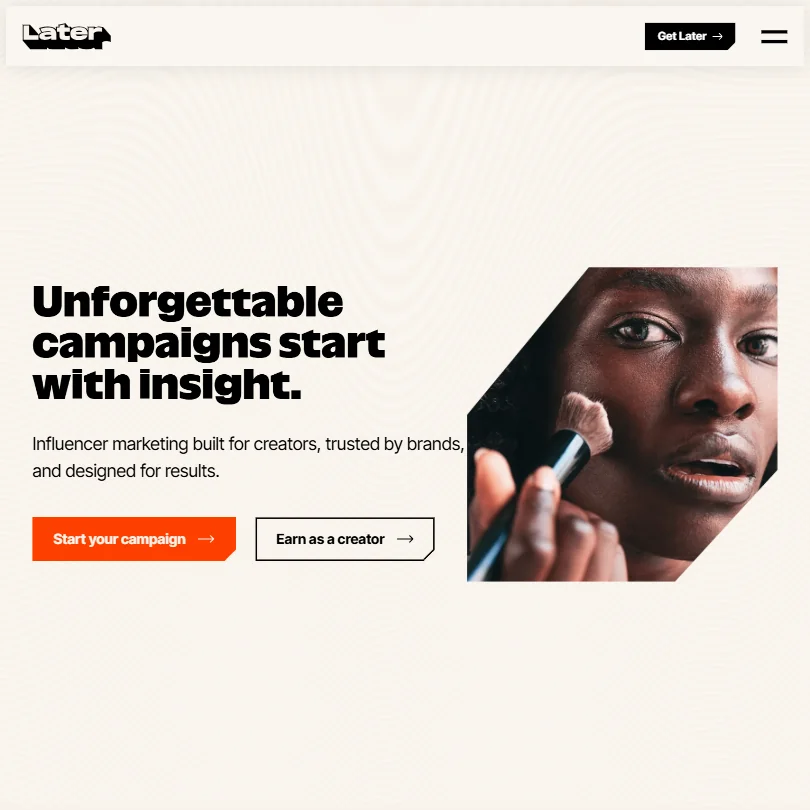
Later is a Vancouver-based company founded in 2014, which puts it firmly in the veteran camp for social scheduling tools. It's been through a few identity shifts over the years, and the current version is genuinely hard to categorize. Not just a scheduler. Not just an influencer platform. It's trying to be both at once, and that ambition shows up in both the product's strengths and its frustrations.
What is Later?
Later started life as an Instagram scheduler. Simple, visual, drag-and-drop. That original positioning stuck around for years, and you can still feel it in the product's bones. But the company has clearly made a bigger bet. The current pitch is built around influencer marketing, a proprietary affiliate network called Mavely, and something they're calling Later EdgeAI, which they claim has tracked over $2 billion in influencer-driven purchases.
That's a real number if true. We're somewhat skeptical of how it's measured, but we haven't seen anyone publicly dispute it either.
The platform now sits across four distinct product lines. There's full-service influencer campaign management, a creator-side earning tool through Mavely, self-serve influencer marketing software, and the original social media scheduling product. Four products under one roof. That's a lot of surface area for a company that isn't Sprout Social or Hootsuite in terms of organizational scale.
For most people reading this, the scheduler is what they're actually evaluating. Plans run from $25.00 per month on Starter up to $110.00 per month on Scale, billed monthly, with lower rates available on annual billing. The 14-day free trial gets you in the door, but there's no permanent free plan. That matters, especially for creators testing the waters.
Later Features: Scheduling, AI Content & Analytics

The scheduling core is solid. The visual content calendar works the way you'd expect, and the smart scheduling feature attempts to recommend posting times based on your account's historical data. On Starter, you get one social set covering eight profiles total, with a cap of 30 posts per profile per month. That's tight. Growth bumps you to two social sets, 16 profiles total, and 180 posts per profile. Scale gives you six social sets, 48 profiles, and unlimited posts. Most serious social media managers will find Starter runs out fast.
Bulk scheduling only kicks in at Growth and above, which feels like an artificial gate. A lot of competitors include some version of bulk posting at their entry tier. Later doesn't. That tracks with a broader pattern we noticed where meaningful workflow features get pushed up the pricing ladder.
The analytics are decent but split unevenly across plans. Starter gives you three months of historical data. Growth stretches that to a year. Scale goes to two years and adds competitive benchmarking, brand health tracking, and brand mentions monitoring. Those last two features carry a "New" badge in the current interface, so they're recent additions rather than long-standing capabilities.
Honestly, that surprised us. Sentiment and brand health tracking on the top tier only is a significant restriction for agencies who need that data at Growth but can't justify $110.00 per month. It's a gap competitors like Sprout Social have long since filled at lower price points.
The Link in Bio tool ships with every plan, including Starter. Later says it's tracked over a billion transactions through it. Whether your Link in Bio page will contribute to that number or not, the feature itself is well-built. Shopify integration works through Mavely. Google Analytics connection is available.
UGC collection requires Growth or Scale. So does the internal and external collaboration and approvals workflow. Custom roles and permissions are present, but again, you need Growth or higher before they're actually useful.
Later Platform Support: Which Networks Does It Cover?
The platform roster is genuinely competitive. Instagram and TikTok are the flagship integrations, as you'd expect given Later's origin story. The list extends to Facebook, Pinterest, LinkedIn, YouTube, Threads, and Snapchat.
Snapchat is the surprising addition. Most schedulers in this category skip it entirely. Whether you actually need Snapchat scheduling is a different question, but having it is notable.
Threads support is now also available across several major competitors, including Buffer, Metricool, and Vista Social, so it's no longer a differentiator worth leaning on. Later has it. So do a lot of others.
Cross-platform publishing from a single dashboard covers all eight networks. That's broad. Getting YouTube into the same dashboard alongside Instagram and TikTok saves real time for teams running multi-platform content. The Snapchat inclusion still stands out, even if it isn't useful for every team.
Later AI Content Creation: Caption & Copy Quality
Later's AI content tools run on something they call EdgeAI, their proprietary model. It handles caption generation and hashtag suggestions. The credit system is the part worth paying attention to. Starter gets 5 AI credits per month. Growth gets 50. Scale goes up to 100.
Five credits on Starter. That's almost nothing for a social media manager posting daily across multiple profiles. We don't buy the idea that this is a meaningful AI content tool at that tier.
Hashtag suggestions are included in the AI content tools across plans. Deeper trending hashtag research with topic tracking is Scale-only. So the more useful research layer requires the top self-serve plan at $110.00 per month on monthly billing.
The Canva integration helps bridge the gap between ideation and design. Unsplash access gives you stock image sourcing inside the platform. Those two together make the content creation workflow meaningfully more complete than it would be otherwise.
Where Later's AI story gets more interesting is the influencer side. The EdgeAI system is supposedly trained on real campaign purchase data through Mavely. If you're using Later to run influencer programs and want the AI to suggest creator rates or predict campaign fit, that data foundation matters. For caption writing, it's less relevant.
Is Later Easy to Use?
The visual calendar is the best part of the Later UX. Drag content around, preview how your Instagram grid will look, adjust timing. That piece of the product has been refined over a decade and it shows. Genuinely works well.
The complexity comes from the product sprawl. A social media manager logging in to schedule posts is navigating the same dashboard as someone managing a six-figure influencer campaign. Those are very different workflows. The interface tries to serve both, and the seams are visible.
Later is available on web, iOS, and Android. The web dashboard is where the real work happens, and for teams accustomed to Hootsuite or Sprout Social's interface density, Later will feel lighter. Whether that's a good thing depends on what you need.
Support access varies by plan. Starter gets basic customer support. Priority support is reserved for Scale. There's no community forum.
Later Pricing: Is It Worth It for Creators & Agencies?
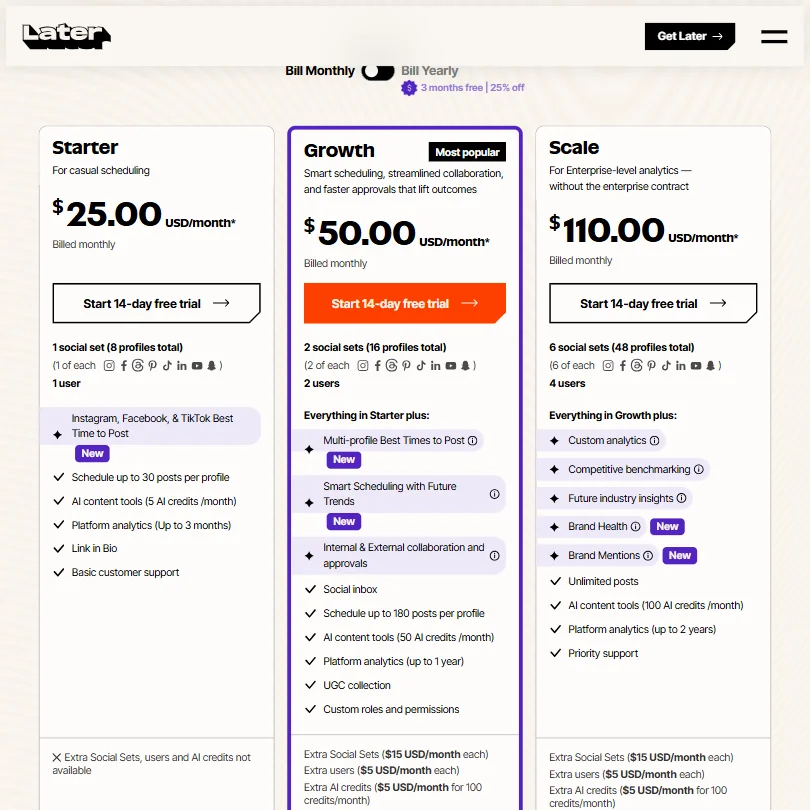
The three self-serve tiers are Starter at $25.00 per month, Growth at $50.00, and Scale at $110.00, all billed monthly. Annual billing brings those numbers down, though the pricing page doesn't prominently surface how much lower. Users shopping on monthly billing see the full rates.
No refund policy is publicly stated anywhere. That's a problem. Paying $110.00 per month with no clear refund terms is a real risk, especially for smaller teams. We'd want that clarified before committing.
Starter is honestly too limited to be useful for anyone managing more than one or two social profiles. 30 posts per profile per month and 5 AI credits doesn't serve a working social media manager. It might work for a solo creator posting occasionally. That's about it.
Growth at $50.00 is where the product actually becomes functional. You get the social inbox, UGC collection, and internal approval workflows. The 180 posts per profile limit is reasonable. This is the tier most small teams will land on.
Scale at $110.00 starts to justify itself if you need the competitive benchmarking or the brand sentiment data. But compared to what Sprout Social offers at similar price points with deeper analytics, Later's Scale plan still feels thin on enterprise-grade reporting.
Enterprise pricing requires a strategy call. No public number. That's standard for full-service influencer platforms, but the full Mavely and EdgeAI influencer capabilities sit behind a custom contract, which is worth factoring into your evaluation timeline.
Extra social sets, extra users, and extra AI credits are all available as paid add-ons at Growth and Scale. Extra social sets run $15.00 per month each. Extra users run $5.00 per month each. Extra AI credits run $5.00 per month per 100 credits. Starter can't add any of them. Worth knowing before you sign up and hit a wall.
Later vs Hootsuite: Which Social Media Tool Wins?
Hootsuite and Later are not really the same product anymore, even though they show up in the same comparison searches. Hootsuite is a full social listening and enterprise management platform. Later is a scheduler that has grafted an influencer marketing business onto its side.
For pure scheduling, Later's visual calendar is better than Hootsuite's. More intuitive, cleaner interface, better Instagram grid preview. That's a real advantage.
For analytics depth, Hootsuite wins. It's not close at the lower price tiers. Hootsuite's reporting goes deeper earlier in the pricing ladder. Later locks the meaningful analytics behind Scale.
For influencer marketing, Later wins, and it isn't a fair comparison. Hootsuite isn't trying to be an influencer platform. Later is building an entire ecosystem around Mavely and EdgeAI campaign tracking. If influencer programs are part of your actual workflow, Later's data advantage is real.
The differentiating factor comes down to what you're actually buying. A scheduler who occasionally uses influencer campaigns? Later makes sense. A social media team that needs deep listening, broad integrations, and enterprise reporting? Hootsuite or Sprout Social will probably serve you better.
Buffer is worth a mention here too. For teams that just want clean scheduling without the influencer complexity, Buffer undercuts Later's Starter significantly on per-channel pricing. The trade-off is that Buffer doesn't have Later's influencer infrastructure or Link in Bio transaction data. Fair.
Who Should Use Later? (And Who Shouldn't)
Brands running influencer programs. That's Later's clearest fit. The Mavely network, the EdgeAI campaign data, the creator sourcing tools. These are genuine differentiators that Buffer and even Hootsuite don't offer.
Social media managers at small agencies who need Growth-tier features. The visual calendar and UGC collection at $50.00 per month is a reasonable deal, assuming you're not also expecting enterprise-grade analytics.
Solo creators on Starter. Probably look elsewhere. The 30-post-per-profile cap and 5 AI credits per month make the $25.00 tier feel like a placeholder rather than a real working tool.
Teams that need deep sentiment tracking or competitive analysis below the Scale price point will hit a wall. If that data is core to your job, the $110.00 per month ask is real, and it's worth comparing Scale's feature set against what you can get from Metricool or Vista Social at lower prices before committing.
Agencies managing many client accounts should check the add-on user and social set pricing carefully before signing up. Those costs accumulate, and the final monthly number can look very different from the plan headline price.
Later Review Verdict
Later is a genuinely interesting product that doesn't fully deliver on its own ambition. The influencer marketing positioning is credible. The Mavely network and the $2 billion in tracked purchases are real assets that no direct scheduling competitor has built from scratch. EdgeAI, if the training data is as strong as claimed, could become a meaningful advantage in creator rate-setting and campaign prediction.
The scheduling product, which is what most people will actually pay for, is good but not exceptional. The visual content calendar is its best feature and has been for years. Everything built on top of it is solid but gated in ways that push you toward more expensive tiers faster than feels fair.
The credit-based AI system is the part that bothers us most. Five credits per month on Starter is a marketing checkbox, not a functional tool. Fifty credits on Growth is better but still limited for daily content operations. Not great.
No public refund policy. Support quality stratified by plan. These are organizational choices that reflect priorities, and they're worth naming plainly.
Later is worth evaluating if influencer marketing is part of your actual workflow. For pure scheduling, there are cheaper options that do the core job just as well. For deep social analytics, there are more capable options at similar prices. Later's value lives specifically in the overlap between scheduling and influencer campaign management. If that overlap is your day job, this might be the right tool. If it isn't, you're paying for infrastructure you won't use.
How Later compares
Later scores 5.4 out of 10 among the AI social media management tools we rate. These three do the same job and are the closest to it, compared on what each vendor publishes.
Hootsuite
Every Later plan includes single sign-on, while Hootsuite saves SSO for its Enterprise tier only. Hootsuite answers with a Wisdom AI agent that generates images and drafts content on request, a capability Later's AI tools lack, and Later still costs $25 a month for five profiles against Hootsuite's $99.
Pick Hootsuite if you need an AI agent that generates images and drafts content.
Pick Later if you want single sign-on on every plan at a quarter of the price.
Buffer
Buffer has a free plan and still publishes to X and Bluesky, neither of which Later lists. Later answers with single sign-on on every plan and undercuts Buffer at $25 a month for five profiles against Buffer's $30, but Buffer keeps an API and GDPR coverage that Later does not clearly state.
Pick Buffer if you need X or Bluesky publishing, an API, or GDPR coverage.
Pick Later if you want single sign-on on every plan at a lower price.
Sprout Social
Sprout Social costs $99 a month for five profiles against Later's $25, and Sprout reaches X plus offers a Trellis AI agent, paid-ads reporting and influencer management, all missing on Later. Later still includes single sign-on on every plan, where Sprout saves SSO for Enterprise.
Pick Sprout Social if you need X publishing, an AI agent, or paid-ads reporting.
Pick Later if you want single sign-on on every plan at a quarter of the price.
Frequently Asked Questions
Does Later have a free plan?
No permanent free plan exists. Later offers a 14-day free trial that gives you access to test the platform before committing. After that, the cheapest paid option is Starter at $25.00 per month on monthly billing, or lower on annual billing. If you need a free tier indefinitely, Later isn't the answer.
What is the Later Link in Bio feature?
Link in Bio is Later's tool for turning your profile link into a clickable landing page that mirrors your social content. It ships on every plan, including Starter. Later claims over a billion transactions have been tracked through it, which reflects how long the feature has been live and how widely it's used. Shopify and Google Analytics connections are available to make it more functional for e-commerce.
Is Later good for influencer marketing?
It's the strongest part of what Later currently offers. The Mavely affiliate network gives creators a way to earn from brand partnerships, and the EdgeAI system is built on real purchase data from campaigns run through the platform. Full-service influencer campaign management is available at the enterprise tier through a custom contract. Self-serve influencer marketing software sits within the standard plans. For brands that need to find creators, set rates, and track ROI from influencer content, Later has built more infrastructure here than most of its direct scheduling competitors have.