Krea is a model library built around its own Krea 2 image model, with dozens of other companies' video, image and audio models on the same account and a free plan that works entirely on images. What decides whether it fits you is whether you need video at all, since the free tier cannot generate it, and whether your work needs the commercial license that free access does not carry.

What is Krea?
Krea runs in the browser and on iOS. It combines its own generation models with a marketplace of licensed third party models for image, video, lip sync and audio, plus a node based workflow builder and an agent that can plan and run a job across models for you.
Krea's own models
- Krea 2 (latest): the company's current image model.
- Krea 2 Turbo: a faster variant of Krea 2.
- Krea 1: the earlier image model, still available.
Other companies' models on Krea
For video, Krea offers Kling 3.0, Kling 3 Turbo, Kling o1, Kling o3 and Kling o3 Pro, Google Veo 3.1 and Veo 3.1 Lite, Seedance 2.0, 2.0 Fast, 2.0 Mini and 2.5, Seedance 1.5 Pro, Runway Gen-4.5, MiniMax H3 and H3 Max, the LTX-2 family, Wan 2.1 through Wan 3.0, Vidu Q3, Grok Imagine, Gemini Omni Flash and HappyHorse, alongside separate lip sync models, Fabric Fast and Hedra. For images it adds Nano Banana, Nano Banana 2, Nano Banana 2 Lite and Nano Banana Pro, Seedream 4.5, 5 Lite and 5.0 Pro, GPT-IMG-2, Krea's name for GPT Image 2, plus ChatGPT 1.5 and ChatGPT 2, Flux 2 in its Flex, Klein, Max and Pro versions, Ideogram 4.0, Recraft V4, Luma UNI-1, Qwen 2512, Muse Image and Z Image. Audio comes from ElevenLabs, for music, text to speech and turning a video's motion into music.
What you can make with Krea
Video clips run up to 12 seconds and can be extended past that with an additional generation. You set a start image and an end image to control how a clip opens and closes, and Fabric Fast or Hedra add lip sync to a still image or a video. Krea's own cost table prices a Kling 3.0 generation at about 1,000 credits, Seedance 2.0 at about 300 and Veo 3.1 at about 1,300, all cheaper in their Fast or Lite versions.
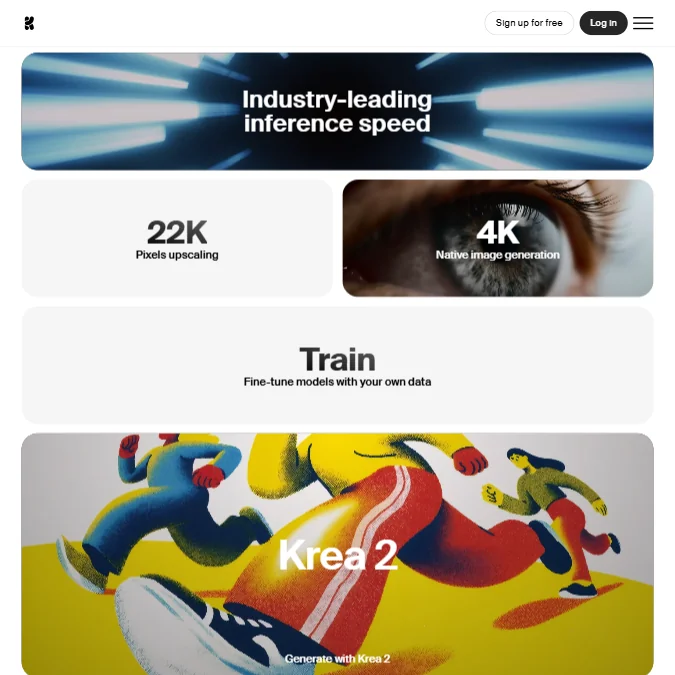
For images, upscalers including Topaz Standard go up to 22K, though the free plan is limited to 2K. The image editor covers background removal and general editing, and LoRA training builds a custom character or style from your own images, from 50 images on the free plan up to 2,000 on Max and Business.
Workflows, agents and teams
Krea Nodes is a visual, node based editor for chaining models, prompts and processing steps into a workflow, and a Nodes Agent can build or change that workflow from a plain language request. A separate Krea Agent plans, generates and iterates across models from a single brief. An API covers more than 40 models through one endpoint. Business and Enterprise plans add up to 50 seats at one flat price, with custom roles and SAML SSO.
Krea pricing: what each plan gives
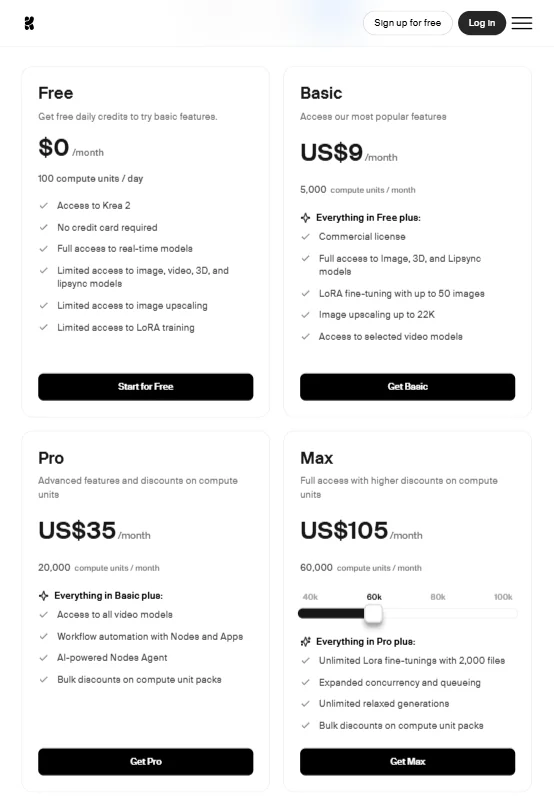
Free gives 100 compute units a day with no credit card, full access to Krea's real time image models, LoRA training up to 50 images and upscaling up to 2K. It has no video generation, no access to the full image, video and lip sync model list, no Krea Nodes and no commercial license.
Pro costs $35 a month, $21 a month billed yearly, for 20,000 units a month. Max costs $105 a month, $63 yearly, for 60,000 units, and Business costs $200 a month, $160 yearly, for 80,000 units; both scale further on a usage slider. Enterprise is priced by contacting sales.
Per generation, Krea's own cost table runs from about 20 credits for a Flux 2 image up to roughly 400 for a Flux 2 Max image, 30 to 100 credits for a Nano Banana image depending on the version, and 300 to 1,300 credits for a video clip depending on the model, with video generally costing far more per clip than a single image. Pro and up also get unlimited relaxed generation on the Krea 2 image family once your units run out.
Privacy and support
Krea's terms grant it a broad license to use what you submit without saying whether that covers training its models, and its Business terms offer a no-training clause as an add-on. Krea is SOC 2 compliant and states GDPR compliance, and SAML SSO is available on Business and Enterprise.
Support is by email, with a Discord community for further help, plus priority support with an SLA on Business and Enterprise.
Who Krea suits
Krea suits people who want a genuine free tier to test image generation, including its own Krea 2 model, before paying, and who want a wide library of current video and image models, Kling 3.0, Veo 3.1, Seedance 2.0, Nano Banana Pro, GPT-IMG-2 and Flux 2 all included, on one flexible credit pool with a node based workflow builder.
It suits less well anyone who needs video on a free budget, since the free plan cannot generate video at all, or anyone who needs a written promise that their content is never used for training without buying the Business add-on.
How Krea compares
Krea scores 9.0 out of 10 among the multi-model AI platforms we rate. These three do the same job and are the closest to it, compared on what each vendor publishes.
Magnific
Krea's cheapest plan is $35 a month. Magnific prices its plans by location, so its price is not compared here. Krea offers slightly more models, 34 video and 27 image against Magnific's 31 and 21, and Krea includes a free plan that Magnific does not. Magnific confirms it does not train AI on your uploads. Both include canvas workflows, an AI agent, an API and single sign-on.
Pick Magnific if you want no AI training on your uploads.
Pick Krea if you want a free plan and slightly more models.
Higgsfield
Higgsfield's cheapest plan is $19 a month, about half of Krea's $35, and both include a free plan, unlimited generation on some models, canvas workflows, an AI agent, an API and single sign-on. Krea lists far more models, 34 video and 27 image against Higgsfield's 8 and 5. Higgsfield's paid plans export without a watermark. Higgsfield only guarantees no training on uploads for enterprise accounts.
Pick Higgsfield if you want the widest model selection regardless of price.
Pick Krea if you want a lower price with the same core toolset.
OpenArt
OpenArt's cheapest plan is $14 a month, far less than Krea's $35, but OpenArt does not offer Veo 3.1 or Flux 2, and has no canvas workflow, no API and no SOC 2, all of which Krea includes. Krea also lists far more models, 34 video and 27 image against OpenArt's 14 and 9. Both support lip sync, image editing and LoRA training. OpenArt's paid plans export without a watermark.
Pick OpenArt if you want a much lower price for core features.
Pick Krea if you want Veo 3.1, Flux 2, an API and SOC 2.
Frequently Asked Questions
Does Krea have a free plan?
Yes. Free gives 100 compute units a day with no credit card, full access to Krea's real time image models, and limited LoRA training and upscaling, but no video generation and no commercial license.
Which models does Krea include?
Its own Krea 2 and Krea 2 Turbo, plus other companies' models including Kling 3.0, Veo 3.1, Seedance 2.0, Nano Banana Pro, GPT-IMG-2 and Flux 2.
What do Krea's paid plans cost?
Pro is $35 a month, $21 billed yearly, for 20,000 units. Max is $105 a month, $63 yearly, for 60,000 units, and Business is $200 a month, $160 yearly, for 80,000 units, both adjustable on a usage slider.
Can I extend a Krea video past its length?
Yes. Clips run up to 12 seconds and you can extend a previously generated clip with an additional generation.