Designers who want one of the broadest model menus, plus a node canvas, an AI agent and an API
Best of · 6 tools ranked
Best Multi-Model AI Tools Under $10/mo
Find the best AI image and video platforms under $10 a month if you want many models behind one login without a large bill. Entry plans are compared by credits, watermarks on exports and where commercial use begins, so you can see what the money buys over a free plan and which limit you will meet first.
Updated 3 October 2026Ranked by our score, worked out from each vendor’s own pages.How we score →All Multi-Model AI Platforms →
Our top 3 Multi-Model AI Tools Under $10/mo
Pro swaps the free plan's 50 daily credits for 300 a day plus a bonus of 1,000 credits, or 25,000 on a yearly term, and adds larger LoRA training runs of up to 1,000 images and private, unlisted models.
Beginner is the cheapest plan on this page, with 9,000 credits a month, about 1,500 images, and it strips the watermark from video downloads.
Best Multi-Model AI Tools Under $10/mo, ranked
#ToolScoreEntry plan includesStarts at
Basic: 5,000 compute units a month
✓ Free plan tooFrom $9Show detailsHide details01 Krea#1 of 13 multi-model AI platforms9.4Score 9.4 out of 10Basic: 5,000 compute units a month✓ Free plan too$9Visit site ↗ReviewDetailsCloseShow more about Krea
Basic: 5,000 compute units a month
✓ Free plan tooFrom $9
Show detailsHide detailsKrea#1 of 13 multi-model AI platforms
9.4Score 9.4 out of 10Basic: 5,000 compute units a month✓ Free plan too$9Visit site ↗ReviewDetailsClose
- Krea's free plan gives 100 compute units a day with no credit card required, full access to the real time image models.
- It includes current third party models: Kling 3.0, Veo 3.1, Seedance 2.0, Nano Banana Pro, GPT-IMG-2 and Flux 2.
- The free plan cannot generate video at all; video concurrency is set to zero.
Pro: 300/day + 1000 permanent bonus credits (monthly term) or 25000 permanent bonus credits (yearly term)
✓ Free plan tooFrom $9.90Show detailsHide details02 Tensor: Best for 300 daily credits and private models7.6Score 7.6 out of 10Pro: 300/day + 1000 permanent bonus credits (monthly term) or 25000 permanent bonus credits (yearly term)✓ Free plan too$9.90Visit site ↗ReviewDetailsCloseShow more about Tensor
Pro: 300/day + 1000 permanent bonus credits (monthly term) or 25000 permanent bonus credits (yearly term)
✓ Free plan tooFrom $9.90
Show detailsHide detailsTensor: Best for 300 daily credits and private models
7.6Score 7.6 out of 10Pro: 300/day + 1000 permanent bonus credits (monthly term) or 25000 permanent bonus credits (yearly term)✓ Free plan too$9.90Visit site ↗ReviewDetailsClose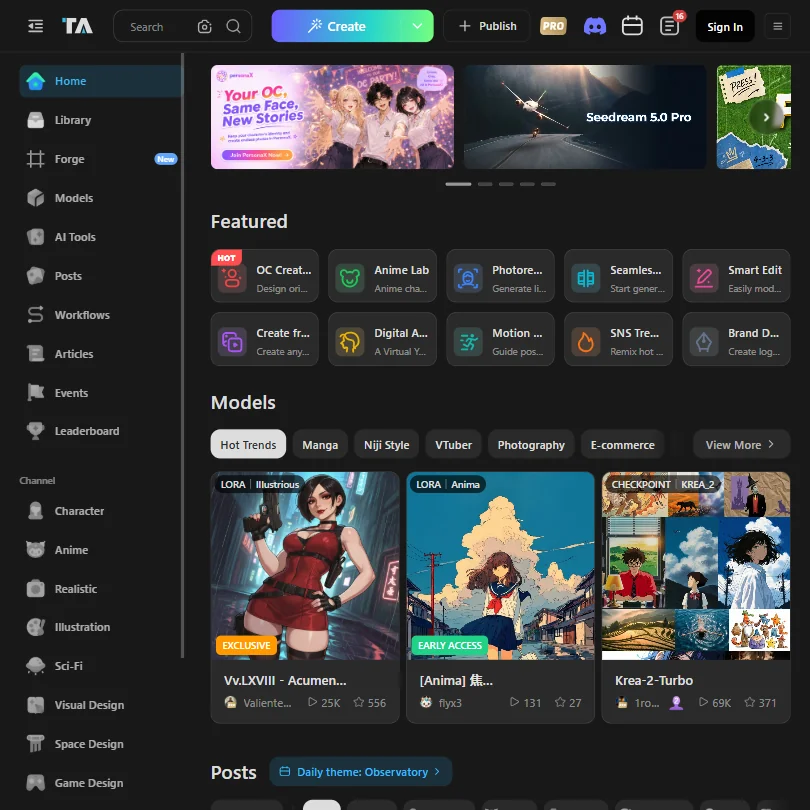
Pro swaps the free plan's 50 daily credits for 300 a day plus a bonus of 1,000 credits, or 25,000 on a yearly term, and adds larger LoRA training runs of up to 1,000 images and private, unlisted models. Its fast-generation pool stops at 200 generations a month, which is what pushes heavy users up. Commercial rights come with paid plans. Pick it over SeaArt AI when open checkpoints and training matter more than apps.
- The free Starter plan never expires and includes 50 credits a day for image and video generation.
- Even the free plan gives access to more than a million community models and LoRAs.
- The Pro plan's fast-generation pool is capped at 200 generations a month, not unlimited.
Beginner: 9,000 credits/month
✓ Free plan tooFrom $5.99Show detailsHide details03 SeaArt AI: Best for the lowest price with watermark-free video7.0Score 7.0 out of 10Beginner: 9,000 credits/month✓ Free plan too$5.99Visit site ↗ReviewDetailsCloseShow more about SeaArt AI
Beginner: 9,000 credits/month
✓ Free plan tooFrom $5.99
Show detailsHide detailsSeaArt AI: Best for the lowest price with watermark-free video
7.0Score 7.0 out of 10Beginner: 9,000 credits/month✓ Free plan too$5.99Visit site ↗ReviewDetailsClose
Beginner is the cheapest plan on this page, with 9,000 credits a month, about 1,500 images, and it strips the watermark from video downloads. LoRA training is included. Unlimited image generation starts at Standard, and first and last frame control for video arrives there too, so those two features push you up a plan. Pick it over PicLumen when you want iOS and Android apps and a lower price.
- The free plan does not require payment to start creating.
- Beginner, the cheapest paid plan at $5.99 a month, already removes the watermark from video downloads.
- Video first and last frame control is limited to Standard, Professional and Master; it is not on Beginner.
Lite: 750 credits/month
✓ Free plan tooFrom $7.59Show detailsHide details04 PicLumen: Best for watermark-free output with a starter license6.5Score 6.5 out of 10Lite: 750 credits/month✓ Free plan too$7.59Visit site ↗ReviewDetailsCloseShow more about PicLumen
Lite: 750 credits/month
✓ Free plan tooFrom $7.59
Show detailsHide detailsPicLumen: Best for watermark-free output with a starter license
6.5Score 6.5 out of 10Lite: 750 credits/month✓ Free plan too$7.59Visit site ↗ReviewDetailsClose
Lite gives 750 Lumens a month, about 750 images or 30 videos, with no watermark and a limited commercial license, where the free plan offers 20 Lumens a day and no rights. Standard brings the full license and Relax Mode's unlimited images, so it is the plan to reach once a client is involved. Pick it over SeaArt AI when you want a commercial license from the entry plan; it has no API.
- PicLumen has a standing free plan with 20 Lumens a day, enough for about 20 images or one video.
- The cheapest paid plan, Lite, is watermark-free for $7.59 a month.
- The free plan carries no commercial-use rights.
Starter: 900 credits/month
✓ Free plan tooFrom $8Show detailsHide details05 Pika: Best for monthly credits for watermark-free clips6.2Score 6.2 out of 10Starter: 900 credits/month✓ Free plan too$8Visit site ↗ReviewDetailsCloseShow more about Pika
Starter: 900 credits/month
✓ Free plan tooFrom $8
Show detailsHide detailsPika: Best for monthly credits for watermark-free clips
6.2Score 6.2 out of 10Starter: 900 credits/month✓ Free plan too$8Visit site ↗ReviewDetailsClose
Starter turns the free plan's credit packs into 900 credits a month, and yearly billing brings it under this page's line. Free and Starter both stay watermark-free, but neither carries a commercial license, which starts at Creator with 3,150 credits. The account lists Veo 3.1, Seedance and Wan 3.0 and adds lip sync and clip extension. Pick it over getimg.ai for video; Kling and Flux are not on it.
- Pika combines its own Pika 2.5 video model with Seedance, Veo 3.1, Wan 3.0 and GPT Image 2.5 in one account.
- The free plan and the $10 Starter plan are both watermark-free.
- Kling and Flux are not among the models Pika lists.
Entry: 3,000 credits/month
From $10Show detailsHide details06 getimg.ai: Best for image work through an API5.3Score 5.3 out of 10Entry: 3,000 credits/month$10Visit site ↗ReviewDetailsCloseShow more about getimg.ai
Entry: 3,000 credits/month
From $10
Show detailsHide detailsgetimg.ai: Best for image work through an API
5.3Score 5.3 out of 10Entry: 3,000 credits/month$10Visit site ↗ReviewDetailsClose
With no free plan, Entry at $10 a month for 3,000 credits is the starting point, and it sits at the top edge of this page's budget. Commercial use is allowed on every paid plan, and the API comes with official Node.js and Python SDKs. Video comes from Grok Imagine Video 1.5 and Wan 3.0, and no plan has an unlimited mode. Pick it over Pika for image work with Flux 2, Nano Banana 2 and GPT Image 2.
- Commercial use is allowed on all paid plans.
- It offers a wide range of third-party image models, including Qwen Image 3.0 Pro, Grok Imagine Image 2.0, Seedream 5.0 Pro, GPT Image 2, Nano Banana 2 and FLUX 2.
- There is no free plan.
How to choose a multi-model AI platform under $10 a month
At this price a multi-model platform is a trade: you give up some of the headline models, a commercial license or a watermark-free export, and in return you get a lot more generations per dollar. Which of those you can give up depends on what you make. This guide covers what each entry plan counts, where the missing pieces are, and which platform fits which kind of maker.
Start with the job, not the tool
Four jobs explain most of the choice on this page, and each platform leans toward one.
- Image volume. Making many images cheaply. SeaArt AI's Beginner plan lists about 1,500 images a month, and its Standard plan and above add unlimited image generation.
- Short video clips. PicLumen Lite counts videos directly, about 30 a month, and Pika is built around social-style video with lip sync. getimg.ai offers two video models, Grok Imagine Video 1.5 and Wan 3.0.
- Community models and your own style. Tensor.Art hosts open checkpoints and LoRAs that other users trained, and SeaArt AI includes LoRA training on every plan.
- Image editing with an API. getimg.ai pairs a pool of credits across many image models with upscaling, editing tools and API access.
Choose the job that matters most, and the plan questions that follow get narrower.
| Job | Start with | Runner-up and the trade-off |
|---|---|---|
| A lot of images for little money | SeaArt AI | PicLumen costs more and gives fewer credits, but lists more of the headline models |
| Short video with a license | PicLumen | Pika needs its Creator plan for a commercial license |
| Train a style or character | Tensor.Art | SeaArt AI trains on every plan and adds a priority training queue from Professional |
| Social clips with lip sync | Pika | PicLumen counts videos plainly, at about 30 on Lite |
| Edit and upscale for a store | getimg.ai | PicLumen has an upscaler too, with a limited commercial license on Lite |
What the price actually buys
Entry plans sell very different amounts, so read each in the unit that matters to you.
- Credit-heavy plans. SeaArt AI Beginner is $5.99 a month for 9,000 credits, about 1,500 images, and it removes the watermark from video downloads. getimg.ai Entry is $10 for 3,000 credits shared across its image and video models.
- Counted-in-outputs plans. PicLumen Lite is $7.59 for 750 Lumens, about 750 images or 30 videos, watermark-free with a limited commercial license. The same pot buys either, so a video costs roughly as much as 25 images.
- Daily pots. Tensor.Art Pro is $9.90 and gives 300 credits a day plus a one-time bonus of 1,000 credits on monthly billing or 25,000 on yearly billing. Its fast-generation pool is capped at 200 generations a month.
- Pay-as-you-go style. Pika Starter is $10, or $8 on yearly billing, for 900 credits, watermark-free and without a commercial license.
Which tool fits which creator
- Hobbyists making lots of images. Start with SeaArt AI, because 9,000 credits a month is a large pot at $5.99 and LoRA training is included. Add Tensor.Art's free plan for a second pot of daily credits.
- Social video creators. Start with Pika, because Starter is watermark-free and its models include Veo and Seedance alongside its own Pika 2.5. Add PicLumen if you want Kling 3.0 in the same budget.
- Small shop owners. Start with getimg.ai, because commercial use is allowed on all paid plans and its upscaler and editing tools work across models. It is paid-only, so there is no free trial.
- Artists building a style. Start with Tensor.Art, where Pro adds bigger LoRA runs (up to 1,000 images) and unlisted private models. SeaArt AI is the alternative with LoRA on every plan.
- Creators who want many models in one place. Start with PicLumen, because it lists Seedance, Kling 3.0, Veo 3.1, GPT Image 2, Midjourney and FLUX on one account.
Where the entry plans stop
| Limit | Tools | What happens at the edge |
|---|---|---|
| Monthly credits | SeaArt AI (9,000), getimg.ai (3,000), Pika (900), PicLumen (750 Lumens) | Generating pauses until the month turns, or you pay for more |
| Daily credits | Tensor.Art (300 a day) | The pot refills daily |
| Fast pool | Tensor.Art (200 generations a month) | The cap, not credits, ends fast generation for the month |
| Commercial license | Pika (Creator and up), PicLumen (limited on Lite, full on Standard), Tensor.Art (paid plans only) | Output is not cleared for client use until you reach that tier |
| Video controls | SeaArt AI (first and last frame from Standard) | Beginner has no frame control |
| Relaxed mode | PicLumen (Standard and up), getimg.ai (none) | Credits are the only meter on Lite and Entry |
The limits that matter most are the ones that stop work: a license, not credits. A client project can fail on that alone, so check the license column before the credit column.
What the cheapest plan leaves out
The entry plans leave the best of each platform on higher rungs. SeaArt AI keeps unlimited image generation for Standard and above and frame control for video there too. PicLumen keeps Relax Mode, which continues image generation after your Lumens run out, for Standard, Pro and Elite. Pika keeps its commercial license for Creator. getimg.ai has no relaxed mode on any plan, so every image spends credits.
The other gap is breadth. Pika does not list Kling or Flux, getimg.ai lists two video models, and Tensor.Art's premium third-party models run on a separate Energy currency in its linked Forge tool, not on Pro credits.
Privacy and who sees your work
Pika may use your content to train its models by default, with no self-serve opt-out, so keep private references out of it. Tensor.Art's Pro plan adds private, unlisted models, which matters if you train on photos you do not want to share. On commercial use, getimg.ai allows it on every paid plan, and PicLumen grants a limited license on Lite and a full one on Standard.
Mistakes to avoid
- Paying for Pika Starter to do client work. It is watermark-free, but a commercial license starts at Creator. Move up, or use getimg.ai, where every paid plan allows commercial use.
- Counting PicLumen in images when you make video. The same 750 Lumens buy about 750 images or 30 videos. Work out your mix before you buy.
- Choosing getimg.ai for heavy video. Two video models are listed, and no plan offers a relaxed mode. It suits images best.
- Assuming Tensor.Art Pro credits cover every model. Premium third-party models such as Kling and Nano Banana run on Forge's Energy currency. Budget for it separately.
- Reading SeaArt AI's 9,000 credits as the whole story. The pot is large, but Beginner lacks frame control for video, and priority for LoRA training begins at Professional.
When to move up a plan
Move up when a missing feature costs you more than the price gap: a license you need, a video control you keep working around, or a pot that ends before the month does.
| If you are | Upgrade to | What changes |
|---|---|---|
| Making images in volume | SeaArt AI Standard | 54,000 credits, unlimited image generation and first and last frame control |
| Delivering client video on PicLumen | PicLumen Standard | 2,500 Lumens, a full commercial license and Relax Mode |
| Posting clips on Pika | Pika Creator | Licensed commercial use, plus 3,150 credits a month |
| Editing images for a store | getimg.ai Core | 15,000 credits a month |
Billing changes the price. SeaArt AI, PicLumen, Pika and Tensor.Art each drop on yearly terms, to $4.79, $6.09, $8 and about $5.83 a month, while getimg.ai bills monthly in credits. Tensor.Art sells only two plans, so Pro is the top step, and getimg.ai has no free plan to test first.
Using two cheap platforms together
Two entry plans on different meters often beat one at the top of the price range.
- Generate images in bulk on SeaArt AI, where credits are plentiful.
- Refine the best ones with getimg.ai's upscaler and editing tools.
- Animate a few of them on Pika or PicLumen, where video is counted separately.
A second pairing is for style work: train a LoRA on Tensor.Art, then bring the best images to PicLumen for short clips.
How we picked
Every tool here is ranked by its score, and each score is worked out from the vendor’s own published pages: pricing, plans, features and terms. No score is adjusted by hand. All 6 tools have enough published facts to be scored, and on average 82% of each score comes from facts the vendor publishes. The facts behind these scores were checked between 19 September 2026 and 28 October 2026.
| Ranked as | On this page | What we score | Scoring guide |
|---|---|---|---|
| Multi-model AI platforms14 reviewed | 6 | 5 criteria, 28 checked facts: for video, for images, pricing, workflow and teams, privacy and trust | How we score these → |
Common questions
What is the cheapest multi-model AI platform with no watermark?
SeaArt AI Beginner is the cheapest paid plan here and removes the watermark from video downloads. PicLumen Lite is watermark-free too, at a higher price. Pika's free plan and Starter are both watermark-free already, so the question there is credits, not the stamp. Tensor and getimg.ai are the other two to compare.
How many images does a cheap plan actually make?
SeaArt AI Beginner's 9,000 credits are about 1,500 images, and PicLumen Lite's 750 Lumens are about 750 images or 30 videos. Tensor gives 300 credits a day. getimg.ai gives 3,000 credits and Pika 900 a month without an image count. Divide credits by the jobs you run in a week to compare them.
Is yearly billing worth it on these platforms?
Where both prices are listed, yearly is clearly cheaper: SeaArt AI Beginner falls from $5.99 to $4.79 a month, PicLumen Lite from $7.59 to $6.09, and Tensor Pro from $9.90 to about $5.83. Tensor's yearly term also adds a one-time bonus of 25,000 credits instead of 1,000. Pika Starter drops under this page's line only when billed yearly.
Which cheap AI platform has an API?
getimg.ai has a production-ready API with official Node.js and Python SDKs, and Pika has a developer API through its API Club. PicLumen states that it has no API, and Tensor and SeaArt AI list none either. If code needs to generate images for you, getimg.ai is the direct choice at this price.
Can I get Veo or Kling on a cheap plan?
Veo 3.1 is on PicLumen and Pika, and Kling 3.0 is on PicLumen. Tensor reaches Kling and Nano Banana through its Forge tool, billed in a separate Energy currency. getimg.ai lists neither Veo nor Kling, and Pika does not list Kling. PicLumen is the one entry plan that names both, so start there for top video models.
Do the credits on a cheap plan roll over?
Tensor describes its Pro bonus credits as permanent, so the 1,000 or 25,000 credits stay while the 300 daily credits refill each day. The other platforms here describe monthly credit amounts without saying more, so plan to spend each month's credits inside the month. A short daily routine on Tensor is the safest fit.