Higgsfield sells a shared credit account across its own Soul photo model plus other companies' current video and image models, with a free account that works but stamps every output with a watermark. What decides whether it suits you is how many generations a plan's credits buy on the models you use, since each model is priced per generation, and whether the free watermark matters for your work.

What is Higgsfield?
Higgsfield runs as a web app, with MCP/CLI and API access for developers. It combines its own Soul character and photo models with a marketplace of licensed video, image and audio models, a node based Canvas, and a Supercomputer agent that plans and runs a job across whichever models suit it.
Higgsfield's own models
- Higgsfield Soul 2.0 (latest): the company's foundation photo model.
- Higgsfield Soul: the earlier version.
- Higgsfield Genjutsu: a further own model in the lineup.
Other companies' models on Higgsfield
For video, Higgsfield offers Seedance 2.5, Seedance 2.0, Kling 3.0, Google Veo 3.1, WAN 2.6, Grok Imagine 1.5, Gemini Omni Flash and Sora 2. For images it adds Nano Banana, Nano Banana Pro, Flux 2, Seedream 5 and GPT Image 2. Audio comes from ElevenLabs.
What you can make with Higgsfield

Video generation covers text and image to video, with first and last frame reference for consistency and an AI Video Extender for lengthening a clip past its first pass. Seedance 2.0 generates audio in the same pass as the video, including lip synced dialogue, and a dedicated Lipsync Studio tool handles lip sync separately.
For images, an Edit Image and Inpaint tool covers retouching and localized changes, an upscale tool raises resolution, and Soul ID trains a consistent character from at least 20 of your own photos, then generates visuals that keep that identity across styles and poses.
Workflows, agents and teams
Higgsfield Canvas is its node based workspace. The Supercomputer agent, which Higgsfield says is powered by GPT-6 Astra, plans, picks the models and renders a job from a description rather than a manual, model by model setup. MCP/CLI and API access extend the same tools to a terminal or your own code. Enterprise plans add a shared team workspace with approvals, comments, sub workspaces and unlimited seats, and a separate Collab feature lets you generate together in shared projects on other plans.
Higgsfield pricing: what each plan gives
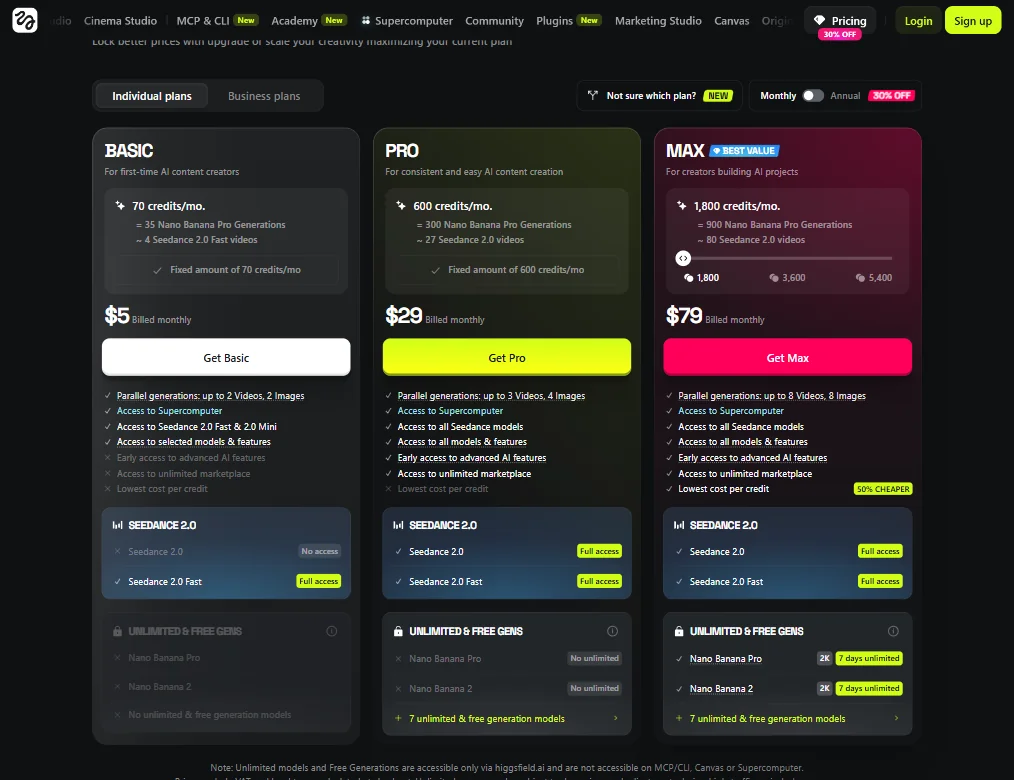
A free account exists alongside the paid plans, but every generation on it carries a visible watermark and it is limited to one concurrent job. Starter costs $19 a month, the same whether billed monthly or yearly, and removes the watermark. Plus costs $59 a month, $47 billed yearly. Ultra costs $129 a month, $99 billed yearly. Team, sold per seat with a minimum of two, costs $79 a seat a month, $69 a seat billed yearly.
Each plan comes with a set number of credits, and every model is priced per generation. Starter's 270 credits a month makes about 135 Nano Banana Pro generations or around 15 Seedance 2.0 Fast videos. Plus's 1,200 credits make about 600 Nano Banana Pro generations or roughly 53 Seedance 2.0 videos. Ultra defaults to 3,000 credits a month, with 6,000 and 9,000 step ups available, enough for about 1,500 Nano Banana Pro generations or 133 Seedance 2.0 videos. A five seat Team workspace shares 5,000 credits a month, about 2,500 Nano Banana Pro images or 833 Kling 3.0 videos across the team.
Per generation, Nano Banana Pro costs 2 credits at standard resolution and 4 at 4K, Kling 3.0 runs 7 to 30 credits per five seconds depending on resolution, and Seedance 2.0 runs 22 to 110 credits per five seconds. GPT Image and FLUX.2 Pro cost 1 credit an image. Starter includes 3 credit free "Unlimited" models and Plus includes 7, though that unlimited pool only works on higgsfield.ai itself, not through MCP/CLI, Canvas or the Supercomputer agent.
Privacy and support
Higgsfield's terms let it use your content, inputs and outputs to train and improve its models by default; you can stop this going forward by deleting your content or account. Enterprise contracts state Higgsfield does not use a customer's content to train its models. The company describes SOC 2 aligned controls and states GDPR compliance, with SSO limited to Enterprise. Its terms say it does not restrict commercial use of what you generate.
Support is by email, with a Discord community for further help.
Who Higgsfield suits
Higgsfield suits people who want its own Soul character model alongside current third party video and image models, Kling 3.0, Veo 3.1, Seedance 2.0, Nano Banana Pro, GPT Image 2 and Flux 2 among them, and who are happy to check a per-model cost table before they generate. The Supercomputer agent and Canvas suit anyone who wants a job planned and run for them rather than set up model by model.
It suits less well anyone who wants to try it for free without a watermark, since only paid plans remove it, or anyone who needs a guarantee their content is never used for training outside an Enterprise contract.
How Higgsfield compares
Higgsfield scores 9.0 out of 10 among the multi-model AI platforms we rate. These three do the same job and are the closest to it, compared on what each vendor publishes.
Krea
Krea's cheapest plan is $35 a month, well above Higgsfield's $19, but it offers far more models: 34 video models against Higgsfield's 8, and 27 image models against Higgsfield's 5. Both include a free plan, unlimited generation on some models, canvas workflows, an AI agent, an API and single sign-on. Higgsfield's paid plans export without a watermark, and it guarantees no training on your uploads only for enterprise accounts.
Pick Krea if you want the widest model selection regardless of price.
Pick Higgsfield if you want a lower price with the same core toolset.
Magnific
Higgsfield starts at $19 a month with a free tier that Magnific does not offer. Magnific prices its plans by location, so its price is not compared here. Magnific lists far more models, 31 video and 21 image against Higgsfield's 8 and 5, and runs on web, iOS, Android and Windows. Magnific confirms it does not train AI on your uploads; Higgsfield only guarantees that for enterprise accounts. Both include canvas workflows, an AI agent, an API and SSO.
Pick Magnific if you want the most models and no AI training on your uploads.
Pick Higgsfield if you want a free plan and a price in US dollars.
OpenArt
OpenArt's cheapest plan is $14 a month against Higgsfield's $19, and offers more video models overall, 14 against 8. But OpenArt does not list Veo 3.1 or Flux 2, both of which Higgsfield offers, and OpenArt has no canvas workflow, no API and no SOC 2, all of which Higgsfield includes. Both support lip sync, image editing and LoRA training. Higgsfield's paid plans export without a watermark, matching OpenArt's.
Pick OpenArt if you want a lower price and more video models overall.
Pick Higgsfield if you want Veo 3.1, Flux 2, an API and SOC 2.
Frequently Asked Questions
Does Higgsfield have a free plan?
Yes, but every generation on the free account carries a visible watermark and only one job can run at a time. Starter, the cheapest paid plan at $19 a month, removes the watermark.
Which models does Higgsfield include?
Its own Soul and Soul 2.0 photo models, plus other companies' models including Kling 3.0, Veo 3.1, Seedance 2.0, Nano Banana Pro, GPT Image 2, Flux 2 and Sora 2.
What do Higgsfield's plans cost and make?
Starter is $19 a month for a fixed 270 credits, about 135 Nano Banana Pro images or 15 Seedance 2.0 Fast videos. Plus is $59 a month, $47 billed yearly, for 1,200 credits, and Ultra is $129 a month, $99 billed yearly, for 3,000 credits by default.
Does Higgsfield train a character from my own photos?
Yes. Soul ID needs at least 20 of your own photos, then generates images and video that keep that identity consistent across styles and poses.