We didn't test this hands-on. What we did instead was cross-reference vendor documentation, G2 reviews, Capterra listings, Reddit threads from the past year, and public pricing pages to get a picture of what Perplexity actually is versus what it claims to be. What we kept seeing was a tool that does something genuinely different from most AI assistants: it answers questions and shows its work. Most AI chat tools give you an answer and ask you to trust it. Perplexity gives you an answer and links to the sources that shaped it. Whether that promise holds up in practice is the more interesting question.
Founded in 2022 and based in San Francisco, Perplexity reported 15 million monthly active users as of late 2024. That's not a small number. It suggests the core proposition is landing with real people, not just AI enthusiasts who sign up for everything.
What is Perplexity?
Think of it as a search engine that answers in complete sentences instead of links. You type a question in plain language, Perplexity pulls from live web sources, synthesizes what it finds, and returns a written answer with inline citations you can click. Every claim points back to a source. That's the model.
It runs on multiple AI engines depending on your plan. The free tier uses a mix of models. Pro users get access to selectable options including Perplexity's own Sonar 2, GPT-5.6 Terra, Claude Sonnet 5, Gemini 3.1 Pro, and a few others. The model picker is real. You're not locked into one AI's particular tendencies, which matters more than most tools admit.
The product runs as a web app and covers iOS, Android, and a Chrome extension. A Spaces feature lets teams share collections and work on research together. There's also an API if you want to build on top of it.
What it isn't: a document editor, a citation manager, or a deep academic database on its own. It's a research starting point. That framing matters because some users come in expecting more and leave disappointed.
Perplexity Features: Search, Synthesis & Research Capabilities
The core loop is simple. Ask a question, get an answer with numbered citations, click through to verify, ask a follow-up. That last part matters: suggested follow-up questions appear automatically, and they're often the right ones. It keeps research moving without requiring you to think of the next angle yourself.
Pro Search goes deeper. It runs multiple searches in sequence before composing an answer. Slower, but noticeably more thorough than the quick default mode. Our research found that users doing competitive analysis or background research on unfamiliar topics got more out of Pro Search than casual queries did.
File uploads landed on Pro. PDFs go in, Perplexity reads them, and answers questions about the content. It's not magic. But it works for what most users need: pulling key points from a dense document without reading the whole thing.
Academic search is also gated at Pro. That's the version that reaches into scholarly sources rather than just the open web. For students and researchers, that gap between free and paid is real. Fair.
The rollout of new capabilities across early 2026 has been fast, sometimes confusingly so. Deep Research received two separate upgrades in February, moving to Opus 4.6 in the second update. Perplexity Computer, a multi-step workflow feature, launched separately later that month for Max users before becoming available to Enterprise Max and Pro users in March. Enterprise documentation also references Comet Max Assistant, though that arrived as its own addition rather than part of a single bundled update. We haven't seen extensive user feedback on most of these yet. Too new. But the direction is clearly toward agents doing more legwork on your behalf, not just answering questions.
Export is limited. Markdown and clipboard copy work fine. There's no direct push to Google Docs, and Notion integration isn't confirmed anywhere in their documentation. For teams who live in those tools, that gap is genuinely annoying.
Perplexity Research Quality: How Accurate and Trustworthy Is It?
This is where the product lives or dies. And honestly, it's complicated.
The citations are real. That's not nothing. Across G2 reviews, users in research-heavy roles consistently said the sourced answers gave them a shortcut to verification they didn't have with other AI tools. You can check the claim. That alone makes Perplexity more useful than a plain chatbot for anything where accuracy matters.
But citations don't equal accuracy. Several Reddit threads from 2025 surfaced a recurring pattern: Perplexity sometimes cites sources that don't fully support the claim it's making. The link is real, the source exists, the synthesis stretches it. That's a meaningful problem for anyone using this professionally without spot-checking.
G2 reviewers flagged hallucinations too, though less frequently than with ChatGPT. The citations create a floor, not a ceiling. They reduce the worst-case errors. They don't eliminate them.
Our take: treat it as a research accelerant, not a research authority. It's good at getting you oriented fast. It's not good at being the last word on anything important.
Perplexity Source Coverage: What Does It Actually Search?
Free tier searches the open web. That's broad, but it's also shallow in some directions. News, blogs, general knowledge sites. It picks up a lot. It misses paywalled content and most academic journals.
Pro opens up academic search. Scholarly sources become part of the pool. That matters a lot for literature reviews and anything requiring peer-reviewed backing. For general knowledge workers, the free tier is probably enough. For academics doing real research, Pro isn't optional.
One thing our research turned up in user reviews: source quality varies by topic. Technical questions about software or current events tend to get decent sourcing. Niche academic topics or recent scientific findings? More hit-or-miss. If you're doing heavy scientific literature work, Scite is worth looking at alongside this. It's built specifically around citation credibility in academic contexts, which Perplexity isn't.
The real-time web search is a genuine advantage over static-knowledge models. Ask about something that happened last month and Perplexity has an answer. ChatGPT's base model doesn't. That's a real difference. Not theoretical.
Is Perplexity Easy to Use for Researchers and Professionals?
Yes, mostly. The interface is clean, the query box is front and center, and there's no onboarding maze. You ask, you get an answer, you keep going. The learning curve is close to zero.
Spaces, their shared collections feature, is where the product starts asking more of you. Setting up shared research projects isn't hard, but it's not obvious either. Reddit threads suggest most individual users ignore Spaces entirely. Teams who use it seem to like it. But it takes deliberate setup.
The mobile apps for iOS and Android get decent reviews. Fast load times, and the search experience translates well to a phone. The Chrome extension works for quick queries from any browser tab. None of those feel like afterthoughts.
Where it gets harder: model switching. Free users don't choose their model. Pro users can pick between Sonar 2, Claude Sonnet 5, Gemini 3.1 Pro, and a few others depending on what they're trying to do. That's genuinely useful. It's also a layer of decision-making that some users found unnecessary. One G2 reviewer in a marketing role said they just left it on default and never touched the picker. That's probably fine for most queries.
The answer formatting can get busy when citations stack up. Long answers with twelve footnotes aren't always easy to skim. Not great. That's a real usability friction point and it comes up enough in reviews that it's worth naming.
Perplexity Pricing: Is It Worth It vs Free Alternatives?
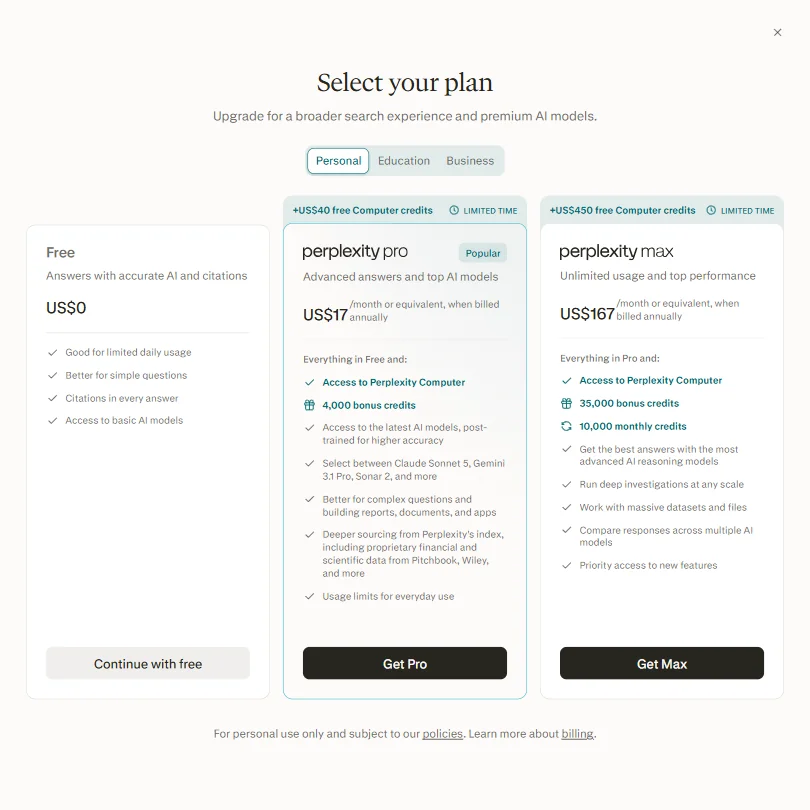
Free tier exists and is genuinely functional. Real-time search, standard AI answers, inline citations. It's not crippled. For occasional research queries, it holds up.
Pro is $20 a month, or $200 a year. That unlocks selectable advanced models, deeper Pro Search mode, file uploads and analysis, image generation, limited video generation, and Create files and apps. The value case is clear if you're doing research regularly. Less clear if you're a casual user asking five questions a week.
Max sits at $200 a month or $2,000 a year. It includes everything in Pro with higher usage limits, greater access to advanced reasoning models, Model Council, enhanced content-generation tools, early feature access, and priority support. Enterprise Pro runs $40 per user per month or $400 per user per year. Enterprise Max is $325 per user per month or $3,250 per user per year, carrying the highest usage limits, premium security controls, and faster support alongside early feature access. Education Pro exists at a discounted price for verified students and educators, though Perplexity doesn't publish a fixed number publicly. The applicable price surfaces during the verification process.
The refund policy isn't publicly documented. We dug through their help center and found nothing concrete. That's not a dealbreaker, but it's a gap. Competitor tools like ChatGPT Plus at least have clear cancellation terms. We're skeptical of that omission.
Compared to free alternatives: Google Gemini does real-time search for free at a certain tier, and Bing Copilot is also free with web access. The difference is that Perplexity's citation layer and answer quality are genuinely better than Copilot in most research scenarios. That $20 buys real capability. We think it earns it for regular users.
Perplexity vs ChatGPT: Which AI Research Tool Is Better?
Depends what you're doing. That sounds like a dodge, but it isn't.
ChatGPT is better at generating text. Long-form writing, code, creative work. The generation quality is excellent and the interface for iterating is mature.
Perplexity is better at answering factual questions quickly with traceable sourcing. It's faster to a cited answer. The citations aren't optional. They're the product.
Reddit threads from 2025 consistently show researchers switching to Perplexity for initial fact-finding and then moving to ChatGPT when they need to draft something longer. That's the real workflow. Not a competition. A division of labor.
The one area where this flips: if you're asking about something that requires synthesis from a specific document you've uploaded, ChatGPT's file analysis is more mature than Perplexity's. More nuanced outputs, more context retention across a long conversation. Perplexity's document upload is functional but younger.
Both tools now pull from multiple AI models, and both have web search capabilities. The gap is narrowing. Perplexity's edge is the citation layer and the focus. It's a tool built for one thing. That focus shows.
Who Should Use Perplexity? (And Who Shouldn't)
Knowledge workers who spend time fact-checking before writing anything. Journalists doing background research. Students doing initial literature sweeps before going into academic databases. Natural fit.
Marketing researchers. Multiple G2 reviewers in that role praised it for competitive research and trend spotting. It's fast, it cites sources, and it doesn't require a subscription to an expensive intelligence platform.
Who shouldn't bother with the paid plan: occasional users with light research needs. The free tier is good. You don't need $20 a month for five queries a week.
Academic researchers needing serious peer-reviewed depth. The academic search on Pro helps, but it's not a replacement for PubMed or a purpose-built literature tool. For that, look at Elicit, which is designed specifically for systematic literature work in a way that Perplexity isn't.
Enterprise teams without IT involvement in AI tooling. The enterprise tiers have data controls and the newer Comet Max Assistant features, but rolling it out without a clear evaluation is not the move.
Perplexity Review Verdict
The citation layer is real and it matters. Most AI tools ask you to trust the output. This one points you to the source. That's a different product philosophy and it makes Perplexity genuinely more useful for anyone doing research rather than just drafting.
The accuracy issues are real too. Citations don't guarantee the synthesis is correct. We'd be lying if we said the hallucination problem is fully solved. It isn't. You still need to verify.
But compared to what's out there, Perplexity is one of the better research-oriented AI tools we've covered at this price point. The free tier is actually useful, which isn't true of every competitor. The Pro plan at $20 a month earns its keep for regular users. The product is still growing fast, which means the enterprise features and new agent capabilities are half-formed. That's fine for now.
What we'd want to see: better export options, a publicly documented refund policy, and deeper academic source coverage at the standard tier. Those aren't small gaps. They're just not reasons to dismiss the product.
Worth trying. Worth paying for if research is a real part of your work.
Frequently Asked Questions
Is Perplexity AI free to use?
Yes. The free tier includes real-time web search, inline citations, and basic AI-powered answers with no time limit. It's genuinely functional, not a stripped demo. The meaningful limitations kick in when you need academic sources, file uploads, or access to advanced selectable models like Sonar 2 or Claude Sonnet 5, all of which sit behind the $20 a month Pro plan.
How accurate is Perplexity compared to other AI tools?
Better than most for factual queries, but not accurate enough to use without checking. The citations give you a way to verify claims, which is a real advantage over plain chatbots. That said, we kept seeing reports in Reddit threads and G2 reviews of the AI stretching sources slightly, citing real pages that don't quite support what's being claimed. Use it to get oriented fast, then verify anything important.
What's the difference between Perplexity Pro and the free plan?
The free plan gives you standard web search with citations. Pro, at $20 a month or $200 a year, adds access to selectable advanced models, deeper Pro Search mode, academic and scholarly source access, file uploads and analysis, image generation, and limited video generation. For occasional queries, the free plan is probably enough. For anyone doing research regularly, the academic sources and model options on Pro are worth the cost.