PicLumen is a multi-model creator platform for images and short video, built around a standing free daily plan rather than a time-limited trial. What decides whether it fits you is how much commercial-use rights and model access you need: those scale up with the paid tiers rather than coming free.

What is PicLumen?
PicLumen is a web app at piclumen.com, with a companion iOS app called Naivideo for generating video from a phone. Rather than building its own generation models, PicLumen brings together third-party image, video and audio models in one account, alongside its own canvas, editing and upscaling tools.
Other companies' models on PicLumen
For video, PicLumen offers Seedance 2.5, Seedance 2.0, Seedance 2.0 Mini, Wan 3.0, MiniMax H3, Kling 3.0 and Veo 3.1. For images it adds GPT Image 2, GPT Image 2.5 (in its Flare and Sunburst modes), ChatGPT Image 2, ChatGPT Image 2.5, Seedream 5.0 Pro, Nano Banana, Midjourney, Qwen Image 3.0 and FLUX. Nano Banana Pro is not among the models listed. Audio comes from Suno v6.
What you can make with PicLumen
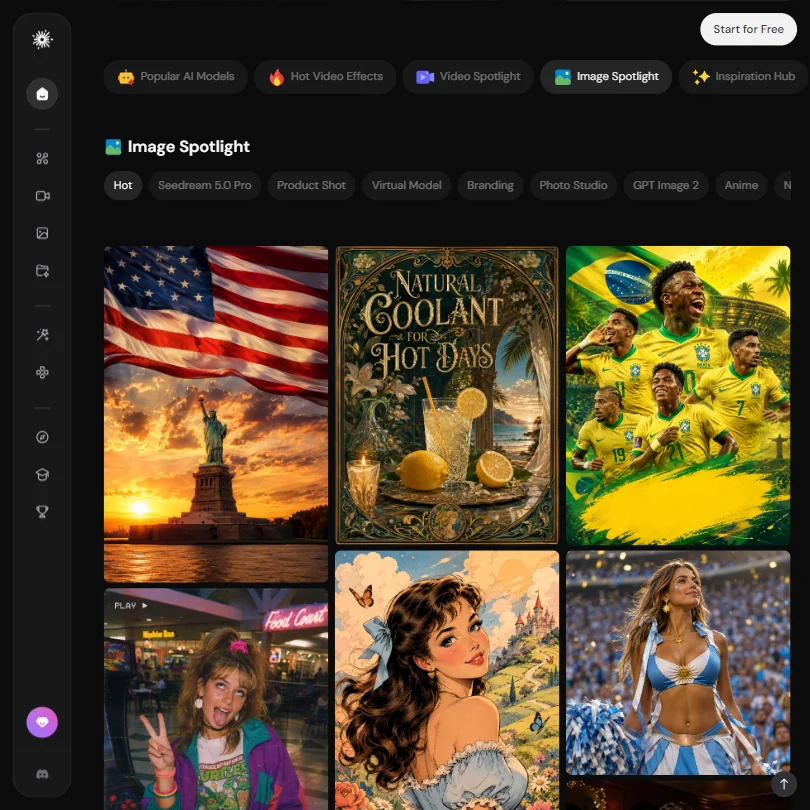
For images, PicLumen bundles an upscaler with a set of editing tools: background removal and replacement, virtual model and outfit changing, face swap, and sketch-to-reality conversion. GPT Image 2.5's Sunburst mode is positioned for precise, premium editing, while Flare handles faster, more general creation.
Workflows, agents and teams
PicLumen's Canvas lets you build image and video pipelines on an infinite canvas, with the number of canvas projects and nodes per canvas increasing by plan. PicLumen does not offer an API. Team collaboration, described as flexible allocation, centralized billing and dedicated support, is limited to the custom-quoted Enterprise plan.
PicLumen pricing: what each plan gives

The free Basic plan gives 20 Lumens a day, enough for about 20 images or one video, in Normal generation mode, with no commercial-use rights.
Lite costs $7.59 a month ($6.09 a month billed yearly) for 750 Lumens a month, about 750 images or 30 videos, watermark-free, with a limited commercial license.
Standard costs $24.99 a month ($19.99 billed yearly) for 2,500 Lumens, about 2,500 images or 100 videos, with a full commercial license.
Pro costs $49.99 a month ($37.49 billed yearly) for 6,000 Lumens, about 6,000 images or 240 videos, with a full commercial license that adds extension rights.
Elite costs $359.99 a month ($269.99 billed yearly) and spans four Lumen sub-tiers from 15,000 to 60,000 a month; the top sub-tier makes about 60,000 images or 2,300 videos, with a business-level commercial license.
Relax Mode lets you keep generating after your Lumens run out, at lower priority and slower speed, but only with PicLumen's own model series. It gives unlimited image generation on Standard, Pro and Elite, unlimited video generation on Pro and Elite, and limited access on Lite.
Privacy and support
PicLumen's terms give it a right to use content you post publicly to train its models, develop new products and market its services, with no opt-out offered. PicLumen has no SOC 2 certification and its privacy policy makes no GDPR reference; it is governed by the laws of Hong Kong. It does not offer SSO. Support is by email at service@piclumen.com.
Who PicLumen suits
PicLumen suits people who want a free daily allowance across a wide spread of third-party models, plus a canvas for chaining image and video steps together, image upscaling and editing tools like background removal and face swap without paying anything upfront.
It suits less well anyone who needs commercial rights immediately, since the free plan carries none and Lite's license is only limited. Teams that need an API, SOC 2, GDPR coverage or SSO, or that post confidential content publicly on the platform, should look elsewhere or read the terms first.
How PicLumen compares
PicLumen scores 6.5 out of 10 among the multi-model AI platforms we rate. These three do the same job and are the closest to it, compared on what each vendor publishes.
SeaArt AI
SeaArt AI costs $5.99 a month against PicLumen's $7.59, and runs on Android as well as iOS and the web. PicLumen offers Kling 3 and Veo 3.1, which SeaArt AI does not list among its 10 video models. Both include a free plan, unlimited generation, an upscaler and image editing. SeaArt AI also offers lip sync.
Pick SeaArt AI if you want an Android app and lip sync.
Pick PicLumen if you want Kling 3 and Veo 3.1.
getimg.ai
PicLumen's cheapest plan is $7.59 a month, slightly less than getimg.ai's $10, and PicLumen offers Kling 3, Veo 3.1 and Seedance 2, none of which appear among getimg.ai's 2 video models. PicLumen also includes a free plan and unlimited generation on some models, which getimg.ai lacks. getimg.ai offers Flux 2 among its image models, which PicLumen does not list. getimg.ai's privacy policy discusses GDPR rights; PicLumen's does not.
Pick getimg.ai if you specifically need Flux 2 for image generation.
Pick PicLumen if you want Kling 3, Veo 3.1 and a free plan.
OpenArt
PicLumen costs $7.59 a month against OpenArt's $14, and includes a free plan plus unlimited generation on some models; OpenArt offers neither. OpenArt lists more than double the video models, 14 against PicLumen's 7, and adds Nano Banana Pro and single sign-on, which PicLumen does not offer. Both support Kling 3, Veo 3.1 and image editing. PicLumen's paid plans export without a watermark, matching OpenArt's.
Pick OpenArt if you want more video models and Nano Banana Pro.
Pick PicLumen if you want a free plan with unlimited generation.
Frequently Asked Questions
Does PicLumen have a free plan?
Yes. The Basic plan gives 20 Lumens a day, about 20 images or one video, in Normal mode, but with no commercial-use rights.
Which models does PicLumen offer?
Video comes from Seedance, Wan 3.0, MiniMax H3, Kling 3.0 and Veo 3.1. Images come from GPT Image 2 and 2.5, Seedream 5.0 Pro, Nano Banana, Midjourney, Qwen Image 3.0 and FLUX. Audio comes from Suno v6.
What do PicLumen's plans cost and make?
Lite is $7.59 a month for 750 Lumens, Standard is $24.99 for 2,500, Pro is $49.99 for 6,000, and Elite is $359.99 for 15,000 to 60,000, each roughly convertible into images or videos at about 1 and 20 to 25 Lumens respectively.
What is PicLumen's Relax Mode?
It lets you keep generating with PicLumen's own models after your monthly Lumens are used up, at lower priority. It is unlimited for images from Standard up, and for video from Pro up, but does not apply to third-party models like Seedance or Kling.