Tensor.Art is a community model-hosting platform where you generate images and video using open checkpoints and LoRAs that other users have trained, plus proprietary models such as Kling and Nano Banana through its linked Forge tool. Whether it suits you depends on whether a free daily credit allowance and a huge library of community models is enough, or whether you need premium third-party video and image models, which run on Forge's separate Energy currency rather than Tensor's own credits.
What is Tensor.Art?
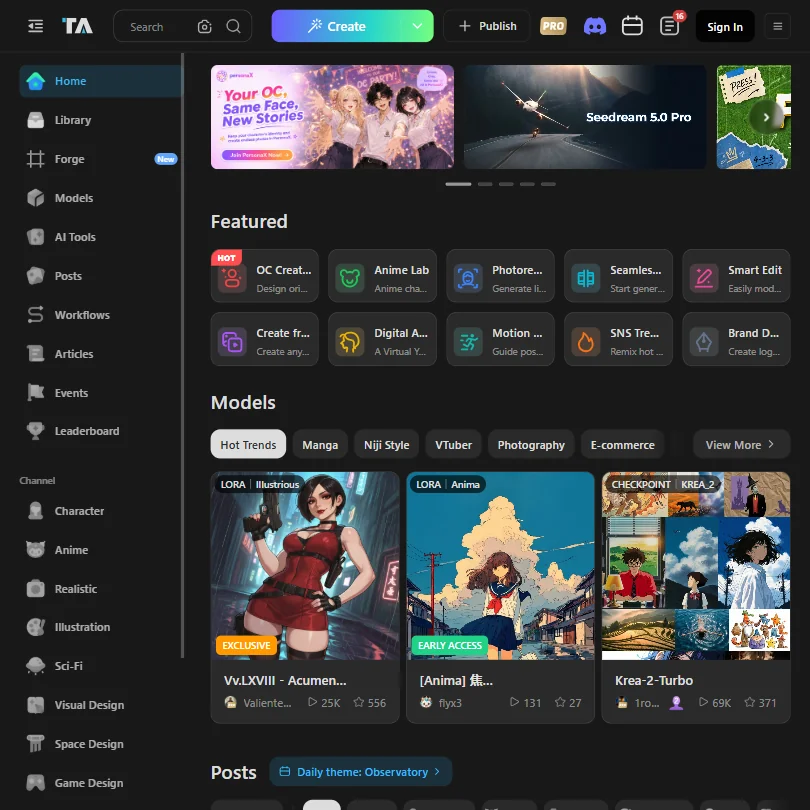
Tensor.Art runs in the browser and works as a hub for open and community-trained image and video models: checkpoints such as Stable Diffusion 1.5 and SDXL 1.0, along with community LoRAs and larger base models such as Wan, HunYuan, CogVideoX, SkyReels, Mochi and LTX 2. Forge, reachable from Tensor.Art's own navigation, adds an infinite canvas and a chat-based Design Agent, plus paid access to proprietary models from other companies.
Other companies' models on Tensor.Art
For video, Tensor.Art offers Wan 2.7, 2.6, 2.5, 2.2 and 2.1, HunYuan, CogVideoX, SkyReels, Mochi, LTX 2 and Minimax H3-REF2V, plus Kling Omni 3.0, Kling V3.0, Seedance 2.0 and Seedance 2.0 Fast through the linked Forge tool. Veo 3.1 is not among the models listed. For images it lists Z-Image-Turbo, Illustrious, Anima, KREA_2, FLUX.2 Klein 9B, Stable Diffusion 1.5, SDXL 1.0, AuraFlow, Chroma, Chroma Radiance, CosXL, ERNIE-IMAGE, ERNIE-IMAGE-TURBO and FireRed-Image-Edit as community base models, and Nano Banana 2, Nano Banana Pro, Midjourney V7, Midjourney V7 Niji, Qwen-Image-Edit and GPT Image 2.5 through Forge.
What you can make with Tensor.Art
Tensor.Art's Img2Video panel supports first and last frame video generation through its FLF2V model filter, alongside standard text to video and image to video modes across the Wan, HunYuan and other open video models.
For images, Smart Edit modifies, enhances or transforms an existing image, and the Edit tab sits alongside Text2Img and Img2Img as a generation mode. LoRA training is available on the free Starter plan, and Pro adds larger training runs of up to 1,000 images plus private, unlisted models.
Workflows, agents and teams
A dedicated Workflows section in Tensor.Art's own navigation builds multi-step generations, and Forge adds a second, infinite canvas for the same kind of work. A Design Agent generates, edits and refines designs from chat inside Tensor.Art, and Forge has its own Agent that builds from a described idea.
Tensor.Art pricing: what each plan gives
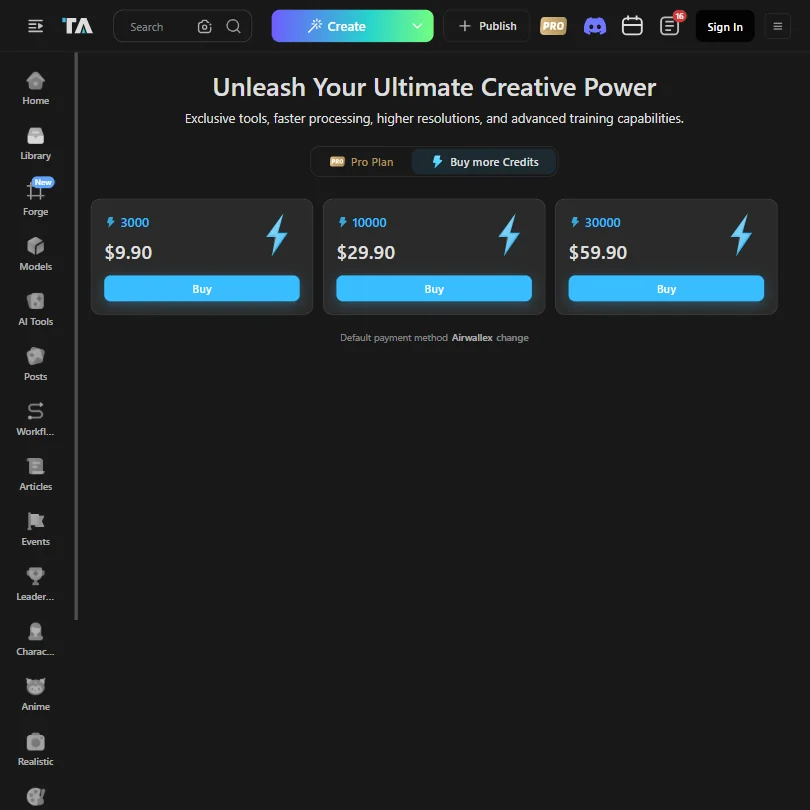
Tensor.Art prices in credits. The free Starter plan never expires and gives 50 credits a day, image and video generation, access to more than a million community models and LoRAs, LoRA training and free storage for up to 7 days.
Pro costs $9.90 a month, or $69.90 billed yearly, about $5.83 a month, for 300 credits a day. The monthly term adds a one-time 1,000 bonus credits, and the yearly term adds 25,000. Pro also raises LoRA training to up to 1,000 images per run, adds private model training, and includes 200 fast generations a month with no queue.
On Tensor.Art's own generation panel, a Z-Image-Turbo image costs 0.36 credits at a custom size, and a 3 second, 720p Wan2.2 video in Fast mode costs 18.32 credits. Forge prices its proprietary models separately in Energy: a $82, 10,500-Energy pack makes about 1,250 Nano Banana 2 images, 625 Nano Banana Pro images, 833 Midjourney V7 images, 10,000 Qwen-Image-Edit images, 1,000 seconds of Seedance 2.0 video and 1,000 seconds of Kling V3.0 video, each plus a bonus on top.
Privacy and support
Support runs through a Discord community linked from Tensor.Art's navigation, with the same Discord also linked from Forge.
Who Tensor.Art suits
Tensor.Art suits anyone who wants to explore a huge range of community-trained checkpoints and LoRAs without paying, and who is comfortable training their own LoRA on the free plan. It also suits people who want occasional access to premium models like Kling, Seedance and Nano Banana Pro through Forge, on top of the open models Tensor.Art hosts directly.
It suits less well anyone who wants premium models billed the same way as the rest of their generation, since Kling, Seedance, Nano Banana and GPT Image 2.5 run on Forge's separate Energy currency rather than Tensor.Art's daily credits.
How Tensor compares
Tensor scores 7.6 out of 10 among the multi-model AI platforms we rate. These three do the same job and are the closest to it, compared on what each vendor publishes.
SeaArt AI
Tensor's cheapest plan is $9.90 a month against SeaArt AI's $5.99, and Tensor offers Kling 3, Nano Banana Pro and Flux 2, none of which SeaArt AI lists among its models. SeaArt AI includes unlimited generation on some models, which Tensor does not, and runs as iOS and Android apps. Both include a free plan, LoRA training and canvas workflows. Tensor lists more image models overall, 20 against SeaArt AI's 9.
Pick SeaArt AI if you want unlimited generation and a mobile app.
Pick Tensor if you want Kling 3, Nano Banana Pro and Flux 2.
RunDiffusion
Tensor's cheapest plan is $9.90 a month against RunDiffusion's $10.99, and Tensor offers GPT Image 2, which RunDiffusion does not list. RunDiffusion offers Veo 3.1, which Tensor does not offer. Both include LoRA training, canvas workflows and a free plan. RunDiffusion confirms GDPR compliance and single sign-on.
Pick RunDiffusion if you want Veo 3.1, GDPR compliance and SSO.
Pick Tensor if you specifically need GPT Image 2.
PicLumen
PicLumen costs $7.59 a month against Tensor's $9.9, and includes unlimited generation on some models, which Tensor does not offer. PicLumen also offers Veo 3.1, which Tensor does not list, while Tensor offers Nano Banana Pro and Flux 2, which PicLumen does not. Both include a free plan, LoRA training and canvas workflows. PicLumen also runs as an iOS app.
Pick PicLumen if you want Nano Banana Pro and Flux 2.
Pick Tensor if you want Veo 3.1 and unlimited generation.
Frequently Asked Questions
Does Tensor.Art have a free plan?
Yes. The Starter plan is free and does not expire, with 50 credits a day for image and video generation, access to more than a million community models and LoRAs, and LoRA training.
Which models does Tensor.Art offer?
Tensor.Art hosts open and community models such as Wan, HunYuan, CogVideoX and Stable Diffusion, plus Kling Omni 3.0, Kling V3.0, Seedance 2.0, Nano Banana 2, Nano Banana Pro, Midjourney V7 and GPT Image 2.5 through its linked Forge tool.
What does Tensor.Art's Pro plan cost and include?
Pro costs $9.90 a month, or about $5.83 a month billed yearly at $69.90, for 300 credits a day plus a one-time bonus of 1,000 or 25,000 credits depending on the billing term, larger LoRA training runs and 200 fast generations a month.
What is Forge?
Forge is a tool linked from Tensor.Art's own navigation that adds an infinite canvas and its own Agent, and prices proprietary models like Kling, Seedance and Nano Banana in a separate currency called Energy, sold in one-time packs.