Researching StackAI took longer than expected. Not because the product is obscure, but because the public review trail is nearly empty. No G2 listing, nothing on Capterra, and Trustpilot has no meaningful presence. So this review is built from vendor documentation, pricing pages, community threads on Discord and Reddit, and whatever product coverage exists across tech forums. The signal we did find was consistent enough to draw conclusions.
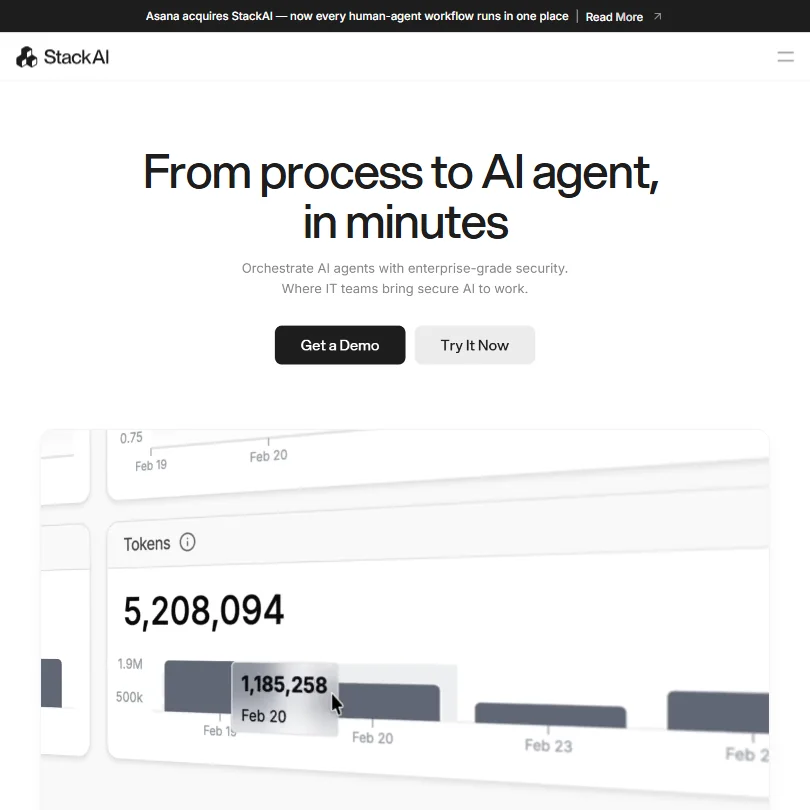
One other thing to state plainly: Asana announced it's acquiring StackAI. The homepage banner says so. What that means for pricing, roadmap, and the product's independence as a standalone platform is not yet clear. We'd factor that into any buying decision.
What is StackAI?
Founded in 2022 and based in San Francisco, StackAI is an agentic workflow platform built specifically for enterprise IT teams and organizations in regulated industries. Healthcare, finance, legal. That's the positioning they've committed to hard.
The product lets you build AI-powered workflows with a no-code drag-and-drop builder. It connects to 100+ integrations and supports multiple LLMs, including OpenAI and Anthropic Claude, so you're not locked to a single model. You deploy the right model for each task. That's genuinely useful in enterprise settings where model choice sometimes carries compliance implications.
What makes StackAI different from something like Zapier isn't the visual builder. It's the governance layer. SOC 2 Type II, HIPAA, ISO 27001, GDPR certified. On-premise and VPC deployment options. Human-in-the-loop controls baked into the workflow design. That stack of compliance credentials is the actual product differentiator. Not a feature. The reason to buy.
StackAI Features: Workflows, AI Agents & Automation Capabilities
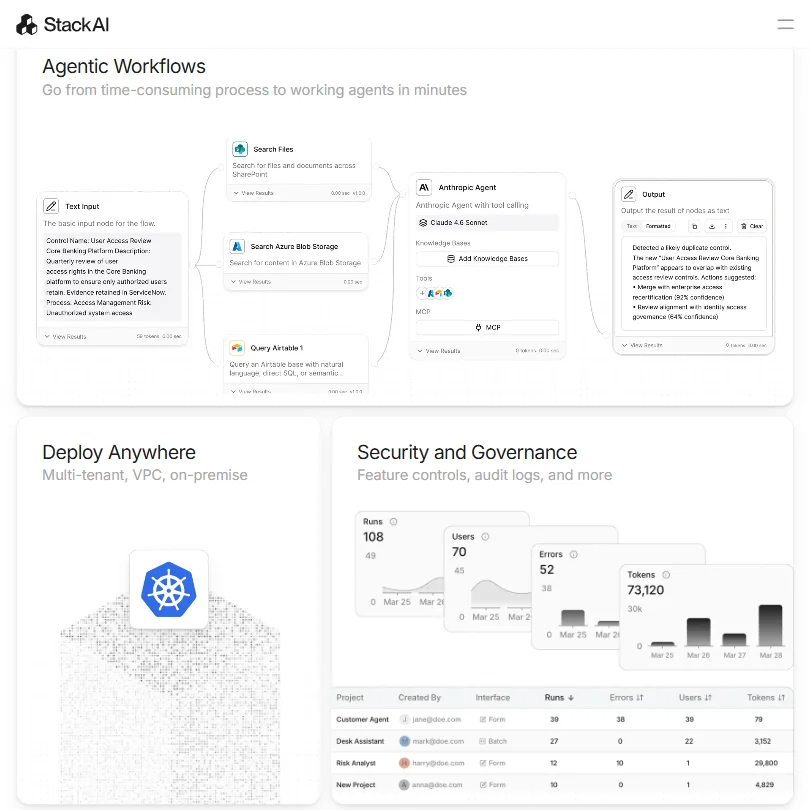
The core product is a visual flow builder. You drag nodes onto a canvas, connect them, and each node can be an LLM call, a data loader, or a human approval step. The output chains into the next node. That's the loop.
Human-in-the-loop integration is real, not a checkbox. You can insert approval gates at specific points in a workflow. For regulated industries, that matters a lot. A claims processing workflow that auto-generates a summary but routes to a human before any action gets taken is a fundamentally different compliance posture than full automation.
Code nodes support Python and JavaScript. So developers on the team can push logic beyond what the drag-and-drop builder handles. That's a smart design choice. Most enterprise workflows hit a wall at some point where no-code runs out of road.
On integrations: Google Drive as a data loader, Slack as a bot trigger, and REST API access are present, and a few others. Whether 100+ integrations feels thin or generous depends entirely on what your stack looks like. Audit logs are included. SSO is available on enterprise accounts. Access controls sit on team plans. Honestly, that's table-stakes for anything selling into regulated industries, so it's less impressive than it sounds.
StackAI Automation Power: How Complex Can Your Workflows Get?
The real question is whether the visual builder holds up under actual enterprise complexity. Based on what we've found, it handles multi-step agentic workflows with branching logic. Conditional logic nodes are supported, so you can route a workflow differently based on what an LLM extracts from a document.
Trigger types include REST API, Slack, and file uploads, plus webhooks and scheduled runs. Most enterprise automation scenarios have at least one of those as an entry point.
Multi-agent support is also present. You can orchestrate multiple agents within a single flow. That's not common in tools at this price range. We'd want to see how it performs under real load before calling it production-grade, but the architecture supports it.
Error handling is listed as enterprise-grade with dedicated infrastructure, which is a feature the Enterprise plan explicitly includes. The documentation is light on specifics here. That vagueness is a minor frustration when you're evaluating something for critical workflows. We'd push any vendor on exactly what that means before signing a contract.
StackAI AI Agent Capabilities: What Can It Actually Do Autonomously?
StackAI is explicitly built around agents, not just automation triggers. The distinction matters. Most tools in this space are trigger-action pipelines with an LLM node dropped in. StackAI is designed from the beginning to run agents that make decisions across multiple steps without a human touching anything in between.
The LLM-agnostic deployment is the piece we kept coming back to. You pick the model per task. A cheap, fast model for classification, a more capable one for drafting. That kind of task-level model assignment is something most competitors haven't built properly.
Use cases listed on their site include IT ticket triage, claims processing, and RFP drafting. Those aren't generic examples. They map directly to real workflows that currently eat hours of human time in large organizations. That specificity is a good sign. Vendors who know exactly what problem they're solving tend to build better products.
We're skeptical of how smooth the out-of-the-box experience is for genuinely novel agent designs. That skepticism isn't based on negative reviews, because there aren't many public ones. It's based on the general state of the category. Agentic platforms are still early.
Is StackAI Easy to Set Up Without Code?
For a non-technical enterprise user, the honest answer is probably not on day one. The visual builder is no-code in the technical sense. But building a workflow that actually connects to your existing systems, loads the right data, and routes correctly requires judgment that comes from understanding the platform.
StackAI offers templates, and an Academy and documentation are available. A Discord community is the support channel on the free tier. Enterprise plans get dedicated support from what the platform calls dedicated solution engineers. That's a named feature on the Enterprise plan, not a vague promise.
The product is positioned as something a vendor-customer team builds together, not something you spin up in a weekend. For regulated industries with complex requirements, that's probably appropriate. For a small team trying to automate a simple workflow, it's probably overkill.
The Chrome extension exists and is mentioned in the platform list. It's unclear from the documentation what it actually does in the core workflow builder context. We'd want clarity on that before recommending the platform.
StackAI Pricing: Is It Worth It vs Zapier or Make?

There's a free tier. 500 runs per month, 2 projects, 1 seat. Community support only. That's workable for evaluation but not for anything meaningful.
Beyond free, the pricing page moves straight to Enterprise at a custom monthly rate. No mid-tier. No per-seat number. Nothing published. The Enterprise plan lists unlimited projects, a custom number of seats, dedicated infrastructure, and on-prem or Virtual Private Cloud deployment, plus SSO and SOC 2, HIPAA, and GDPR compliance. You get all of that for a price only a sales call reveals.
The complete absence of any published pricing anchor makes it nearly impossible to build an internal business case without getting on a call first. That's a real friction point for individual contributors trying to justify the spend upward.
Compare that to n8n, which publishes its self-hosted pricing, its cloud pricing, and enterprise starting points. You can run a real cost comparison before ever talking to sales. With StackAI, you can't. We understand the enterprise sales motion. Custom pricing is normal. But some kind of starting-point anchor would make the tool much easier to evaluate. Not great.
StackAI vs n8n: Which Automation Platform Wins?
These two aren't really competing for the same customer. n8n is a developer-first workflow automation tool. Open source, self-hostable, strong on integrations, and used heavily by solo builders and small technical teams who want control over their infrastructure.
StackAI is built for enterprise IT with compliance requirements baked in. The HIPAA and SOC 2 certifications, the VPC deployment option, the human approval gates, and the dedicated solution engineer model. That's not the n8n story.
Where they do overlap is the no-code builder and the ability to incorporate LLMs into workflows. n8n has added AI capabilities meaningfully. StackAI has always been built around agents first. For a healthcare organization that needs HIPAA compliance on its AI workflows, StackAI wins that conversation without much debate. For a startup that wants to automate a CRM sync and needs 500 integrations, n8n is probably the faster path.
The Asana acquisition muddies this comparison. If StackAI starts moving into task management territory, the competitive landscape shifts in ways that are hard to predict right now.
Who Should Use StackAI? (And Who Shouldn't)
Enterprise IT teams in healthcare, finance, or legal. That's the core audience. If your organization has compliance requirements that rule out most consumer AI tools, StackAI's certification stack is one of the few ready-made answers available today.
Large organizations that need agent workflows reviewed by humans before they act. The approval gate functionality is built for that.
Smaller teams without compliance requirements and with a limited budget. The opaque pricing, the sales-led model, and the learning curve don't justify the fit. There are faster, cheaper tools for simpler problems. Fair.
StackAI Review Verdict
StackAI is a legitimate platform for a specific type of organization. One with regulated data, complex workflows, and an IT team willing to invest time in setup. The compliance certifications are real. The agentic architecture is real. The human-in-the-loop design is genuinely differentiated.
The concerns are real too. Pricing opacity is a genuine barrier. The review trail is almost nonexistent, which makes it hard to validate vendor claims with real customer experience. And the Asana acquisition creates uncertainty around where the product goes from here.
The platform is worth evaluating seriously for any enterprise with AI automation needs in a regulated industry. For everyone else, it's probably not the first tool to reach for.
Frequently Asked Questions
Does StackAI have a free plan?
Yes. The free tier gives you 500 runs per month, 2 projects, and 1 seat with community support on Discord. It's limited enough that you'd feel the walls quickly, but it's a real evaluation option.
Is StackAI HIPAA compliant?
According to their documentation and website, yes. StackAI holds HIPAA, SOC 2 Type II, ISO 27001, and GDPR certifications. Those are listed prominently on the site and appear to be verified, not just self-reported. For healthcare organizations evaluating AI workflow tools, that certification stack is one of the stronger ones we've seen at this tier.
What happened with the Asana acquisition?
Asana announced the acquisition and StackAI's homepage now carries that news prominently. What changes for existing customers, pricing, or the standalone product roadmap hasn't been clarified publicly as of this writing. We'd recommend asking that question directly before signing any new contracts.