Activepieces is a no code automation platform, MIT-licensed and open source, with unlimited runs and no per-execution charge.

We pulled vendor docs, community forum threads, and Trustpilot reviews before writing this. What we kept seeing was a tool the market hasn't quite figured out how to categorize yet. Founded in 2022, based in San Francisco, and sitting on 23,000+ GitHub stars, Activepieces isn't doing the Zapier impression most newcomers default to. That's either its biggest strength or its biggest sales problem, depending on who's evaluating it.
What is Activepieces?
MIT-licensed. Open-source. Those two facts shape almost everything else about Activepieces. It's an automation platform with a built-in AI agent builder, deployable on their managed cloud or on your own infrastructure via Docker or Helm. The pitch isn't just "connect your apps." It's closer to "own your automation layer entirely if you want to."
764 integrations, four trigger types (webhook, scheduled, app events, and manual), conditional logic, custom code steps, and data transformation. Standard fare. What isn't standard is that unlimited automation runs carry no per-execution charge, on any plan. For teams doing high-frequency polling or bulk data processing, that single fact rewrites the pricing comparison entirely.
Honestly, the self-hosting angle is what kept surfacing in the communities we read. Fintech teams especially. Makes sense.
Activepieces Features: Workflows, AI Agents & Automation Capabilities

The drag-and-drop builder is the entry point. Non-technical users can get something running. Developers can drop into custom code steps when the visual builder runs out of road. Both profiles seem to coexist without one experience obviously suffering, based on the Discord threads and forum posts we read through.
The AI agent builder is the more interesting addition. You write instructions, configure a trigger, attach tools, and optionally insert a Human Approval step before the agent does anything consequential. That last part matters more than it might seem. Most agent builders treat human checkpoints as optional friction. Activepieces made it a first-class feature. That tracks.
There's a pre-built agent library organized by team function, sales agents and support agents being the most prominent categories. Whether those agents are genuinely deployment-ready or dressed-up demos, we can't say without hands-on testing. Community feedback on the library specifically is still thin.
Governance features sit in the upper tiers. Custom RBAC, SSO, SCIM provisioning. Audit logs are gated behind the Ultimate plan, which is annual contract, custom pricing, contact sales. Fair as a governance tier decision. Still going to frustrate mid-market teams who need audit trails but aren't ready for an enterprise sales process.
Activepieces Automation Power: How Complex Can Your Workflows Get?
The case here is real. Conditional logic means flows don't have to be linear. Custom code steps in TypeScript or Python give developers an exit when the no-code layer isn't enough. That combination covers a wider range of actual workflows than pure no-code tools manage.
The unlimited runs model deserves more than a bullet point mention. Zapier charges per task. At meaningful automation volume, that math turns ugly fast. The Plus tier's $20 per month is a fixed cost regardless of how many times each flow executes. the Plus plan is $20 a month regardless of flow count, full stop. No overage anxiety.
We cross-referenced the documentation with community forum activity. Loops, branching, and automatic retries are all documented and appear to function as described. Not great, however, is what we found alongside that: multiple forum reports of queue build-ups, hanging agents, scheduled flows that stopped firing, and failed runs that didn't recover cleanly. These aren't proof of systemic instability. But they do exist, and they contradict any clean claim that execution reliability is complaint-free.
Performance under load on self-hosted deployments is the thing we'd most want stress-tested before committing. Vendor documentation won't tell you that honestly.
Activepieces AI Agent Capabilities: What Can It Actually Do Autonomously?
The agent builder connects to OpenAI via integration. No proprietary model underneath. Activepieces supplies the runtime, the trigger layer, and the tooling structure. The intelligence comes from whatever model you configure. Reasonable architecture. It also means agent quality is entirely dependent on how well your team sets things up, not on anything Activepieces built into the model itself.
The Human Approval step is worth returning to. Agents that pause for a human decision before touching money or customer records are meaningfully more deployable in real business environments than fully autonomous ones. Building that in as a deliberate feature, not an afterthought, is a point in Activepieces' favor.
Unlimited MCP servers on the free plan. We kept noticing that. MCP server access at no cost is unusual enough that it signals something about where Activepieces is building toward, more sophisticated agent infrastructure than basic workflow glue.
We're skeptical of the agent library framing until real-world workflow testing backs it up. Pre-built agents live or die by their documentation and configurability. The homepage makes them sound deployable today. That's almost never the full story.
Is Activepieces Easy to Set Up Without Code?
Cloud setup is fast. Connect an account, pick a template or start blank, wire up your apps. Trustpilot reviews, which Activepieces surfaces prominently on their homepage, do mention quick setup and ease of use as positives. Other reviewers on the same platform describe the interface as initially daunting, with a learning curve once APIs and webhooks enter the picture. "Consistently easy" overstates it.
Self-hosting is genuinely a different experience. Docker and Helm deployments require real DevOps capacity. Self-hosting is a technical undertaking, not a one-click install, and ongoing maintenance lands entirely on your team. That's not a complaint. It's just the honest framing teams should have before they start.
Docs, a YouTube channel, a community forum, and a Discord all exist and appear current. On G2, 142 verified reviews give Activepieces a 4.8 out of 5 at the time of our research. We couldn't confirm a current Capterra rating. One layer of user validation, not two.
Activepieces Pricing: Is It Worth It vs Zapier or Make?

The free tier is substantive. Ten active flows, unlimited runs, AI agents, unlimited MCP servers, unlimited tables, community support. That's a usable starting point, not a crippled demo with a countdown clock.
Standard pricing is a flat $20 per month on the Plus plan. The arithmetic is transparent. The Team plan is $200 a month flat. That compares favorably to Make at equivalent automation volume, and it likely beats Zapier once unlimited runs offset per-task charges on the other side of the ledger.
The Ultimate tier is annual contract, custom pricing, and requires a sales conversation. That's where Team and Personal Projects separation, Piece Access Controls, Global Connections, Custom RBAC, and SSO live, plus whatever control and compliance features sit below the "Show All" cutoff on the pricing page. The jump from Standard to enterprise is entirely opaque until you talk to someone. Procurement teams trying to budget-plan before a sales call will find that genuinely annoying.
Refund policy isn't publicly documented. Minor issue on monthly plans. Less minor if you're committing to an annual contract.
Activepieces vs Zapier: Which Automation Platform Wins?
Zapier wins on integration count. 9,000+ apps against 764 isn't a rounding error. Teams whose workflows depend on niche tools should check the Activepieces integration list before assuming coverage.
Activepieces wins on pricing model and data control. No per-task charges, no run limits, and the option to keep data entirely on your own infrastructure. For GDPR-sensitive organizations or high-volume teams, those are real advantages, not marketing copy.
Zapier also has years of community-built templates, a mature support structure, and internal legitimacy when you're trying to get a non-technical team to adopt something new. Activepieces is newer. The community is smaller. That's just true.
Where Activepieces pulls ahead is the AI agent layer. The human approval workflow and the MCP server infrastructure feel like they were designed for teams that need control over what agents actually do, not just speed. Different design philosophy from what Zapier is building.
Who Should Use Activepieces? (And Who Shouldn't)
Developer-led teams and IT departments wanting to own their automation infrastructure. Clear fit. Custom code steps, self-hosting, and RBAC together make it genuinely usable for organizations with real security requirements.
Business teams running high-volume automations who are currently wincing at per-task invoices. The unlimited runs model is the draw. The math is worth doing against your current bill.
Small teams starting with automation. Ten free active flows with unlimited runs is a real starting point.
Who shouldn't bother: teams dependent on integrations outside the 756 currently available. Also, teams needing audit logs without an enterprise contract. Anyone expecting a Zapier-scale template library for off-the-shelf workflows will be disappointed.
Activepieces Review Verdict
Not a Zapier clone. The MIT license, the unlimited runs model, and the self-hosting option carve out a distinct position. The AI agent builder is more considered than most, particularly the human approval workflow. These aren't marketing features bolted on after the fact.
The integration library is the honest ceiling. 756+ covers the common stack well, Gmail and Slack and HubSpot and a few others, but unusual tooling will find gaps. That won't close quickly.
Pricing is fair at low flow counts and potentially compelling at scale. The enterprise pricing opacity is the friction point that will cost them mid-market deals, teams that need governance features but won't initiate a sales process just to find out what things cost.
We came away more impressed than we expected going in. The GitHub star count and the G2 review volume suggest real adoption. The free plan is worth a test. The per-flow paid model is worth the spreadsheet if you're currently overpaying on a task-based platform somewhere else.
How Activepieces compares
Activepieces scores 7.8 out of 10 among the workflow automation tools we rate. These three do the same job and are the closest to it, compared on what each vendor publishes.
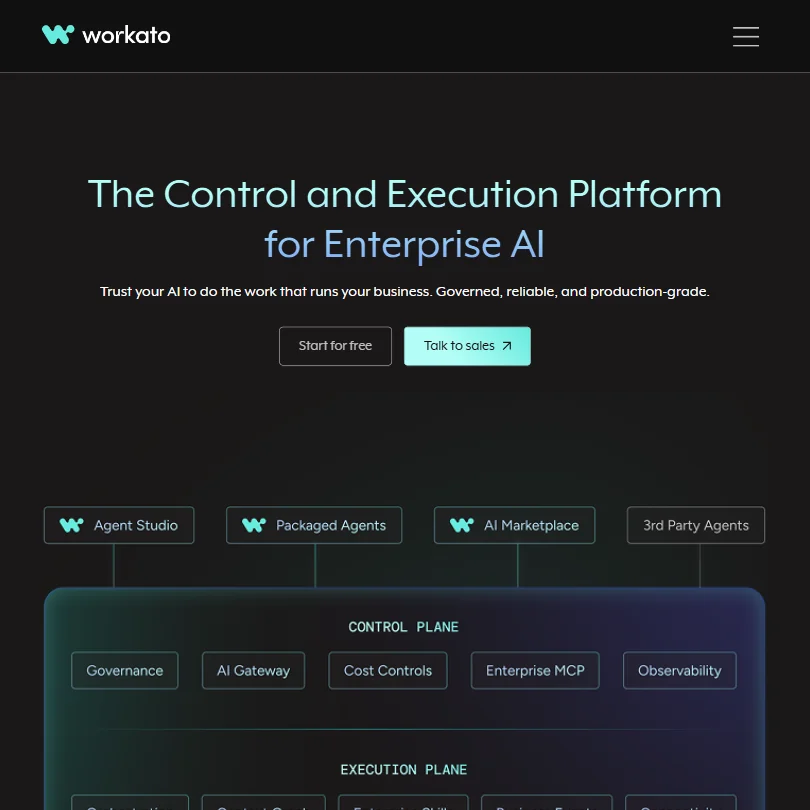
Workato
Workato's Agent Orchestration lets multiple agents hand off work to each other; each Activepieces agent works alone with no agent-to-agent handoff. Activepieces answers with infrastructure: self-hosting is available on every plan including the free tier, with EU hosting by default, while Workato has no self-hosted edition. Workato lists far more app connectors, 14,000 against Activepieces' 764. Both offer a visual builder, branching, and webhook triggers.
Pick Workato if you need agents that hand off work to each other.
Pick Activepieces if you want to self-host and keep data in the EU.
Zapier
Activepieces' cheapest paid plan clears 1,000 five-step runs for $20 a month; the same basket costs $133.5 a month on Zapier, which bills per task and counts every step as a task. Zapier connects to a stated 10,076 apps against Activepieces' 764, and adds live chat support. Activepieces keeps your data out of AI training entirely, while Zapier trains on it by default unless you opt out.
Pick Zapier if you need the biggest app library and live chat support.
Pick Activepieces if you want cheap high-volume runs and data that never trains AI.
n8n
n8n agents can supervise and hand off tasks to other AI Agent Tool nodes, and n8n ships a dedicated Evaluations feature to test agent output against test cases; Activepieces agents work alone and Activepieces has no agent evaluation tool. Both self-host and default to EU hosting. Activepieces costs $20 a month on its cheapest paid plan against n8n's $25.92 a month, and keeps 30 days of run history against n8n's 7. Activepieces also adds email support alongside community, where n8n offers community only.
Pick n8n if you need agents that hand off tasks and get evaluated.
Pick Activepieces if you want longer run history and email support included.
Frequently Asked Questions
Is Activepieces really free to use?
Yes, and it's not a hollow free tier. Ten active flows, unlimited automation runs, AI agent access, unlimited MCP servers. No time limit on the free plan. The gaps are community-only support and no SSO or advanced permissions. Those gaps matter more as team size grows, less if you're a small team proving out automation before spending money.
Can I self-host Activepieces and keep my data private?
You can. Docker and Helm deployments are supported. The MIT license means vendor terms don't govern what you do with your own data on your own infrastructure. The practical caveat is that DevOps resources are required upfront, and ongoing maintenance falls entirely on your team. One-click self-hosting this is not.
How does Activepieces compare to n8n for technical teams?
n8n is the closest real comparison for developer-oriented, self-hosted automation. Both are open-source. Both support custom code. Activepieces has the more polished no-code interface and a more deliberate AI agent layer. n8n has a larger head start in the technical community and more flexibility for complex node-based workflows. Neither is the obvious default. The decision comes down to how code-heavy your team actually is, and how much weight you place on governance tooling versus workflow flexibility.