Plaud turns recordings into transcripts and summaries, and it is built around its own recorder devices as much as its apps. In-person meetings and phone calls are recorded with a Plaud device, while online meetings are captured by a free desktop app that never joins the call. What decides whether it suits you is whether you want a dedicated recorder, and how many transcription minutes you need each month.
What is Plaud?
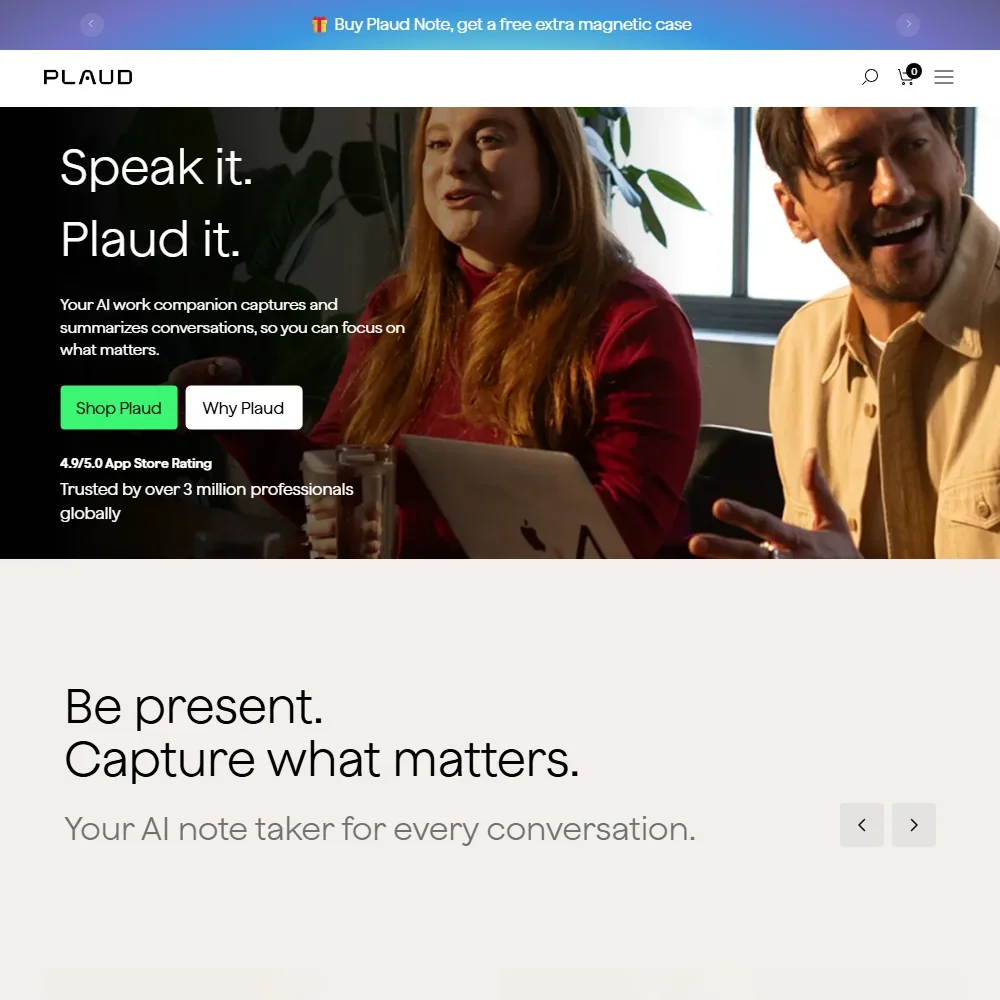
Plaud is an AI note-taking service from a company headquartered in San Francisco in the United States. It sells two things: recorder devices and AI membership plans that set how much you can transcribe. The devices are the Plaud Note Pro at $189, the NotePin S at $179, and the Plaud Note and NotePin at $159 each.
The Plaud app runs on iPhone and Android, Plaud Web runs in the browser, and Plaud Desktop (beta) runs on Windows and macOS. Every version signs in to a Plaud account, and all recordings are sent to Plaud's cloud for processing. The recorders are hardware that pairs with the app.
What Plaud captures from a meeting
Plaud has no meeting bot. For online meetings, Plaud Desktop notices when a Zoom, Google Meet, Microsoft Teams or any other meeting call begins and starts capturing the audio from your computer, both system sound and microphone. Nobody in the call sees a bot join. For in-person meetings, phone calls and conversations on the go, you record with a Plaud device.
Plaud records audio, not video, so it does not keep meeting video. While recording on the desktop you can highlight important moments as they happen and add notes and photos to the recording. Transcription covers more than 112 languages.
Summaries are written from more than 10,000 professional summary templates, and you can build custom templates; both come on every plan. The models behind Plaud's AI come from the GPT, Claude and Gemini families. Ask Plaud searches across your recordings and files to find the right context, and you can search your library by keyword, name or topic.
Working with other people
The Team plan adds a dedicated team workspace and workspace-level control over where data is kept. Plaud connects to Google Calendar, Notion, Slack, Linear and Zapier, and every one of these connectors is marked as a preview. A Salesforce integration, also in preview, is on the Team plan.
Plaud MCP, a preview feature on all plans, connects your recordings to any MCP-compatible AI client, including Claude and ChatGPT. For developers, Plaud offers a Transcription API and a Device SDK for building on Plaud devices, plus command-line access to your own recordings.
Plaud pricing: what each plan gives
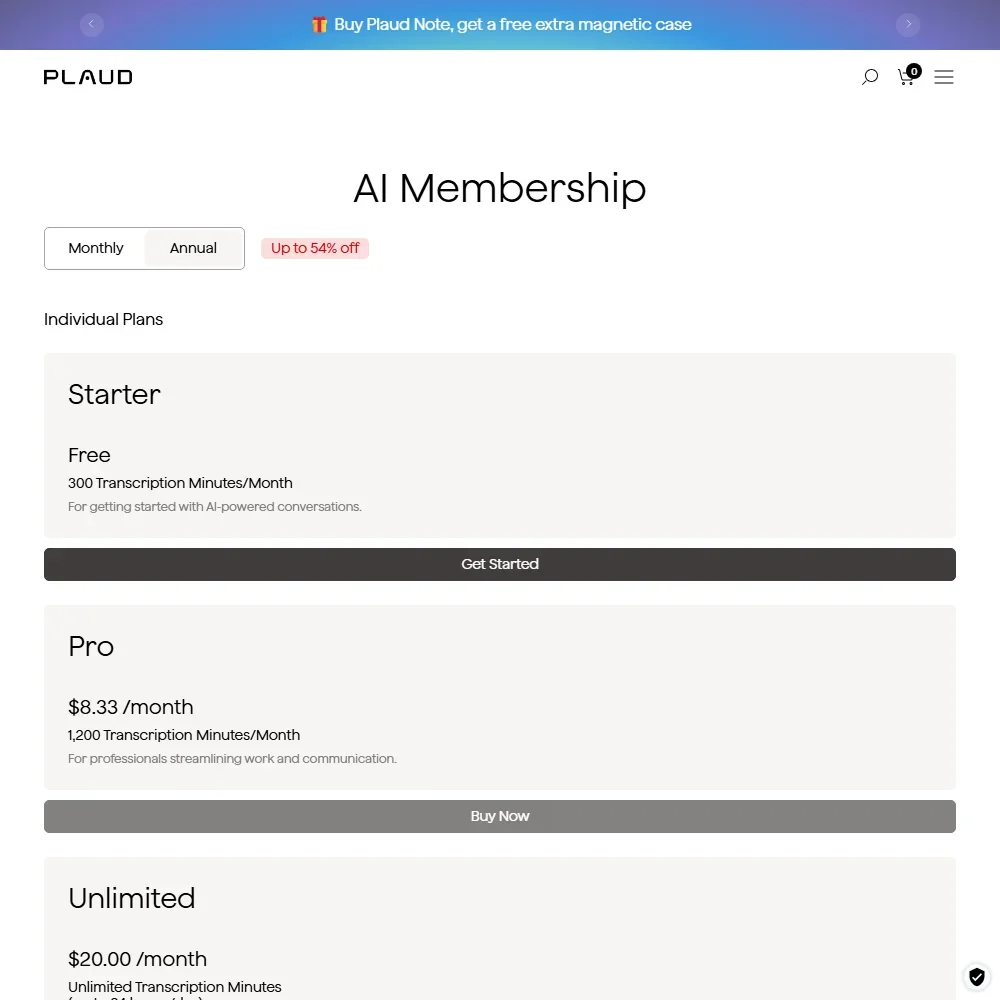
Starter is free and gives 300 transcription minutes a month. When the minutes run out, transcription pauses, but recording and every other feature keep working. The Plaud app and Plaud Desktop are free to download, though recording in person needs a Plaud device.
Pro costs $17.99 a month, or $8.33 a month billed yearly, and gives 1,200 transcription minutes a month for one account. AI transcription, summaries and templates are all included; the limit is on minutes, not on AI features. Unlimited costs $29.99 a month, or $20 a month billed yearly, and transcribes up to 24 hours a day. Team costs $35 per user a month, or $25 per user a month billed yearly, and adds the team workspace and the Salesforce integration.
On Starter and Pro, unused minutes do not roll over to the next month. One-time Extra Minutes top-ups of 600, 3,000 or 6,000 minutes are also sold. There is no free trial of a paid plan; the free Starter tier is the way in. The membership prices do not include the recorder, which is bought separately.
Privacy and security
Plaud's privacy policy is direct about training: it will "never use your Content" to train its own or any third-party AI models unless it has your explicit and informed consent. The AI model providers it uses are contractually barred from training on your data.
Every plan comes with ISO 27001, ISO 27701, GDPR, SOC 2 Type II, HIPAA and EN 18031 compliance. Plaud runs data centers in the US, in Europe (Frankfurt), in Singapore and in Japan, and stores your data in the one for your region. SAML single sign-on is available through Plaud's sales team. Support runs through email, live chat, a ticket form and a help center.
Who Plaud suits
Plaud suits people who spend much of their day in face-to-face meetings, client visits or phone calls and want a dedicated recorder for them, with online meetings handled by a desktop app that stays out of the call. It also suits anyone who works across many languages, and anyone who wants a firm promise that recordings are not used for training without consent.
It suits less well people who meet only online and do not want to buy hardware, or anyone who needs meeting video kept alongside the transcript. The free Starter tier transcribes 300 minutes a month, and unused minutes do not carry over.
Frequently Asked Questions
How much does Plaud cost?
The Starter tier is free with 300 transcription minutes a month. Pro costs $17.99 a month ($8.33 a month billed yearly), Unlimited costs $29.99 a month ($20 a month billed yearly), and Team costs $35 per user a month ($25 per user a month billed yearly). Recorder devices are sold separately, from $159 for the Plaud Note or NotePin to $189 for the Plaud Note Pro.
Does Plaud join meetings as a bot?
No. Plaud has no meeting bot. Plaud Desktop on Windows and macOS captures the audio of Zoom, Google Meet, Microsoft Teams and other calls from your computer, and a Plaud device records meetings and calls in person.
Do I need a Plaud device to use it?
For in-person recording, yes: that is what the Plaud Note and NotePin recorders are for. The Plaud app and Plaud Desktop are free to download, and Plaud Desktop records online meetings on your computer.
Does Plaud train AI on my recordings?
No, not without your explicit and informed consent. Plaud does not use your audio, files or conversations to train its own or third-party models by default, and its AI model providers are contractually barred from training on your data.