Dream Machine is what most people still call Luma's video app. Luma has since retired the name: the product is now the Luma app, built around Luma's own Ray3.2 video model, with Kling, Seedance, Veo and other companies' models in the same account on one pool of credits. What a plan buys depends heavily on which model and resolution you choose.
What is Luma Dream Machine?
Luma AI is a California company founded in 2021. Its app runs in the browser and on iOS and turns text, images and existing footage into video, with image and audio generation alongside. Luma Agents can plan and carry out multi-step creative work, such as a set of product shots or a short sequence, using whichever models suit each step.
Luma's own current video model is Ray3.2, released in June 2026. The older names you may see in guides, Dream Machine as a model, Ray2 and the Photon image model, are deprecated.
Luma's own models
- Ray3.2 (latest video model): text to video and image to video in 5 or 10 second clips from draft quality up to 1080p, Modify Video for restyling footage up to 20 seconds at 1080p, up to 16 keyframes per clip, and native HDR in 16-bit colour with EXR export.
- Ray3.14: the previous video model, cheaper per second, and the one that extends clips.
- UNI-1.1 (latest image model): text to image with up to nine reference inputs.
- Uni-1: the earlier image model, still available.
Other companies' models in Luma
For video, Luma offers Seedance 2.5, 2.0 and 2.0 Mini, Kling Omni, Kling 3.0 and 3.0 Turbo, Google Veo 3.1, MiniMax H3, Flux 3 and Gemini Omni Flash, plus Sync's lip sync models. For images it adds GPT Image 2 and 2.5, Nano Banana 2 and Pro, and Seedream. Audio comes from ElevenLabs (speech, sound effects, music and stem separation), Seed Audio and Whisper for transcription.
What you can make with Luma
Ray3.2 covers text to video, image to video and video to video. To control how a shot unfolds, you set a start and end frame or up to 16 keyframes along the clip, and describe camera moves in the prompt. Reframe changes a clip's aspect ratio while keeping its motion, and Ray3.14 extends a clip past its end.
Ray3.2 does not generate sound. For audio made together with the picture, Luma offers Seedance, Kling 3.0, Veo 3.1, MiniMax H3 and Flux 3, all at a higher credit cost. Speech, sound effects and music can also be generated separately with ElevenLabs, lip sync comes from Sync's models, and Whisper transcribes speech for captions.
Ray3.2 tops out at 1080p. Kling Omni, Kling 3.0 and Seedance 2.0 generate in 4K inside Luma, and any clip can be upscaled to 4K for 17 credits a second. Ray3.2 is the one model here that renders HDR.
Luma pricing: what each plan makes
Credits pay for everything. A ten-second Ray3.2 clip costs 1,200 credits at 1080p, 300 at 720p and 60 as a draft. HDR doubles the cost and HDR with EXR triples it. Ray3.14 at 1080p costs 800 credits for ten seconds, and Kling 3.0 at 1080p with audio costs 490.
New accounts get free trial credits. Free output is for personal use only and can carry a watermark.
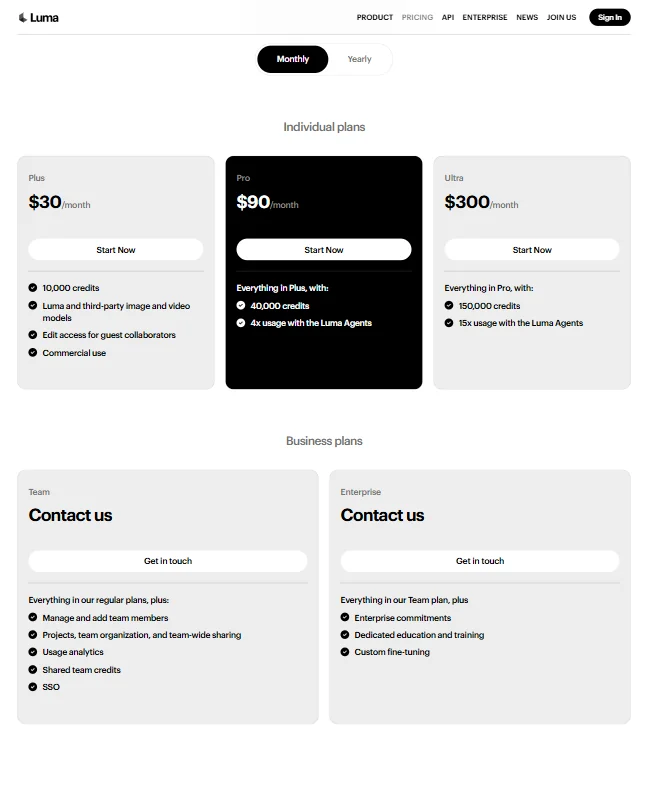
Plus costs $30 a month ($25 a month billed yearly) for 10,000 credits. That is about eight ten-second Ray3.2 clips at 1080p, 33 at 720p, or 20 Kling 3.0 clips with audio. It removes the watermark, allows commercial use and opens every model.
Pro costs $90 a month ($75 billed yearly) for 40,000 credits, about 33 Ray3.2 clips at 1080p, and four times the Luma Agents usage. Ultra costs $300 a month ($250 billed yearly) for 150,000 credits, about 125 Ray3.2 clips at 1080p, and fifteen times the agent usage. Team and Enterprise plans are sold through sales and add shared credits, team management and SSO.
Privacy and support
Luma's terms let it use what you upload to train and improve its models on paid plans as well as free ones, and they describe no opt-out. On the free tier the licence is wider still, covering public display and distribution of your inputs. Enterprise contracts are negotiated separately.
Support is by email at support@lumalabs.ai, with a learning hub of guides and a Discord community.
Who Luma suits
Luma suits filmmakers and creative teams who want Ray3.2's keyframe control and HDR output for hero shots, and who like having Kling, Seedance and Veo a click away for shots that need sound or 4K. Guest collaborators can edit on every plan, and the agents help when a job is a batch of related shots rather than one clip.
It suits less well anyone who needs a lot of 1080p footage on a small budget: Plus makes only about eight full-resolution Ray3.2 clips a month. Teams handling confidential material should read the training terms first.
How Luma AI compares
Luma AI scores 8.0 out of 10 among the AI video generators we rate. These three do the same job and are the closest to it, compared on what each vendor publishes.
Runway
Both offer other companies' models next to their own. Luma AI's Ray3.2 takes first and last frames and extends clips on Luma's own model; Runway's Gen-4.5 takes text or an image and outputs 720p, reaching first and last frames, audio and 4K through Veo 3.1, Kling 3.0 and Seedance 2.0. A working month of 20 ten-second clips costs $90 on Luma AI's Pro plan against $95 on Runway's Max plan. Runway holds SOC 2 and GDPR, which Luma AI does not list.
Pick Runway if you need SOC 2 and GDPR compliance for a team.
Pick Luma AI if you want first and last frames and clip extension on the tool's own model.
Kling AI
Luma AI's own Ray3.2 outputs up to 1080p and reaches 4K through Kling Omni and Kling 3.0, which it offers inside its app. Kling AI's VIDEO 3.0 generates 4K itself, and Kling offers only its own models. A working month of 20 ten-second clips costs $90 on Luma AI's Pro plan against $32.56 on Kling AI's Pro plan.
Pick Kling AI if you want 4K from the tool's own model for far less.
Pick Luma AI if you want Kling, Seedance, Veo and other companies' models in one account.
Hailuo AI
Luma AI's own Ray3.2 outputs up to 1080p and reaches 4K through the Kling models it offers; Hailuo AI's MiniMax H3 tops out at 2K but generates sound and dialogue itself. A working month of 20 ten-second clips costs $38 on Hailuo AI's Pro plan against $90 on Luma AI's Pro plan. Luma AI lists a brand kit and a shared team workspace, which Hailuo AI does not.
Pick Hailuo AI if you want sound from the tool's own model at well under half the cost.
Pick Luma AI if you want a brand kit and a shared team workspace.
Frequently Asked Questions
Is Luma Dream Machine still available?
Yes, under a new name. Luma retired "Dream Machine" and the product is now the Luma app, running the Ray3.2 video model alongside other companies' models.
What is Luma's latest video model?
Ray3.2, released in June 2026. It generates up to 1080p, supports up to 16 keyframes and renders native HDR. Ray2 is deprecated.
Does Luma generate audio?
Ray3.2 itself does not. Seedance, Kling 3.0, Veo 3.1 and MiniMax H3, all available in Luma, generate sound with the video, and ElevenLabs adds speech, sound effects and music separately.
How many videos do you get on Luma's plans?
About eight ten-second Ray3.2 clips at 1080p a month on Plus, 33 on Pro and 125 on Ultra. At 720p the counts are four times higher.