Grok is xAI's AI assistant, free to use on the web and in its iOS and Android apps, and upgraded through several SuperGrok tiers and a Business plan. What decides whether it suits you is whether you need the higher usage limits on SuperGrok and SuperGrok Plus, since core chat, image generation and the Grok Build coding agent are already included on the free plan.
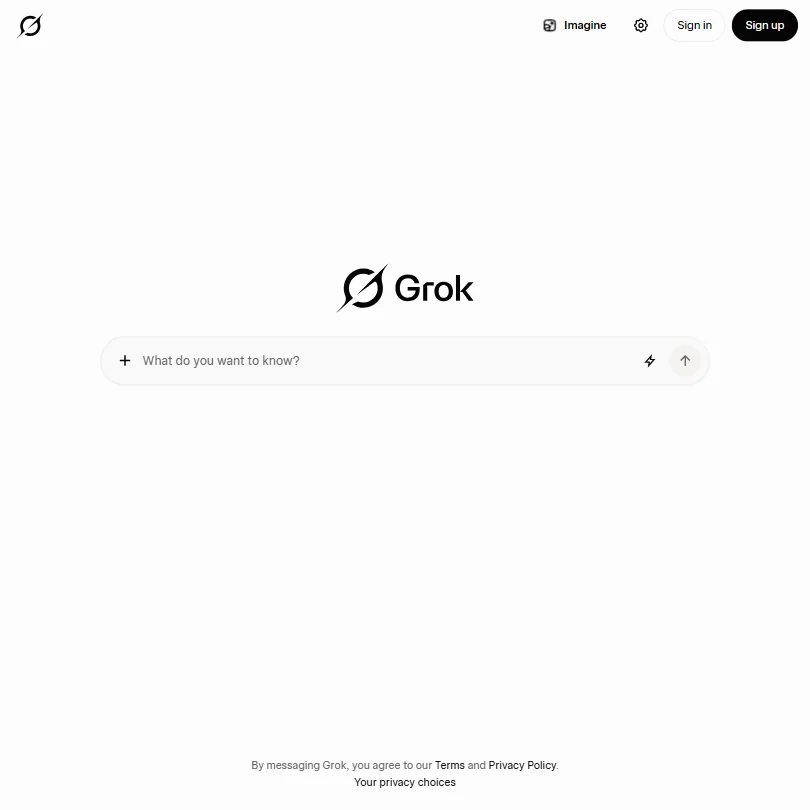
What is Grok?
Grok is made by xAI, a US company that has joined SpaceX and whose website now brands itself SpaceXAI. Grok runs on the web at grok.com and in mobile apps for iOS and Android, and one account keeps your conversations, settings and subscription in sync across them.
What you can do with Grok
Grok's app runs on the Grok 4.6 model. Only xAI's own models are offered inside the chat app.
Real-time web and X search is included, at a limited level on the free plan and in full on paid plans.
Grok accepts uploaded files including PDFs, images, spreadsheets, code and audio for analysis and summarization. Image generation, part of Grok's Imagine feature, is included even on the free plan, and video generation under Imagine starts at SuperGrok Lite. Voice mode is also included on the free plan.
Grok Build is a coding agent with a plan mode, for proposing a structured approach before writing code, and subagents that run in parallel for testing and research; sandboxed and terminal execution run the code it writes. Grok Build is available even on the free plan. SuperGrok and above add Grok Bot, which runs AI teammates on a persistent cloud computer.
Through its connectors, Grok can read from Google Drive, Gmail, Google Calendar, Outlook Mail, Outlook Calendar, SharePoint, OneDrive, Microsoft Teams and Salesforce, and it supports custom MCP tunneling for connecting other tools. Projects are available on grok.com.
Working with other people
The Business plan adds team seat management and consolidated billing. xAI also sells a developer API as a separate product with its own console. The app itself runs on the web and in the iOS and Android apps.
Grok pricing: what each plan gives
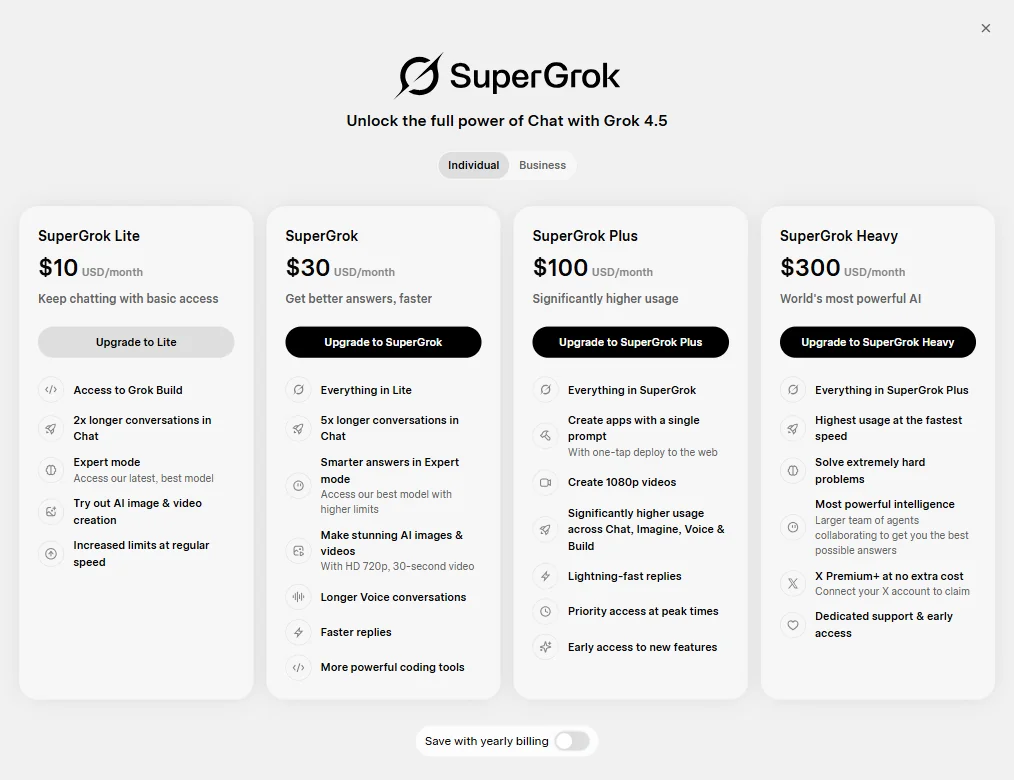
The Free plan costs nothing and already includes core chat, image generation through Imagine, voice mode and the Grok Build coding agent. Web and X search is limited on Free, and paid tiers raise the usage limits.
SuperGrok Lite costs $10 a month and SuperGrok costs $30 a month; SuperGrok Plus costs $100 a month and SuperGrok Heavy costs $300 a month. Video generation starts at SuperGrok Lite, and Grok Bot at SuperGrok.
Business costs $30 a month per user and adds team seat management and consolidated billing. Single sign-on is only on Enterprise, which is priced on request.
Privacy and security
On grok.com, you can choose whether your content is used to train Grok, in Settings, Data, and Improve the Model. Business and Enterprise plans include no training as their standard setting, rather than requiring you to opt out.
Grok is SOC 2 Type I and Type II compliant on every plan, including Free. It includes privacy tools meant to help organizations comply with regulations including HIPAA, the GDPR and the CCPA. Single sign-on is available on the Enterprise plan.
Support runs through the in-product issue report, email and a Discord community.
Who Grok suits
Grok suits people who want a free AI assistant that already includes image generation, voice mode and a coding agent rather than holding them back for a paid tier. It also suits small and medium teams that want seat management and consolidated billing on the Business plan.
It suits less well anyone who wants no training on their content without opting out on a consumer plan, since the default no-training setting is limited to Business and Enterprise. It also suits less well companies that need single sign-on, which is only on Enterprise.
How Grok compares
Grok scores 8.0 out of 10 among the AI assistants we rate. These three do the same job and are the closest to it, compared on what each vendor publishes.
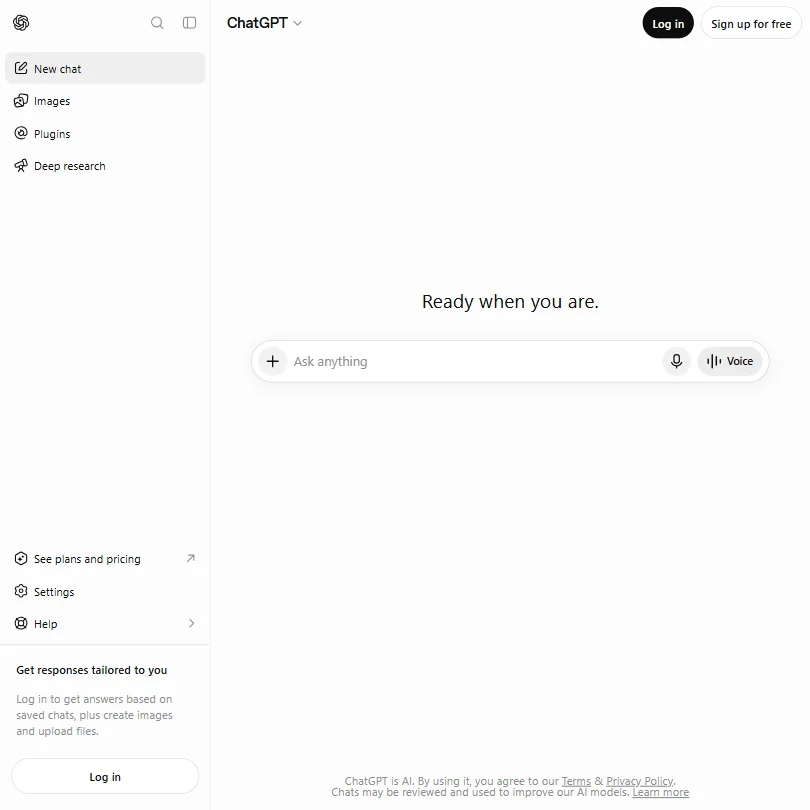
ChatGPT
Grok includes SOC 2 on every plan, even Free; ChatGPT reserves SOC 2 for Business and Enterprise only. Grok's cheapest paid plan is $10 a month with full access already included, core chat, images and Grok Build are already free, and the paid tier mainly raises usage limits and adds video generation. ChatGPT's $8 a month Go plan is cheaper, though it mainly raises usage limits rather than unlocking its top models. Both give teams a shared workspace and hold GDPR compliance.
Pick ChatGPT if you want the cheaper monthly price of the two.
Pick Grok if you want SOC 2 on every plan and full access already included.
Perplexity
Grok's cheapest paid plan is $10 a month, half what Perplexity charges at $20, and Grok already includes chat, images and its Build agent on the free tier, with the paid plan mainly raising limits and adding video. Perplexity reserves team collaboration for Enterprise, while Grok includes a team workspace without an enterprise plan. Grok also holds SOC 2 on every plan, including Free.
Pick Perplexity if you want desktop apps as well as web and phone.
Pick Grok if you want the cheaper plan and a team workspace without enterprise.
Claude
Grok generates images already on its free plan; Claude cannot generate images at all. Grok includes SOC 2 on every plan, including Free; Claude also holds SOC 2. Grok's cheapest paid plan is $10 a month with full access already included; Claude's is $20 a month, also open in full once you're on it. Both give teams a shared workspace.
Pick Claude if you want desktop apps as well as web and phone.
Pick Grok if you want image generation and SOC 2 from the free plan.
Frequently Asked Questions
How much does Grok cost?
Grok has a free plan. Paid tiers run from SuperGrok Lite at $10 a month and SuperGrok at $30 a month, up to SuperGrok Plus at $100 a month and SuperGrok Heavy at $300 a month, with Business at $30 a month per user.
Which model does Grok use, and is web search included?
Grok's app runs on the Grok 4.6 model, with no other companies' models offered inside the chat. Real-time web and X search is included on every plan, limited on Free and in full on the paid tiers.
What does Grok Build do?
Grok Build is a coding agent included even on the free plan. It offers a plan mode that proposes a structured approach before writing code, subagents that run in parallel for testing and research, and sandboxed and terminal execution for running the code it writes.
Does Grok train on my conversations?
On grok.com you can turn off training on your content in Settings, Data, and Improve the Model. Business and Enterprise plans include no training as their standard setting rather than requiring an opt-out.