
Four-word sentence. Then context. Our research on Gorgias started in the places Gorgias would rather you didn't look: Shopify forum threads from brand operators venting about ticket backlogs during peak season, G2 comment sections, and Reddit posts from DTC operators who were very much not impressed. This Gorgias review pulls from vendor documentation, G2 reviews across 900+ ratings, Capterra feedback, Reddit threads, and Product Hunt comments. We haven't touched the product hands-on. What follows is what the data actually shows.
For Shopify-first brands, Gorgias is genuinely hard to argue against. For everyone else, the math gets complicated fast.
What is Gorgias?
Founded in 2015 and based in San Francisco, Gorgias has spent a decade building something specific. Not a general-purpose helpdesk that happens to have ecommerce integrations. The other way around. An ecommerce helpdesk that happens to do everything a helpdesk does.
The company claims to serve over 17,000 ecommerce brands. That's a real number, not a vague "thousands of customers" hedge. They also claim that 40% of Shopify brands run on Gorgias. That's either a remarkable market position or remarkable marketing, and our research suggests it's mostly the former.
The product sits at the intersection of a helpdesk and an AI agent. Their AI Agent 3.0, built on a direct OpenAI partnership with fine-tuning specific to ecommerce, is trained on over a billion support conversations. The pitch isn't just ticket deflection. They want the AI to drive revenue, handle pre-sale guidance, and convert browsers into buyers. That's a different frame than most support tools, and it's worth taking seriously.
Shopify invested in Gorgias directly. That's not a detail you gloss over. It explains the depth of the native integration, where order data, customer history, and product catalog all pull into the same conversation view with one click.
Gorgias Features: Chatbot, Helpdesk & Support Automation Breakdown

The core product is an omnichannel inbox with an AI layer on top.
The helpdesk side covers what you'd expect, including ticket routing, assignment, team collaboration, and macros. Where it gets interesting is the in-conversation actions. Agents can issue refunds, apply discounts, cancel orders, and initiate upsells without leaving the ticket view. That's not standard. Most helpdesks require you to hop into Shopify, execute the action, come back. Gorgias collapses that into one place.
The AI Agent is where they're placing the biggest bet right now. According to their documentation, the agent handles roughly 60% of support tickets autonomously. That tracks with patterns we saw in G2 reviews, where merchants in fashion and home goods consistently mentioned automation rates in that range. Not every category hits 60%, though. Brands with complex product configurations reported lower numbers.
Custom training is real here. You can feed the AI your SOPs and brand tone guidelines. The AI is supposed to hold those guardrails, not improvise around them. User reviews largely confirm this works as described, at least for the common cases.
Knowledge base support is included. Help Center documentation feeds the agent. Nothing exotic there.
The email automation layer runs through the same omnichannel inbox. So does live chat. The unified view is what makes the feature set feel coherent rather than bolted together. SMS and voice channels sit alongside Instagram and Facebook, all feeding into one queue. The integrations list is long, but the two that come up most often in operator conversations are Klaviyo and Recharge. A few others round it out.
Honestly, the feature breadth is strong. What you're paying for is the depth of ecommerce-specific functionality, not just a long list of channels.
Gorgias Bot Quality: How Well Does It Handle Real Customer Queries?
This is where Gorgias makes its real argument.
The AI Agent is fine-tuned specifically for ecommerce query patterns. Order status and returns are the high-volume cases. G2 reviewers in ecommerce operations roles consistently flagged that the bot handles those well. Not "pretty well." Actually well.
The pre-sale capability is the part that surprised us most in the research. Most support bots are purely reactive. Gorgias is trying to do something more active, where the AI asks follow-up questions, guides shoppers toward products, and works to improve average order value in the process. One G2 reviewer described it as feeling like the AI was trained the way they'd train a human agent. We're skeptical of that. But we saw enough variation of that sentiment in independent reviews that it's not just cherry-picked feedback.
Real-time sentiment detection is included. The system watches for signals that a conversation is heading somewhere a bot shouldn't handle and escalates with full context intact. No "please re-explain your issue" moments. That's the critical part.
Where the bot falls short, according to Reddit threads from 2025 and some Capterra comments, is edge cases. Unusual return situations and multi-item order complications don't fit clean templates. The bot doesn't fail gracefully enough in those moments. It either over-escalates or, worse, tries to answer when it shouldn't. That's a training problem more than a fundamental one, but it's real.
We cross-referenced the ~60% automation claim against user reports. The range in practice seems to run from 45% to 70%, depending on brand type, ticket volume, and how thoroughly teams have configured the agent. Fair range, though.
Gorgias Channel Coverage: Which Platforms Does It Support?
Email and live chat are the obvious ones. Both are solid.
Beyond those, the channel list extends to SMS, Instagram, Facebook, and WhatsApp. WhatsApp support is meaningful for brands selling into European and Latin American markets, where the platform carries a larger share of customer conversations than it does in the US. Voice is also included.
Gorgias supports 30+ languages. The multilingual coverage matters if you're running any international footprint. We didn't find specific complaints about translation quality in the reviews we read, which is at least the absence of a red flag.
The ecommerce platform coverage beyond Shopify includes WooCommerce, BigCommerce, and Magento. The integrations exist. What the reviews make clear is that the Shopify experience is in a different tier entirely. WooCommerce users on G2 mentioned that the integration works but requires more configuration time. That tracks.
Slack is available via integrations. The developer API is documented at gorgias.com/developers for teams that need custom connections. No specific Salesforce or HubSpot native integrations appeared in the documentation we reviewed.
Is Gorgias Easy to Set Up and Manage?
For Shopify brands, the setup story is clean. One-click connection, order data flows in immediately, and the AI starts learning against your existing ticket history. G2 reviewers in the 1-to-50 employee range mentioned being operational within a day or two. That's a consistent enough pattern to be credible.
For brands on other platforms, the experience takes longer. That's not a knock. It's just the reality of where the native depth lives.
The Gorgias Academy is their training resource, and it's actually used by the brands they work with. Onboarding playbooks, help center articles, ebooks. Above average compared to what we usually see. Their own support is handled by their own bot at first contact, with human escalation available. That's either ironic or a good demonstration of the product, depending on how you want to read it.
Managing ongoing AI behavior requires configuration investment. Updating SOPs, adjusting guardrails, reviewing escalation patterns. Some Capterra reviewers mentioned that keeping the AI accurate during promotional periods or policy changes requires deliberate maintenance. Not a flaw. Just something to budget time for.
Mobile apps for iOS and Android are available. Chrome extension too.
Gorgias Pricing: Is It Worth It for Support Teams?
This is the section we spent the most time on.
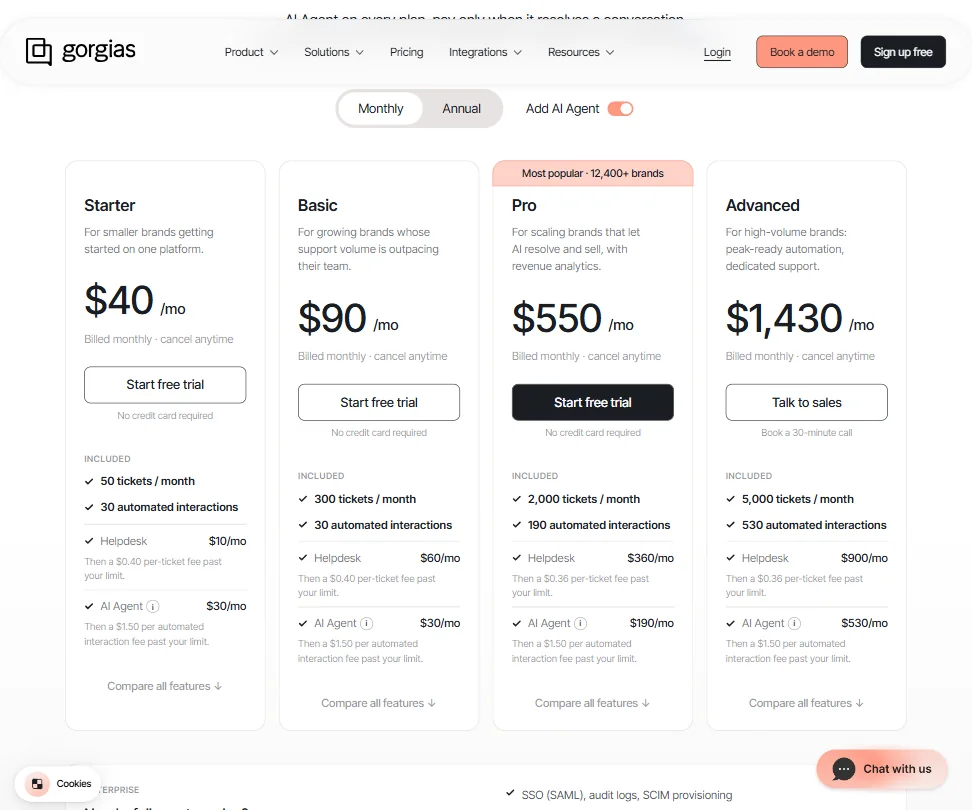
Four plans appear on the pricing page: Starter, Basic, Pro, and Advanced. Starter covers 50 tickets per month at $10 per month. Basic covers 300 tickets per month at $60 per month. Pro covers 2,000 tickets per month at $360 per month. Advanced covers 5,000 tickets per month at $900 per month.
Overage fees apply. Starter and Basic charge $0.40 per ticket past the monthly limit, while Pro and Advanced drop that overage rate to $0.36. For brands with volume spikes, that gap between your included tickets and your actual peak-month volume is worth calculating before you commit. Several G2 reviewers specifically mentioned surprise costs during high-volume periods.
Here's the part the plan cards don't make obvious: the AI Agent is not included in the base price. It's an add-on, priced separately on top of whichever plan you're on. That changes the math meaningfully if the AI automation is the primary reason you're looking at Gorgias. Worth asking the sales team for the bundled number before you evaluate whether the automation ROI holds up.
No free plan. Free trials are available on Starter, Basic, and Pro, with no credit card required. Advanced requires a sales call to start. That's standard at that tier.
Honestly, we'd push back on the AI Agent add-on structure. If 60% ticket automation is the headline differentiator, burying the cost for that capability behind a separate line item feels like a pricing design choice that will frustrate operators who price-checked the plan page and assumed automation was included. Competitors like Zendesk have their own opacity problems, but at least their AI tier inclusions are clearer at the plan level. Ask directly. Don't assume.
Gorgias vs Zendesk: Which Customer Service AI Wins?
This comparison comes up constantly.
Zendesk is a general-purpose customer service platform. Large enterprise customer base, strong ticketing and SLA tooling, built for companies with complex internal support hierarchies as much as external customer service. The Shopify integration in Zendesk exists, but it is not the same thing as Gorgias's Shopify integration.
Gorgias pulls live order data into the ticket view without middleware. Zendesk's ecommerce integrations typically require third-party connectors or developer work to reach the same level. For a brand doing 50,000 orders a month and needing agents to act on order data inside tickets, that difference is real.
Where Zendesk wins: enterprise-grade SLA management, broader platform-agnostic coverage, and deeper reporting on higher tiers. Where Gorgias wins: everything ecommerce-specific. The AI trained on ecommerce conversations, the in-ticket order actions, and the Shopify depth.
For a DTC brand under 500 employees, this comparison mostly resolves itself. The harder comparison for Gorgias is actually against more specialized alternatives like Fin, which plays in the AI-first customer support space and has broader platform coverage, though without Gorgias's native ecommerce revenue angle.
Who Should Use Gorgias? (And Who Shouldn't)
Shopify brands with real support volume. That's the clearest case. The AI automation, the native order data access, the revenue upsell layer. Built for that operator.
DTC brands with international customers will find the multilingual coverage and WhatsApp channel inclusion meaningful. Brands processing enough tickets to justify ticket-based pricing, with enough product complexity to actually benefit from trained AI guardrails. The setup investment makes more sense at volume.
Who shouldn't bother. B2B software companies and SaaS businesses, where support questions don't map to order management. The product will technically work, but you'd be paying for ecommerce-specific depth you'd never touch.
Brands on Magento or WooCommerce who want Shopify-level depth. You won't get it. The integration exists. The native depth doesn't transfer.
Very early-stage brands with under 200 tickets a month. The pricing model and setup overhead probably don't justify it yet. Come back at 1,000 tickets a month.
Gorgias Review Verdict
Gorgias is the real deal for the use case it's designed for. That's not a soft endorsement. It's a specific one.
The AI Agent 3.0 is genuinely strong for ecommerce query patterns. The Shopify integration isn't a checkbox feature. The unified inbox with in-ticket order actions is the kind of thing that feels obvious once you've seen it and frustrating to live without. 17,000 brands and a Shopify investment don't happen by accident.
The weaknesses are real too. The AI Agent add-on cost is easy to miss when you're evaluating plan cards, and discovering it later is annoying. The ticket-based model surprises people with volume spikes. Bot performance on edge cases isn't as clean as the marketing suggests. Non-Shopify users get a lesser product.
None of those weaknesses undermine the core case. For a mid-sized DTC brand on Shopify, this is probably the right tool. The automation rates hold up across independent reviews. The revenue angle is more than positioning.
Go into pricing conversations with specific volume numbers. Ask directly about the AI Agent add-on cost, and ask about peak-season billing behavior. That's the conversation worth having before you commit.
How Gorgias compares
Gorgias scores 7.6 out of 10 among the helpdesks we rate. These three do the same job and are the closest to it, compared on what each vendor publishes.
Zendesk
Gorgias starts at $10 a month for 50 tickets, a different pricing model from Zendesk's $25 a month per agent, which can undercut Zendesk for small ticket volumes. Zendesk is ISO 27001 certified; Gorgias does not state this on its own site. Both are SOC 2 audited and HIPAA compliant, and both bill AI usage per resolution. Zendesk also reaches more data regions, five against Gorgias's two, US and EU.
Pick Zendesk if you want ISO 27001 certification and more data regions.
Pick Gorgias if your ticket volume is low and per-seat pricing doesn't fit.
Kustomer
Kustomer's pricing is not published; we could not find a monthly price on its site, only a custom quote. Gorgias is public and starts at $10 a month for 50 tickets. Kustomer bundles its AI, Concierge and Architect, into the package price with no separate usage charge; Gorgias bills AI resolutions on top of the plan. Gorgias also gives more ways to reach its own support, email, chat and community, where Kustomer publishes only email.
Pick Kustomer if AI included in one package price appeals to you.
Pick Gorgias if you want a published starting price and more support channels.
Intercom
Gorgias starts at $10 a month for 50 tickets against Intercom's $39 a month per seat, a different model that can cost less at low ticket volumes. Gorgias's AI answers in 80 languages against Intercom's 45. Intercom is ISO 27001 certified and lets customers opt out of AI training; Gorgias does not state its ISO status and its own AI learns across every brand's data with no opt out offered. Both are SOC 2 audited and HIPAA compliant.
Pick Intercom if you want ISO 27001 certification and an AI opt out.
Pick Gorgias if you want more AI languages and lower entry pricing.
Frequently Asked Questions
Does Gorgias work for non-Shopify stores?
Yes, but with caveats. Gorgias integrates with WooCommerce, BigCommerce, Magento, and PrestaShop. The platform functions on those connections. What you won't get is the native depth of the Shopify experience, where live order data flows into the ticket view without extra configuration. WooCommerce users in particular have flagged that setup takes meaningfully longer and some features require more manual work to match the Shopify experience out of the box.
Is Gorgias's AI Agent actually autonomous or does it need constant supervision?
The autonomous rate is real in the right conditions. Independent reviews suggest a range of 45% to 70% of tickets handled without human intervention, depending on how thoroughly you've configured the agent with your SOPs and policies. That setup work matters. The AI doesn't self-configure. You feed it your return policy, your brand tone, your escalation rules. Brands that do that upfront maintenance get closer to the high end of that range. Brands that don't tend to complain that the bot mishandles edge cases, which is really a configuration problem more than a product flaw.
How does Gorgias pricing actually work?
Unlike most helpdesks that charge per seat, Gorgias charges based on ticket volume per month. Starter covers 50 tickets at $10 per month, Basic covers 300 tickets at $60 per month, Pro covers 2,000 tickets at $360 per month, and Advanced covers 5,000 tickets at $900 per month. Overages on Starter and Basic run $0.40 per ticket. Overages on Pro and Advanced run $0.36 per ticket. The AI Agent is a separate add-on cost on top of whichever plan you're on, so get that number from sales before you finalize your budget. Ask specifically about how billing works during peak periods. That's where some existing users have run into unexpected costs they didn't anticipate at signup.