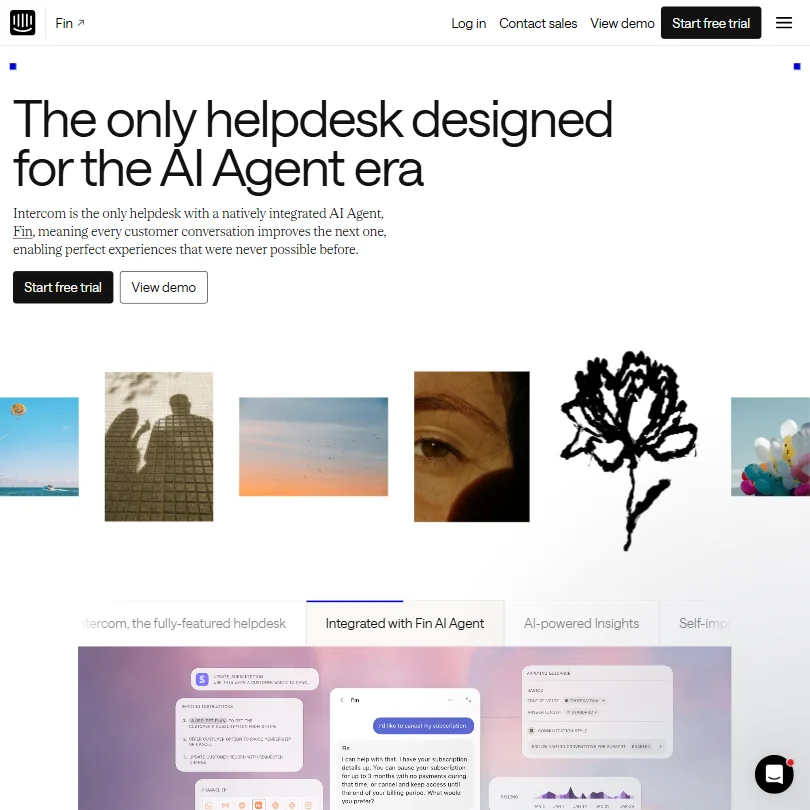
Vendor claims are the easy part. What we kept seeing, after going through G2 reviews, Reddit threads, and the public documentation at fin.ai, is that the distance between Fin's marketing copy and actual user experience is smaller than average for this category. That's a low bar, but Fin clears it by a meaningful margin. We've been tracking AI customer service tools long enough to greet resolution rate claims with suspicion. Fin's held up better than most under that scrutiny.

Fin came out of Intercom, the San Francisco messaging company founded in 2011, and has since been spun into its own product with its own pricing and its own URL. It runs on two proprietary models: Apex 1.0 (the primary model) and Apex Flash, a lighter, faster variant. Both are trained specifically on customer experience data, not adapted from a general-purpose LLM. That's a real architectural decision. The effect shows up in resolution rates, though we'll get to the skepticism around that number shortly.
What is Fin?
Not a chatbot wrapper. Not a sidebar assistant that waits for a human to do the real work. Fin is a full AI customer service agent that handles conversations end to end, resolves the issue where it can, and escalates to a human only when it genuinely can't close the ticket. That's the ambition. Our research suggests it mostly delivers on it for routine support volume, with real limitations at the edges.
The product handles web chat, voice, email, and SMS natively. It also runs on WhatsApp and Slack, and a few others. Intercom built it into their platform over several years, then separated the AI agent into a standalone product with its own pricing structure. Fin now operates two ways: as a layer on top of existing helpdesks like Salesforce or HubSpot, or bundled with the full Intercom helpdesk at a combined price.
The 76% average resolution rate is the headline claim. Honestly, that number held up better in our research than we expected. G2 reviewers reported rates in that range, and some reported over 85%. Most competing products don't publish equivalent numbers at all, which either means their numbers are worse, or they simply haven't measured carefully. Neither is a good look.
No free tier exists. The startup program (93% off Intercom, Fin free for a year) is real but narrowly available. Everyone else pays per outcome.
Fin Features: Chatbot, Helpdesk & Support Automation Breakdown

The core loop is straightforward. A customer sends a message, Fin reads it, pulls from configured knowledge sources, checks connected integrations, and replies. It resolves or it escalates, and the escalation carries full conversation context to whatever helpdesk is receiving it. That behavior holds across every supported channel, at least according to the docs and the majority of reviews we read.
Training runs through what Fin calls Knowledge Sources. You supply procedures, brand voice guidelines, and product content. The Public Help Center and Knowledge Hub are also available as sources on the Intercom plan. We cross-referenced their documentation with G2 user reports, and the training setup is flexible, though several reviewers noted that the initial configuration took longer than expected. Not a dealbreaker. More of a calibration for your timeline.
The human handover implementation is one of the better ones we've seen documented in this category. Context carries over cleanly to Freshdesk, Salesforce, HubSpot, and a few others. A G2 reviewer in fintech mentioned the handover made their team's workflow feel continuous rather than interrupted. That tracks with what the docs describe, and with the general pattern we saw in positive reviews.
Analytics features like the CX Score, AI Topics, Trends, AI Recommendations, Monitors, and Custom AI Scorecards all sit behind the Pro add-on at $99 per 1,000 conversations per month. Not included at the base tier. Worth flagging now rather than discovering later.
The Shopify Data Connector pulls live order data so a customer asking where their package is gets a real answer, not a human hand-off. That specific capability shows up constantly in positive reviews from ecommerce and retail teams, across G2 threads and Reddit posts from merchants who had tested multiple tools before landing on Fin. It's a concrete differentiator for that use case.
Email handling works across helpdesks. Fin takes inbound tickets, resolves what it can, and routes the rest. Native ticketing is part of the Intercom plan. Running ticket management through a third-party helpdesk requires a separate integration setup.
Fin Bot Quality: How Well Does It Handle Real Customer Queries?
This is where most AI tool reviews go soft. Resolution numbers from vendors are always suspect, so we dug into the specifics.
Fin claims Apex 1.0 delivers 2.8% higher resolution rates than Sonnet 4.6. It also claims 65% fewer hallucinations against the same benchmark. Those are specific numbers with a named comparison point, not vague superlatives. Companies manufacturing claims tend to stay vague. Specificity is a modest positive signal here.
The complaint pattern we kept seeing in G2 reviews wasn't wrong answers. It was edge cases. Complex queries that don't map cleanly to a knowledge source, or multi-step problems requiring the bot to hold context across several exchanges. Fin handles routine questions well. When things get complicated, some reviewers reported faster-than-expected escalation. That isn't always a failure, but it does mean your human team still needs to exist for the outliers.
Honestly, that's true of every AI agent in this category right now. Not great. But Fin's floor appears higher than most of the competition.
Multilingual support runs real-time AI translation. We didn't find specific complaints about translation quality in the reviews we read. A few customers in non-English-primary markets mentioned it handled their support volume adequately. Worth validating for your specific languages before signing anything.
G2 reviewers in SaaS support roles mentioned that response tone consistency improved noticeably after customizing the brand voice and tone settings, which is a meaningful quality-of-life detail for support leads who care about how the bot sounds to customers. Custom training on those parameters is available from the base tier.
Fin Channel Coverage: Which Platforms Does It Support?
Web chat is the obvious starting point. But Fin also handles voice, email, SMS, WhatsApp, and Slack natively, and covers Instagram and Facebook Messenger as well.
Wide channel coverage claims are easy to make and frequently oversold. With Fin, the reviews are more consistent across channels than we expected. The Slack integration in particular gets mentioned by B2B teams using Fin for internal support, not just external customer-facing use. That secondary use case is one that competitors like Ada and Tidio haven't built for as deliberately.
Voice deserves its own note. AI voice support is harder to get right than text-based handling. We didn't find a deep pool of reviews specifically about Fin's voice channel, so the docs confirm it exists but we'd encourage anyone evaluating that feature to ask Intercom directly for production reference customers before assuming it's ready at your volume. Fair.
The API platform is fully documented and supports custom actions and workflows, including MCP support. For teams with non-standard integration needs, that's the path. The Copilot add-on, at $35 per user per month, adds an in-inbox AI assistant for agents covering instant advice, expert onboarding, and AI-powered translations for agents handling conversations themselves.
Is Fin Easy to Set Up and Manage?
Setup opinions in our research were more divided than the resolution rate data.
For teams already on Intercom, deployment is relatively fast. Knowledge base connection, channel activation, and basic configuration can happen in days. Intercom offers deployment services and an AI Agent Blueprint framework as a guided setup resource. Useful. Not always sufficient for complex environments.
For teams running Fin on top of Salesforce or HubSpot, the setup story is bumpier. Multiple G2 reviews from those configurations described timelines longer than expected, not because the integrations are broken, but because configuring proper context-passing between systems requires technical work that the top-level marketing copy underplays. Plan for that time explicitly.
The ongoing management experience is where Fin earns back some goodwill, based on what reviewers consistently said about the dashboards. Resolution rate tracking over time, monitor alerts, and the QA tooling (for teams on the Pro tier) give support managers something actionable rather than vanity metrics. That's not guaranteed in this category. We've seen competitors collect data without surfacing it in any useful form.
The claim that resolution rates improve roughly 1% per month as Fin processes more conversations is bold. We're skeptical of it as a universal promise. It reads like an aggregate across a large install base, not a product specification you can hold Intercom to. We'd want to see the methodology before treating it as a commitment.
Fin Pricing: Is It Worth It for Support Teams?
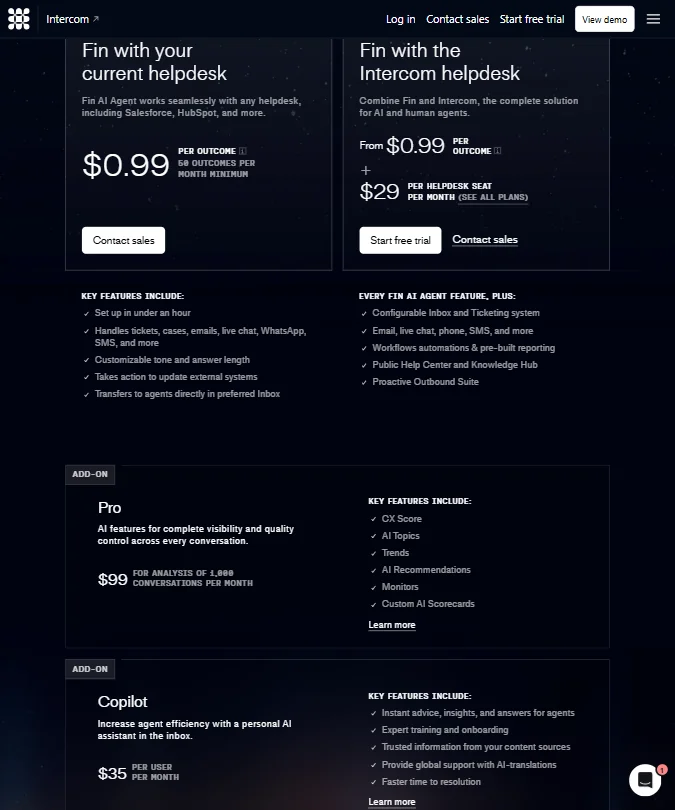
$0.99 per resolved outcome, with a 50-outcome monthly minimum. That's the entry point for running Fin on your existing helpdesk. Add the Intercom helpdesk and it's $0.99 per outcome plus $29 per helpdesk seat per month, per what the pricing page shows. Enterprise pricing is custom. The structure is transparent enough to run a rough calculation before talking to sales, which is more than some competitors offer.
At scale, outcome-based pricing works well when your resolution rate is high. If Fin resolves 76% of conversations, you're paying for those and getting full deflection on the rest. That math compounds favorably as volume grows. At low volume or with a complex, judgment-heavy ticket mix, the per-outcome cost accumulates without enough resolved tickets to justify it.
The Pro add-on at $99 per 1,000 conversations per month is the most notable gap between base pricing and real operational insight. CX Score, Trends, AI Recommendations, Monitors, and Custom AI Scorecards are all behind that wall. If you want meaningful performance analytics, build that cost into your model from the start. It's a pattern across this category, but that doesn't make it less worth flagging.
No refund policy is publicly stated. Worth asking sales about before committing to anything beyond month-to-month. The startup program (93% off Intercom, Fin free for a year) is a legitimate offer. Qualifying criteria aren't fully published, but worth asking about if you're early-stage.
Fin vs Zendesk AI: Which Customer Service AI Wins?
Zendesk has been in this market longer. Its AI layer sits inside a ticketing system that millions of support teams already run on. Migrating off Zendesk is a real project, which is a meaningful part of why Zendesk AI retains customers even among teams that aren't particularly happy with it. Switching costs do real work.
Fin doesn't require you to leave Zendesk. That's an underrated point. You can run the Fin AI agent on top of Zendesk without replacing your existing ticketing setup. It's positioned as an agent layer, not a mandatory stack replacement.
On bot quality, our research consistently surfaced Fin's resolution rate claims as more specific and more independently verifiable than Zendesk's equivalent. Zendesk publishes extensive AI use-case documentation alongside a growing number of customer-specific automation and resolution metrics, but the documentation leans heavily toward use-case descriptions rather than methodology. Fin publishes an average resolution rate across 12,000+ customers with a named benchmark comparison. That's a more falsifiable claim. We prefer falsifiable.
Zendesk is the better fit for teams that want a single-vendor ticketing and AI story without assembling pieces. For a fuller look at how that plays out, our Zendesk review covers the AI layer against the core helpdesk functionality. Fin wins on bot quality. Zendesk wins on ticketing depth and workflow breadth, particularly for enterprises already invested in the platform.
Pricing comparison is genuinely difficult because Zendesk prices per agent per month and Fin prices per outcome. Different risk profiles. Zendesk is more predictable. Fin is potentially cheaper at high resolution rates, and more expensive when resolution rates disappoint.
Ecommerce teams. Consider Gorgias alongside both. It's built around Shopify-first workflows and handles revenue attribution in ways Fin doesn't attempt. Different tool for a different job.
Who Should Use Fin? (And Who Shouldn't)
Mid-market and enterprise support teams with real ticket volume. That's the core fit. The per-outcome pricing structure rewards volume and high resolution rates in ways that simply don't apply at low scale, and Fin doesn't pretend otherwise.
Teams already on Intercom. Shortest path to value, tightest integration, helpdesk features already in place.
Ecommerce brands on Shopify. The Data Connector functionality is specifically valuable here. Real-time order status without human involvement is a concrete deflection for a high-frequency ticket type.
B2B SaaS companies running Fin for product support, particularly Intercom customers already, appear consistently in the happy-customer profile across the G2 data we reviewed. High-repetition queries with clear answers are where Fin's resolution rate earns its keep.
Very small teams. The 50-outcome monthly minimum and per-seat Intercom cost won't pencil out at low volume. Teams running highly complex, judgment-heavy support cases where most queries require genuine human reasoning are also a poor fit. No AI agent handles genuinely novel situations at 76%. Not yet.
Teams expecting advanced analytics at the base tier will hit the Pro add-on ceiling faster than the entry price implies. Know what you're buying before you commit.
Fin Review Verdict
The resolution rate claim holds up better under scrutiny than most competitors' equivalent claims. The pricing model is structured in a way that actually aligns with your outcomes rather than charging for seat licenses while the AI deflects nothing. Those two things together make Fin worth taking seriously in a category that is otherwise full of overstatement.
The proprietary Apex models are a real differentiator, trained specifically on customer experience data rather than adapted from a general-purpose LLM. The 65% hallucination reduction claim versus Sonnet 4.6 is specific enough to believe unless shown otherwise. The add-on structure is the biggest watch-out in the pricing model, because if you want real performance analytics, you're paying meaningfully more than the base rate suggests. Walk in knowing that.
Setup complexity for non-Intercom integrations is real. Don't expect a two-hour deployment when you're running Salesforce or HubSpot as your primary helpdesk. Build in the time, and build in the technical resources to configure context-passing properly.
At 12,000+ customers with consistent positive signal across G2 and Capterra, the product's reputation isn't vendor-manufactured. That's difficult to fake at scale. We'd trust Fin over most of what's available in this space, for the right team at the right volume. The outcome-based model is fair. The bot quality is above par. Not perfect. Worth it.
Frequently Asked Questions
Does Fin work with helpdesks other than Intercom?
Yes. Fin has native integrations for Salesforce and HubSpot, and works with Freshdesk as well. The human handover passes full conversation context to whichever helpdesk is receiving the escalation. The setup is more involved than the Intercom-native experience, though. Budget extra implementation time, particularly if your helpdesk configuration is complex. Several G2 reviewers on non-Intercom setups flagged this specifically, not as a blocker but as a meaningful time investment that the onboarding materials understate.