Richpanel is AI customer service software for ecommerce, built for multi-brand support with a self-service portal and ticket automation.

The homepage is confident. Thirty percent cost savings, fifty percent fewer tickets, guaranteed within thirty days or you get your money back. Most SaaS tools don't put a refund behind their claims. Richpanel does, and that's what kept pulling our attention back as we worked through their docs, pricing pages, and user reports from G2 and Capterra.
Founded in 2019 and built around Shopify from the start, Richpanel sits in a crowded field alongside Gorgias and Zendesk. Whether it belongs there depends on what you're actually running.
What is Richpanel?
A helpdesk and AI customer service platform, purpose-built for e-commerce. San Francisco, 2019. The Shopify focus wasn't added later as a positioning move. It was the starting point, and that shows in the architecture.
The product is built in layers. A unified inbox pulls messages from email, live chat, Facebook, Instagram, WhatsApp, SMS, and phone. Above that sits a self-service portal, an AI assistant called Sidekick AI, and a broader "Customer Service AI" layer designed to close tickets without a human agent touching them. The self-service portal is arguably the most structurally distinct piece, letting customers track orders, start returns, and find answers before a conversation thread ever opens. That's a different bet than automating tickets after they arrive.
The target user is pretty obvious. DTC brands, lean support teams, inbox full of "where's my order." That framing drives almost every product decision they've made.
Richpanel Features: Chatbot, Helpdesk & Support Automation Breakdown
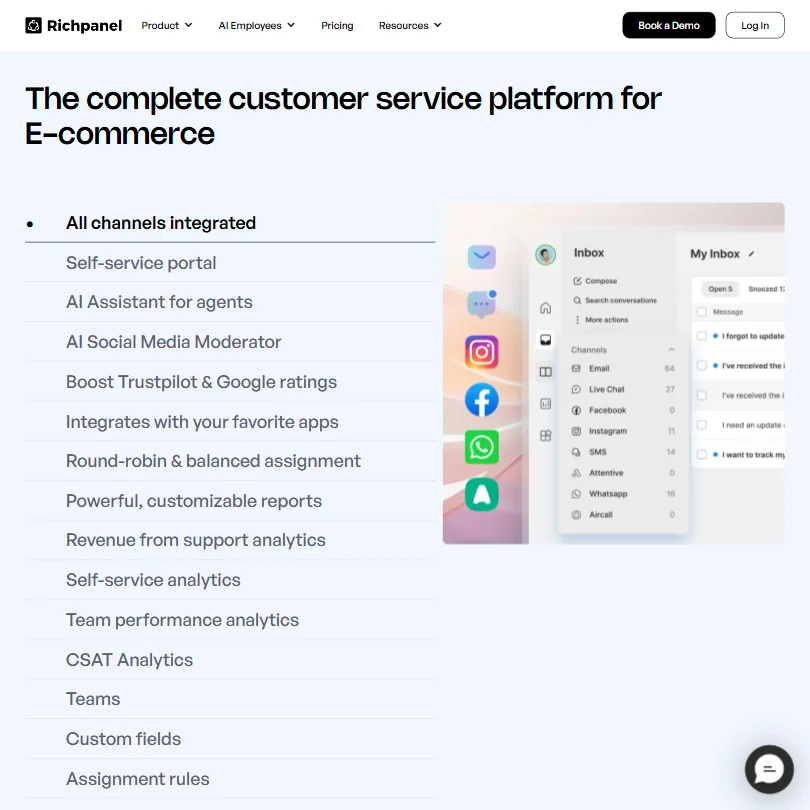
The helpdesk side covers the expected ground. Ticket views, tagging, macros, snooze, private notes, round-robin assignment. Standard. Nothing missing, nothing exotic.
The AI layer is where they're trying to differentiate. Sidekick AI handles real-time multilingual translation for agents mid-conversation, which is genuinely practical for brands selling across markets without bilingual headcount. It also auto-drafts replies, handles repetitive queries, and trains on the brand's own policies and conversation history. Their "Voice of Customer AI" surfaces what customers are saying they like and dislike across conversations. Useful. Not unique, but useful.
The knowledge base builder supports custom fonts, embedded video, and product recommendations. Automation covers task bots and spam filtering. The Social Media Moderator AI is listed as a free add-on, which surprised us when we first saw it.
One correction to earlier versions of this review. We previously noted SLA management wasn't mentioned in public docs. That's no longer accurate. Richpanel introduced native SLA Management on May 26, 2026, covering response and resolution targets, channel-specific policies, business-hour controls, custom SLA rules, breach monitoring, and an SLA analytics dashboard. Worth noting that the previous gap existed for a long time, so if you looked at this product before mid-2026 and wrote it off for that reason, the situation has changed.
CRM integrations are still referenced without being named specifically. That vagueness shows up more than once across their materials. Frustrating when you're trying to evaluate actual fit.
Richpanel Bot Quality: How Well Does It Handle Real Customer Queries?
Generic bots are mostly useless for e-commerce. Richpanel's AI trains on brand-specific data, order history, return policies, and brand voice, which is the right approach. That puts it ahead of out-of-the-box alternatives before you've customized anything.
Across the G2 and Capterra reviews we cross-referenced, a consistent pattern emerged. Strong performance on predictable queries. Order tracking, return requests, shipping questions. The self-service portal absorbs most of that before AI even engages. Where things break down is on anything requiring judgment. Complex product variant questions, complaints with emotional context, edge cases the policy docs don't address. Reviewers describe those situations as requiring more human intervention than the demo suggested.
Honestly, that's the same story with every AI support tool available right now. The 50% ticket reduction claim holds up for brands with high concentrations of repetitive queries, and we cross-referenced it against independent reviews where it tracked consistently for that profile. Brands with complex catalogs or high-emotion customer interactions will land somewhere lower.
Richpanel Channel Coverage: Which Platforms Does It Support?
Email and live chat are the base. Facebook and Instagram are integrated. WhatsApp, SMS, and phone are in. For a DTC brand running paid social, that covers the channels where inbound actually arrives.
The Shopify integration is native. Agents see order data, tracking info, and purchase history inside the conversation view without switching tabs. Small detail. Real time savings per ticket.
What's thin: Slack isn't listed publicly. Zapier isn't listed. HubSpot and Salesforce don't appear in their docs. The integration story outside the core e-commerce stack is underdeveloped, and any brand running a more complex tech setup should probe this specifically in a demo before committing. "API access available" is not the same as "your integrations are covered." Those are different claims.
Is Richpanel Easy to Set Up and Manage?
Their migration page promises a full white-glove move from Zendesk or Gorgias. Reviews generally support this. The migration experience comes up positively more often than not across the sources we pulled.
The admin interface reads as manageable from user reports. Nothing technically demanding. Most reviewers describe the learning curve as lower than Zendesk, which is a reasonable bar. Small team with a clean Shopify setup? Probably fine without dedicated IT involvement. Larger team with unusual workflows? Budget setup time regardless of what the migration promise says.
One nuance on trials. Richpanel's migration page mentions a free-trial stage for teams with fewer than thirty agents, and other pages reference a fourteen-day free trial. A promotional bundle offered four weeks. The current main pricing page emphasizes booking a demo rather than a standard trial duration, so the applicable trial length likely depends on the offer or where you are in their sales process. Ask directly.
Richpanel Pricing: Is It Worth It for Support Teams?
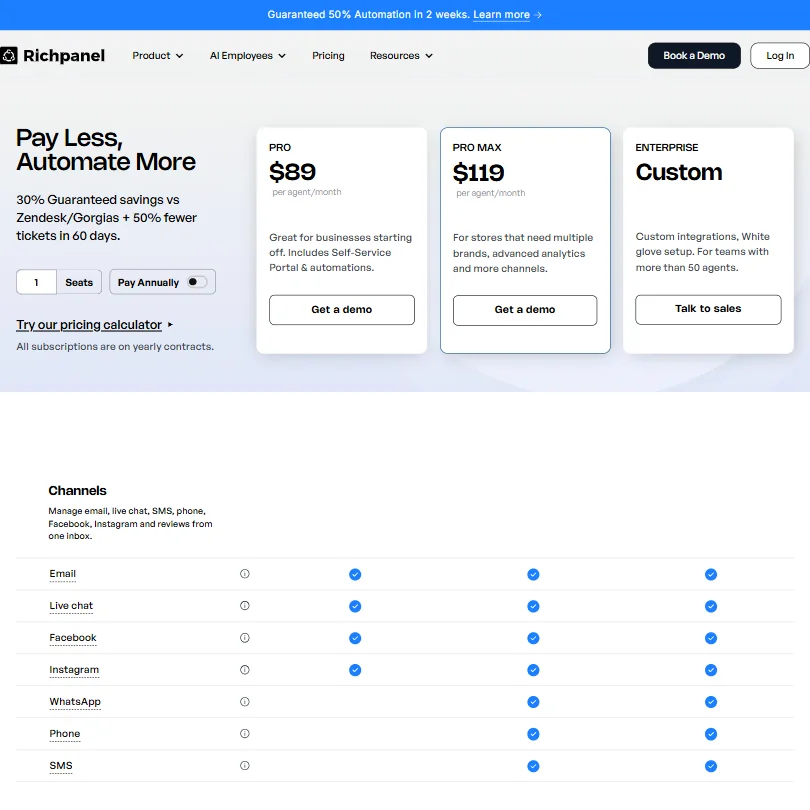
The pricing picture has shifted from earlier versions of this review. The screenshot on their site shows PRO at $89 per agent per month and PRO MAX at $119 per agent per month, with Enterprise at custom pricing. But current pricing documentation tells a more specific story: approximately $99 per human-agent seat per month, plus roughly $0.20 per AI-handled conversation. The final monthly and annual cost is calculated based on agent count and conversation volume combined. Not a flat package.
We're skeptical of the simplified tier framing when the actual calculation is more variable. Worth asking for a precise cost estimate based on your actual agent count and projected conversation volume before agreeing to anything annual.
No free plan. The Social Media Moderator AI, Sidekick AI, and the Self-Service Portal are listed as free add-ons, which is a decent gesture given the overall pricing level. White-label branding, meaning removing Richpanel's logo from customer-facing experiences, isn't documented on any published plan. Know that before you finalize a plan decision.
The refund guarantee is the most structurally unusual element of the pricing story. Thirty percent cost savings and fifty percent ticket reduction within thirty days, or a full refund, including on annual contracts. That's an uncommon commercial commitment. We'd still read the fine print on exclusions carefully. But it's real, and it's not nothing.
The per-AI-conversation charge at $0.20 is worth modeling carefully. A brand handling large conversation volumes could see that add up in ways that erode the predictability advantage Richpanel has over Gorgias's ticket-volume model. Not a dealbreaker. Worth the math.
Richpanel vs Gorgias: Which Customer Service AI Wins?
Gorgias is the obvious comparison, and both products are genuinely aimed at the same Shopify-native buyer. The differences are real but specific.
Gorgias has a larger integration ecosystem and longer track record at scale. Its pricing is usage-based: included monthly ticket allowances with overage fees, plus separate charges for automated outcomes from its AI Agent. Overage rates are published and alerts exist when another tier would be cheaper. Costs can fluctuate with volume. Not unpredictable exactly, but variable in ways that require monitoring.
Richpanel's per-seat plus per-AI-conversation model is also variable once you factor in the $0.20 charge, so the "flat and predictable" framing isn't entirely clean either. That tracks with what we see in the docs.
Richpanel's self-service portal is a structural differentiator Gorgias doesn't match directly, resolving customer issues before they generate a ticket rather than automating the ticket after it lands. That's a different philosophy, not just a feature gap. Whether it matters depends on how your support volume is distributed.
Richpanel also carries the guarantee. Gorgias doesn't. Fair.
Who Should Use Richpanel? (And Who Shouldn't)
Shopify-native DTC brands with high concentrations of repetitive queries. That's the fit. Brands doing real ticket volume, probably five hundred or more per month, where order status and returns dominate the inbox.
Non-e-commerce teams. Not this product. The architecture assumes an order behind every conversation. SaaS support, B2B service teams, anything without a transactional commerce context, move on.
Teams with complex CRM or enterprise integration needs shouldn't assume those are covered. The generic "integrates with your favorite apps" language in the docs isn't specific enough to rely on. Ask about your actual stack in the demo, by name.
Richpanel Review Verdict
A focused product that works for the right buyer. The self-service portal plus AI layer combination is genuinely well-suited to DTC brands absorbing the same five questions on repeat. The Shopify integration is native, not retrofitted. The refund guarantee is unusual and appears real.
The gaps are also real. Integration coverage outside the Shopify ecosystem is thin. The pricing model is more variable than early marketing suggests once you factor in the per-AI-conversation charge. The bot handles predictable queries well, but nuanced or emotional tickets still route to humans, and that's an honest limitation that reviewers consistently confirm.
For DTC brands drowning in repetitive tickets, Richpanel earns a spot on a shortlist. Not every support operation. But the right one.
How Richpanel compares
Richpanel scores 7.4 out of 10 among the helpdesks we rate. These two do the same job and are the closest to it, compared on what each vendor publishes.
Gorgias
Richpanel charges $0.24 per AI-resolved conversation with no separate seat price; Gorgias starts at $10 a month for its Starter plan plus its own per-resolution AI charge. Gorgias supports a voice channel, which Richpanel does not offer. Gorgias connects to Slack and Zapier; Richpanel's integrations list only Shopify and HubSpot. Neither lets you remove the vendor's branding.
Pick Gorgias if you want voice support and more integrations.
Pick Richpanel if you want to pay only per resolved conversation.
Zendesk
Zendesk's cheapest plan is $25 a month per seat; Richpanel instead charges $0.24 for each AI-resolved conversation, with no seat price. Zendesk holds ISO 27001 certification; we could not find that on Richpanel's site. Zendesk offers phone support and connects to Salesforce and Slack; Richpanel's integrations list is limited to Shopify and HubSpot. Both hold SOC 2 and HIPAA and keep an audit log.
Pick Zendesk if you want a seat-based price and more integrations.
Pick Richpanel if you want to pay only for resolved conversations.
Frequently Asked Questions
Does Richpanel have a free plan?
No free plan. Add-ons including the Social Media Moderator AI, Sidekick AI, and the Self-Service Portal are listed as free on the pricing page, but the core product starts at the PRO tier. Trial availability varies. The migration page references a free trial for teams under thirty agents, other pages mention fourteen days, and a promotional bundle offered four weeks. The main pricing page now pushes toward booking a demo, so the applicable trial length is worth confirming directly with their sales team.
Is Richpanel's 30-day money-back guarantee real?
It appears to be a genuine commercial commitment. The stated terms promise a full refund if Richpanel doesn't deliver thirty percent cost savings and fifty percent ticket reduction within thirty days, including on annual contracts. We'd read the exclusions carefully before signing an annual deal on the strength of that promise alone. But it's not just marketing language, as far as our research shows.
How does Richpanel compare to Zendesk for e-commerce brands?
Zendesk is a broader platform built across industries, and its pricing and complexity reflect that. Richpanel is narrower by design, built around e-commerce order data and Shopify workflows specifically. For a DTC brand, Richpanel's native context probably wins on daily usability. Zendesk wins if you need enterprise-grade configurability, a mature integration ecosystem beyond e-commerce, or support for non-commerce use cases running in parallel.