Vendor docs, G2 threads, Reddit complaints, Capterra deep-dives, Trustpilot, a few Product Hunt comment sections from over the years. That's what this is built from. Intercom was founded in 2011, is headquartered in San Francisco, and has over 30,000 businesses on the platform. That's enough of a track record to have real opinions forming around it, and they are forming, loudly, in both directions.
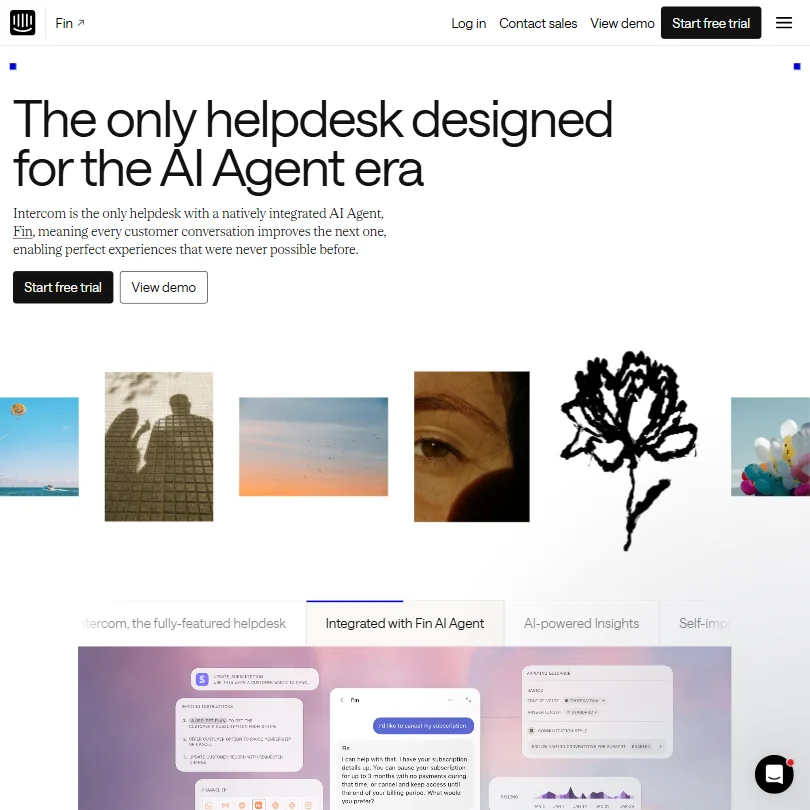
The direction they've committed to is clear. Intercom now calls itself the only helpdesk designed for the "AI Agent era," which is marketing language, but the underlying product actually reflects that bet. Fin, their native AI agent, isn't a bolt-on. It's built into the same system your human agents use, sharing a customer record, context intact. That's a real architectural choice. Not everyone has made it.
Intercom 2 dropped recently, bringing over 60 product updates. We haven't seen a full changelog, but the volume signals they're moving fast. Whether "fast" translates to "better" depends on what you need.
What is Intercom?
A customer service platform that bundles live chat, a ticketing system, an AI agent, and a knowledge base into one product. That's the short version. The longer version is that they've spent the last few years rebuilding around Fin, so the AI and human sides of support aren't separate tools stitched together. They're the same tool.
The platform runs on web, iOS, and Android. A Chrome extension is available too. It supports 45+ languages, which is real coverage for international teams. The integration list includes Salesforce, HubSpot, and Shopify, and a few hundred others via their marketplace.
Honestly, the pitch isn't complicated. Every conversation Fin handles feeds into the same system your human reps work from. Every handover carries full context. Managers see what's working and get flagged when something isn't. That's the loop. It's a clean concept. The execution is what reviewers argue about.
Intercom isn't positioned as a budget tool, and the pricing confirms it. Plans start at $29 per seat per month for Essential, currently listed at a promotional discount from $39. That sits at roughly the category median we track across 21 tools. But the features that actually differentiate the platform, SLAs, a private and multilingual Help Center, white-label Messenger, those live behind the $99 per seat Advanced and $139 per seat Expert plans. The entry point is accessible. The ceiling is not.
Intercom Features: Chatbot, Helpdesk & Support Automation Breakdown
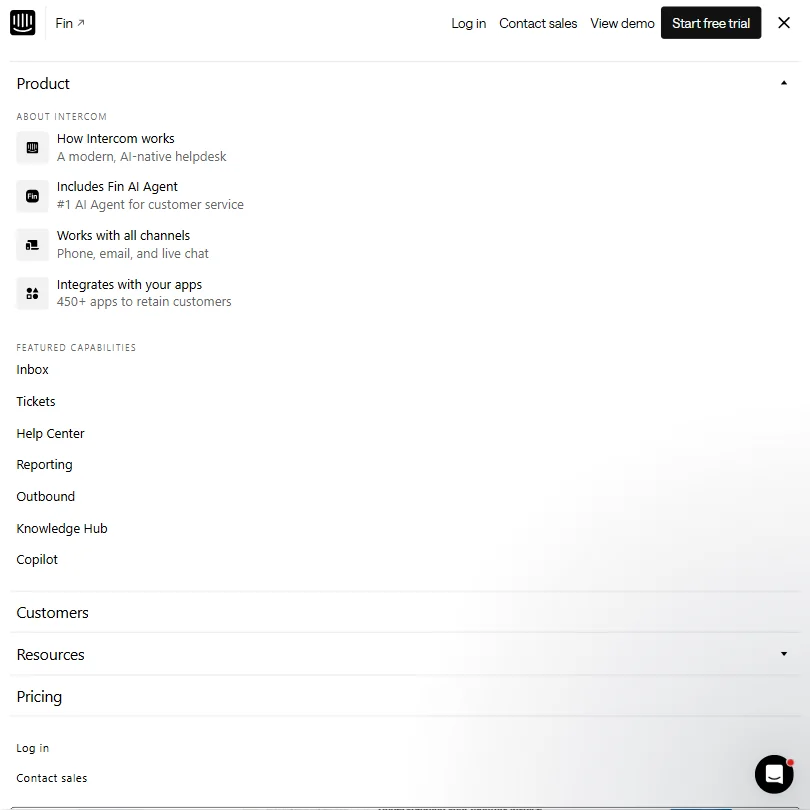
The Fin AI Agent handles customer queries on its own, with customizable tone and answer length, and it learns from your best human reps over time. Managers get recommendations when content is missing or when a data integration would help Fin do better. One click to act on those recommendations, according to the docs. We haven't verified that claim hands-on, but G2 reviewers in operations roles have mentioned the setup assistance as a genuine time-saver.
On the ticketing side, Intercom offers AI-enhanced ticket management with auto-categorization and one-click conversion from conversation to ticket. That's a workflow improvement that shows up repeatedly in positive reviews from support team leads.
The Knowledge Hub is included across plans, though the private and multilingual Help Center only unlocks at Advanced and above. The public Help Center is there from Essential. AI auto-translation for the Help Center is technically available, but it requires a Copilot add-on. That's not hidden, but it's easy to miss when you're reading the main pricing page.
The Copilot feature is an AI assistant for human agents, giving real-time help inside the agent workspace. Sentiment analysis and CX scoring come via the Pro add-on, layered on top. These are separate purchases from the core plans, and the costs accumulate in ways the headline pricing doesn't telegraph. There's also a Proactive Support Plus add-on for outbound and campaign tooling. More on that in the pricing section.
SLA management lives on the Expert plan at $139 per seat per month. White-label Messenger and Help Center too. Expert also includes 50 free Lite seats. Advanced includes 20. So if you need SLAs, you're in the top tier before adding a single add-on. Not ideal for mid-sized teams watching their budget.
The workflows automation builder unlocks at Advanced. Round robin assignment too. Worth knowing if you're evaluating Essential as a long-term home rather than a starting point.
Intercom Bot Quality: How Well Does It Handle Real Customer Queries?
Fin is built on multiple large language models, OpenAI among them, with Intercom's own layer on top. The claim is that Fin handles service, sales, and ecommerce queries without needing to escalate most of the time. Big claim.
What we kept seeing in G2 and Capterra reviews is that Fin performs well when the knowledge base is solid. A well-maintained Help Center leads to high resolution rates. A sparse or outdated one leads to frustrated customers getting unhelpful answers. That's not unique to Intercom, but it's worth saying plainly: the bot is only as good as what you feed it.
Reddit threads from 2024 and early 2025 surfaced a consistent pattern. Teams that built out content and tuned Fin over a few weeks reported strong results. Teams that switched it on expecting magic out of the box were disappointed. That tracks. We're not surprised, but it matters for how you set expectations going in.
The self-improving system is Intercom's biggest differentiator claim. Fin learns from human rep conversations over time and gets flagged when something's missing. In theory, the bot gets better without someone manually retraining it every month. In practice, a few Capterra reviewers noted the improvement loop worked, but slowly. "Gradual" was a word that came up more than once. Fair.
Human handover is where Intercom pulls ahead of most competitors. Full context transfers when Fin escalates to a human agent. No starting over, no repeated questions. Support managers on G2 described this as one of the clearest wins on the platform.
Intercom Channel Coverage: Which Platforms Does It Support?
Live chat is included on every plan. Web, mobile, and the Messenger widget are covered from day one. For teams running support across web and app simultaneously, that's solid baseline coverage.
Email is handled on the outbound side through campaigns and automated workflows. Inbound email flows through the shared inbox. Slack integration is available. Shopify and Salesforce plug in natively.
WhatsApp and SMS are available on every plan, but are charged separately based on usage. They're pay-as-you-go channels, not bundled features, and Intercom's pricing FAQ documents both separately. That distinction matters at scale. Social channels aren't prominently featured in the standard documentation, and if your support volume runs primarily through Instagram DMs or similar, we'd verify coverage directly before committing.
The Chrome extension is a small detail that matters for teams doing a lot of outbound. Quick access without switching contexts. Not a headline feature, but reviewers in sales-adjacent support roles mentioned it positively.
Forty-five-plus languages is meaningful for global teams. The multilingual Help Center unlocks at Advanced. AI auto-translation is available via the Copilot add-on. That's enough coverage for most international deployments, though the add-on cost needs to factor into your budget math before you get too far into evaluation.
Is Intercom Easy to Set Up and Manage?
Setup ease is where reviews split most sharply. G2 reviewers in smaller teams flagged initial configuration as time-consuming. Getting Fin to a reliable resolution rate requires real content work upfront. The platform's complexity means the learning curve is steeper than lighter tools like Freshdesk or a basic Zendesk implementation.
The Academy and Help Center are extensive. Community forums are active. The Developer Hub is available for API work. That's a solid documentation ecosystem. Support itself is handled by Fin first, which is either a feature or an irony depending on your mood. Human escalation is available, but you're going through the bot to get there. A few Trustpilot reviews noted frustration with exactly this. Trustpilot sits meaningfully lower than G2 and Capterra for Intercom, and that gap usually points to post-sale service complaints more than product complaints.
For enterprise teams, there's onboarding support through the sales process. That helps. For teams on Essential or Advanced trying to self-serve the setup, plan for at least a few weeks before Fin is operating at a useful level. Not a dealbreaker. Just a real time cost.
Managing ongoing performance is where the platform earns back goodwill. The AI-powered insights layer scores every conversation, flags trends, and surfaces what's going wrong. That's a genuine operational advantage for managers who want data without building their own dashboards.
Intercom Pricing: Is It Worth It for Support Teams?
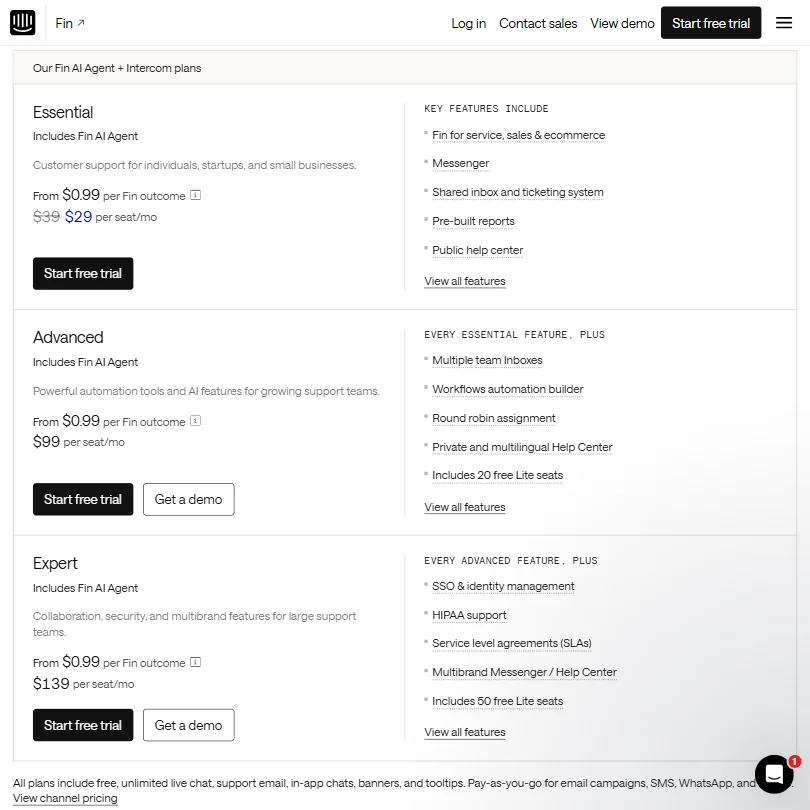
Three public tiers. Essential at $39 per seat per month, Advanced at $99, Expert at $139. Enterprise is custom. No permanent free plan. Intercom does offer a 14-day free trial with no credit card required to start, which is a reasonable evaluation window if you go in with a clear testing plan.
At $39 per seat, Essential covers live chat, the public Help Center, shared inbox, and basic Fin access. It's enough to see what the product does. It's not enough to run a mature support operation. The workflows automation builder, multiple team inboxes, and the private multilingual Help Center all require Advanced at minimum.
The add-on structure is where the real cost builds. Copilot is a separate purchase on top of any plan. The Pro add-on for sentiment analysis and CX scoring layers on further. Proactive Support Plus adds outbound tooling. Depending on team size and needs, you reach a meaningful monthly number before touching enterprise pricing. Reddit flagged this specifically and repeatedly: the base plan looks reasonable, the final bill doesn't match it. We've seen this complaint often enough across support tools that it's worth taking seriously.
Fin is billed at $0.99 per Fin outcome across all three plans. That's usage-based pricing on top of the per-seat cost. For teams with high AI resolution volume, that line item can grow fast. Factor it in.
Compared to Zendesk, which starts higher and scales into territory most SMBs won't touch, Intercom's $39 entry is accessible. Compared to Freshdesk, which has a free tier, Intercom costs more from day one. No permanent free plan means the 14-day trial is your only low-risk window. That's enough for a proof-of-concept but probably not enough to properly tune Fin and see realistic resolution rates.
Refund policy isn't publicly stated. For SMBs on monthly plans, ask about this directly before committing to anything longer than a month-to-month arrangement.
Intercom vs Zendesk: Which Customer Service AI Wins?
The intercom vs zendesk question dominates buyer research in this category, and for good reason. Both are serious platforms with real AI investment, and the choice between them isn't obvious.
Zendesk has more depth in enterprise ticketing. Years of feature development, a large integration marketplace, and a track record in complex support operations. If the primary need is a mature ticketing system with AI layered on top, Zendesk has built that over a long time. Our own Zendesk review covers that in detail.
Intercom's edge is the native AI architecture. Fin and the human agent workspace share the same data from the ground up. Zendesk AI is improving, but it's an addition to a ticketing-first system. Intercom's system is built with the AI and human side in the same foundation. Whether that matters depends entirely on how central AI resolution is to your strategy.
For pure ticket volume and complex enterprise routing, Zendesk probably wins. For teams that want Fin handling a meaningful percentage of queries autonomously, with humans stepping in only when needed, Intercom's architecture is better suited. That's the honest read.
Freshdesk is the other common comparison. Cheaper, simpler, with a free tier. It doesn't match Intercom's AI depth. Budget is the constraint there, not capability ambition. For e-commerce teams specifically, Gorgias is worth a look. It's built around e-commerce workflows in a way that Intercom isn't, and the Shopify-native experience is tighter.
Who Should Use Intercom? (And Who Shouldn't)
Mid-sized and growing support teams with real query volume. That's the fit. Companies where automating a meaningful share of customer conversations would actually move a metric, not just look good in a demo.
Teams that can invest time upfront. Fin's quality depends on content quality. Thin documentation or an outdated Help Center won't get fixed by turning Fin on. It'll get exposed faster.
B2B SaaS companies show up heavily in the positive review pool on G2. The combination of live chat, AI automation, and CRM integrations maps well to that profile.
Not the fit: one-person or very small support operations on tight budgets. The $39 entry isn't expensive by category standards, but there's no permanent free plan, and a lighter tool or freemium Zendesk account would serve that use case better.
Teams whose primary support volume runs through WhatsApp at high scale should model the usage-based costs carefully before committing. The channel is available, but it's not bundled.
Enterprise teams with complex compliance requirements, including HIPAA, which is an Expert-tier feature, should get on a call with sales before assuming the platform fits. What's included in custom contracts isn't public.
Intercom Review Verdict
A serious platform. Not a hedge. Among the tools we track in this category, it sits at the top of the research stack for AI-native helpdesk capability.
What Intercom does better than most is the AI-human collaboration model. Fin's native integration into the agent workspace is a real architectural advantage. Full context on handovers, shared customer records, a self-improving AI tied to human rep quality. That loop exists in the product, not just in the pitch.
The concerns are real too. Add-on pricing builds faster than the headline tiers suggest. Copilot, Pro, Proactive Support Plus, these are all separate line items. The Trustpilot gap points to post-sale friction for some customers. Initial setup takes genuine work, and Fin's 14-day trial window is probably not long enough to see realistic bot performance. We noticed that.
For teams that have outgrown simple chat widgets and need a platform where AI does real work on real queries, Intercom is a strong answer. The pricing is manageable at the base tiers for SMBs, though the full picture of what the platform can do requires Advanced at minimum. Go in knowing that, and knowing what the add-ons will actually cost you.
How Intercom compares
Intercom scores 8.2 out of 10 among the helpdesks we rate. These three do the same job and are the closest to it, compared on what each vendor publishes.
Kustomer
Kustomer includes its AI agent in the price instead of billing per resolution like Intercom's Fin; we could not find a published price for Kustomer on its site. Intercom supports Slack and Messenger as channels, which Kustomer's page does not list. Both hold SOC 2, HIPAA, ISO 27001 and SSO, and both keep an audit log. Intercom lets you remove its branding on the Advanced plan; Kustomer offers no such option.
Pick Kustomer if you want the AI agent bundled into the price.
Pick Intercom if you want slack and messenger support with published pricing.
Zendesk
Zendesk's cheapest plan is $25 a month against Intercom's $39, and its AI agent answers in 80 languages compared with Intercom's 45. Zendesk offers phone support in its ways to reach support list; Intercom does not. Zendesk trains its own machine learning models on sanitized customer data with no stated opt-out, while Intercom lets you opt out of AI training. Zendesk also publishes five data regions against Intercom's three.
Pick Zendesk if you want the lowest price and phone support.
Pick Intercom if you want the option to opt out of AI training.
Freshworks
Freshworks starts at $23 a month, well under Intercom's $39, and its AI agent answers in 60 languages against Intercom's 45. Freshworks lists phone as a way to reach support; Intercom does not. Intercom includes Slack as a customer-facing channel, which Freshworks does not offer. We could not find on Freshworks's site whether it trains on your data; Intercom lets you opt out of AI training.
Pick Freshworks if you want the lowest starting price and phone support.
Pick Intercom if you want slack as a channel and a clear training opt out.