We pulled Ada's vendor documentation, sifted through Reddit threads from 2023 and 2024, and cross-referenced their marketing claims against what support operators actually report in the wild. The picture that came back is uneven. Capable platform. Genuinely differentiated in a few meaningful ways. Also opaque, demanding, and clearly uninterested in buyers who need a pricing page to get started.

What is Ada?
Toronto, 2016. Ada is one of the older entrants in a category that's gotten very crowded very fast, and they've used that time to go deep rather than broad. The core product is an agentic AI platform built to close customer service inquiries without a human ever touching them. Not surface-level FAQ matching. Actually resolving tickets end-to-end, pulling data from connected systems, initiating account changes, closing the loop.
The word "agentic" is working overtime in their marketing right now. In practice it means the AI takes actions, not just answers. Order lookups, refund initiations, account updates. The bot handles the full cycle, or it's supposed to.
They advertise a 162% CSAT improvement prominently. We're skeptical of that framing. That figure comes from the Checkr case study specifically, where Checkr improved its AI agent's CSAT by 162% after onboarding and coaching Ada's platform. It is not an aggregate result across Ada's customer base. Fair to cite it. Not fair to present it like it's typical.
350-plus enterprise customers. No self-serve tier. No trial. You're in a sales call before you see anything.
Ada Features: Chatbot, Helpdesk & Support Automation Breakdown
Wide surface area. Not uniformly polished, but there's real substance here.
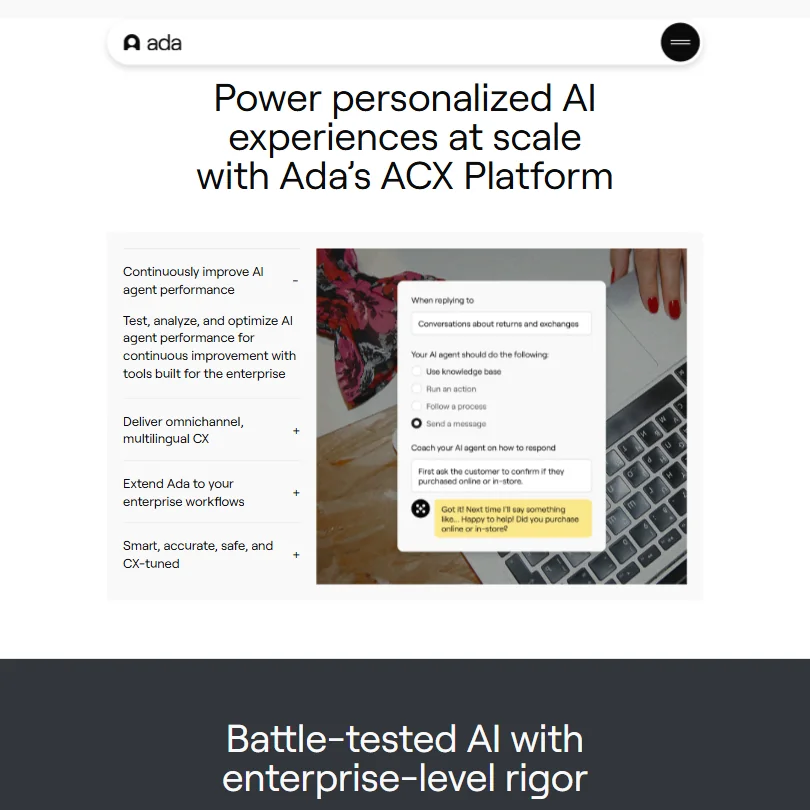
The AI chatbot is the headline, built on what Ada calls their agentic AI engine, a proprietary LLM-based architecture. It ingests existing knowledge base content, learns company-specific workflows, and can close tickets without escalation. That's the core loop. Human handover exists for the cases the bot can't resolve, and the transition reportedly reads cleanly in the conversation thread, though a handful of Reddit comments from 2024 noted it felt abrupt in edge cases. Setup issue more than a product flaw, but worth knowing.
On the helpdesk side, Ada handles ticket management natively, with SLA-aligned routing so priority conversations don't stall in a queue. Knowledge base ingestion pulls from what you've already built rather than requiring a manual rebuild. That saves real time during setup.
Sentiment analysis is baked in. It reads interactions for quality signals and feeds the analytics layer. We haven't seen granular reporting on how deep that goes, but it's confirmed present.
API access is open REST. Integrations cover Salesforce, HubSpot, and a few others. The two that matter most for most enterprise buyers are Salesforce and Zendesk. Branding customization is limited to colors and theme, not full white-labeling. Multilingual support runs to 50-plus languages. Honestly, at enterprise scale that's table stakes, but it's confirmed and it's broad.
Ada Bot Quality: How Well Does It Handle Real Customer Queries?
Ada isn't on G2 or Capterra. Deliberate positioning choice, not an oversight, and it makes independent quality assessment genuinely hard. The absence of public user reviews forces you to rely on forum threads and vendor-supplied case studies, neither of which is ideal.
What we did find: Reddit threads from 2024 surface mostly positive sentiment from operators running Ada at scale. The consistent signal is that the bot performs well on high-volume, repetitive query types. Billing questions, order tracking, standard account management. Confident, fast, reliable on those.
Shakier territory is complex, contextual queries. A few operators noted that when a request required nuance or touched multiple systems at once, resolution quality dropped. The bot would give a technically correct but contextually unhelpful answer. Not unique to Ada, that's the current ceiling for most agentic tools. But worth naming.
The custom training layer is where Ada separates from cheaper alternatives. You can train the AI on company-specific processes, not generic FAQ content. A bot trained on your actual return policy behaves differently than one trained on a template. The setup investment is real. The payoff in resolution quality is real too.
One pattern we kept seeing: the first weeks post-deployment are messy. Teams that expected plug-and-play were disappointed. Teams that treated it like an implementation project were much happier. That tracks.
Ada Channel Coverage: Which Platforms Does It Support?
Web chat is obvious. iOS and Android apps, SMS, email, and phone are all supported. On the messaging side, Ada covers WhatsApp and Facebook Messenger, plus Instagram and Google Business Messages.
Seven distinct channel types in a single platform is a genuine advantage for enterprise buyers running omnichannel support at scale. You're not stitching together separate bots per channel.
Phone is worth calling out specifically because it's less common than chat in this category. Ada handles voice through its AI layer, not just a triage bot that routes to a human. That said, we couldn't find detailed independent reviews of voice quality specifically. The vendor documentation confirms it exists. Whether it matches chat-tier resolution quality is unclear.
Social messaging integrations are confirmed but not heavily documented in terms of depth. Not great. "Supported" can mean basic message intake or full agentic resolution, and those are very different things. Verify that in a demo before assuming parity across channels.
Is Ada Easy to Set Up and Manage?
Not particularly. That's not a knock exactly. It's the nature of what Ada is trying to do.
Autonomously resolving tickets across multiple channels with custom workflows requires work. Most user reports we found described multi-week implementations. Some enterprise deployments ran longer. Ada's knowledge base ingestion pulls existing documentation into the training pipeline, which cuts manual work, but configuring integrations, setting escalation rules, and tuning response patterns all take real time.
No public community forum. No peer Slack group. You're working with their support team and the help center during setup. The help center is described as comprehensive in their documentation, and we have no specific reason to dispute that. But for a platform at this price point, the absence of a user community is a gap.
Live chat support is bot-handled. Email support exists. Enterprise contracts presumably include a dedicated account manager, but that's not documented publicly. Worth asking about directly on your first sales call.
Ada Pricing: Is It Worth It for Support Teams?
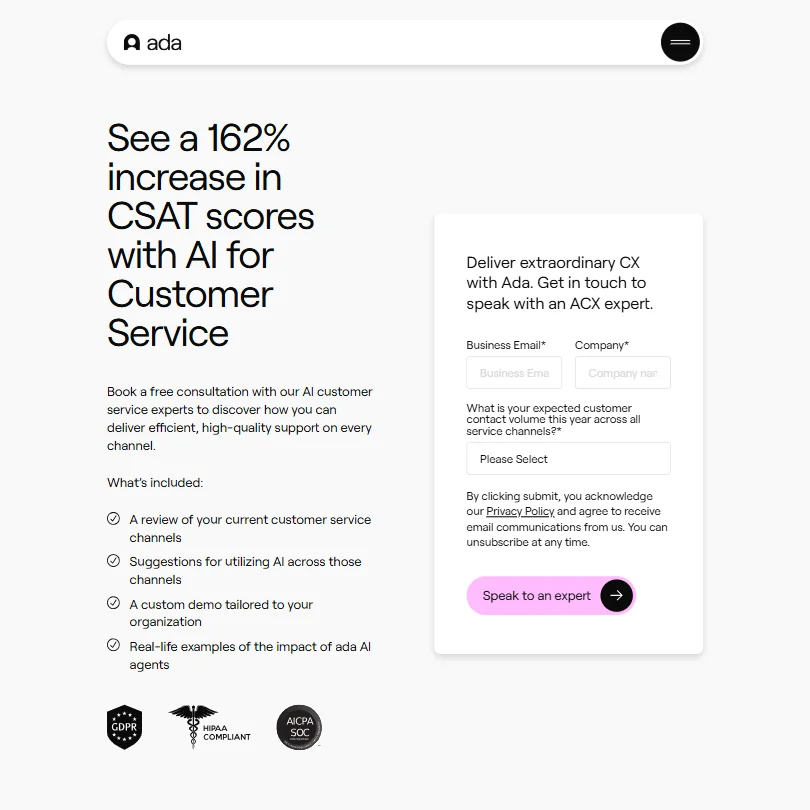
No public pricing. None. No tier names, no starting figure, no "from $X per month." Contact sales, get a custom quote.
We dug through the pricing page and found nothing useful. Ada's website uses Cloudflare bot protection, which briefly challenged automated traffic during our research, though that's standard traffic-screening behaviour and says nothing meaningful about Ada's broader security posture. More practically, the complete absence of pricing transparency is a genuine friction point for teams doing real budget evaluation before getting on a call.
Not unusual for enterprise AI platforms, Intercom gets complicated fast, Zendesk has its own opacity issues. But Ada is more closed than most. There's not even a ballpark signal.
What we can reasonably infer: the platform's complexity and sales-led motion point to contracts starting well into five figures annually. If that's outside your range, Ada isn't built for you and they're not pretending otherwise.
For teams with that budget, the value calculation depends on resolution rates. If Ada's AI genuinely closes 70 to 80 percent of tickets without human intervention, the math works fast against a large support headcount. That's the ROI story. Whether you believe it requires a demo and hard questions about what exactly counts as a "resolution." We'd push on that one.
Ada vs Intercom: Which Customer Service AI Wins?
The most common comparison we saw. Intercom is the category incumbent, long head start, AI features built on top of a live chat core. Ada is built AI-first from the ground up.
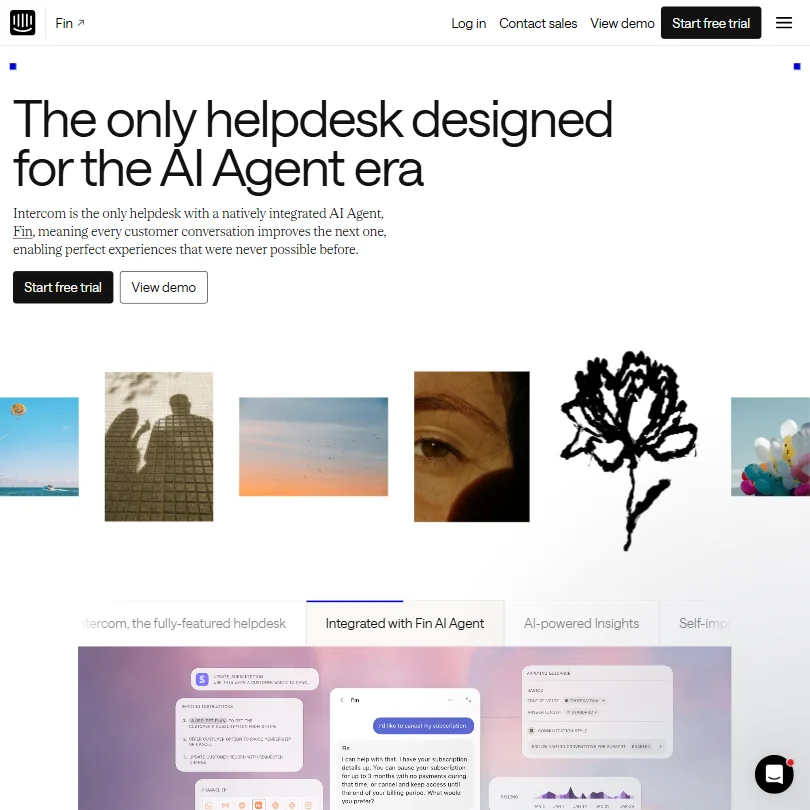
That architecture difference matters. Intercom's AI layer, Fin, sits on top of a product originally designed for human-led conversations. Ada's entire platform assumes the AI is the primary agent. The workflows, the escalation logic, the training infrastructure, all of it assumes the bot is doing the work.
Fin is worth evaluating if you're already deep in the Intercom ecosystem, because rebuilding everything in Ada has real transition costs. Starting fresh, or at a scale where bot resolution rate is the primary metric, Ada's architecture is more coherent for that specific job.
Intercom publishes pricing. Ada doesn't. That alone gives Intercom an advantage for buyers who need a business case before a sales call. The honest answer is neither clearly wins for every buyer. Large enterprise with complex workflows and big support volume? Ada's depth starts to matter. Growing mid-market team on a defined budget? Intercom is easier to start with and easier to justify to finance.
Who Should Use Ada? (And Who Shouldn't)
Enterprise support teams with high ticket volume and a clear automation ROI case. That's the fit. The implementation effort and price point only make sense above a certain scale, and Ada seems to know it.
Ecommerce operators running at volume. Ada's Shopify integration and autonomous handling of order-related queries make it a reasonable option, though Gorgias is worth a look for Shopify-native teams that want something purpose-built for that stack.
Small teams. Not the audience. The setup overhead and enterprise pricing don't make sense below a certain scale, and Ada isn't trying to serve that segment.
Startups. Same conclusion. No trial, no self-serve, no flexibility on commitment level. Ada is not interested in you yet, and that's fine.
Ada Review Verdict
The agentic AI architecture is genuinely differentiated. The channel breadth is real. The custom training layer works. These aren't marketing claims that fall apart under scrutiny, they're confirmed by enough operator accounts to take seriously.
What falls apart is the buying experience. No pricing, no trial, no community, and no presence on public review platforms makes independent evaluation harder than it needs to be. That's a deliberate enterprise-market strategy, not deception. But it puts enormous weight on the sales process, and sales processes aren't always candid about where the product has gaps.
The setup realism issue is the one we'd push hardest in any demo. Teams that went in expecting a fast deployment and got a months-long implementation aren't rare in the accounts we found. Ada can perform very well. Getting it there takes sustained work and internal resources.
Right scale, right resources, Ada earns its place. Below that threshold, more accessible tools cover most of what most teams actually need.
How Ada compares
Ada scores 6.1 out of 10 among the AI support agents we rate. These three do the same job and are the closest to it, compared on what each vendor publishes.
Forethought
Ada answers in 60 languages and only trains its AI on your data if you explicitly agree to it; Forethought answers in 100 languages but trains on your support data by default. Forethought is ISO 27001 certified, which Ada is not. Both connect to Salesforce, Zendesk and Gorgias, and both help agents at handoff: Ada hands over a summary, Forethought also drafts the reply.
Pick Forethought if you want more languages and AI that drafts replies, not just summaries.
Pick Ada if you want AI that never trains on your data without agreement.
Capacity
Capacity runs its own shared inbox and a customer help center; Ada has neither and instead hands off to a connected system like Zendesk or Salesforce. Ada answers in 60 languages against 30 for Capacity's voice agent, and connects natively to Gorgias, which Capacity does not list. Both hold SOC 2 and HIPAA, but only Capacity offers Microsoft Teams as a channel.
Pick Capacity if you want a built in shared inbox and help center.
Pick Ada if you want to keep your existing helpdesk as the system of record.
Fin
Fin runs a full Intercom helpdesk with a shared inbox, help center and SLA policies on its top plan; Ada offers none of those and only hands off into your existing system. Fin bills its AI at $0.99 per resolution and, by default, fine-tunes on anonymized customer data unless you opt out. Ada never trains on your data unless you explicitly opt in. Both are HIPAA compliant and connect to Gorgias and Zendesk.
Pick Fin if you need a full helpdesk with SLA policies built in.
Pick Ada if you want data used only with your explicit sign off.
Frequently Asked Questions
Does Ada offer a free trial?
No. Ada doesn't offer a free trial or a free plan. The platform sells exclusively through enterprise contracts, which means a sales call before you see anything. Deliberate choice for a tool at this complexity level, but it makes early evaluation genuinely harder than it should be.
What is Ada's pricing?
Ada doesn't publish pricing publicly. Custom quotes only. Based on the platform's positioning and customer profile, contracts likely land well into five figures annually, though we can't confirm a specific number. Get on a demo call and ask directly about cost structure before going deep into evaluation. Don't assume anything.
How does Ada compare to Zendesk AI?
Different DNA. Zendesk is a full helpdesk platform with AI features layered in. Ada is built as an AI agent first, with helpdesk-adjacent features supporting that core. Already on Zendesk and satisfied with it? The switching cost to Ada is real and you should model it carefully. Evaluating from scratch with autonomous ticket resolution as the primary goal? Ada's architecture is more coherent for that specific job than Zendesk's current AI layer.