When we first started pulling together this DeepSeek review, the thing that kept stopping us was scale. A company founded in 2023, headquartered in Hangzhou, reporting over 100 million users across web and mobile. That's not a slow build. We cross-referenced the launch timeline with coverage from tech press and Reddit threads, and the growth curve is real. Whether it's built to last at that pace is a different question.

What is DeepSeek?
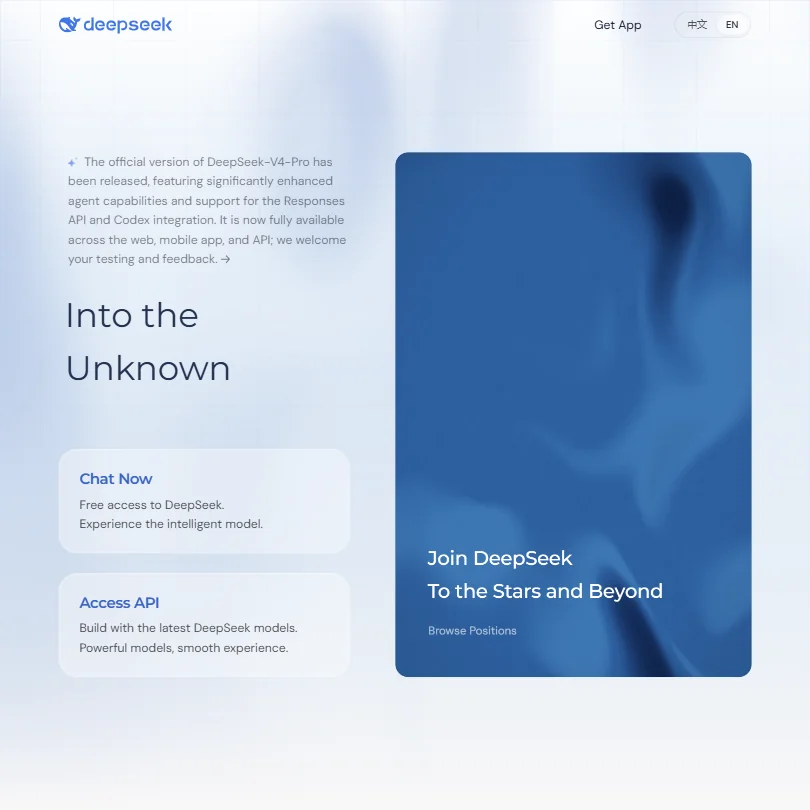
DeepSeek is a Chinese AI lab that builds and ships large language models. The consumer-facing product is a chat interface, free to use, available on web, iOS, and Android. The technical product is a family of models. The V3 and R1 families came first, followed by the V4 generation. The current flagship is DeepSeek-V4-Pro, specifically the V4-Pro-0813 build released August 13, while V4-Flash-Vision-Exp is a newer experimental multimodal release that arrived August 21, 2026. Developers access these through the API platform at platform.deepseek.com.
V4-Pro is not a V3 rebrand. DeepSeek's own transparency page lists V4 and V3.2 separately, and the API changelog documents V4 as a distinct model family released April 24, 2026. Worth flagging because we've seen that confusion in forum threads.
The company's framing is deliberate. They're not pitching this as a specialized academic research AI. They're pitching a general-purpose frontier model that happens to be priced aggressively. That positioning is what made the industry pay attention in early 2024, and it's still the core of the value argument.
Benchmark scores on reasoning and coding put DeepSeek-R1 close to GPT-4 class performance. At a fraction of the API cost. That's the actual story.
DeepSeek Features: Search, Synthesis & Research Capabilities

The free chat interface does more than most free tiers. Real-time web search is included. File and document upload works. Multi-turn conversations with synthesized answers pulling across sources in a single response. For someone treating DeepSeek as a quick research assistant or an ai paper summarizer, that's a solid baseline.
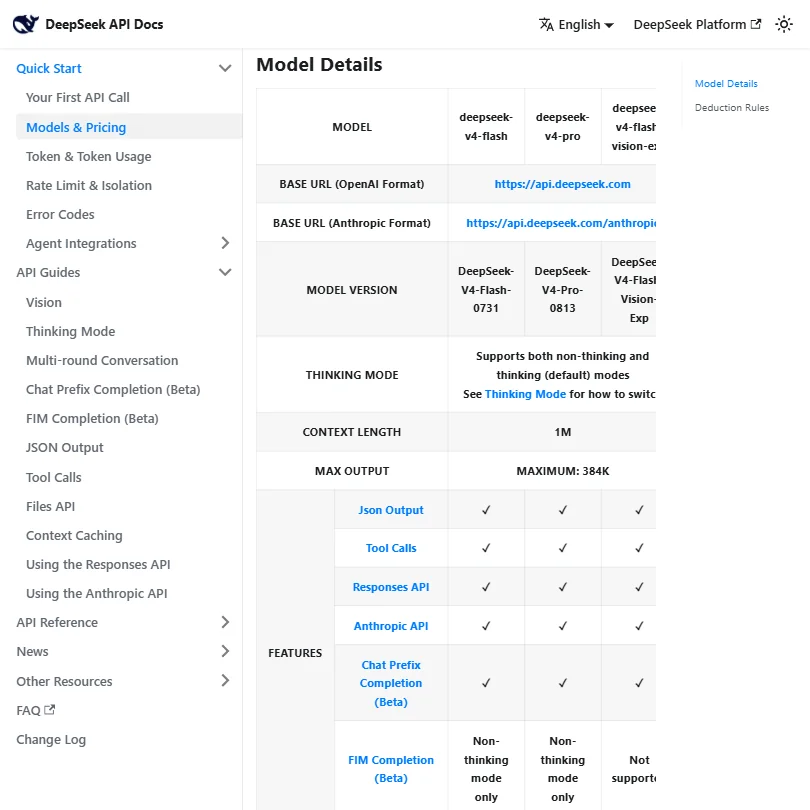
The Responses API and Anthropic-format API support are both live across the V4 model family, which extends what developers can build, particularly around agentic workflows. JSON output and tool calls are supported across V4-Flash, V4-Pro, and V4-Flash-Vision-Exp. Chat Prefix Completion is available in beta. FIM Completion in beta runs on V4-Flash and V4-Pro in non-thinking mode only, and is not supported on V4-Flash-Vision-Exp. Worth knowing before you plan around it.
No browser extension. No Notion integration. The integration list is short. Honestly, for the core developer audience, that probably doesn't matter. But for anyone expecting this to slot into a research workflow the way something like Perplexity does, the connective tissue isn't there.
What's genuinely good is the reasoning layer. The V4-Pro model supports both non-thinking and thinking modes, with thinking on by default. It handles multi-step problems in a way that general chat tools don't. It shows its work. It backtracks. That's useful for structured research or checking logic on a complex synthesis.
The consumer interface has also moved past the old V3-versus-R1 toggle framing. Current modes are closer to Expert and Instant rather than the earlier "DeepThink (R1)" button that sat beside Search in the 2025 UI. Small thing, but relevant if you're reading older tutorials.
DeepSeek Research Quality: How Accurate and Trustworthy Is It?
This is where things get more complicated. The model performs well on benchmarks. Our research across Reddit threads and tech forums found consistent praise for reasoning quality, especially from developers running it against GPT-4o on coding and math tasks. That tracks with what the published benchmark data shows.
Accuracy on general-purpose research is a different thing. Hallucination is a real problem across every model in this class. DeepSeek is not exempt. We didn't find a consistent pattern of DeepSeek being worse than ChatGPT or Claude on factual reliability. We also didn't find strong evidence it's better. It's in the same messy neighborhood.
Citation generation is not a stated feature. The tool will often cite sources when web search is active, but there's no dedicated citation format output, no academic reference management, nothing close to what purpose-built tools like Scite offer for literature review. If you need verified citations for academic work, DeepSeek isn't built for that. Full stop.
Fact-checking as a deliberate feature is also not documented. What you get is a capable model that reasons through problems well. Not the same thing.
DeepSeek Source Coverage: What Does It Actually Search?
The web search function is live in the chat interface. Beyond that, details are thin. No public documentation on which index it uses, how fresh the data is, or whether academic databases are covered. DeepSeek does not publicly identify PubMed or arXiv as specific training sources. Its disclosures describe scientific, technical and other multi-domain corpora more generally, alongside Common Crawl, Stack Exchange and licensed third-party datasets. That's what the current V4 training-data disclosure actually says.
For general web queries, the search works. Users on Reddit reported fast, relevant results on current events and technical questions. For academic literature review or systematic review workflows, the coverage is almost certainly not deep enough. No structured access to scholarly databases, no paper-level search, no citation graph navigation.
That's a real gap. Not fatal for the general user. Significant for the researcher.
The document upload feature helps bridge some of this. You can bring your own sources in, ask the model to reason across them, get synthesis that way. That's a workaround, not a feature. We've seen worse workarounds.
Is DeepSeek Easy to Use for Researchers and Professionals?
The chat interface is clean. No onboarding friction. You open it, you type, it responds. Mobile apps on iOS and Android follow the same pattern. Nothing about the UX is confusing, and nothing is particularly clever either.
For developers, the API platform is well-documented relative to what you'd expect from a company this young. The docs cover authentication, model selection, context windows at 1M tokens, and max output at 384K. Reddit threads from developers in 2024 and 2025 generally confirm the integration isn't a headache.
For non-developers doing research, the experience is functional but flat. No guided workflow for literature review. No structured research mode. No way to organize sessions or outputs. You talk to it, it answers, you copy what you need and go elsewhere. For casual use, fine. For anything reproducible or auditable, that's a problem.
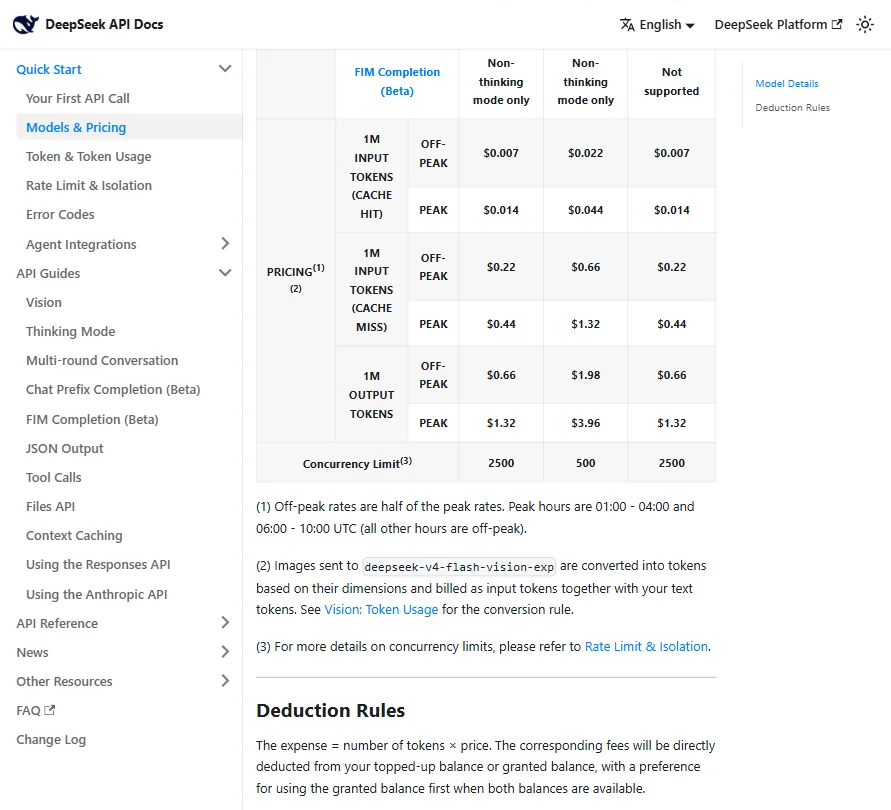
The concurrency limits are worth knowing before you scale. V4-Pro sits at 500 concurrent requests. V4-Flash and V4-Flash-Vision-Exp both allow 2,500. If you're building something high-throughput, that gap matters.
DeepSeek Pricing: Is It Worth It vs Free Alternatives?

Free is the starting point and, for most users, the only point. The web and mobile apps are fully free. No trial expiry. That's table stakes in this category, but the depth of what the free tier covers is competitive.
API pricing is where DeepSeek has made headlines. Off-peak input token pricing on V4-Flash sits at $0.007 per million with cache hits, rising to $0.014 at peak. V4-Pro off-peak input runs $0.022 per million cached, $0.044 at peak. Output tokens on V4-Flash off-peak run $0.66 per million, with peak at $1.32. V4-Pro output is $1.98 off-peak and $3.96 at peak.
Honest comparisons with OpenAI API costs vary more than the forums suggest. One 2025 Reddit discussion put DeepSeek at less than 10 percent of OpenAI API costs for certain workloads, while other comparisons showed much smaller gaps depending on which OpenAI model was used, caching behavior and output length. We're not going to anchor to a fixed percentage. The variables are too significant. What we can say is that for reasoning-quality output at volume, the published numbers are meaningfully lower than comparable OpenAI tiers in most configurations we've seen discussed.
Mid-tier and enterprise pricing is not publicly stated. No seats-based plan, no team tier. Not unusual for API-first products. But it means any large-scale deployment starts with a conversation we can't document.
For individuals and small teams, the free chat tier and low API costs are genuinely good value. We don't think that's spin.
DeepSeek vs ChatGPT: Which AI Research Tool Is Better?
The honest version of this comparison depends entirely on what you're doing.
For API cost, DeepSeek wins. Not close. Developers who need reasoning-quality output at volume have a real reason to look here. The R1 model competing with o1-level performance at substantially lower price is what moved the market in early 2024.
For ecosystem and integrations, ChatGPT wins. The plugin library, third-party integrations, enterprise tooling. None of that exists on the DeepSeek side in comparable form.
For general chat quality, the gap is smaller than OpenAI would prefer. V4-Pro performs close to GPT-4o on many task types, particularly coding and structured reasoning. On creative writing and nuanced instruction-following, user reports lean slightly toward ChatGPT. That's consistent across the Reddit threads and forum discussions we read through.
The data privacy question is harder. DeepSeek is a Chinese company. The privacy policy is published. What's in it, and what it means in practice for enterprise users, is a real consideration. We're not going to hand-wave that away. Users handling sensitive research data or proprietary information should read the policy before using the API in production. Due diligence, not a specific accusation.
Who Should Use DeepSeek? (And Who Shouldn't)
Developers running cost-sensitive API workloads. That's the clearest fit. The model quality is there, the concurrency limits on V4-Flash are workable, and the price is genuinely low.
Casual users who want a capable free chat tool. No complaints there. The free tier is real and functional.
Academic researchers needing a full literature review pipeline. Wrong tool. No citation management, no academic database access, no structured output for systematic reviews. Purpose-built options exist for that.
Enterprise teams with data sensitivity concerns should proceed carefully. Not because DeepSeek is necessarily unsafe, but because the documentation on enterprise data handling is thin and the company's jurisdiction matters for compliance frameworks.
Anyone needing team collaboration features or export workflows will hit a wall quickly. None of that is built out.
DeepSeek Review Verdict
The model is genuinely good. The API pricing is the most competitive we've tracked in this space. The free chat tier works. These things are real.
What creates friction is everything around the model. No citation tools. No integration layer built for research workflows. Privacy documentation that raises questions for enterprise deployments. Support that amounts to an email address and API docs. And no substantial review trail on G2, Capterra, or Trustpilot to triangulate user experience across roles.
For developers, the value case is strong. For researchers, it's partial at best. The reasoning capability is there, but DeepSeek hasn't been built into a research tool yet. It's a powerful engine sitting inside a basic shell.
The V4 generation, particularly V4-Pro with thinking mode and the newer multimodal V4-Flash-Vision-Exp, suggests the model roadmap is moving quickly. The agent capabilities they're now pushing suggest they know the shell is thin. Whether they build the right features around the model is the question worth watching.
Frequently Asked Questions
Is DeepSeek free to use?
Yes. Web and mobile apps are permanently free with no trial expiry. The API is paid but priced significantly lower than comparable models from OpenAI. For most individual users, the free chat interface covers everything they'd actually need.
Is DeepSeek safe for research and professional use?
For casual research and development work, most users we read about treat it as safe. For anything involving sensitive data, proprietary research, or regulated industries, the calculus is more careful. DeepSeek is a Chinese company, the privacy policy governs data handling, and enterprise-level compliance documentation isn't publicly detailed. Read the policy before committing production data to the API.
How does DeepSeek compare to purpose-built academic research tools?
It's not really in that category yet. DeepSeek is a general-purpose AI with good reasoning. It doesn't have citation generation, structured literature search, or academic database access. Tools built specifically for literature review or systematic research workflows operate in a different lane. DeepSeek is useful as a reasoning layer on top of sources you bring to it, not as a discovery and citation tool on its own.