AI productivity tools are showing cracks in real-world use
New evidence from developer surveys, student research, and workplace experience suggests AI tools are quietly undermining the productivity gains they promise.

The case for AI tools has always rested on a simple equation: put Claude Code, GitHub Copilot, or Cursor in front of a knowledge worker and they get more done. That equation is now being stress-tested by actual data, and the results are uncomfortable. Across developers, students, and office workflows, studies, surveys, and firsthand reports point to a more complicated pattern: output can rise even as dependence, learning outcomes, or attention worsen.
What makes this moment significant is that warning signs are arriving from several directions at once, although their evidentiary weight varies. They include a developer survey, a reported student study that had not yet been independently verified, and a firsthand workplace essay. Together they raise a coherent question about what happens when people outsource thinking rather than augment it, but they should not be treated as equally strong proof.
80% of developers say AI coding feels like dependence, not advantage
A survey of 305 developers by Coddy Tech found that four in five said their use of AI coding tools had come to feel more like dependence than a genuine advantage. The same survey found that 43% keep coding with AI after hours even when they intended to stop, and 32% have sacrificed sleep to keep going. Quentin Rousseau, CTO of incident-report company Rootly, described the dynamic precisely in a LinkedIn post: watching Claude Code refactor a module at 2:47 a.m., unable to stop, eventually needing medical help for the resulting sleep disruption. The feedback loop of agentic tools, where a successful output delivers a dopamine hit and a failure delivers an adrenaline spike, is structurally similar to other compulsive behaviours. The 2025 Stack Overflow Developer Survey adds another layer: while 80% of developers now use AI tools in their workflows, trust in AI accuracy has fallen from 40% to just 29% year on year, and overall positive sentiment toward AI has dropped from 72% to 60%. The tools are more embedded than ever, and trusted less than ever.

Reported China study: homework scores up 18%, exam scores down 20%
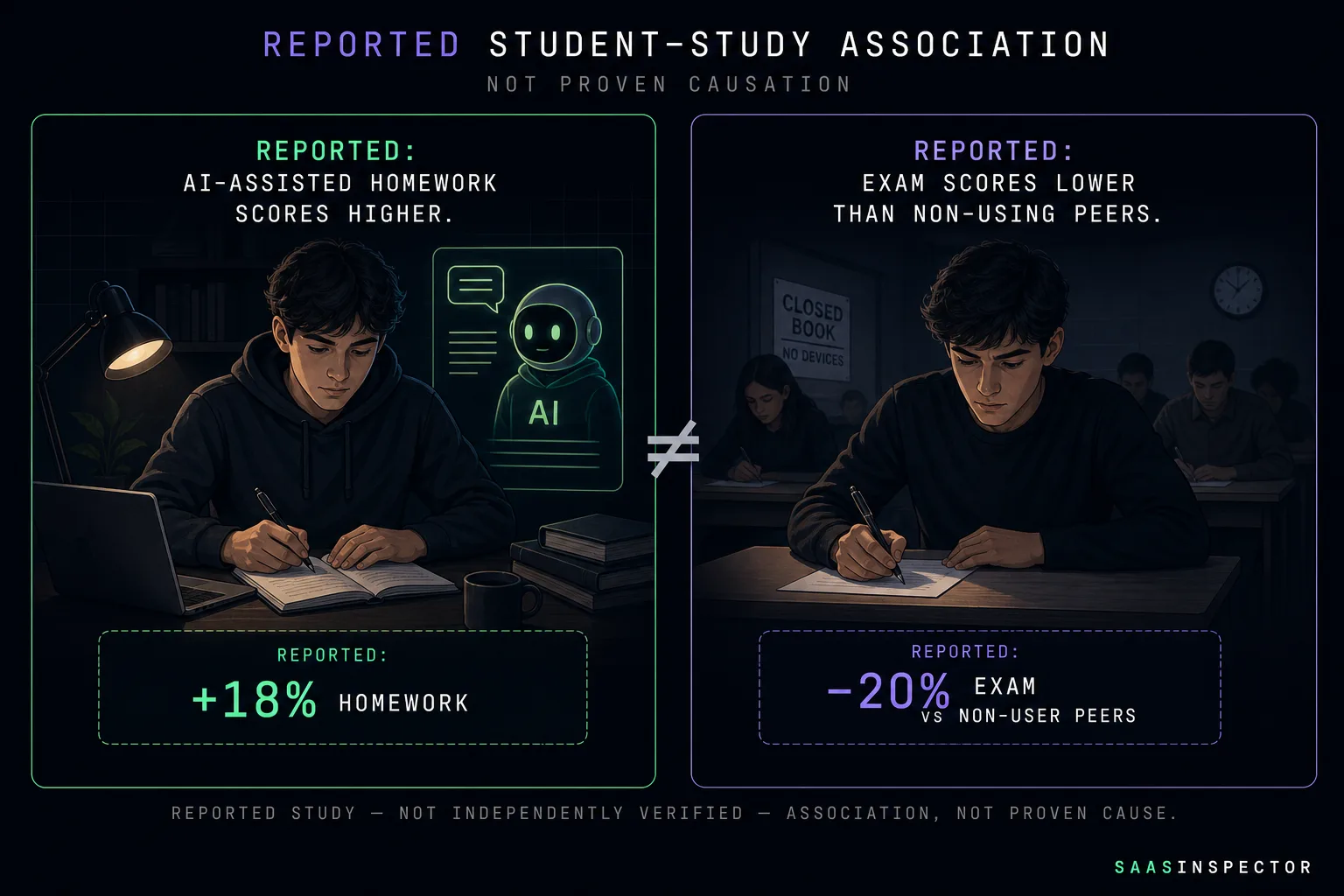
A reported study tracking 27,000 students aged 12 to 18 in China, led by David Stromberg of Stockholm University alongside Victor Lei and Wu Yanhui of the University of Hong Kong, produced the starkest numbers yet on this theme. Students using AI tools including Doubao and DeepSeek saw their average homework scores rise by 18% over six months. When those same students sat exams without AI access, they reportedly scored 20% below peers who had not used AI during the study period. The researchers’ full study had not been independently verified at the time of the source report. A smaller 2024 study at the University of Pennsylvania found the same broad pattern in maths: AI-assisted practice produced better short-term results, but the advantage vanished in a subsequent closed-book test. A plausible mechanism is cognitive offloading, although the reported study does not by itself prove causation. If a tool completes the cognitive work, the person using it may fail to build the mental model that makes knowledge transferable. Higher scores on assisted tasks can reflect the tool's capability rather than the user's alone.

AI-generated workplace documents are triggering "AI blindness" in readers
There is a second-order effect that rarely gets discussed. When AI tools flood workplaces with output, colleagues on the receiving end start to disengage. One software engineer wrote recently about noticing that their brain simply refuses to process documents that carry the hallmarks of low-effort AI generation, the verbose technical requirements documents that sound like an LLM reasoning aloud, the marketing decks that mix plausible strategy with meaningless technical gibberish, the design documents peppered with Claude-specific phrasing. The writer described becoming "AI-blind" and compared the effect to banner blindness, the well-documented phenomenon where people learn to ignore display advertising. When a tool designed to accelerate communication produces content that recipients have learned to tune out, the productivity gain at the point of creation becomes a productivity loss at the point of consumption. The net effect on the organisation may be negative.
What buyers of AI productivity tools should take from this evidence
None of this means tools like GitHub Copilot, Cursor, or Claude Code are without value. The Stack Overflow data confirms they are now a standard part of developer workflows, and the reported student findings do not establish a case for banning AI tools; they raise a concern that unstructured reliance without deliberate practice may undermine skill development. The Brookings Institution has noted that AI can support learning when used intentionally, with the operative word being intentionally. For organisations evaluating or renewing subscriptions to AI productivity tools, the practical question is whether their workflows are designed around augmentation or replacement of thinking. The evidence and firsthand reports suggest a risk that when AI handles the cognitive load entirely, the human producing the work, the person receiving it, or both may come away worse off.
- 80% of developers find AI coding more addictive than helpful, ZDNET AI ↗
- AI boosted homework scores, then exam scores dropped: Study, Hacker News AI ↗
- I'm becoming AI-blind, Hacker News AI ↗