Seven hundred and fifty thousand developers on a platform that launched in 2023. That's the Vapi number that actually stopped us when we were pulling vendor docs. The $50M Series B gets more press, but the developer adoption figure is the one that tells you what kind of product this is. Not a support tool with an API bolted on. An infrastructure layer that developers build voice products on top of, and everything else about Vapi follows from that.
What is Vapi?
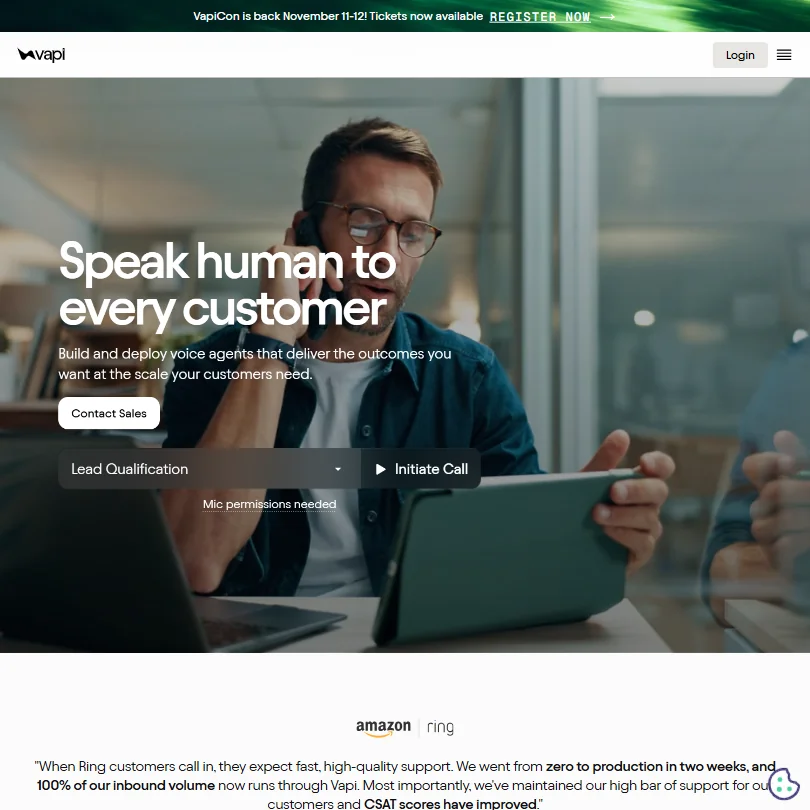
Vapi is an API-first voice agent platform built around the assumption that you're an engineer who wants to control the whole stack. Bring your own language model. Bring your own speech-to-text provider. Bring your own text-to-speech voice. Vapi handles the connective tissue that keeps latency under 500ms and keeps calls from falling apart mid-conversation. The company claims over a billion calls processed and 2.5 million agents launched. Those numbers are vendor-supplied, but the developer community reception we tracked on Reddit doesn't contradict them.
The homepage pushes lead qualification, customer support, and appointment scheduling as primary use cases. Ring reportedly went from zero to full inbound call volume on Vapi in two weeks. That's on the homepage, not buried in a PDF case study. Honestly, that's a fast deployment for a company that size, even with marketing polish factored in.
What Vapi is not: a helpdesk. No ticket management. No email automation. CRM integrations aren't named anywhere in the public docs. If those are requirements, this review can stop here.
Vapi Features: Chatbot, Helpdesk & Support Automation Breakdown
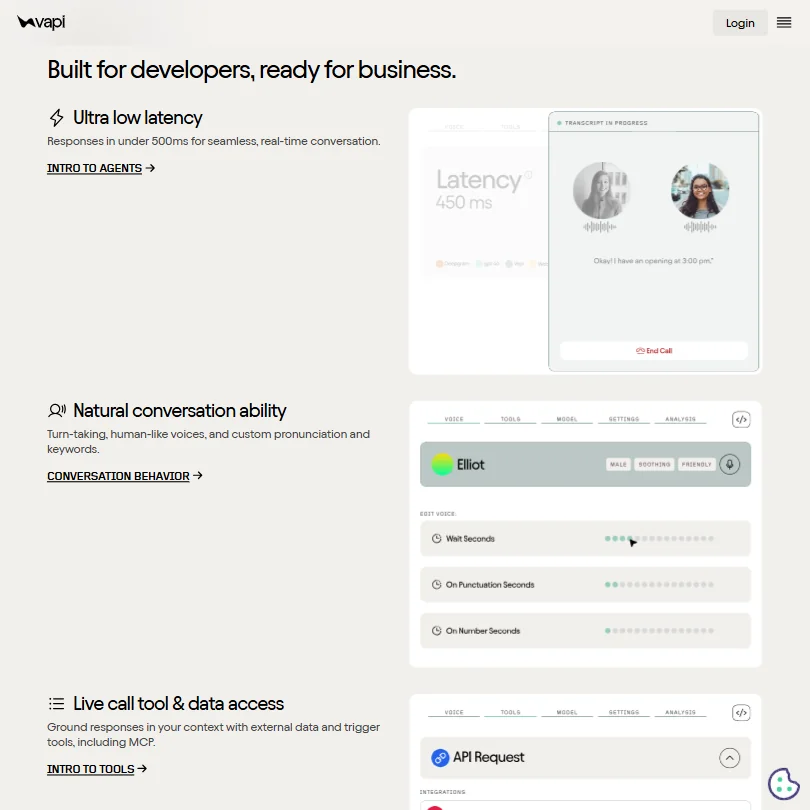
Voice agents for inbound and outbound calls are the core product. Full stop. SMS and chat channels exist alongside them, but AI voice agents are where the product depth lives, and the other channels are clearly secondary. Ticket management doesn't exist. Email automation doesn't exist. This is not a support suite that happens to have a voice feature.
Configurability is the real feature. You can swap LLM providers, with OpenAI and Anthropic supported among others. Speech-to-text works with Deepgram and a few others. Text-to-speech connects to ElevenLabs and similar. Custom voices are supported on the Build plan, which is notable for a usage-based tier.
The Scale plan, which requires an annual contract, adds fixed platform fees with committed volume and volume-based per-minute pricing. It also brings SOC 2, HIPAA, PCI, SSO, and RBAC compliance, plus data residency, a dedicated account team, and a support SLA. Those aren't checkbox items in regulated industries. Healthcare and finance deployments care deeply about that list, and most competitors can't match all of it.
HIPAA is available on the Build plan too, at $2K a month as an add-on. Zero Data Retention is separately priced at $1K a month on both plans. Worth knowing before you assume compliance is bundled.
CRM integrations are theoretically possible because the API allows you to build them. Vapi doesn't name Salesforce or HubSpot anywhere. You're laying that plumbing yourself. Fine for a developer team. A real problem for a support ops manager who expected it to be a checkbox.
Vapi Bot Quality: How Well Does It Handle Real Customer Queries?
Vapi doesn't have a G2 or Capterra presence, which makes third-party review data thin. We cross-referenced Reddit threads, Product Hunt comments, and developer community discussions to fill that gap. The pattern we kept seeing in those sources is consistent: latency and reliability get cited positively, repeatedly, often by developers who've tried Retell AI or Bland AI for comparison.
The bring-your-own-model approach is where quality gets complicated. Vapi doesn't add a proprietary intelligence layer. It routes, manages, and connects. Your bot quality is almost entirely a function of which LLM you've connected and how carefully you've written the prompts. If your prompts are weak, your agent is weak. That's not a criticism of Vapi's architecture, it's just the honest implication of the design. Worth knowing before you sign up expecting a smart out-of-the-box voice bot.
Reddit threads from 2024 surface occasional friction around cold transfer behavior and edge cases in conversation orchestration. Nothing catastrophic. More like expected gaps in a platform that's two years old and moving fast.
Vapi Channel Coverage: Which Platforms Does It Support?
Voice is the main channel. SMS and chat exist but this is not an omnichannel platform in the way Intercom or Dixa would use that word. If voice is your primary support channel, that's a workable fit. If you need email, social, and chat all managed together, Vapi isn't it.
Telephony connects through your own provider via the API. Multilingual support exists as a pass-through from whichever STT and TTS providers you've configured, not as a native feature. That distinction matters for global deployments where you need guaranteed language coverage and can't afford gaps to surface at runtime.
We've seen worse channel coverage in this category. We've also seen better from tools that weren't billing themselves as enterprise-grade.
Is Vapi Easy to Set Up and Manage?
No. Not for non-developers.
The documentation is genuinely good. Developers in Reddit threads reference it positively without prompting, which is a real signal. The Discord community is active and appears useful for getting unstuck. On the Build plan, community access and email support are what you have, no dedicated support SLA.
Getting from signup to a production voice agent requires real engineering work. Configuring your LLM provider, your STT provider, your TTS provider, and your telephony stack is not a visual-builder experience. The Ring "two weeks to full inbound volume" story only makes sense if Ring has dedicated engineering capacity, which they do.
The 60-plus free minutes on signup are actually useful for testing, not a token gesture. Just don't expect to spend those minutes clicking around a drag-and-drop interface. You'll spend them reading API docs and writing configuration calls. For developers, that's fine. For everyone else, that's a dealbreaker.
Vapi Pricing: Is It Worth It for Support Teams?
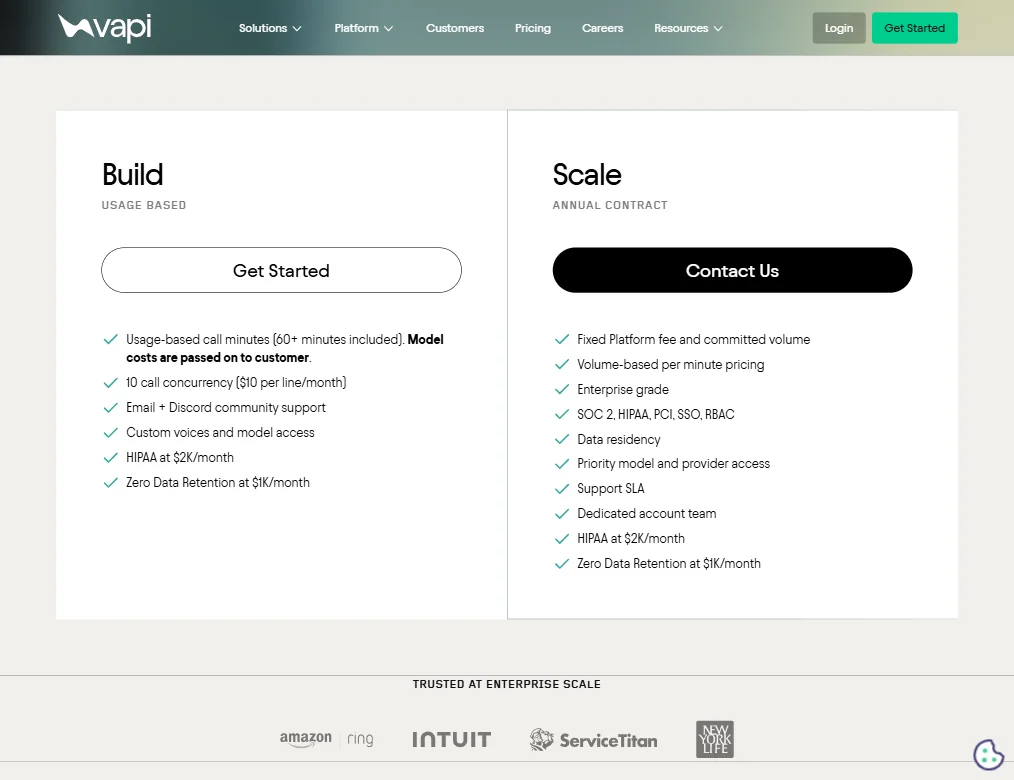
The Build plan starts at $0.05 per minute, usage-based, with no monthly floor after the initial included minutes run out. In our database of tools with public pricing in this category, that's one of the cheaper entry points. The category median sits around $29 a month flat, so Vapi looks inexpensive at first. It stops looking inexpensive when volume scales.
The Scale plan is a custom annual contract. No public number. You're talking to sales, and the pricing page makes no pretense otherwise.
The model cost pass-through is the pricing mechanic that actually differentiates Vapi. LLM and TTS costs pass through at actual provider rates with no markup. Fair. But those costs compound fast at call volume, so your real per-minute cost is always higher than the $0.05 headline. Buyers who miss that are going to have a bad time reconciling their first month's invoice.
HIPAA compliance is $2K a month on top of your usage costs. Zero Data Retention is $1K a month on top of that. There's no permanent free tier. No publicly stated refund policy. We're skeptical of pricing pages that leave compliance costs in footnote territory rather than leading with them.
Vapi vs Retell AI: Which Customer Service AI Wins?
Both are API-first voice agent platforms targeting developers building production voice AI. Both are young companies that launched around the same time. The surface-level positioning is similar enough that the differentiation lives in the details.
Retell AI has published its HIPAA compliance stance and offers self-service BAAs before PHI is transmitted, which is a more accessible compliance path for smaller teams. Vapi's HIPAA coverage exists but comes as a $2K monthly add-on, which tilts it toward larger budgets. For teams without that budget, Retell's self-service BAA approach is meaningfully more accessible for healthcare deployments at smaller scale.
Vapi's scale credentials are stronger in aggregate. A billion-plus calls processed and a broader enterprise compliance stack including PCI and SOC 2 alongside HIPAA. For large-volume deployments, that matters.
Deepgram has moved beyond being just a speech-to-text provider that Vapi integrates with. They now offer a full Voice Agent API combining STT, LLM orchestration, and TTS in one product, with turn-taking, barge-in handling, and function calling included. That makes Deepgram a more direct competitor than it was a year ago, not just an integration option.
Teams that need voice agents plus a full support suite should look at Intercom instead. Different product category, but the boundary is real and worth knowing.
Who Should Use Vapi? (And Who Shouldn't)
Developers building voice AI products at scale. That's the fit, and it's a specific one.
Enterprises in regulated industries with engineering teams. The compliance certifications are real. The dedicated account team on Scale is real. But you still need engineers to configure and maintain the stack.
Support teams without developers on staff. Don't start here. Setup complexity will stall you before a single call reaches production. Look at platforms with visual builders and native helpdesk integrations first.
E-commerce brands expecting plug-and-play voice automation. Not happening. The API-first design is a feature for developers and a barrier for everyone else, and no amount of good documentation changes that.
Vapi Review Verdict
The latency story holds up in user reports. The compliance stack is real. The developer community reception is genuinely positive. The Ring deployment and the Series B give Vapi credibility that most two-year-old startups haven't earned yet.
The weaknesses are structural, not patchable. No helpdesk features, limited channel coverage, and a setup process that requires engineering resources put it out of reach for most support teams, regardless of budget. The absence of G2 or Capterra reviews means less third-party validation than we'd want for a product pitching enterprise contracts. The compliance add-on pricing buries costs that enterprise buyers discover late.
Specialized is the honest word for it. Vapi does one thing, building and deploying voice agents at scale, and the evidence suggests it does that thing well. The question isn't whether Vapi is good. The question is whether a voice-agent infrastructure layer is actually what you need, or whether you've been dazzled by the latency numbers into thinking it's something broader.
How Vapi compares
Vapi scores 5.5 out of 10 among the voice agent platforms we rate. These two do the same job and are the closest to it, compared on what each vendor publishes.
Bland
Vapi charges $0.05 a minute for calls, well under Bland's $0.14. Vapi lets you remove its branding on a plan; Bland offers no such option. Bland connects to Salesforce, HubSpot and Zapier; Vapi's only listed integration is Slack. Bland also covers Canada as a data region alongside the US and EU, which Vapi does not state.
Pick Bland if you want more integrations and canada as a data region.
Pick Vapi if you want the lower per minute price and removable branding.
Retellai
Vapi charges $0.05 a minute for calls against Retellai's $0.07. Retellai holds ISO 27001 certification, which Vapi does not have. Retellai's AI answers in 55 languages; we could not find that figure on Vapi's site. Vapi lets you remove its branding on a plan and keeps an audit log; Retellai offers neither.
Pick Retellai if you need iso 27001 certification and more languages.
Pick Vapi if you want the lower per minute price and removable branding.
Frequently Asked Questions
Does Vapi have a free plan?
No permanent free tier exists. Sign-up includes 60-plus minutes for testing, which is genuinely enough to evaluate the platform seriously. After that, you're on usage-based billing at $0.05 per minute on the Build plan. No free tier after those initial minutes are gone.
Is Vapi suitable for small businesses without a development team?
Realistically, no. Configuring LLM providers, speech-to-text, text-to-speech, and telephony requires engineering work. Without that capacity on staff, you're likely to get stuck before a single production call goes out. Smaller teams without developers will have a better starting experience with a tool that offers a visual builder and pre-built integrations out of the box.
How does Vapi's pricing actually work at scale?
The $0.05 per minute covers Vapi's infrastructure. Your LLM costs and TTS costs pass through separately at provider rates, and telephony costs sit on top of that. The transparency is fair, but the headline number understates real per-minute cost meaningfully at volume. High-volume deployments move to a custom annual Scale contract with committed volume pricing, and that number isn't public.