Our research on TextCortex started where most reviews don't: in the weeds of customer complaints rather than on the homepage. This textcortex review pulls from G2 write-ups, Capterra feedback, Trustpilot threads, and the vendor's own documentation, and the picture that emerges is more interesting than the marketing suggests. Founded in Berlin in 2021, the company has built something that doesn't fit neatly into the "AI writing tool" box it keeps getting dropped into. Which is both an asset and a communication problem.

What is TextCortex?
TextCortex started as a writing assistant. It's moved well past that. What they're selling now is closer to an AI agent infrastructure layer, one that lets enterprise teams build no-code workflows, connect internal knowledge bases, and run AI tasks across dozens of apps without leaving whatever tool they're already in.
The browser extension is the clearest example of how this works in practice. It covers 30,000+ apps and websites. One extension, everywhere. That's not a writing tool feature. That's an infrastructure play.
The company leans hard on a few differentiators. European data sovereignty is one. TextCortex holds GDPR compliance, SOC2 certification, and ISO 27001 certification. For any team nervous about where their data goes, that combination matters. Zero data training is another. Your inputs don't get used to train anything. Honestly, for enterprise buyers, that might be the whole pitch right there.
The model setup is worth understanding too. TextCortex doesn't lock you into one AI. The Model Hub lets teams swap between GPT-4, Claude, Gemini, and others depending on the task. That's a real differentiator, not a marketing bullet.
TextCortex Features: What You Actually Get
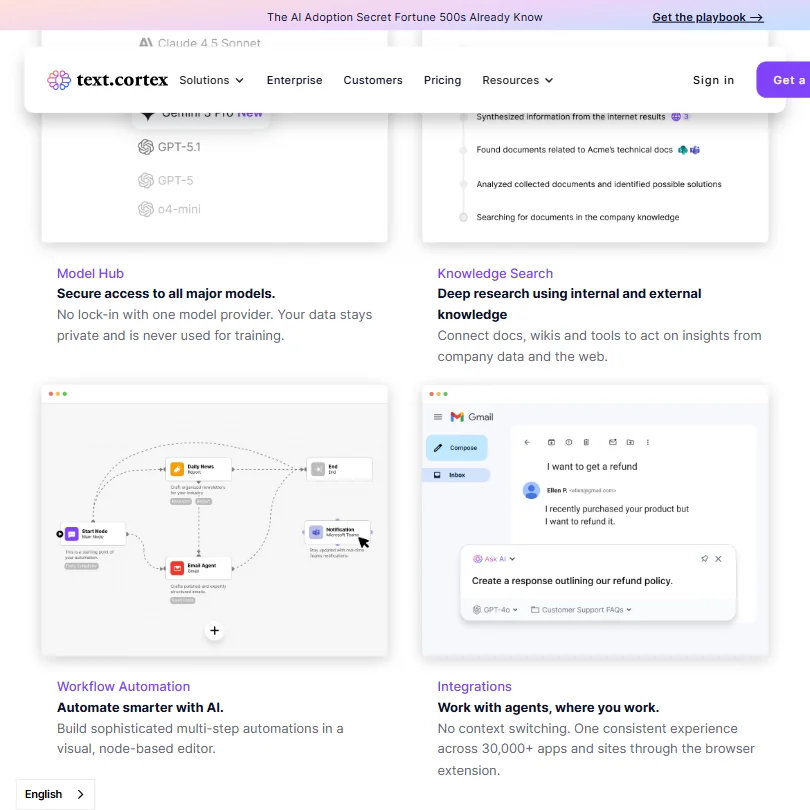
The feature set breaks into two rough layers. There's the writing side and there's the agent side. Most competitors stay in the first layer. TextCortex tries to own both.
On the writing side: paraphrasing and rewriting tools, a built-in content editor, short-form templates, and tone adjustment. Standard stuff. Well-executed based on what G2 reviewers in marketing and content roles consistently report. Paraphrasing in particular gets named more than any other feature in positive reviews. Users seem to reach for it constantly.
The Knowledge Search feature is where things get interesting. You can pull from internal docs, uploaded PDFs, connected wikis, and live web searches. The AI uses all of that context to generate output. In our research across G2 and Capterra reviews, we kept seeing people mention how much this changed their day-to-day. One recurring pattern was support and customer success teams building agents that could answer questions from internal knowledge bases without manually hunting for documents.
The no-code agent builder is the newest-feeling piece. You build workflows visually. Scheduled automations handle bulk tasks. API access opens up for enterprise and developer tiers. We cross-referenced their docs with user reports on this and the feature seems genuinely capable, though feedback from newer users suggests the learning curve is steeper than the "no-code" label implies.
Worth noting: SEO optimization tools don't appear anywhere in the confirmed feature list. Neither does image generation. For content teams with heavy SEO needs, that's a real gap.
TextCortex AI Output Quality: Is It Good Enough?
The output quality question is complicated by the model-agnostic setup. Because TextCortex routes through GPT-4, Claude, and Gemini depending on what you've configured, the ceiling for output quality is high. Genuinely high. The floor, though, depends on which model you're running and how well you've set up your knowledge context.
In our research, G2 reviewers rate it 4.7 out of 5 across 855 verified reviews. Capterra sits at 4.7 out of 5 from 232+ reviews. Trustpilot is lower, landing at 4 out of 5 from 362 reviews. The Trustpilot gap is the number that caught our attention. It tends to surface broader, less curated feedback, and a 4.0 versus a 4.7 is a meaningful gap worth sitting with.
What G2 reviewers praise most: contextual accuracy when the knowledge base is properly set up, multilingual output across 25+ languages, and the paraphrasing engine. What shows up as a recurring frustration: outputs that feel generic when no knowledge context is provided, and occasional inconsistency in longer-form content. That second complaint tracks. It's a known issue with most AI writing tools.
We're not alarmed by the reviews overall. But we'd want to see that Trustpilot number climb before calling the output quality exceptional.
Is TextCortex Easy to Use?
Mixed signals here. The browser extension is straightforward. Install it, and it surfaces across whatever you're working in. That frictionless access is something reviewers appreciate, especially people using it in Slack and Microsoft Teams. The Cortex Academy and a detailed Enterprise AI Adoption Playbook suggest the company knows their product takes some onboarding. That's honest. We appreciate the honesty. We're less thrilled it's necessary.
The no-code agent builder is where the ease-of-use story gets complicated. "No-code" as a label sets expectations. Several reviewers with less technical backgrounds describe a steeper ramp than they anticipated. Not impossible. Just not as plug-and-play as the marketing implies.
For individuals who want to open a tool and write something quickly, TextCortex probably isn't the right mental model to walk in with. It's built for teams who will invest time in configuration and knowledge integration. The payoff is real, but it's not instant.
TextCortex Pricing: Is It Worth the Cost?

We dug through the pricing page and found very little. No public starting price. No published plan tiers. Enterprise requires a demo. That's it.
This is a problem. Not because the pricing is necessarily bad. We don't know if it is. It's a problem because it signals who TextCortex is primarily building for, and it excludes everyone else from making an informed decision without jumping on a sales call first.
Competitors like Jasper AI publish their pricing. That transparency matters to buyers who are comparing options before they've committed to a demo slot. TextCortex's refusal to publish even a starting number adds friction to evaluation. We've seen this pattern before in enterprise software and it never helps buyers.
A free plan does exist. That's something. But what it includes and what it limits aren't spelled out anywhere we could confirm publicly. The free plan is almost certainly a taste, not a working setup for serious use.
TextCortex vs Jasper: Which Is Better?
These two tools overlap at the surface and diverge underneath. Both handle long-form and short-form writing. Both offer brand voice features. Both target teams rather than solo writers.
The differences are sharper than the similarities. Jasper is built around content production at scale. Templates, campaigns, marketing output. It's a content machine. TextCortex is built around agent infrastructure and governed AI workflows. It's positioning itself closer to Writer than to Jasper, though it doesn't say that directly.
The model flexibility is where TextCortex wins clearly. Jasper locks you into a smaller set of AI options. TextCortex lets you pick from a broader roster through the Model Hub. For teams that care about which AI they're running and why, that matters.
Where Jasper wins: pricing transparency and a more mature content marketing feature set. The SEO tooling in Jasper is more developed. If SEO output is the primary use case, TextCortex doesn't have the answer.
The enterprise compliance story favors TextCortex. GDPR, SOC2, ISO 27001, zero data training. If you're in a regulated industry or a European market, the comparison isn't close.
Who Should Use TextCortex? (And Who Shouldn't)
Enterprise teams in regulated industries. That's the clear fit. The compliance stack, the data sovereignty story, and the no-code agent infrastructure all point there.
Customer success and knowledge management teams get specific value from the Knowledge Search and agent workflows. We saw this pattern repeatedly in reviews. Teams that spend time hunting internal documentation report meaningful time savings once the knowledge base is properly configured.
Solo writers and freelancers. Probably not. The free plan exists but the tool's architecture is built for organizational setups. Using it solo is like using enterprise software for personal projects. You can, but you're paying for things you won't touch.
SEO-focused content teams should look elsewhere. The missing SEO optimization features are a real gap, and this isn't a tool that's pretending otherwise.
TextCortex Review Verdict
TextCortex is a genuinely interesting product that's harder to buy than it should be. The agent infrastructure is real. The compliance story is real. The model flexibility is a legitimate differentiator. These aren't marketing claims we'd push back on.
The pricing opacity is the biggest practical problem. No published numbers means no self-serve evaluation. That might work in enterprise sales cycles. It doesn't work for anyone trying to make a quick decision.
For enterprise teams with GDPR requirements and a real need for governed AI workflows, TextCortex is worth the demo. For everyone else, the friction probably isn't worth it until they publish some numbers.
The Trustpilot gap is worth watching. The output quality from the underlying models is high, but configuration-dependent quality is a double-edged thing. Teams that invest in setup will do well. Teams that don't will be disappointed by generic output and blame the tool.