What we kept seeing, across G2 threads, Capterra write-ups, and a fair amount of Reddit, was a product that had visibly outgrown its original pitch. WRITER started as a grammar and brand-voice enforcement tool. It's now selling itself as a full enterprise AI automation platform, proprietary models and all. That's a significant distance to travel in a few years. Whether the product actually covers that ground, or just claims to, is what we spent time trying to figure out.

Founded in 2020, San Francisco-based, WRITER built its own model family called Palmyra. The latest, Palmyra X5, ships with a one-million-token context window. The company claims 500,000+ users, though the breakdown between active enterprise seats and trial accounts isn't disclosed anywhere we could find.
What is WRITER?
Most AI writing tools are wrappers. WRITER doesn't want to be one.
The product is built around three interlocking ideas: a proprietary AI model, a system for enforcing brand voice at scale, and an agentic workflow layer that lets teams chain tasks together without writing code. Those three things together are what separates it from tools like Jasper or Copy.ai, which are primarily generation interfaces sitting on top of third-party or routed models.
The Knowledge Graph is the piece that gets the most attention in their docs. Your company's data, style guides, and approved content get indexed and used as grounding for every output. So instead of an AI that hallucinates product specs, you get one anchored to what you've actually told it is true. In theory. We cross-referenced that claim against G2 reviews and found that most enterprise users do report noticeably fewer factual errors compared to generic tools. That tracks.
WRITER also pitches hard on compliance. SOC 2 Type II, GDPR, HIPAA. For regulated industries, that list matters. A lot of the competition can't say the same.
WRITER Features: Workflows, AI Agents & Automation Capabilities
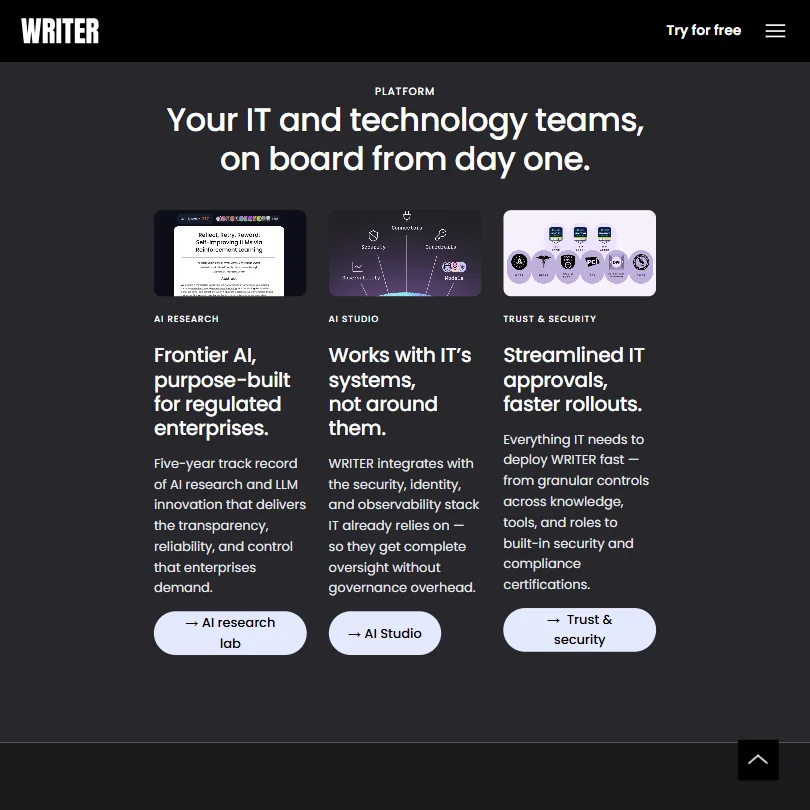
Brand voice enforcement is the oldest and most mature capability here. You can set up personality profiles by department, upload your style guide, and define guardrails that filter every output regardless of who generated it. G2 reviewers in marketing roles flag this consistently as the reason they stay subscribed. One called it the only tool that stopped their team from sounding like three different companies.
The Canvas editing interface is where content actually lands and gets reviewed collaboratively. It's not remarkable on its own. It's usable without much training, according to most users, and it's where workflow outputs surface, which matters for teams that don't want to chase outputs across multiple screens.
Image generation is listed as a built-in capability. Honestly, we'd treat that cautiously. The vendor docs mention it, but we didn't find user reviews that spoke specifically to image output quality. Could be fine. Could be an afterthought.
SEO and GEO optimization tools are mentioned on the homepage, with specific workflow playbooks built around both. The GEO angle, meaning optimizing content to surface in AI-generated search results, is one of the few places we've seen a platform take it seriously enough to build a named playbook around it. Worth watching how that develops.
WRITER Automation Power: How Complex Can Your Workflows Get?
This is where WRITER is making its biggest bet.
The Playbooks and AI Agent Library are the core of the automation story. Playbooks are saved multi-step workflows where you define the inputs, the steps, and the outputs, then WRITER runs them on demand or on a schedule. The Agent Library ships with 100+ prebuilt agents covering common marketing and operational tasks. Sales teams tend to gravitate toward the CRM-connected agents. Content teams tend to build around research-and-draft loops.
Chained workflows are possible. You can string agents together so the output of one becomes the input of the next. Based on the docs, WRITER has thought about this more carefully than most competitors. Whether reliability holds under real enterprise load is a different question. We found threads from late 2024 where users described workflows breaking silently, with no clear error message to follow. Not a dealbreaker. Worth watching.
Scheduled routines allow bulk content generation to run automatically. Legal disclaimers, product descriptions, weekly reports. The boring, high-volume stuff, handled without someone clicking a button each time.
We'd put WRITER's automation ceiling meaningfully higher than Jasper's. But if you're comparing it to purpose-built orchestration tools, that's a different conversation entirely. CrewAI is worth a look for teams that want deeper multi-agent coordination with developer-level control.
WRITER AI Agent Capabilities: What Can It Actually Do Autonomously?
The word "agentic" gets thrown around a lot right now. WRITER uses it constantly. So let's be specific.
The WRITER Agent can take a prompt and execute a multi-step task without manual approval at each step. It pulls from the Knowledge Graph, runs web searches, generates content in your brand voice, and drops the finished output into Canvas. That's a real autonomous loop, not just autocomplete with a fancier name.
Ask WRITER is the conversational layer. More like a chat interface on top of the platform than a formal workflow trigger. G2 reviewers use it daily for quick drafts and rewrites, which suggests it's handling a real volume of casual, non-workflow-level tasks.
What it can't do is make judgment calls that weren't anticipated in the workflow design. If something breaks mid-chain, the agent tends to either fail quietly or produce output that looks finished but isn't. That's a category-wide problem, not specific to WRITER. Still annoying.
Unlike Jasper, WRITER offers its own publicly documented enterprise model with a one-million-token context window. Jasper's routed stack does provide access to third-party models with comparable context capacity, including Gemini 3 Pro, but Jasper doesn't publicly disclose the context limits of all its proprietary models. For teams working with long documents or complex content libraries as grounding context, Palmyra X5's documented window is a concrete, verifiable spec Jasper can't match on its own model.
Is WRITER Easy to Set Up Without Code?
Depends what you mean by "set up."
Getting an account started, picking a prebuilt agent, and generating content? No code needed. WRITER Academy has certifications, self-paced courses, and video tutorials. The documentation is thorough. For a non-technical content manager, the basics are approachable without much friction.
Building custom workflows connected to your CRM, your SharePoint, and your internal data? That gets more complex. The API is well-documented, and enterprise customers get expanded rate limits. But the integration setup, particularly for SAML SSO and SCIM provisioning, involves your IT team. Not unusual for enterprise software. Still worth flagging for buyers who assume "no-code" means no IT involvement at any stage.
One thing we kept seeing in smaller-team reviews: the onboarding felt designed for companies with a dedicated implementation resource. A solo marketer at a 20-person startup would have a harder time than an enterprise team with an IT contact and a customer success manager. That's probably intentional. WRITER isn't really selling to solo marketers anymore.
The Chrome Extension helps for quick access outside the platform. The iOS app is listed but described as limited across the reviews we read. Treat the mobile experience as a bonus, not a core workflow component.
Not great for small teams flying solo. Fine.
WRITER Pricing: Is It Worth It vs Zapier or Make?

Here's the part that frustrated us most.
There are no public prices on the WRITER pricing page. None. Plan names, yes. Feature comparisons, yes. Dollar amounts, no. The 14-day free trial requires no credit card, which is a genuine positive and one of the few concrete things we could confirm from the pricing page directly. Everything after that requires a sales conversation.
The Starter plan caps at 5 users and includes one WRITER Agent interface, up to 5 Playbooks, one team Personality profile, basic connectors, and a limited Knowledge Graph. Enterprise removes those caps entirely, adds unrestricted Playbooks and cross-team workflows, advanced admin controls, full Knowledge Graph capabilities with unrestricted connectors, departmental brand and voice profiles, full LLM interoperability, granular agent governance and auditability, and priority support with AI program management. That's a wide gap between tiers, and the pricing opacity makes it genuinely difficult to budget for either without a vendor call.
For context, Jasper publicly lists Pro at $69 per seat monthly, or $59 on annual billing, with Business on custom pricing that adds governance features and priority support. Copy.ai shows pricing on the page too. WRITER shows you nothing. That's a deliberate choice, and it signals "you probably can't get a number into a spreadsheet without talking to sales first." Which is fine if you're enterprise. Less fine if you're trying to compare options quickly.
Is it worth it compared to Zapier or Make? That's not quite the right comparison. Zapier automates tasks across apps. WRITER generates content within a brand framework and then automates the distribution of that content. Adjacent problems. If your bottleneck is content creation at scale, WRITER might justify whatever they charge. If your bottleneck is connecting apps, WRITER is the wrong tool.
The Trustpilot score sits at 3.7, noticeably lower than the G2 number of 4.4. Trustpilot reviews skew toward frustrated SMB users and billing complaints. G2 reviews skew toward satisfied enterprise content teams. That gap tells you something real about who this product actually works for.
WRITER vs Jasper: Which Automation Platform Wins?
Not a close fight at the enterprise level.
Jasper is a marketing-focused AI platform with public Pro pricing and team features. Its AI Engine combines proprietary in-house models with third-party models, including Gemini 3 Pro in its routed stack. It does not have a Knowledge Graph. It does not carry WRITER's compliance certifications. For a content team at a mid-size company that wants to generate better copy faster, Jasper is probably the right call. Easier, cheaper, and less to configure.
WRITER is for organizations with brand governance problems. Where content is produced by dozens of people across multiple departments, and someone in legal or brand has started sending correction emails. That's the specific pain point WRITER is designed to solve.
On integrations, WRITER connects to Salesforce, Figma, and Slack at the enterprise tier, plus a few others. Jasper integrates with the usual suspects too. Neither one will feel as flexible as a purpose-built automation platform. Both are primarily content tools with workflow features layered on top.
WRITER wins on governance and documented model capability. Jasper wins on price transparency and simplicity. Choose based on which problem is bigger for your team.
Who Should Use WRITER? (And Who Shouldn't)
Enterprise marketing and content teams. That's the core fit.
Specifically, organizations where brand consistency is a real operational problem. Multiple departments producing content with no reliable way to enforce standards. Regulated industries where compliance certifications open doors that other tools can't. Content volumes high enough that manual review becomes a genuine bottleneck.
WRITER also fits operations teams automating content-heavy workflows. Weekly reports, form submissions processed into structured documents, content routed through approval chains. That's not traditional writing tool territory. It's where the agentic layer starts earning its keep.
Who shouldn't use it? Small teams without a clear brand governance problem. Anyone who needs to see a price before starting a vendor conversation. Anyone whose primary need is connecting apps rather than generating content within a controlled framework.
Solo founders looking at WRITER: don't. Not because it's bad, but because it's not built for you.
WRITER Review Verdict
There's a real product here. That's the first thing worth saying.
WRITER has built genuine differentiation: a proprietary model with a documented context window, brand enforcement that actually works according to a meaningful sample of enterprise users, and an agentic layer that's more mature than most of the competition. The Knowledge Graph grounding is real, not just a marketing phrase. The compliance certifications open doors that other tools can't.
The problems are real too. Pricing opacity is the biggest friction for any buyer who isn't already running an enterprise procurement process. The Trustpilot reviews suggest a meaningful gap between how the product works for large teams versus small ones. Setup complexity isn't trivial. And workflow reliability issues appeared often enough in user feedback that we'd want to test them specifically before fully committing.
We're not skeptical of WRITER's capabilities. We're skeptical of the onboarding experience for anyone who doesn't have an IT team and a customer success manager available. And we'd want to see some public pricing before we stopped recommending that buyers sit through a demo before they can even ballpark a budget number.
The deprecation of older Palmyra models is worth flagging for existing customers. If you've built workflows on deprecated models, you've got a migration on your calendar. Plan for it.
Worth a serious look for enterprise teams with budget, a brand governance problem, and IT support. Everyone else should probably start somewhere simpler.
Frequently Asked Questions
Does WRITER have a free plan?
No free plan exists. There's a 14-day free trial that doesn't require a credit card, which is more generous than some competitors. After that, you're in a sales conversation. We didn't find any evidence of a permanent free tier in their docs or on the pricing page.
What model does WRITER use?
WRITER runs its own proprietary model family called Palmyra. The current flagship is Palmyra X5, with a one-million-token context window. That's a meaningful spec for teams working with long documents or complex content libraries as context. They don't rely on OpenAI or Anthropic models, which matters for some enterprise buyers from a data governance perspective.
How does WRITER compare to Jasper for enterprise teams?
WRITER is a stronger fit for enterprises with brand governance and compliance requirements. Jasper is more accessible and publicly priced, Pro at $69 per seat monthly or $59 on annual billing, which makes it easier to evaluate without a sales call. For teams that need deep brand enforcement, Knowledge Graph grounding, and regulatory compliance, WRITER has capabilities Jasper doesn't match on its own model stack. For teams that just want to write faster with less configuration overhead, Jasper is probably less friction to deploy.