What is ProWritingAid?
It's a writing editor built around manuscript-level analysis. Not just grammar. Not just spell-check. The pitch for ProWritingAid has always been depth, specifically depth for writers working in long form. Novelists, memoirists, people churning through 80,000-word drafts. The tool lives in a few places at once. There's a web editor, a desktop app, a Chrome extension. It also plugs into Microsoft Word, Google Docs, and Scrivener, which matters a lot if you're already embedded in one of those environments. That Scrivener integration in particular is something Grammarly doesn't offer, and we kept seeing that come up in community threads as a genuine differentiator. It runs on a proprietary AI model. No GPT-4 branding, no Anthropic partnership they're leaning on for credibility. Make of that what you will.ProWritingAid Features: What You Actually Get
ProWritingAid AI Output Quality: Is It Good Enough?
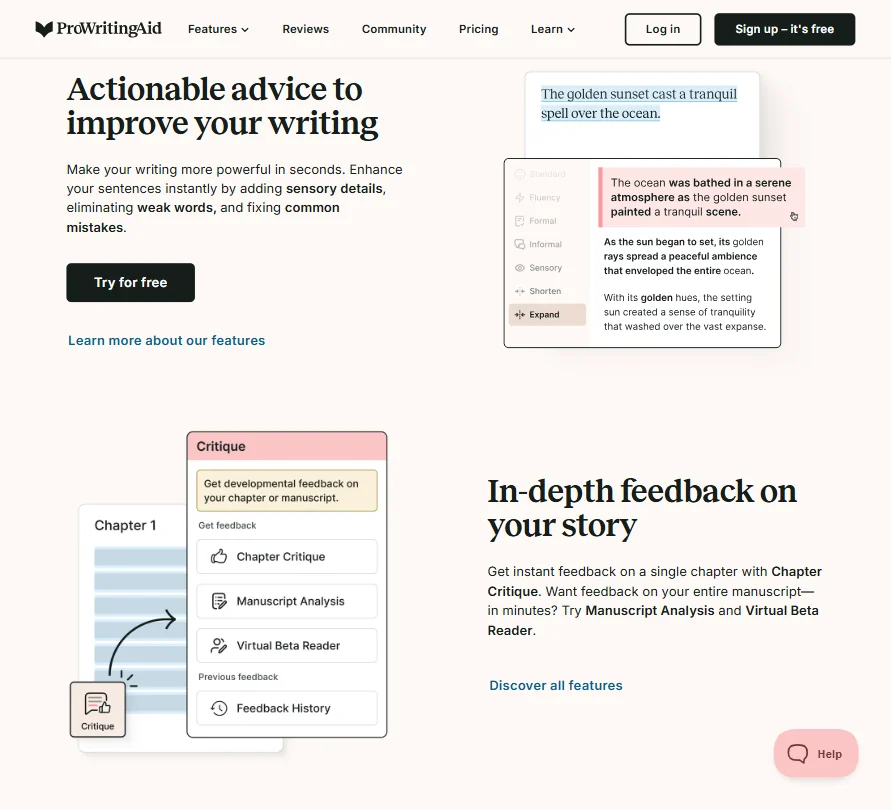
The grammar and style checking is solid. Not perfect. The tool can flag stylistic choices as errors, particularly in dialogue-heavy fiction. That's a known issue with grammar tools applied to creative writing, and ProWritingAid handles it better than most, but it still happens. The Chapter Critique feature is where the AI output stands out. That's a meaningful step up from what a basic grammar checker does. Useful for getting unstuck, less useful if you want something that sounds like your voice and not like a writing prompt generator.Is ProWritingAid Easy to Use?
This is where things get more complicated. The tool is not difficult to learn. The web editor is clean enough. But the sheer volume of reports creates a real decision problem for new users. Where do you start? What do you run first? The onboarding doesn't answer that question particularly well. Experienced writers get past it. Newer writers sometimes don't. The integrations generally work. The Word and Google Docs add-ins behave as advertised, though the Google Docs extension can have occasional sync lag. Not dealbreaking. Just annoying. The Scrivener integration is the smoothest path for serious fiction writers and probably the strongest argument for picking ProWritingAid over a browser-based alternative. We don't buy the idea that any other major grammar tool handles Scrivener as cleanly.ProWritingAid Pricing: Is It Worth the Cost?
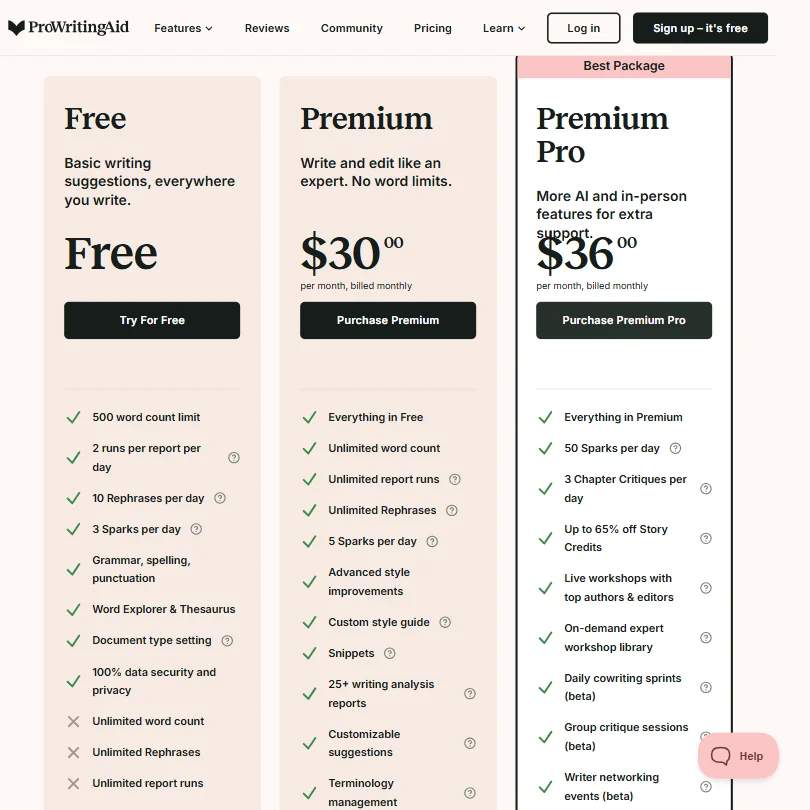
Ten dollars a month, billed annually. That's $120 a year for Premium, and $144 for Premium Pro, which adds live workshops and community cowriting sprints for another $24 a year. Honestly, that delta is small enough that working fiction writers should probably just start with Pro and skip the comparison entirely.

The lifetime plans are real and currently listed on the pricing page. Premium Lifetime sits at $399, Premium Pro Lifetime at $699. Whether that math works depends entirely on how long you plan to use the tool, but for a novelist mid-series, amortizing $399 over five or six years beats the annual fee without much effort.
The free plan is essentially a product demo dressed as a tier. 500-word check limits and two report runs per day don't get you anywhere near a chapter, let alone a manuscript. Three Sparks and ten Rephrases daily round out the picture. We're not surprised, but we are a little tired of free tiers structured specifically to frustrate rather than inform.
The refund policy deserves a close read before anyone clicks buy. Annual and lifetime plans get three days. Monthly plans get nothing. That's a short window on the annual side and a hard stop on monthly, which cuts against the casual user who wants to try it for a month and bail. Worth knowing.
No enterprise pricing exists, at least not publicly. Teams looking for seat-based contracts or admin dashboards will dead-end here fast. That's not a knock so much as a plain fact about who this product is built for.
Fiction writers and long-form solo creators. That's the target. The pricing reflects it.
ProWritingAid vs Grammarly: Which Is Better?
Depends entirely on what you're writing. That's not a dodge. Grammarly is broader. It works across more contexts, handles more languages, integrates with more apps, and has a stronger business-writing focus. Its tone suggestions are sharper for professional email and workplace communication. If you write at work and occasionally write other things, Grammarly is probably the right default. ProWritingAid is narrower and deeper. The fiction-specific reports don't exist in Grammarly. The Scrivener integration doesn't exist in Grammarly. The Chapter Critique and Virtual Beta Reader have no real equivalent over there. For novelists and long-form writers, ProWritingAid consistently outperforms Grammarly in the areas that actually matter to them. The price comparison is notable. Grammarly Pro runs $12 a month billed annually. ProWritingAid Premium is $10. You're getting more fiction-specific depth for less money. That's a real argument.Who Should Use ProWritingAid? (And Who Shouldn't)
Novelists and fiction writers. That's the fit. People working in Scrivener, people revising 60,000-word manuscripts, people who want something closer to developmental feedback than grammar correction. Long-form nonfiction writers are a reasonable secondary audience. The pacing and style reports translate reasonably well to memoir or narrative journalism. Content marketers and SEO writers should look elsewhere. There's no keyword optimization here, no template library, no bulk generation. If SEO content is your day job, something like Koala AI is built for that workflow and ProWritingAid isn't. Business writers who just want clean, correct professional copy will likely find Grammarly more intuitive and better integrated with the tools they already use.ProWritingAid Review Verdict
ProWritingAid is a genuinely good tool for a specific kind of writer. It's not trying to be everything. The 25+ reports, the Chapter Critique, the Scrivener integration, and the Virtual Beta Reader are real features that serve real needs, and the price is fair. The weaknesses are real too. The free plan is nearly unusable for actual work. The learning curve on the report system is steeper than the marketing suggests. The three-day refund window on annual plans is tight. No enterprise option means teams are out. For working fiction writers, ProWritingAid at $10 a month is probably the most useful writing tool at that price. For everyone else, it depends on whether the manuscript-analysis features are relevant to what you actually write. If they're not, this isn't the tool. We wouldn't call it a must-buy. But we wouldn't talk someone out of it either.How ProWritingAid compares
ProWritingAid scores 3.9 out of 10 among the AI writing assistants we rate. These three do the same job and are the closest to it, compared on what each vendor publishes.
Grammarly
ProWritingAid Premium and Grammarly Pro both cost $30 a month for their cheapest plan. Grammarly adds three things ProWritingAid's known facts do not have: text generation from a prompt, AI-text detection and AI-humanizing rewrites. Grammarly also ships a phone keyboard and a team plan with Slack, Outlook and Gmail add-ins; ProWritingAid has none of those. ProWritingAid states flatly that it does not train its AI on your writing, while Grammarly lets individual users opt out but defaults training on.
Pick Grammarly if you want AI writing, detection and humanizing in one tool.
Pick ProWritingAid if you only need grammar and plagiarism checks, not AI generation.
Wordtune
Wordtune's Advanced plan is $13.99 a month, under half of ProWritingAid Premium's $30. Wordtune writes new text from a prompt; ProWritingAid only rewrites and checks text you already have, with no blank-page generation found. ProWritingAid checks for plagiarism through separate credits, a feature not present in Wordtune's known facts. ProWritingAid says it does not train its AI on your writing at all, while Wordtune lets users opt out but defaults training on.
Pick Wordtune if you want cheaper text generation and don't need plagiarism checks.
Pick ProWritingAid if you want plagiarism checking without opt-out AI training.
LanguageTool
ProWritingAid checks for plagiarism through separate credits; LanguageTool does not offer plagiarism checking at all. LanguageTool includes a team plan, an API and a personal dictionary, none of which appear in ProWritingAid's known facts. LanguageTool's Premium plan is $25.48 a month, cheaper than ProWritingAid Premium's $30. Both tools say they do not train their AI on your writing.
Pick LanguageTool if you want a team plan, an API and cheaper pricing.
Pick ProWritingAid if you want plagiarism checking and don't need an API.