This wasn't a tool trying to be everything. It was a tool with a very specific bet, placed a long time ago, that's still paying out for a particular kind of user.

Founded in 2013, well before generative AI became a crowded market, Anyword built its core identity around one idea: predicting which version of copy will actually perform better before you spend money finding out. Everything else on the platform is secondary to that. Honestly, that kind of focus is rare, and it shows in how the product is built.
What is Anyword?
Marketing copy. That's the lane. Not fiction, not academic writing, not general-purpose drafting. Ad copy, email subject lines, landing pages, social posts. They've stayed in that lane since before most of their current competitors existed.
The engine underneath is described as LLM-agnostic, meaning it can run on GPT and other models without being locked to one provider. What separates it from a generic wrapper is the predictive performance scoring layer, which Anyword claims predicts which copy variation will outperform the others with 82% accuracy, based on accumulated A/B testing data.
The platform covers long-form work through a Blog Wizard, short-form through 100-plus templates across ads and email and social, brand voice configuration, and an SEO-capable editor. There's also a real-time content editor that scores copy as you write. Web-based. Chrome extension available. No mobile app. Based in New York.
Anyword Features: What You Actually Get
The Blog Wizard includes a built-in research tool and a plagiarism checker, both inside the same workflow. No exporting to check for copied content.
Short-form templates cover paid ad copy, email subject lines, and social captions, over 100 of them. They're tied to the predictive scoring system, so they're not just fill-in-the-blank forms sitting on top of a generic model.
Brand voice is more developed here than at comparable price points. The Business plan supports up to 15 distinct brand voices, each carrying its own tone and vocabulary. There's also a messaging bank for approved phrases. Fair. A lot of mid-market teams won't use all of that, but it's there when they grow into it.
Bulk generation via CSV templates is available for teams running high-volume campaigns across multiple product variants. Not glamorous. Saves hours.
The gaps are real, though. No image generation, which is a meaningful omission as competitors move into visual territory. Integration documentation is thin. WordPress and Google Docs connections aren't clearly documented publicly. Zapier support isn't confirmed. API access exists but sits behind the Enterprise tier, leaving the middle of the product feeling underconnected to the tools most teams already use.
The real-time content editor with live performance scoring is where the product earns its differentiation. Write a headline, watch the score shift as you revise. That feedback loop doesn't exist in most AI writing tools at any price.
Anyword AI Output Quality: Is It Good Enough?
Two things stood out looking at the product. The raw output quality is described as good but not exceptional. The performance scoring is described as the actual reason people keep their subscriptions. Those two observations, taken together, tell you exactly what Anyword is.
The copy it generates won't threaten an experienced human copywriter. What it does is produce workable drafts quickly, then help you identify which one is most likely to convert. That's a different value proposition entirely. Not "replace your writer." Replace your guesswork.
The Blog Wizard output tends to need editing before it's publishable. Short-form ad copy is tighter. Makes sense. Shorter outputs have fewer opportunities to drift off-brief.
Is Anyword Easy to Use?
Onboarding is light. Pick a use case, configure a brand voice, start generating. The template library is organized by channel, and it's straightforward to navigate.
The scoring dashboard takes longer. Users who skip the documentation often misread how the scoring system works, treating the number as a quality grade rather than a conversion prediction. A number that rises is satisfying. A number that rises but doesn't map to actual conversion lift is a different problem.
The Chrome extension covers in-browser quick drafts. It's not a full editor, but it reduces the friction of switching contexts for a short variation.
Anyword Pricing: Is It Worth the Cost?
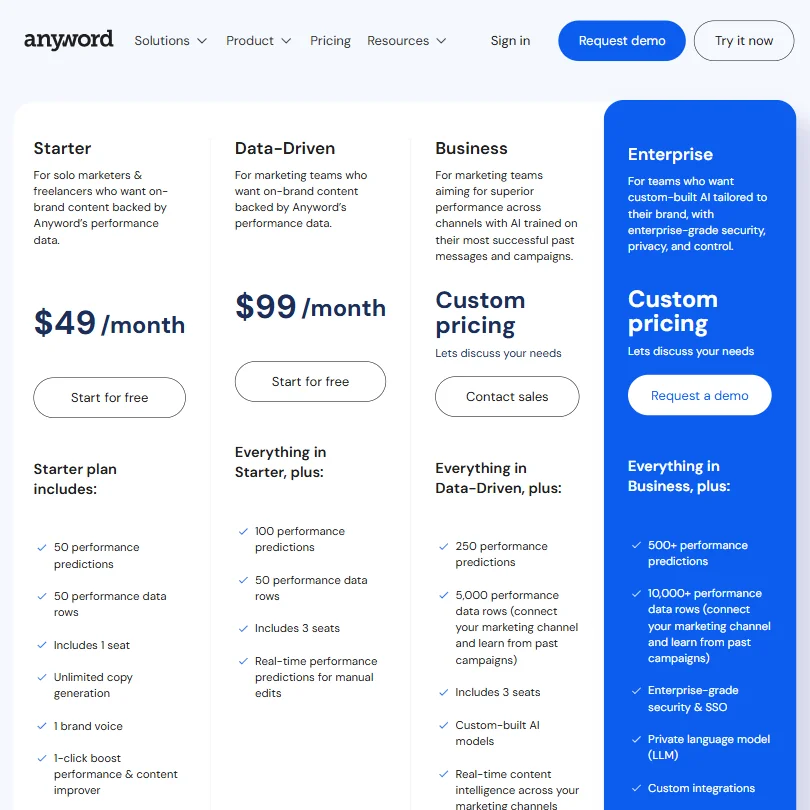
Three tiers. Starter is $49 per month, or $39 per month on annual billing. Data-Driven is $99 per month. Enterprise is custom pricing through sales.
Anyword moved to unlimited words across all tiers at some point, which removes the usage anxiety that plagued the old per-word model. Good change. Long overdue in this category.
The Starter plan includes one brand voice, performance predictions, performance data rows, and the Boost Performance tool. Functional, but limited. The Data-Driven plan is where the product starts to feel complete, with higher limits and real-time predictions that make the scoring layer actually useful day-to-day. If you're considering Anyword seriously, $99 is the realistic entry point for the full product experience.
No public refund policy that we could find. For a $99 monthly commitment, that's a gap buyers should probe before entering payment details. A 7-day trial exists. That's not the same thing as a refund policy, and the difference matters.
Enterprise adds API access and custom integrations. Teams that need the API won't find it anywhere below that tier, which means a call with sales before you can even price it. Standard for enterprise software. Still annoying.
Compare that to Jasper AI, which runs $69 per month, or $59 monthly with annual billing, for its Pro plan. Anyword Starter undercuts that. Data-Driven exceeds it. The pricing comparison is close enough that the decision comes down to which differentiation you actually need, not which bill is smaller.
Anyword vs Jasper: Which Is Better?
These two get compared constantly, and for reasonable cause. Both target marketing teams. Both run templates. Both sit in similar price territory and share a lot of surface-area overlap.
The difference is the core bet. Jasper is built around volume and brand consistency, with strong long-form tools and a mature template library. Anyword is built around prediction. Which copy converts. Narrower claim, and more specific.
Anyword's predictive scoring has no real equivalent in Jasper's core product. If your primary concern is knowing which headline to run before you spend ad budget finding out, Anyword wins that comparison and we're not particularly skeptical of it.
Jasper wins on long-form depth. If you're producing articles at scale and need brand voice enforcement across a large team, the Jasper ecosystem is more developed in that specific area.
Writer enters the conversation for enterprise brand governance. Different kind of tool, more focused on style enforcement at organizational scale, less on performance prediction. Worth knowing it exists before assuming the comparison is only between these two.
We're not crowning a winner. These tools solve overlapping but distinct problems. If your budget flows to paid ads after content is created, Anyword. If it flows to SEO content production at volume, the calculation shifts away from predictive scoring and toward something else entirely.
Who Should Use Anyword? (And Who Shouldn't)
Performance marketing teams. The obvious fit. Paid social, Google Ads, email campaigns where copy variation moves conversion rates. The scoring system was built for them and works the way they think about copy.
GTM teams at mid-size companies running product launches or campaign variants at scale. The $99 tier handles most of that. The bulk CSV generation alone saves meaningful time.
Agencies managing copy across multiple client accounts will find real value in the brand voice features. Setup cost is real, but it amortizes quickly if you're running campaigns across several brands simultaneously.
Solo content creators. Not the right fit. The pricing structure isn't built for one-person operations, and the SEO features, while present, aren't the reason to buy this tool. Anyword is a marketing copy tool that also handles SEO. Not the reverse.
Enterprise teams with complex integration requirements should confirm every specific connection they need before committing. The documentation is too thin to assume. Ask sales directly.
Anyword Review Verdict
Predictive performance scoring is real, it's differentiated, and it holds up better than we expected going in. That's the honest summary.
The case against Anyword is mostly about fit, not about quality. If you're not running performance marketing campaigns where copy variation testing has actual budget implications, $99 per month is hard to justify. You'd be paying for predictive analytics you're not using, which makes it just another AI writing tool at a premium price.
Integration gaps are a legitimate concern. No public refund policy is annoying. The Starter plan at $49 can feel like a limited demo of the real product. Worth knowing before you sign up for the lower tier expecting the full experience.
For the team it was built for, it works.
Use the 7-day trial. Put real ad copy through it. If the scoring changes how you edit, you'll know the $99 is justified. If it doesn't move your decisions at all, you've lost nothing but a week.
How Anyword compares
Anyword scores 7.0 out of 10 among the AI copywriting tools we rate. These two do the same job and are the closest to it, compared on what each vendor publishes.
Jasper AI
Anyword predicts how a piece of copy will perform before you publish it; Jasper does not offer that scoring. Jasper builds a whole campaign's assets from one brief and generates images, both of which Anyword lacks. Anyword's Starter plan is $49 a month against Jasper's Pro at $69 a month. Anyword also sends content straight to HubSpot, Salesforce and LinkedIn, where Jasper's direct integrations are Webflow, Google Docs, Salesforce, Zapier and Make.
Pick Jasper AI if you want to build campaigns from one brief and generate images.
Pick Anyword if you want performance prediction on copy at a lower monthly price.
neuroflash
neuroflash builds a whole campaign's assets from one brief and creates images, neither of which Anyword does. Anyword sends finished copy straight into HubSpot, Salesforce and LinkedIn; neuroflash lists no direct publishing integration. Both tools predict how copy will perform and both offer a long-form editor. Anyword's Starter plan runs $49 a month against neuroflash's Essential at $45.36 a month, and only Anyword includes a review and approval step.
Pick neuroflash if you want full campaigns from one brief plus image generation.
Pick Anyword if you want direct publishing to HubSpot, Salesforce or LinkedIn.
Frequently Asked Questions
Does Anyword have a free plan?
No free plan. A 7-day free trial exists on paid plans, but there's no ongoing free tier. Don't confuse the trial with a freemium model. It isn't one. If you need to test before committing, that trial window is your only option.
What is Anyword's predictive performance scoring?
It's a system that scores generated copy against historical A/B testing data, predicting which variation is most likely to perform with your target audience. Anyword claims 82% accuracy on those predictions. We can't independently verify that figure, and we're mildly skeptical of how it was calculated.
How does Anyword compare to Jasper for ad copy?
For ad copy specifically, Anyword has the edge because of the performance scoring. Jasper generates variations but doesn't predict which one will convert before you spend money running it. That gap is meaningful if paid campaigns are your primary use case. Jasper is stronger for long-form content at scale. The choice comes down to where your actual problem sits: volume, or conversion prediction before launch.