The picture that emerges is of a tool that's genuinely good at what it does, priced accordingly, and aimed squarely at teams that can justify the spend.

What is Jasper AI?
Jasper launched in 2021 out of Austin, Texas. It's still headquartered there. The company has grown fast enough that its positioning has shifted noticeably since launch. Early Jasper was a template machine. Current Jasper is pitching itself as a full marketing AI platform, which is a different product with a different price tag to match.
The technical setup matters here. Jasper doesn't run on a single model. It routes across multiple large language models, GPT-4 and Claude among them, and layers its own fine-tuning on top for marketing-specific output. That means Jasper isn't locked to one provider's limitations, which is a real architectural choice. Whether that routing actually improves output in practice is an open question. More on that below.
The core pitch is brand voice at scale. Their product called Jasper IQ is supposed to embed your brand's tone, style guidelines, and audience profiles into every piece of content the team generates. That's the differentiator they push hardest.
Not a tool for solo bloggers on a budget. The entry price alone makes that clear.
Jasper AI Features: What You Actually Get

The features list is long. Genuinely long. We'll focus on what's actually useful, versus what reads more like marketing inventory.
Long-form writing runs through a product called the Marketing Editor, plus a Canvas platform. Canvas is built for daily use on blog posts, campaign briefs, and longer articles.
Short-form is covered by over 100 templates. Ad copy for Meta and Google, social posts, press releases, landing pages. That 100+ number sounds impressive. In practice, most people probably use maybe a dozen of them regularly. Fair. That's how template libraries work.
The brand voice tooling, Jasper IQ, is where Jasper separates itself from cheaper competitors. You feed it your style guide and tone parameters. It applies them across your team's output without everyone having to manually prompt the same constraints each time. For marketing teams with multiple writers, this is often the thing that makes Jasper worth the price.
Image generation is built in. AI-generated images, background removal, upscaling, plus something they call packshot compositing. It's more than a bolt-on. Whether it replaces a dedicated image tool depends entirely on how demanding your visual requirements are.
On the SEO side, there's a GEO Agent specifically for AI search optimization, plus the standard blog SEO tooling. One case study Jasper cites claims 60% of SEO tasks automated. We're skeptical of that number without more context, but the directional claim is credible. Worth noting: plagiarism checking is not native. It's a Copyscape add-on, which means another line item if you need it.
Jasper Chat functions as a research layer inside the platform. The deeper research agents are locked to the Business plan. Jasper Grid, which handles bulk content generation at scale, also sits behind that Business tier. That's the feature enterprise teams actually care about, and it's not available until you've had the sales conversation.
Jasper AI Output Quality: Is It Good Enough?
Not perfect. Usable. For marketing copy, ad headlines, and social posts, that's often enough. For technical writing or anything requiring genuine subject-matter depth, the output likely needs more human work than expected.
The multi-model routing approach should theoretically help here. In practice, quality doesn't appear to jump dramatically compared to just using GPT-4 or Claude directly. The value Jasper adds is context persistence, brand voice rules, style parameters, rather than raw output quality. Honestly, that surprised us initially.
Is Jasper AI Easy to Use?
Canvas is described as clean. The template library is navigable. The Chrome and Edge extensions work well enough that they serve well as a primary entry point rather than the web app, which is either a compliment to the extension or a mild critique of the web experience, depending on how you read it.
Onboarding is another matter. Jasper has built out a Knowledge Center, a community platform with courses, and something called Jasper Foundations training. That's a significant infrastructure investment, and it implies the tool has enough complexity that new users genuinely need it. There's a real learning curve before the brand voice features feel natural to configure.
For solo users or very small teams, the setup overhead may not pay off quickly. The more people on the account, the faster the brand voice tooling justifies itself. A three-person content team will get less out of Jasper IQ than a fifteen-person marketing department. The power scales with headcount, which is worth knowing before you sign up.
It's the configuration layer, the brand voice setup and style guide integration, where friction shows up most. Once configured, daily use tends to be smooth. Not great onboarding. Fine product once you're past it.
Jasper AI Pricing: Is It Worth the Cost?
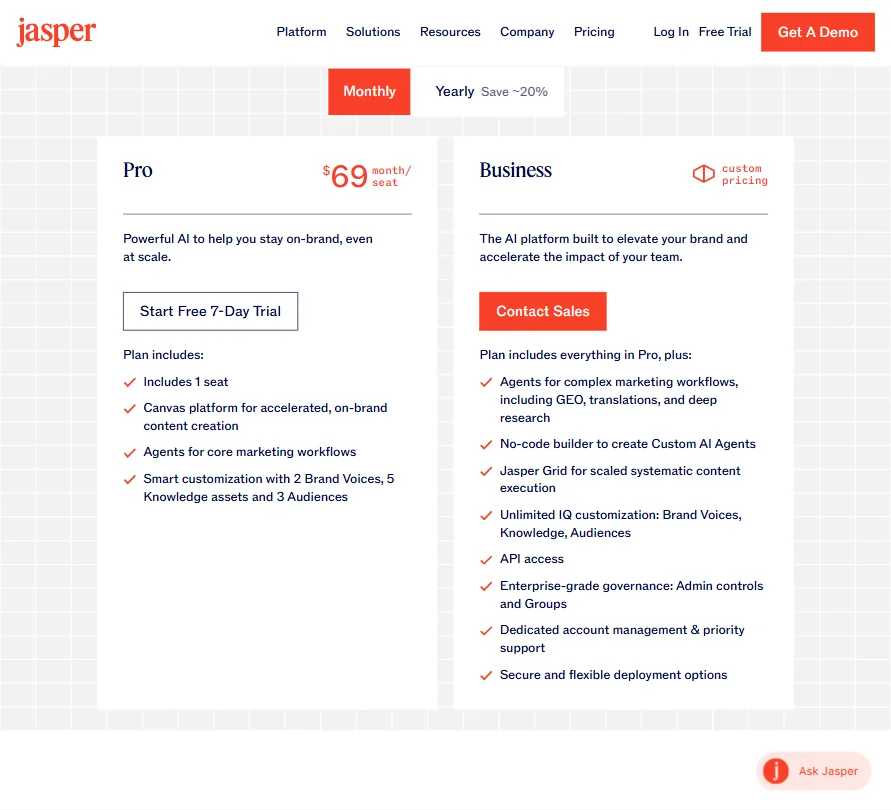
The Pro plan starts at $69 per month per seat, billed monthly ($59 a month billed yearly). Per seat. Not per team. For a five-person content team, you're looking at $345 a month before anyone's even had a conversation about the Business plan.
The Business plan is custom pricing. Contact sales. No public number. We went through the pricing page carefully and found no indication of what Business costs beyond the implication that it's more. Bulk generation via Jasper Grid, deep research agents, API access, and document collaboration all sit behind that Business tier. The features most enterprise teams would actually want require a sales call to price. That's a deliberate choice on Jasper's part, and it's a frustrating one if you're trying to do budget planning.
There's a 7-day free trial. No free plan. The refund policy isn't publicly documented, which is a problem. We couldn't find a clear answer in the docs about what happens if you sign up and immediately regret it. Not great.
The Copyscape integration for plagiarism checking is an add-on cost. Surfer SEO, which Jasper mentions on the homepage, is a separate subscription. Integrations include Google Docs, Webflow, and other tools through Jasper's integrations marketplace, plus a Surfer SEO integration at additional cost. The real cost of running Jasper for a marketing team is meaningfully higher than the per-seat price suggests. Worth building that out on a spreadsheet before committing.
Whether $59 per seat is worth it depends almost entirely on how much you value the brand voice tooling. If Jasper IQ saves a content lead two hours of review time per week, the math works. If your team's output is mostly one-off blog posts with no consistency requirements, you're probably paying for something you won't use.
Jasper AI vs Copy.ai: Which Is Better?
Copy.ai is the most direct comparison point. Both launched in the same era. Both target marketing teams. Both offer template libraries and long-form writing tools.
Where they split: Copy.ai leans into workflow automation. Jasper leans into brand consistency. Copy.ai has a free plan. Jasper doesn't. For teams where budget is tight, that distinction alone settles the question.
At the paid tier, Jasper's brand voice tooling is more developed than Copy.ai's equivalent. Jasper IQ, with its style guide embedding and audience profiles, goes deeper. That's a meaningful edge for enterprise marketing teams, less meaningful for everyone else.
Copy.ai gets the nod for smaller teams and tighter budgets. Jasper gets the nod when brand governance actually matters at scale. The gap between Copy.ai's free tier and Jasper's $59 per seat entry is real money for early-stage companies.
One more comparison worth making: Writer sits in this conversation for enterprise buyers. Writer positions itself on compliance and brand governance even more aggressively than Jasper. If the main driver is brand control for a large organization, that comparison deserves its own look before signing anything.
Who Should Use Jasper AI? (And Who Shouldn't)
Marketing teams at mid-size and larger companies. That's the fit. Specifically teams where multiple people are producing content and brand consistency is a real operational problem. Jasper IQ is built for exactly that scenario.
Enterprise brands running campaigns across multiple channels. The Business plan features, Grid for bulk generation and the deep research agents, are designed for volume. Not for occasional use.
Solo content creators. Don't bother at this price. The per-seat cost alone puts it out of range unless you're generating enough content that the time savings are significant, and even then, cheaper tools will cover most of what a solo writer needs.
Agencies are a middle case. Some will find Jasper's brand voice setup useful for managing multiple client voices in one platform. Others will find the per-seat cost structure awkward for client billing. That one depends on how the agency runs its numbers.
Small startups. Probably not yet. Come back when there's a content team and a documented brand voice that needs enforcing across multiple writers. Until then, the overhead isn't worth it.
Jasper AI Review Verdict
Jasper is a real product with real capabilities. The brand voice tooling is the most defensible thing it does. No serious competitor has matched Jasper IQ's depth for embedding brand standards across a team's daily output. That's where the value lives, and it's a genuine value.
The pricing structure is the main thing that gives us pause. $69 per seat per month is a meaningful commitment, and the Business plan requires a sales conversation before you even know what you're agreeing to. For teams that can justify it, the tool earns that spend. For everyone else, it's hard to ignore that the most important features require the most expensive tier.
Output quality is good, not exceptional. The multi-model routing adds flexibility, but raw writing quality is comparable to what you'd get from a well-prompted GPT-4 or Claude session. What Jasper adds is structure, templates, and that brand persistence layer. If you need those things, the quality ceiling is more than adequate. If you don't, you're paying for infrastructure you'll underuse.
We'd point marketing-heavy organizations toward Jasper when brand consistency at volume is an actual business problem. For everyone else, cheaper tools cover most of the same ground. That's not a criticism of what Jasper has built. It's just an honest read of who it's built for.
How Jasper AI compares
Jasper AI scores 7.2 out of 10 among the AI copywriting tools we rate. These three do the same job and are the closest to it, compared on what each vendor publishes.
Anyword
Jasper builds a whole campaign's assets from one brief and generates images; Anyword does neither, focusing on scoring text copy instead. Anyword's core feature is predicting how a piece of copy will perform before you publish it, which Jasper does not offer. Jasper's Pro plan costs $69 a month against Anyword's Starter at $49. Jasper also adds Word and Slack add-ins alongside Google Docs, where Anyword integrates with HubSpot, Salesforce and LinkedIn instead.
Pick Anyword if you want performance prediction on copy at a lower price.
Pick Jasper AI if you want full campaigns and image generation from one brief.
neuroflash
neuroflash predicts how copy will perform through its Digital Twins feature; Jasper has no equivalent scoring tool. Jasper builds a whole campaign's assets from one brief, which neuroflash also does, and both generate images. Jasper's Pro plan is $69 a month, well above neuroflash's Essential at $45.36. Jasper adds Word and Slack add-ins and Google Docs; neuroflash lists no direct publishing integration or office add-in at all.
Pick neuroflash if you want performance prediction on copy at a lower price.
Pick Jasper AI if you want Word, Google Docs and Slack add-ins.
Rytr
Jasper builds a whole campaign's assets from one brief and generates images, neither of which Rytr offers. Rytr's cheapest paid plan is $9 a month and it also has a free tier; Jasper has no free plan and its Pro tier starts at $69. Jasper adds team plans, Word and Google Docs add-ins and SOC 2 certification, none of which appear in Rytr's known facts. Rytr's policy states no training commitment; Jasper says it blocks third parties from training on customer data.
Pick Rytr if you want a free plan and the lowest monthly price.
Pick Jasper AI if you want campaigns, images and team features built in.
Frequently Asked Questions
Does Jasper AI have a free plan?
No free plan exists. Jasper offers a 7-day free trial, which is the only way to test the product without paying. After the trial, the cheapest option is the Pro plan at $69 per seat per month billed monthly ($59 billed yearly). That's a real commitment before you've had time to fully evaluate the brand voice features that justify the price, and the lack of a documented refund policy makes that more uncomfortable than it needs to be.
What AI model does Jasper AI use?
Jasper doesn't run on a single model. It routes across multiple large language models, GPT-4 and Claude among them, and applies its own fine-tuning on top for marketing use cases. In practice, this means output style can vary depending on which model handles a given request. Jasper's brand voice layer, Jasper IQ, is designed to keep output consistent regardless of which model runs underneath.
Is Jasper AI worth it for small teams?
Probably not. The per-seat pricing at $69 per month adds up fast, and the features that make Jasper genuinely powerful, brand voice enforcement across a team and bulk content generation via Jasper Grid, scale better with larger headcounts. A two or three-person operation will find they're paying for a platform they can't fully use. Cheaper alternatives cover most of their needs without the configuration overhead. Honestly, the math just doesn't work at that size.