We spent time pulling apart Playform's vendor docs, scanning Reddit threads, and cross-referencing what users say publicly about the platform before writing this playform review. Honest summary: it's a tool built for artists first, with real privacy commitments and a feature set that's wider than most people expect. Whether it earns the price is a harder question. Let's get into what the research actually shows.

What is Playform?
Playform launched in 2019 out of New York. It's a web-based AI art studio that combines a GAN and diffusion hybrid model under one roof. The pitch isn't just text-to-image. It's a modular set of tools covering sketch-to-image, face manipulation, custom model training, and video generation.
What makes Playform different from most tools in this category is the privacy angle. No hidden sharing. Your generations stay yours by default, across every plan. That's not a Pro feature. That's the baseline. Honestly, that surprised us. Most platforms bury private mode behind a paywall.
The user base size is unknown. No public figures, no disclosed investor rounds we could find.
Playform Image Quality: How Good Are the Results?
The output quality depends heavily on which mode you're using. Text-to-image results vary across styles: artistic, photorealistic, anime, and what Playform calls "minimal." From what we could piece together through publicly shared outputs and user reports, the photorealistic outputs are decent but not class-leading. Midjourney and Adobe Firefly both produce more reliably polished results in that register.
Where Playform's quality gets more interesting is in the prompt-free and sketch-guided modes. Users consistently describe outputs from visual input as feeling more personal. Less generic. That tracks with what you'd expect from a tool oriented toward artists rather than marketers.
The inpainting is there. Upscaling goes up to 12x on higher plans, which is a legitimate differentiator. We're somewhat skeptical of 12x as a real-world number, but the 2x and 4x options are standard and reliable based on what users report.
Playform Features: Text-to-Image, Video & Editing Tools

The feature list here is genuinely wide. Text-to-image runs across multiple style modes. Sketch-to-image works as a ControlNet-style input where your drawing steers the output rather than a text prompt. That's a smart tool for illustrators. FaceMorph generates video from face inputs.
Custom model training with LoRA support sits behind the Pro plan at $30/mo. That's the feature that separates Playform from simpler generators. You bring your own images, train a model on your visual style, and generate from it. The docs describe granular controls. Whether those controls are actually intuitive is harder to verify without hands-on testing.
Batch generation is available for bulk or dataset work. Video clip generation from trained models requires Plus or above. Inpainting for mask-based refinement is in there too.
What's missing: outpainting, background removal, and any video style transfer. No Photoshop plugin. No Figma integration. Standalone only. We've seen worse, but for teams expecting tool interoperability, this is a real gap.
Is Playform Easy to Use?
Our research here is limited because Playform has virtually no presence on G2 or Capterra, and Trustpilot is blank. Reddit mentions exist but they're scattered. The picture we can draw is incomplete.
What the docs suggest: the interface is module-based. You pick your tool, feed it your input, and generate. That structure is clean on paper. Where complexity shows up is in the custom model training workflow. LoRA training with granular controls is not a beginner feature, and Playform doesn't appear to smooth that experience the way some newer platforms do.
The free plan offers 100 generations per day. That's enough for real exploration. Most users seem to land on the tool for the sketch tools or FaceMorph, then discover the training features later.
Playform Pricing: Free Plan vs Paid — Is It Worth It?
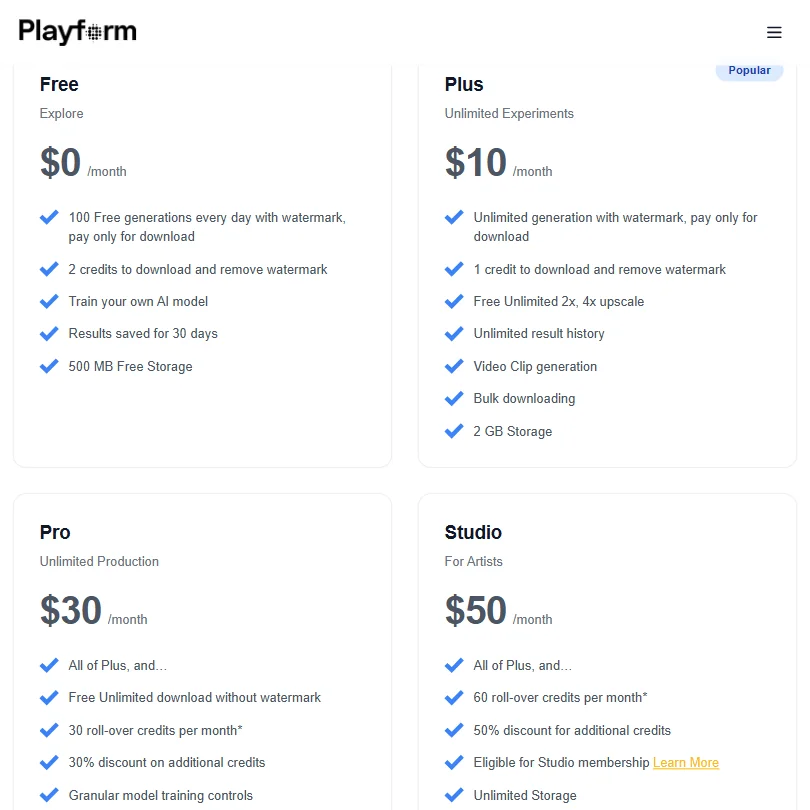
Three paid tiers sit above the free plan. Plus at $10/mo, Pro at $30/mo, Studio at $50/mo. No enterprise option listed publicly. No refund policy we could find anywhere on the site.
The free plan is more functional than most. 100 daily generations, privacy included. Watermarks apply at free and Plus levels. Pro at $30/mo removes watermarks and adds LoRA-based custom training. That's where the real capability unlocks. Studio at $50/mo adds batch generation and dedicated GPU access.
Value is contextual. For an individual artist who wants private generation and custom model training, $30/mo is competitive. Compared to Midjourney at $10/mo for pure image quality, it's a different proposition entirely. You're paying for the privacy and the training tools, not for the best raw output.
The missing refund policy is a concern. Not a dealbreaker, but worth flagging.
Playform vs Midjourney: Which AI Image Generator Wins?
Midjourney wins on raw image quality. Not close, currently. The aesthetic ceiling on Midjourney is higher, and the community around it produces more style references and shared prompts than Playform has.
Playform wins on privacy and modular tools. Midjourney has no custom model training. No sketch-to-image. No inpainting. It's a text-to-image tool with a very good model. Playform is a studio with more levers.
The honest answer is they're not really competing for the same user. Midjourney is for people who want beautiful outputs fast. Playform is for people who want to train on their own visual style and keep their work private.
Who Should Use Playform? (And Who Shouldn't)
Artists and illustrators with an existing visual style to train on. That's the core fit. The sketch-to-image workflow and LoRA training are built for people who think in images, not prompts.
Solo creators who care about data privacy. Playform's no-sharing default is genuinely rare.
People expecting Midjourney-level output quality from a $10 plan, or teams needing deep integrations, should look elsewhere. Adobe Firefly is the more obvious fit for anyone already inside the Adobe ecosystem who needs commercial-safe generation and tool interoperability.
Playform Review Verdict
Playform is doing something real. The privacy-first model, the sketch tools, and the custom AI model training put it in a category slightly different from most text-to-image generators. That's genuinely worth something.
What holds it back is visibility. No ratings on G2 or Capterra. No community to speak of. No public update cadence. A refund policy that doesn't exist publicly. For a tool founded in 2019, the trust infrastructure is thin.
The product appears solid for its target audience. The commercial rights situation is unclear, which matters if you're generating for clients. The integration story is essentially nothing.
We'd take it seriously as a private studio for visual artists. We'd want more transparency before recommending it to teams.
Frequently Asked Questions
Does Playform keep your generated images private?
Yes, and this is one of the few things Playform documents clearly. Privacy is included across all plans at no extra cost. Your generations aren't shared without your knowledge, which is not standard behavior in this category. It's one of the platform's actual differentiators.
Can you train a custom AI model on Playform?
You can, but it's a Pro or Studio feature. That means $30/mo minimum. The training uses a diffusion-based LoRA approach with granular controls according to their docs. What "granular" means in practice is hard to verify from the outside, but the capability is real and it's one of the features that separates Playform from simpler generators.
What is the Playform free plan actually like?
More functional than most free tiers in this space. You get 100 generations per day, privacy included, and access to the core tools including text-to-image and sketch-to-image. Watermarks appear on exports. Custom model training and video generation require a paid plan. For testing whether the tool fits your workflow before paying, the free plan covers a lot of ground.