SAASINSPECTOR
Mistral logo

Mistral Review

AI coding, team collaboration, and enterprise deployments

Visit MistralFrom $14.99/mo

Research-based review. We analyzed vendor documentation, customer reviews on G2, Capterra, and Reddit, and live pricing — not hands-on testing yet. We update as our team puts tools through real workflows.

The verdict

Mistral is a Paris-based AI lab founded in 2023 that offers both open-weight models under Apache 2.0 and a proprietary cloud platform targeting enterprises. It scores well for teams prioritizing data sovereignty, self-hosting, and a European alternative to OpenAI or Anthropic. Without major third-party review platform presence, the evidence base is thinner than most tools at this stage.

Pros

  • Open-weight models released under Apache 2.0 licensing allow self-hosting and full control over inference without vendor lock-in.
  • Genuine data sovereignty option for enterprises with compliance requirements who need to run models on their own hardware.
  • Founded by former Google DeepMind and Meta researchers, giving the models strong technical credibility and pedigree.
  • Diverse product stack covering agents (Studio), fine-tuning (Forge), coding (Vibe), document intelligence (OCR), and speech (Voxtral).
  • Mistral is a European alternative to the American AI stack, which is a meaningful differentiator for EU-based organizations with data residency concerns.
  • Multiple model tiers (Large, Medium, Small) at different API price points give teams flexibility to match cost to task complexity.
  • Vibe offers agentic coding in the terminal, inside IDEs, and as an async background worker, covering multiple developer workflow styles.

Cons

  • No presence on G2, Capterra, or Trustpilot at time of writing, making it difficult to ground the review in broad user feedback.
  • The review is based on vendor docs and community discussion rather than hands-on testing, limiting the depth of practical assessment.
  • Proprietary cloud models require trust in Mistral's managed infrastructure, which may conflict with the sovereignty pitch for some buyers.
  • The product stack is still maturing, with Vibe being a new addition whose reliability and feature depth are not yet well-documented at scale.
  • Benchmark scores are not the primary reason developers choose Mistral, suggesting the models may not consistently lead on raw performance.
  • Community discussion is concentrated in developer subreddits rather than verified enterprise case studies, making business use cases harder to evaluate.
From $14.99/moFree plan YesFree trial No

Two years old and already selling to HSBC. That's the short version of where Mistral sits right now. We pulled vendor docs, dug through r/LocalLLaMA and r/MachineLearning, and cross-referenced what Mistral claims against what developers are actually reporting. No hands-on testing from our end. What we kept seeing is a company that's moving faster than the timeline suggests it should, and positioning itself around a specific idea: European AI infrastructure you can actually control. Whether the product earns that pitch is what we spent time working out.

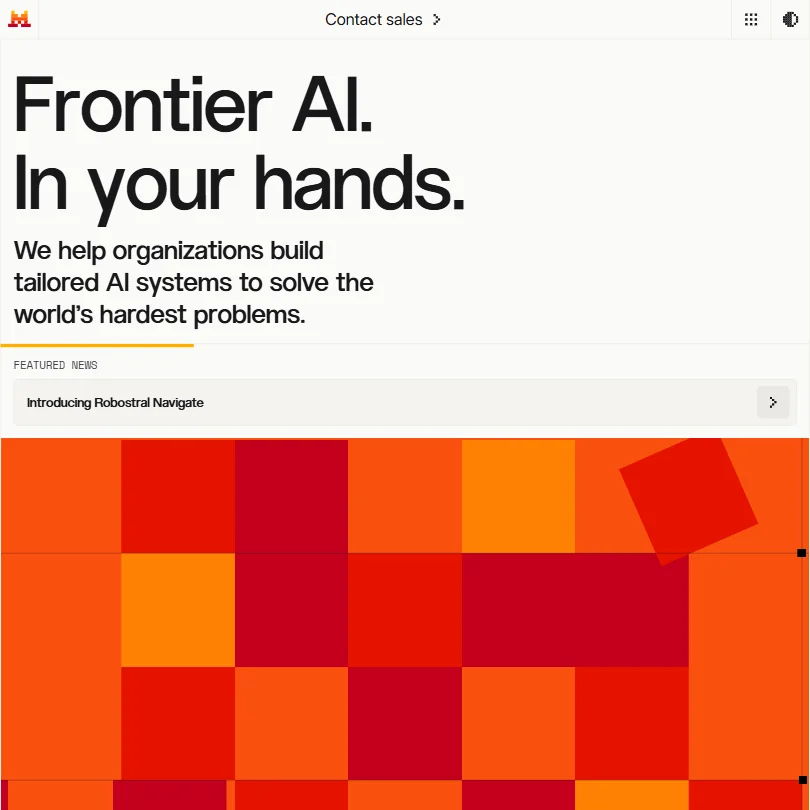
Mistral homepage screenshot
Mistral — Homepage

On the review sourcing question: Mistral has a live G2 presence with product reviews, and a Trustpilot page with dozens of entries. We did not locate a current Capterra listing. So the picture isn't as thin as some coverage implies, though the G2 volume doesn't yet match what you'd see for OpenAI or Anthropic.

What is Mistral?

Paris-based AI lab, founded 2023. The founding team came out of Google DeepMind and Meta, raised capital quickly, and built a model lineup faster than anyone expected from a company that young. The core offer splits in two directions: open-weight models under Apache 2.0 licensing, and a managed cloud platform for enterprises that want the infrastructure handled for them.

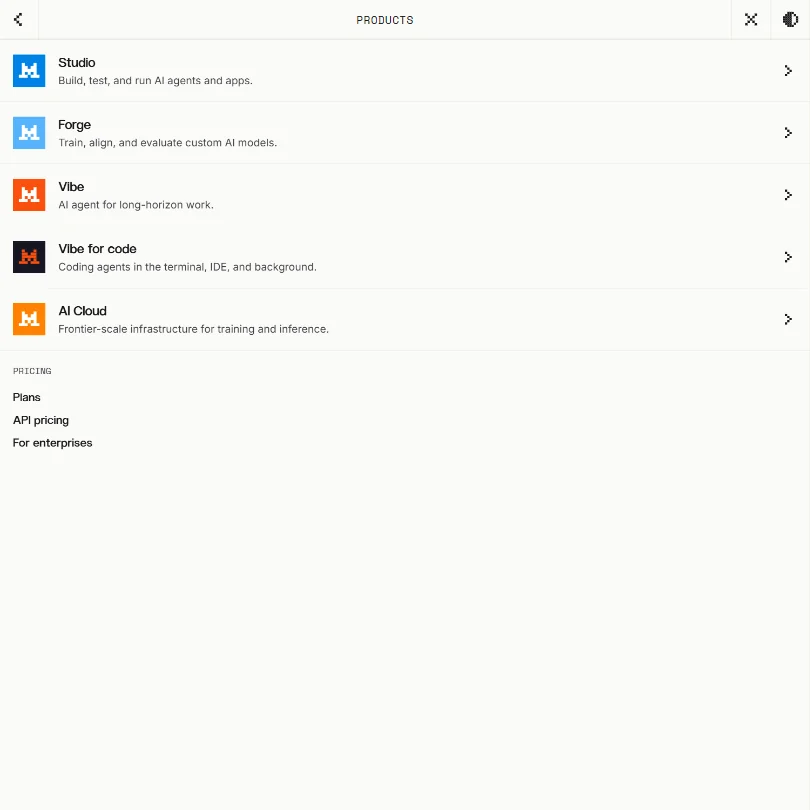
The product stack has three main pieces. Studio is the workspace for building and testing AI agents. Forge handles fine-tuning. And Vibe, the newest addition, is an agentic coding product that runs in the terminal, inside IDEs, or as an async background worker for longer tasks.

The model family runs from Mistral Large and Mistral Medium down to Mistral Small on the proprietary side. Then there's Mistral OCR for document intelligence, and Voxtral for speech. Each tier carries different API pricing. The open models sit underneath all of it, free to download and self-host.

That open-weight track is genuinely unusual. OpenAI and Anthropic don't give you the weights. Mistral does, for a meaningful portion of their lineup. That creates a real second path for enterprises with compliance requirements, or teams that need inference running on their own hardware. We kept seeing that come up in developer communities as the actual reason people pick Mistral over the American alternatives. Not benchmark scores. The sovereignty angle. That tracks.

Mistral Features: Code Generation, Review & Developer Workflow

Mistral features screenshot
Mistral — Features

Vibe for Code is where Mistral's AI coding assistant story lives now. There's a CLI client for terminal-heavy workflows, an IDE plugin for VS Code and compatible editors, and a background execution mode for longer tasks that don't need you watching.

The architecture-aware reasoning claim in their docs is the part we'd watch most carefully. The idea is that Vibe understands your codebase structure before generating output, not just the file you have open. We're skeptical of that at scale. It's a hard problem, and every AI code tool says some version of it. Community threads suggest it works reasonably well on smaller repos and gets shakier as scope grows.

Automated code review runs through CI/CD hooks, with explicit support for GitHub and GitLab. The tool can catch issues in pull request flows and generate documentation alongside test stubs. That's a real workflow, not just a bullet point. If AI code review specifically is what you're shopping for, CodeRabbit does that one thing and nothing else, which is either a strength or a gap depending on whether you want a focused tool or a platform. Different answer for different teams.

Shieldstral is the safety layer. Built into Studio, it provides guardrails for model outputs alongside an evals framework for teams that need to audit agent behavior. Financial services shops keep appearing in Mistral's customer case studies for a reason. HSBC is named directly.

Legacy code translation is also listed in their feature docs. Honestly, that's underrated. Most tools in this space are optimized for greenfield work. Teams maintaining old codebases get ignored constantly. Mistral at least acknowledges they exist.

Mistral Code Quality: How Accurate and Reliable Is It?

Depends heavily on which model you're running and what you're asking it to do. That's not a dodge, it's the actual answer.

Mistral Large is the flagship. On third-party benchmarks it competes reasonably with GPT-4o and Claude Sonnet on coding tasks, though it doesn't consistently top either one. Mistral Small is where things get more interesting, partly because it's fast and cheap, and partly because the 2024 and 2025 iterations showed meaningful jumps in reasoning capability relative to price.

Reddit discussions from the past year tend to land in roughly the same place. Mistral's smaller models punch above their weight on tasks with well-defined structure, like writing boilerplate, converting between formats, and generating tests for existing code. Complex multi-file reasoning, or anything requiring sustained context over a long session, draws more complaints. Not unique to Mistral. It's a general limitation of the current model generation. Worth knowing anyway.

We cross-referenced their documentation claims about codebase indexing against developer reports. The gap isn't huge, but it exists. Architecture-aware reasoning seems to work best when you configure it intentionally, not as a passive background process that figures everything out on its own.

Mistral OCR is a different story. Genuinely well-regarded in the document intelligence corner of the community. For teams parsing PDFs or invoices at scale, that's worth knowing about separately from the coding features.

Mistral IDE & Workflow Integration: Where Does It Work?

VS Code gets explicit support through Vibe for IDE. That covers the majority of the developer market. JetBrains support is also real now and documented: Vibe supports IntelliJ IDEA, PyCharm, WebStorm, GoLand, and other JetBrains IDEs through the Agent Client Protocol. Worth knowing that the previous standalone Mistral Code Enterprise JetBrains plugin is deprecated, and ACP is now the supported path. Mistral says so directly in their docs. Anyone still running the old plugin should migrate.

The CLI is real and functional. Developers who prefer terminal-first workflows seem to get on well with it. The background agent mode is the more interesting piece. Running async code tasks while you work on something else is how the more ambitious coding agents are differentiating right now, and Mistral is clearly competing in that space rather than just offering tab-completion.

On the cloud side, the platform connects to Google Cloud, AWS, and Azure. The Free plan lists 100-plus connectors, and custom MCP connectors are available for teams building specific pipelines. Whether all of those integrations are production-ready or just technically available is something we couldn't fully verify. We'd push on that in sales conversations.

The self-hosted option deserves its own sentence. Studio can run on your own infrastructure, whether that's a private cloud, edge deployment, or on-premises hardware. Combined with Apache 2.0 open-weight models, that gives enterprises a path to zero data leaving their environment. Cursor doesn't offer that. GitHub Copilot doesn't offer that. Not for everyone, but for the organizations that need it, it's a genuine differentiator.

Is Mistral Easy to Set Up and Use?

For developers, reasonably yes. The API documentation is thorough. There are cookbooks, a full API reference, and a help center that's actively maintained. Getting something running takes less than an afternoon for anyone comfortable with REST calls.

Studio is the more involved piece. Building agents, configuring evals, running Forge for fine-tuning, none of that is plug-and-play. The platform assumes technical users. That's probably fine for Mistral's core audience. Non-developers on a mixed team will struggle without dedicated support, though.

Vibe's CLI setup runs cleanly, based on developer reports. IDE installation follows the standard extension model. Nothing exotic there.

Enterprise deployment is where complexity compounds. The Team plan at $24.99 per user per month adds SAML SSO, audit logs, domain name verification, and admin API access. Standard enterprise checklist. Configuring all of that for a large organization involves friction, not because Mistral is difficult, but because enterprise AI deployments are messy regardless of vendor. Fair.

Support on the free tier is bot-only. Email support starts at Pro, $14.99 per month. Not unusual, but it means early-stage users troubleshooting setup are largely on their own. The community forum is active enough to cover common problems.

Mistral Pricing: Is It Worth It for Solo Devs and Teams?

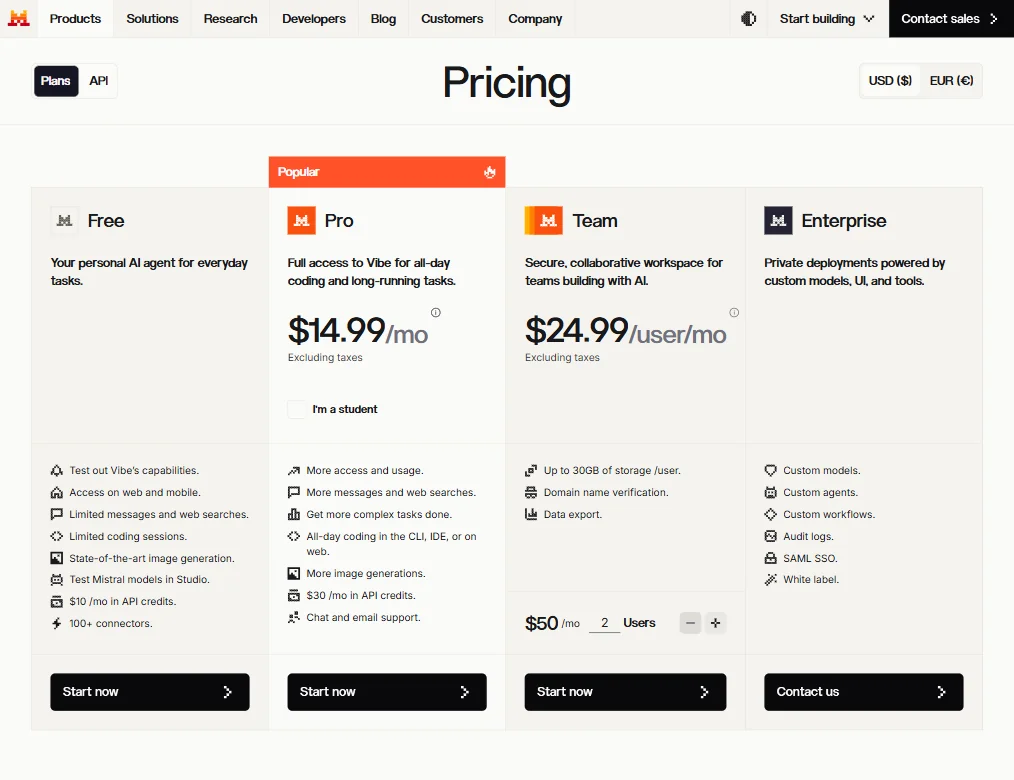
Mistral pricing screenshot
Mistral — Pricing

The free plan is real. Limited Vibe access, Studio access, and $10 per month in API credits. That's enough to do actual evaluation work. Not just a demo environment.

Pro lands at $14.99 per month. There's a student discount toggle on the pricing page, no price shown publicly, worth checking if that applies to you. At $14.99, Mistral sits below what we'd call the rough category median for AI developer tools with comparable feature sets. For a solo developer who mainly wants expanded API access and Studio time, it's defensible.

Team is $24.99 per user per month. The pricing page shows a user-count adjuster, with a floor of two users and a displayed base of $50 per month for that minimum. API usage is billed separately and per-token, which adds variability if consumption spikes. Enterprise is custom, no public number, standard for this category.

The refund policy isn't published anywhere we could find. We'd ask sales directly before committing to an annual plan. Not great.

One thing worth flagging separately: the open-weight models are free to run. A team with infrastructure capability could skip the SaaS subscription entirely and host Mistral Small or Medium on their own hardware. That's an unusual pricing ceiling for a commercial AI tool. It keeps Mistral honest on what the paid tiers actually need to deliver.

Mistral vs OpenAI: Which AI Coding Tool Is Better?

OpenAI's developer platform, particularly GPT-4o and the Codex-derived tooling, has a longer production track record. More community resources. More third-party integrations already built. The AI pair programming experience through GitHub Copilot, which runs on OpenAI models, is something millions of developers already have muscle memory for. That matters.

Mistral's case against OpenAI isn't really about raw benchmark performance. It's about control. Self-hosting, fine-tuning through Forge, keeping data in Europe under EU data protection law. OpenAI offers none of that. For teams where those things matter, Mistral wins the comparison before you even look at code quality.

On API cost, Mistral is generally competitive, particularly on the smaller models. Mistral Small is fast and cheap in ways that make it attractive for high-volume, lower-complexity tasks where GPT-4o rates don't make sense.

Where OpenAI still pulls ahead is ecosystem maturity. The volume of third-party tooling built on top of their API is vastly larger. More tutorials, more people who've already debugged the problem you're hitting. Not a forever advantage, but a real one right now.

Anthropic's Claude is a closer competitor on reasoning quality for complex code tasks. We cover Claude separately, and the honest take there is that Claude Sonnet gets warmer reception on complex multi-turn coding sessions. Mistral's advantage over Claude comes back to open weights and self-hosting. Same answer, different comparison.

Who Should Use Mistral? (And Who Shouldn't)

European enterprises with data residency requirements. That's the clearest fit. EU-based infrastructure, open-weight options, and on-premises deployment together cover a compliance need that very few AI vendors can actually address. HSBC and the European Patent Office showing up as customers isn't accidental.

Developers who want an AI code review tool and code generation in one place, without committing to a US-based vendor's data policies, have a real option here, especially on the Team plan where governance features kick in.

Researchers working with open models. Mistral's Apache 2.0 releases are actively used across the research community. If you need to modify, redistribute, or build on the weights, that licensing matters enormously.

Teams that just want simple autocomplete. There are cheaper, more focused tools for that. Teams with no API or infrastructure experience will also find the platform's technical demands frustrating. And anyone still running the deprecated Mistral Code Enterprise JetBrains plugin should know that migration to ACP is now the supported path, not optional maintenance.

Mistral Review Verdict

Two years old and already past the point where "promising for a young lab" is the right framing. Mistral is doing something real. An actual AI lab with its own models, its own infrastructure, and a platform that landed serious enterprise customers before most companies in its cohort finished their Series A.

The open-weight strategy is the most interesting long-term bet. It keeps the commercial product honest on pricing, gives enterprises a genuine alternative to fully-managed cloud AI, and builds developer goodwill that converts into paid usage over time. Not many commercial AI companies can run that play credibly. Mistral is doing it reasonably well.

The gaps are real too. Vibe's async agent capabilities are the most ambitious part of the product and community sentiment there is cautious rather than enthusiastic. The refund policy is nowhere to be found. And the platform's technical demands are high enough that it's genuinely not the right tool for non-technical teams, no matter how the marketing frames it.

For developers or enterprises who care about data sovereignty, self-hosting, or the open-weight ecosystem, Mistral belongs on the shortlist. Everyone else might find OpenAI's ecosystem depth or Anthropic's reasoning quality easier wins depending on the use case. Strong option. Not a universal one.

Frequently Asked Questions

Does Mistral have a free plan?

Yes. The free plan includes limited Vibe access, Studio access, and $10 per month in API credits. That's enough to do real evaluation work before committing to a paid tier. Pro starts at $14.99 per month if you need more capacity.

Can you self-host Mistral's models?

Yes, and that's one of the more unusual things about Mistral compared to OpenAI or Anthropic. Several models are released under Apache 2.0 licensing, meaning you can download the weights and run them on your own hardware with no ongoing fees. Studio can also be deployed on-premises or on a virtual cloud you control, which is what makes Mistral attractive to enterprises with strict data residency requirements.

How does Mistral compare to OpenAI for coding tasks?

On raw coding performance, they're close enough that model choice often comes down to price and specific task type rather than a clear winner. Mistral's smaller models are fast and cheap for high-volume, well-defined tasks. OpenAI's ecosystem is more mature, with more third-party integrations and community resources built on top of it. The bigger difference is control: Mistral offers self-hosting and open weights, OpenAI doesn't. That's the reason most developers we saw choosing Mistral over OpenAI gave.

Mistral is featured in

Alternatives to Mistral

See all Mistral alternatives →

Other AI Developer Tool options we've reviewed.

User reviews

Review Mistral

Your rating

Reviews are moderated and appear once approved.