

Academic library blogs don't have a reputation for enthusiasm. So when we kept seeing Keenious mentioned favorably in those spaces, alongside posts from graduate students in academic subreddits describing it as genuinely useful, we paid attention. We pulled vendor documentation, checked what university librarians were writing, and cross-referenced those accounts against the pricing page and feature specs. No hands-on testing on our end.
Founded in 2019 out of Tromsø, Norway. That detail matters less than what they built. The field map keeps coming up in every secondhand account we found. More on that below.
What is Keenious?
A search box it is not. You paste in text or type a topic, and Keenious returns a spatial view of the research domain, showing how paper clusters relate to each other, where the work is concentrated, and where the gaps are. That's the part that distinguishes it.
Layered on top of that is conversational AI. Ask follow-ups, ask for methodology explanations, ask it to clarify a concept from a specific paper. That combination of visual domain mapping and conversational query is genuinely unusual in this category. We checked Elicit, Consensus, and Connected Papers. None of them do it quite that way.
One correction to what the vendor materials sometimes imply: the Chat function runs on Google Gemini 2.0 Flash, not a fully proprietary model. A smaller Gemini model handles research-area label generation. Search itself uses a hybrid of embeddings and keyword ranking, so it's not purely LLM-driven. Worth knowing. Keenious does not offer model selection.
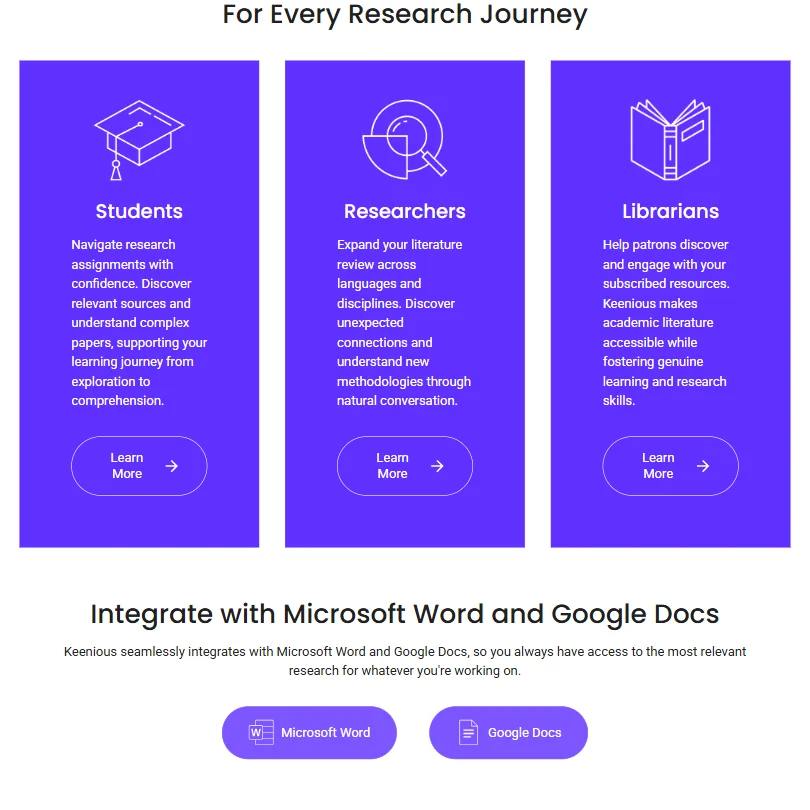
Available on the web, as a Microsoft Word add-in, and as a Google Docs add-in. No mobile app.
Keenious Features: Search, Synthesis & Research Capabilities
The core loop is simple enough. Upload a document or enter a query. Keenious surfaces relevant papers and arranges them spatially. Then you ask questions about what it found.
The free tier caps document uploads at 3 MB and limits you to five AI responses per conversation, with three conversations per day. The Plus Individual plan raises the file ceiling to 20 MB and removes those conversation caps entirely. A single dense academic PDF can push close to 3 MB without much effort. That free-tier limit bites faster than most people expect.
The AI explanation layer is what library communities seem to value most. Reddit threads from research librarians describe it as genuinely useful for students encountering an unfamiliar field's vocabulary for the first time. That tracks with what we'd expect from something designed for early-stage exploration.
Citation export in RIS and BibTeX formats is available, but only on Plus plans. That makes it Zotero-compatible without special configuration. The free tier doesn't include it. Paywalling export formats is a familiar move.
Native-language search is something competitors mostly ignore. Keenious explicitly supports it. For researchers who don't work primarily in English, that's a real differentiator.
Keenious Research Quality: How Accurate and Trustworthy Is It?
No G2 listing. No Capterra page. No Trustpilot presence. Traditional review aggregation doesn't apply here, which is part of why writing this was harder than most entries in our database. What we found instead were university library blog mentions, academic subreddit threads describing the field map as useful for literature review orientation, and a Trust Center backed by ISO 27001 certification and GDPR compliance.
Honestly, that's a thin public record for a tool that's been around since 2019.
The ISO 27001 certification is more than most AI research tools bother with, especially at this price point. Institutions handling sensitive research data will notice. We'd still want more transparency on the AI response layer.
Because the Chat function runs on Gemini 2.0 Flash, the question of hallucination risk is tied to that model's known behavior, not some opaque proprietary system. That's actually more useful information than most competitors offer. The tool does link responses back to source papers, which is a meaningful safeguard. But we'd want to know more about how the grounding works in practice.
Keenious Source Coverage: What Does It Actually Search?
"Millions of published academic papers" is the vendor's language. Not great. There's no public breakdown of which databases feed the index, whether preprints are included, or how frequently coverage updates. Semantic Scholar publishes that information. Keenious doesn't.
That's not disqualifying. It's a friction point.
The integration with EBSCO and PRIMO link resolvers is the most practically useful infrastructure detail for institutional buyers. Students at universities with those subscriptions can click through to full papers rather than stopping at abstracts. Without that institutional layer, you're mostly skimming surfaces.
Fair. But the lack of a published corpus size will bother researchers who care about reproducibility, even with the source (OpenAlex) disclosed.
Is Keenious Easy to Use for Researchers and Professionals?
From everything we read, yes. There's an explicit first-timer orientation on the homepage. Library communities describe onboarding as low-friction for students who've never touched an academic search tool. That's consistent with a product built for early-stage exploration rather than expert retrieval.
The Word and Google Docs add-ins are the practical differentiator in daily workflows. You stay in the document. You find a reference without switching tabs. Not every tool bothers with in-document integration, and the ones that do usually implement it poorly.
The absence of a browser extension is a real gap. You can't pull Keenious into an arbitrary journal page reading session. That limits how it fits into a researcher's existing habits. No mobile app compounds this slightly.
Keenious Pricing: Is It Worth It vs Free Alternatives?

Three tiers. Free, Plus Individual, and Plus Teams, with Institutions on custom pricing.
The free tier gives you all search results, five AI responses per conversation, three conversations per day, and a 3 MB upload cap. Usable for occasional curiosity. Not enough for sustained research work. The AI response cap is the one that creates the most friction.
Plus Individual runs $10 per month billed annually, though the pricing page may display in local currency depending on region. The screenshot we reviewed showed $10. Either way, that's roughly $120 a year. Plus Teams is $20 per user per month, also billed annually. The Institutions tier requires contacting sales.
No public refund policy that we could locate. Yellow flag.
The free competition worth naming: Semantic Scholar is free and indexes a documented corpus at massive scale. Elicit has a free tier with structured extraction features that are genuinely powerful. Neither does the field map. That's Keenious's argument for charging money.
Keenious vs Elicit: Which AI Research Tool Is Better?
Different stages of the same process. Elicit is built for systematic literature reviews, structured data extraction across large paper sets, the kind of work that comes after you know your field. Keenious is for the stage before that. When you don't know the terrain yet and you need a map before you start pulling papers.
Elicit wins on structured extraction and formal review workflows. Keenious wins on spatial orientation and language accessibility for non-English researchers.
Early-stage PhD students figuring out a new domain. That's Keenious's moment. Researchers in the data extraction phase of a registered systematic review. That's Elicit's moment. The tools aren't really competing for the same user at the same point in time.
Who Should Use Keenious? (And Who Shouldn't)
Students new to academic research. The visual map, the conversational layer, the low barrier to entry. The product is clearly designed for exactly that population.
University librarians deploying research tools at scale. The Institutions plan includes SSO, SAML, and IP-based access, plus library collection integration, a Data Processing Agreement, and training and workshops. That's a real institutional infrastructure offer, not just a team license with a fancier name.
Researchers who live inside established databases with documented coverage. Keenious's corpus opacity will frustrate them. Not great for that use case.
Heavy systematic reviewers doing formal extractions. Too loose. Look at Elicit or Rayyan instead.
Keenious Review Verdict
The field map is not a gimmick. Understanding the shape of a research domain before you start retrieving papers has real value, and most tools in this category skip that step entirely. Keenious built around it.
The clearest weaknesses are coverage transparency and the absence of any meaningful public review record. No G2 page. No public refund policy. No documented corpus. For a tool selling to university procurement offices, that undisclosed corpus size creates friction in ways that are entirely avoidable.
The Plus Individual plan at roughly $10 per month is defensible for regular use. The free tier's conversation caps push casual users toward paid faster than we'd like. And the clarification that Chat runs on Gemini 2.0 Flash rather than a purely proprietary model is actually reassuring, not the liability the vendor's vague documentation made it seem.
We'd point students and early-stage researchers toward it for orientation work. For systematic, extraction-heavy research, start somewhere else.
How Keenious compares
Keenious scores 5.1 out of 10 among the literature search tools we rate. These three do the same job and are the closest to it, compared on what each vendor publishes.
Elicit
Keenious starts at $10 a month, billed annually; Elicit's academic plan is $19 a month. Keenious answers back with a Word and Google Docs add-in for finding sources as you write, something Elicit does not offer. Elicit goes much further otherwise: it screens papers for a systematic review, deduplicates references automatically, summarizes papers, and reads figures and tables, none of which Keenious does, since Keenious is built to find sources rather than summarize or analyze them for you.
Pick Elicit if you need systematic review screening, summaries and dedup.
Pick Keenious if you want a Word or Docs add-in while you write.
Consensus
A Word and Google Docs add-in for finding sources while you write is Keenious's edge over Consensus, which does not offer one. Keenious starts at $10 a month, billed annually, against Consensus's $20 a month. Consensus goes further on the research side: it answers a question with a written, cited answer, pulls study details from many papers into a comparison table, and writes a full literature review, none of which Keenious does, since it is built to find sources, not analyze them.
Pick Consensus if you want answers synthesized across the literature with citations.
Pick Keenious if you want a Word or Docs add-in while you write.
Semantic Scholar
Semantic Scholar is free, with no paid plan; Keenious starts at $10 a month, billed annually. Semantic Scholar answers back with a free, documented API and citation alerts on saved searches, and it works directly with Zotero, Mendeley and EndNote, none of which Keenious offers without a paid plan. Keenious has its own edge: a Word and Google Docs add-in for finding sources while you write, and search results that cross languages, both missing from Semantic Scholar.
Pick Semantic Scholar if you want a free plan with a documented API.
Pick Keenious if you want a Word or Docs add-in and multilingual search.


