Our research on Bardeen started, as it often does, with the homepage claims. Then we went looking for what actual users said. This Bardeen review pulls from vendor docs, Reddit threads, Product Hunt comments, and whatever review signals we could surface, because Bardeen isn't listed on G2 or Capterra. That absence shapes a lot of what follows.

Founded in 2020 and headquartered in San Francisco, Bardeen has built a Chrome extension and web platform aimed squarely at sales reps, solopreneurs, and recruiters who want to automate lead sourcing without paying Clay prices. Over 200,000 users have signed up. That's not nothing.
What is Bardeen?
Bardeen sits at the intersection of web scraping and sales automation. The core idea is that your leads aren't all sitting in one database. They're scattered across LinkedIn, company websites, job boards, and directories. Bardeen lets you build scrapers to pull data from those places, then run AI on top to qualify and enrich what you've found.
The product runs as a Chrome extension with a companion web app. You can build scrapers visually, no code required. You can schedule runs, export to Google Sheets or Airtable, and push enriched contact data into tools like Salesforce or Notion.
The platform is English-first. International teams should check that before committing.
Bardeen Features: Workflows, AI Agents & Automation Capabilities

The feature set clusters around four things. Scraping is the first. The agentic web scraper lets you extract data from almost any website, either by building your own scraper or using premade Premium scrapers from their template library. The second is web search, where AI can research or generate leads at scale by querying search providers directly.
Then there's enrichment. Bardeen finds and validates contact information for leads you've already sourced. Email validation is built into the process. That matters more than it sounds.
Qualification rounds it out. You describe what your ideal lead looks like, and AI filters the list before you ever see it. Human review is optional, not forced. Honestly, that's the right call.
The workflow builder supports scheduled runs, event-based triggers, and manual kicks. Conditional logic runs through the AI qualification layer. Bardeen doesn't have an API and custom webhooks are not supported. The integration count sits at 50+, with the headline connections being Google Sheets and Salesforce, and a few others.
Bardeen Automation Power: How Complex Can Your Workflows Get?
The honest answer is: moderately complex. Bardeen isn't trying to be Make, and it doesn't pretend to be. The automation model is purpose-built around lead workflows. Scrape, research, enrich, qualify, export. That loop is well-designed. Stepping outside it gets harder.
Conditional logic exists but it's mostly AI-driven qualification, not the kind of branching logic you'd build in a general-purpose automation tool. There's no publicly documented custom code option. For teams that need deeply custom logic, that's a ceiling.
Scheduled runs work. Triggers cover the main cases. The workflow builder is genuinely no-code, which is a real advantage for sales teams who don't have a technical person available. We don't know how well execution logs work in practice because Bardeen doesn't publicize those details. That gap showed up in community threads too.
Bardeen AI Agent Capabilities: What Can It Actually Do Autonomously?
The AI agent angle is where Bardeen is leaning hardest right now. The scraper has agentic behavior, meaning it can navigate and extract data without you mapping every field manually. The AI research layer can generate leads by running queries across search providers, not just scrape from pages you already found.
We're cautiously impressed by that. Most tools at this price still treat AI as a formatting layer. Bardeen's AI is doing actual discovery work.
The qualification engine is where it gets interesting. You write a plain-text description of your ideal prospect and the AI decides which scraped records match. That's a reasonable implementation. Whether it's accurate enough to trust without review is a different question. Users we read about in Product Hunt comments were positive about the qualification feature but mentioned needing to tune the descriptions a few times before results tightened up. That tracks for any AI filtering setup.
Is Bardeen Easy to Set Up Without Code?
Easier than most, harder than advertised. That's the short version.
The Chrome extension installs quickly and the visual builder is clean. Template scrapers mean you don't have to build from scratch. For common sources like LinkedIn, the setup is fast. For custom or less common sites, users reported needing more trial and error.
We didn't find recurring complaints about the setup being broken or confusing. What we did see was the occasional "took me an afternoon to get my first workflow right" comment. Fair. That's not a failure.
The help center appears to have guides, FAQs, and an app reference, along with an AI chatbot for first-contact support. Bardeen does have human support staff and a solutions-engineering team, and users can submit a request to reach a person directly. That said, the pricing page only calls out Premium Support as an explicit Enterprise feature. Whether the $50 Premium plan gets you meaningfully faster human access than the $10 Basic plan isn't documented anywhere we could find. We're skeptical that it doesn't matter at all.
Bardeen Pricing: Is It Worth It vs Zapier or Make?
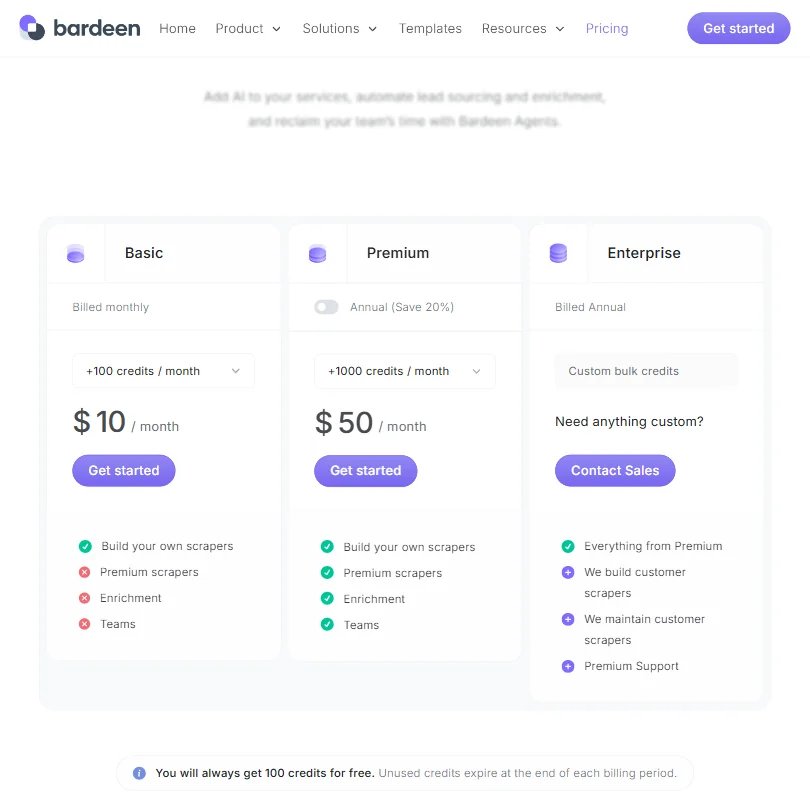
The free plan gives you 100 credits per month. Permanently. No trial clock. That's a reasonable way to test whether scraping and enrichment actually works for your use case before paying. Unused credits expire at the end of each billing period, which is worth knowing upfront.
The Basic plan is $10 per month, billed monthly, and includes 100 credits on top of the free allocation. Premium is $50 per month and adds Premium scrapers, Enrichment, and Teams access that Basic doesn't have. Enterprise is custom, billed annually, and layers on dedicated scraper builds and maintenance alongside Premium Support.
Credits are the currency here. Every scrape, enrichment, and AI action draws from your credit pool. The pricing is opaque enough that it's hard to know exactly how far $10 goes for a given workflow until you're in it. That credit ambiguity is a real friction point, and Reddit threads from 2024 surface the same concern repeatedly. Users running out of credits mid-campaign is not a rare story.
Bardeen doesn't publicly state a refund policy anywhere we could find. Minor irritant, but worth flagging.
Compared to Zapier, Bardeen is cheaper and more focused. Zapier connects more apps and handles broader general automation scenarios. Bardeen goes deeper on the lead sourcing side at a fraction of the cost. They're not really competing for the same job.
Bardeen vs Clay: Which Automation Platform Wins?
Bardeen positions itself explicitly as a Clay alternative for people without a Clay budget. That's a defensible position.
Clay is powerful. It's also expensive and has a steeper learning curve. For an enterprise sales team running hundreds of enrichment workflows, Clay makes sense. For a solopreneur building a targeted list for an outbound campaign, Clay's pricing is painful. Bardeen fills that gap.
What Bardeen doesn't have is Clay's depth on the data provider side. Clay aggregates from dozens of enrichment sources and lets you waterfall through them. Bardeen's enrichment is narrower. That's the real gap, not the price.
For recruiters and small sales teams with focused scraping needs, Bardeen probably wins on value. For anyone running large-scale, multi-source enrichment at volume, Clay still has the edge.
Who Should Use Bardeen? (And Who Shouldn't)
Solopreneurs doing their own outbound. That's the clearest fit. The price is right and the setup doesn't require a technical co-founder.
Recruiters sourcing candidates from LinkedIn and company sites will also find it useful. Template scrapers make common sources fast.
Small sales teams without a Clay budget but with real lead sourcing needs. Bardeen gets you most of the way there.
Who shouldn't use it. Technical teams wanting deep branching logic and custom code. Go somewhere with more flexibility. Teams needing extensive integration depth across dozens of apps. The 50+ integration count is fine but this isn't a general automation platform.
Also worth saying: if you have no idea whether web scraping is even the right approach for your lead gen, don't start with Bardeen. Figure out where your leads actually live first.
Bardeen Review Verdict
Bardeen does a specific job well. Scrape leads, qualify them with AI, enrich contact details, export somewhere useful. That loop works. The price is fair for what you get, especially at the free and $10 tiers.
The weak spots are real. Credit transparency needs improvement. The distinction between human support access on Basic versus Premium isn't documented, which is a gap that matters when something breaks mid-campaign. The integration library is fine but not deep. No public refund policy. And the total absence from G2 and Capterra means there's no independent review body to cross-check against.
None of those are fatal for the audience Bardeen is built for. A solopreneur doing outbound doesn't need 9,000 integrations or enterprise SLA support. They need a scraper that works and a qualification layer that saves time.
That's what Bardeen delivers. Mostly.
Frequently Asked Questions
Does Bardeen have a free plan?
Yes. Bardeen includes 100 free credits per month on a permanent free tier, with no trial period. You won't get far with heavy enrichment workflows on 100 credits, but it's enough to test whether the scraper actually handles the sites you care about before committing to a paid plan. Unused credits do expire at the end of each billing period.
How does Bardeen compare to Clay for lead enrichment?
Bardeen is cheaper and easier to start with. Clay is more powerful on the enrichment side, especially for teams that need to pull from multiple data providers in sequence. Bardeen's enrichment comes from a narrower source set. For solo operators and small teams running focused campaigns, Bardeen makes more financial sense. For high-volume, multi-source enrichment, Clay still has the advantage.
Is Bardeen only useful for sales teams?
Sales is the obvious use case, but recruiters use it heavily for candidate sourcing from LinkedIn and job sites. Real estate agents are also mentioned in Bardeen's own docs as a target user. The common thread is needing to pull structured data from websites that don't offer a convenient export. If that's your problem, Bardeen's scraper is worth a look regardless of what industry you're in.