Founded in 2022 out of San Francisco, Supademo has moved at a pace that catches your attention. Our research pulled vendor docs, combed through Reddit threads from product marketers, and cross-referenced what limited public review data exists. The G2 listing now sits at roughly 616 reviews with a 4.7/5 aggregate. Capterra has one review, but the listing is real. That's a meaningful difference from where the product was even eighteen months ago, and it's enough to say something substantive now.
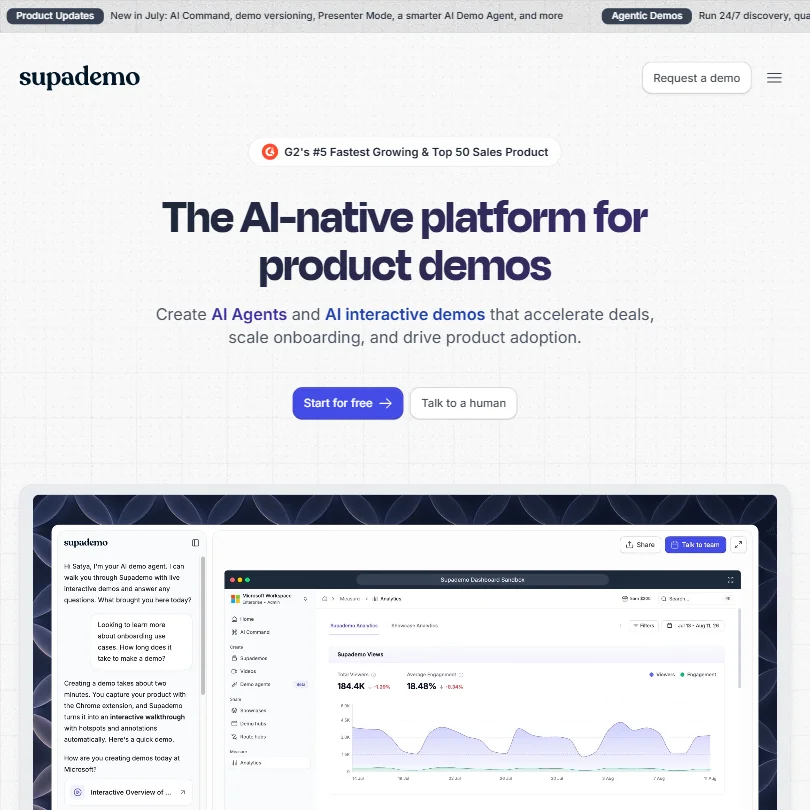
What is Supademo?
Click-through product demos, AI-assisted routing, and a conversational agent running on top of your demo library. That's the stack. You build demos of your software, distribute them to buyers or users, and let the AI Demo Agent handle the front-end qualification work while your reps do other things. The Chrome extension captures your product screens. The editor handles annotation and branching. The Route Hub manages conditional logic, deciding which demo path a visitor sees based on what they say or click. Then the AI Demo Agent takes a conversation, figures out buyer intent, and either surfaces content or hands the prospect off to a human.
Coherent concept. The question is always how well the individual pieces hold together under real conditions. We'll get into that.
Supademo Features: Workflows, AI Agents & Automation Capabilities
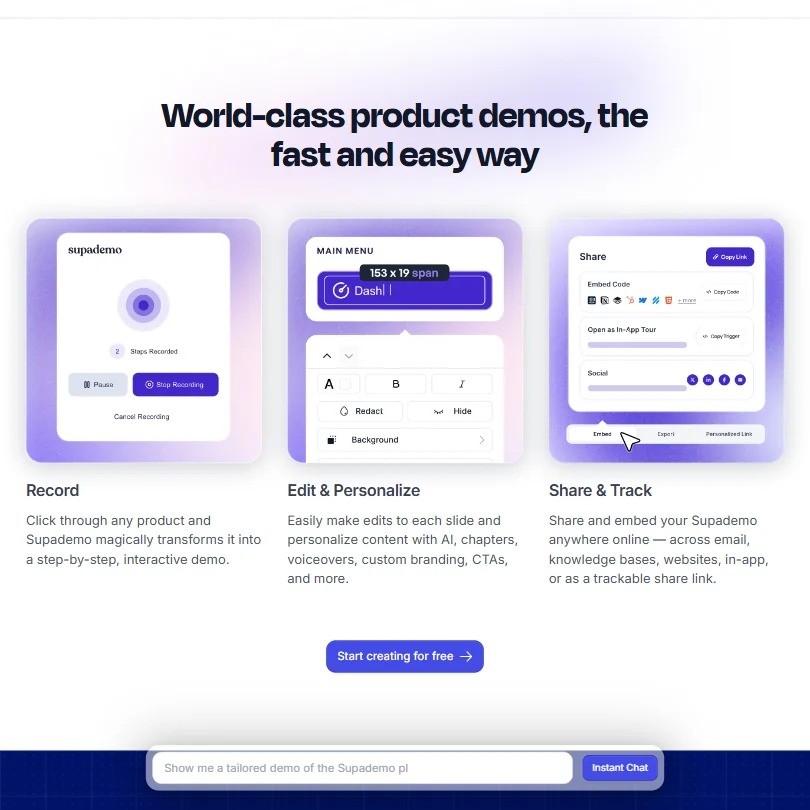
The visual builder is where most users spend their days. Record, annotate, arrange steps, publish. Basic workflow. What sits on top of that is more interesting. The Route Hub adds branching and conditional routing, variables feed into path logic, and intake form answers can change what a viewer sees next. Path-level analytics show you where viewers drop off. Named tracking links tell you who opened what and when.
Honestly, the builder looks cleaner than most tools in this category. Reddit threads from 2024 forward describe setup as faster than expected, and that's consistent enough across independent sources that we believe it.
The AI Command feature launched in beta in July 2026, with the announcement published August 3, 2026. It lets you update, translate, or reorganize demos through a typed prompt rather than manual click-through editing. Translate a full demo into one of 50+ supported languages by writing an instruction. Real time saver for teams running demos across multiple markets. The 50+ language support on the AI Demo Agent itself is the other half of that picture. MCP access, Supademo's API-style integration layer, is gated behind Scale and above. Below Scale, there's no API access at all. Worth knowing before you start a free trial assuming you'll connect it to your existing stack.
Supademo Automation Power: How Complex Can Your Workflows Get?
The Route Hub handles branching well. Variables and conditional routing let you build paths that respond to what prospects actually input. Smart intake forms feed data into routing logic. That's the core of what Supademo calls agentic demos, and the architecture makes sense on paper.
Outside Supademo's own ecosystem, things get thinner. No native Slack connection we could confirm. No Google Workspace hookup in the public docs. MCP access on Scale is the primary bridge to external tools, which means integration work falls on your team. That's a meaningful contrast to something like Zapier, which hands you hundreds of pre-built connectors. Not the same category, but the comparison matters if external automation is a core requirement.
Error handling isn't documented publicly. Session analytics and path tracking exist, but that's demo performance data, not an audit trail. We don't have enough information to say what happens when the AI Demo Agent breaks mid-conversation. Not great.
Supademo AI Agent Capabilities: What Can It Actually Do Autonomously?
The AI Demo Agent is the headline feature. It runs continuously, takes prospect input, determines intent, and routes buyers to the right demo content without a sales rep present. Warm handoff to sales is the mechanism when a conversation reaches actual buying interest. That part matters. A bot that can't escalate properly is a fancy FAQ page and nothing more.
The architecture is reasonable. Training the agent on your own demo library is the right approach. Navattic now offers its own AI agents that converse with prospects in real time, qualify buyers, and hand off to sales, operating by voice or chat. So the competitive gap on this specific feature has narrowed. Supademo was earlier, but Navattic's qualification and website agents are now a direct parallel, not a distant comparison.
What we couldn't find: credible third-party validation of how the AI Demo Agent performs in real buyer conversations at volume. The G2 reviews give us signal on the builder and overall experience, but specific agent accuracy data isn't surfacing publicly. We're taking agent performance claims largely from vendor documentation. We're skeptical of that, not because the claims are implausible, but because 616 G2 reviews that don't surface agent-specific performance data is a gap worth naming.
Is Supademo Easy to Set Up Without Code?
Yes, mostly. The Chrome extension handles capture. The visual editor is point-and-click. Users across multiple independent threads flag the same thing: first demo is done in under an hour. That's consistent enough to be believed.
The Route Hub gets more involved as branches and variables accumulate. Still no-code, but it rewards upfront planning. Walking in blind works for simple demos. Complex conditional paths require thinking through your flows before you build them, not after.
AI Command reduces the maintenance burden in a real way. Updating a multi-step demo after a UI change used to mean manual re-annotation throughout. If AI Command performs as the vendor documents describe, a typed prompt handles the affected steps instead. We're reserving final judgment until we see independent confirmation of that in practice.
Supademo pricing: what each plan gives
The free plan is genuinely usable. One creator seat, five guided interactive demos, 50 video recordings at 4K, and unlimited demo views. For a solo founder testing the concept, that's real signal before any money changes hands.
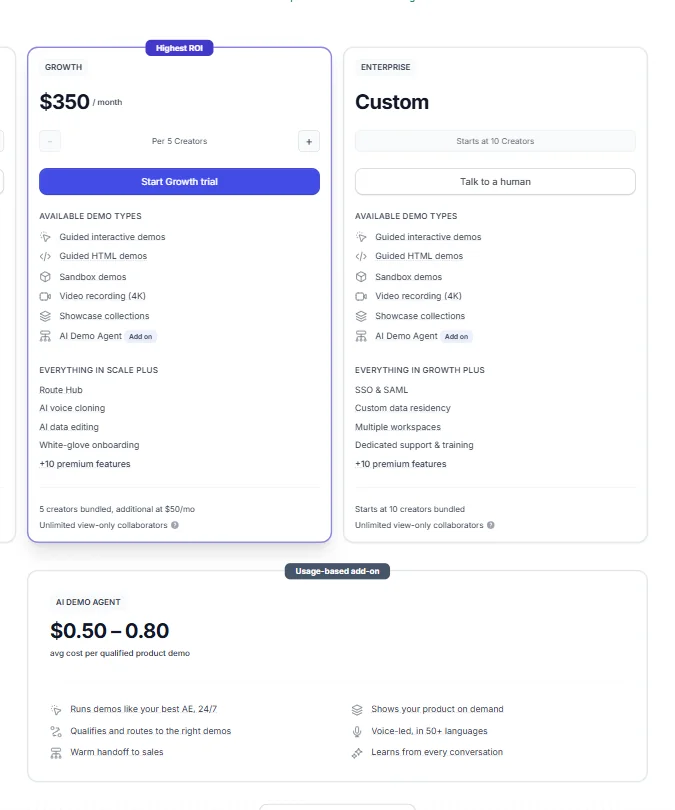
Paid plans are where it complicates. Scale starts at $38 per month. Growth jumps to $450 per month for five creators, with additional creators at $50 per month each. That's a steep gap. The feature gates are real, not cosmetic. AI data editing, which is how you personalize on-screen data for individual prospects, is Growth-only. So are AI voice cloning, AI data editing, white-glove onboarding, and ten additional premium features the pricing page doesn't fully enumerate. Enterprise is custom-priced, starts at ten creators, includes SSO, SAML, custom data residency, and multiple workspaces.
The AI Demo Agent is a usage-based add-on across plans, priced at $0.50 to $0.80 per qualified product demo. That per-interaction cost adds up fast at volume. No refund policy is publicly documented. We came up empty looking for it.
Compared to Make, which handles demo distribution and outreach as part of a broader automation stack, Supademo's pricing feels steep for teams that need Growth features but can't justify $450 per month plus per-demo agent costs.
Supademo vs Navattic: Which Automation Platform Wins?
Navattic is the most direct comparison. Both do interactive demos. Both target sales and product marketing teams. Navattic has more public review data and has been at this longer.
Supademo was earlier to the AI Demo Agent concept, but Navattic now offers qualification agents and website agents operating by voice or chat in real time. The differentiator gap has closed. What Supademo still holds is the Route Hub's conditional routing depth at the entry price point, and the sandbox demo type, which Navattic doesn't prominently feature. Storylane competes more aggressively on price. Arcade leans into simplicity, which makes it faster for teams that don't need routing complexity.
The native integration gap is where Navattic and Storylane don't have the same problem. If your workflow is mostly self-contained inside Supademo, that's fine. If demos need to trigger CRM updates or Slack alerts automatically, you're wiring that yourself through MCP. Fair on the trade-off, but it's a real one.
Who Should Use Supademo? (And Who Shouldn't)
Sales teams at growth-stage SaaS companies with high inbound volume. The AI Demo Agent covering buyer qualification while reps focus elsewhere is a real value proposition, not a marketing claim, assuming the agent performs as documented.
Product marketing teams building multi-path demo experiences. The Route Hub is the right tool for that use case, and the personalization layer on Growth is the version that actually delivers on the promise.
Solo founders and small teams on the free plan. Enough to get signal, not enough to access the AI features that differentiate the product.
Teams with deep external integration requirements. Not a natural fit out of the box. Evaluate MCP coverage against your specific stack before committing, because the integration burden landing on your team is a real operational cost.
Supademo Review Verdict
Something genuinely interesting is happening here. The AI Demo Agent running 24/7 buyer qualification is a concept the market needed someone to take seriously, and Supademo was early to it. The free plan is real. The builder is clean. AI Command is a useful addition that suggests the team is solving the right problems.
The gaps are real too. Navattic has closed the AI agent gap more than Supademo's positioning acknowledges. The jump from $38 to $450 per month is a pricing cliff that will frustrate mid-market teams who need Growth features but can't justify the spend. The per-demo agent cost at $0.50 to $0.80 adds a variable line item that compounds at scale. Integration depth outside MCP is unproven. Error handling and audit trail data aren't documented publicly.
616 G2 reviews at 4.7 is a good signal on the builder experience. It doesn't tell us enough about agent performance at scale. Watch the next two product update cycles. The trajectory is good. The product isn't fully seasoned yet.
Frequently Asked Questions
Does Supademo have a free plan?
Yes. One creator seat, five guided interactive demos, and 50 video recordings at 4K resolution. Demo views are unlimited on the free tier. It's enough to build and distribute a real demo. Advanced features like AI data editing, Route Hub branching, and the AI Demo Agent require a paid plan, and the conversational agent carries a usage-based cost of $0.50 to $0.80 per qualified demo on top of the plan price.
What is the Supademo AI Demo Agent?
A conversational AI layer that runs on top of your demo library. Buyers interact with it, it determines what they're looking for, and it routes them to the appropriate demo content without a rep present. When a conversation reaches sufficient buying interest, it hands off to a human sales rep. The vendor calls this a warm handoff. We have G2 review data on the overall platform, but agent-specific performance data isn't surfacing independently yet. We'd treat vendor claims on accuracy as provisional until that changes.
How does Supademo compare to Arcade?
Arcade is simpler and faster to start with. It targets teams that want clean interactive demos without routing complexity. Supademo goes deeper on conditional logic through the Route Hub and adds the AI Demo Agent on top. Need branching paths and autonomous buyer qualification. Supademo is the more capable tool. Need something running in a day with minimal setup. Arcade is the faster path, and the pricing is more accessible for that use case.