We pulled vendor docs, pricing pages, and whatever public feedback exists on SmythOS, and this review landed somewhere we didn't expect. Founded in 2023. Claims are large. And yet when we cross-referenced the architecture docs with what developers were saying in community threads and on Trustpilot, the gap between marketing and reality was smaller than we typically see at this stage of a product's life.

Dense by design. This isn't something you pick up in an afternoon, and the product doesn't pretend otherwise.
What is SmythOS?
SmythOS positions itself as an open-source enterprise agent operating system, which is genuinely a mouthful. Practical translation: a unified platform for building, running, and deploying AI agents at scale, with a visual drag-and-drop builder sitting on top of a full SDK, sitting on top of a runtime layer that handles sandboxing, access control, and multi-tenant enforcement.
The "run anywhere" claim is what they push hardest. Docker image, hosted SaaS, AWS, on-prem, edge. Most agent builders pick one or two of those. SmythOS says all of them from a single build. We haven't stress-tested that personally, but the architecture docs back it up technically, and we haven't found developers contradicting it in the wild.
The 20,000+ developer user base is cited frequently. GitHub activity supports the number. Not a vanity figure.
SmythOS Features: Workflows, AI Agents & Automation Capabilities
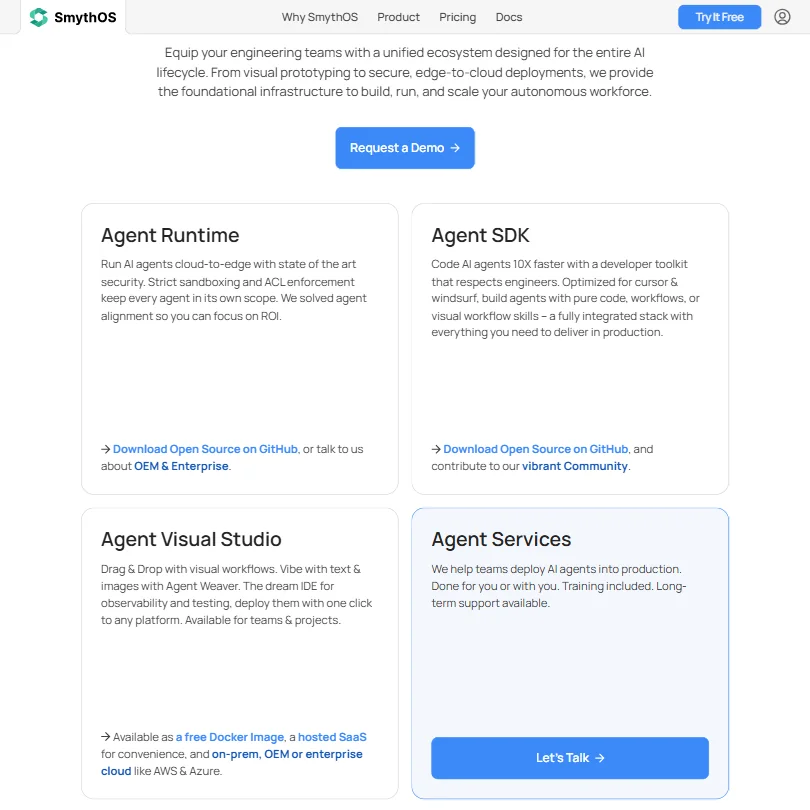
The Visual Agent Studio is the core of it. Drag-and-drop workflow building, real-time debugging, one-click deployment, and it ships as a free Docker image. Smart move for developer adoption. The open-source community around it is active, which matters more than most vendors admit when you're betting infrastructure on a two-year-old product.
Beyond the visual layer, there's a full SDK. Python and JavaScript, both supported. The SDK is specifically described in their docs as optimized for tools like Cursor and Windsurf. That tells you exactly who they're building for. Engineers who live in AI-assisted IDEs. That tracks.
Trigger options cover the real bases: API calls, webhooks, schedules, and bulk CSV input, among a few others. The bulk CSV trigger is something we don't see often at this tier of agent tooling. Useful for batch processing without building a custom pipeline around it.
Team features are real, not bolted on as an afterthought. Role-based access control and per-project key vaults are both present in the architecture, and the multi-tenant ACL enforcement runs at the runtime level, not just the UI level. That distinction matters for anyone deploying agents across departments or client accounts.
The 500+ integration count deserves the usual skepticism. Honestly, that number in any tool's marketing copy gets the eyebrow. The core native integrations are narrower. The Zapier connector gets you to the longer tail, which is fine, but it's not the same as 500 native connections.
SmythOS Automation Power: How Complex Can Your Workflows Get?
This is where SmythOS separates from most of the field. The agent runtime with strict sandboxing and ACL enforcement isn't common at this price range. Most tools give you automation logic. SmythOS gives you isolated execution environments per agent, with scope enforcement baked into the runtime itself, not layered on top after the fact.
Conditional logic runs inside both the visual builder and the SDK. Error handling includes a step-by-step debugger with real-time inspection, which developers in community threads consistently flag as a standout. Not just logs. Actual step tracing. That matters when agents fail in non-obvious ways.
Multi-agent coordination is supported natively. You can define agent work schedules, run bulk operations, and have agents hand tasks off to other agents. Genuinely sophisticated orchestration for a product this young. We're not overselling that.
Human-in-the-loop features aren't part of the platform's autonomy-first design. Chat-with-agent exists. Human task assignment exists. But the product is clearly optimized for agents executing work, not humans approving each step. Design choice, not an oversight.
SmythOS AI Agent Capabilities: What Can It Actually Do Autonomously?
The multi-model support is worth understanding properly. SmythOS isn't locked to one LLM. OpenAI is supported natively, and you can bring your own model. The Enterprise plan explicitly lists fine-tuned LLMs as supported, which matters for teams with data residency requirements or existing model investments they can't walk away from.
Agents can be deployed as API endpoints, MCP servers, or custom ChatGPT integrations. That last one is niche but useful for enterprise teams who've already standardized on GPT-based tooling internally.
The autonomous capability story is strong on paper. Agents that schedule themselves, process bulk input, and coordinate with other agents. Where we'd want more evidence is in real-world production complexity. The Trustpilot signal is positive but the pool is small, mostly enthusiastic early adopters. No G2 presence yet. No Capterra listing. We're not dismissing the Trustpilot data. We'd just want more of it.
Not a red flag. A gap.
Is SmythOS Easy to Set Up Without Code?
Depends entirely on what you're building. The Visual Agent Studio is genuinely accessible for non-engineers prototyping simpler agents. Drag-and-drop, visual logic, one-click deploy. That part works and the docs support it clearly.
But SmythOS is not positioned as a no-code tool for business users. Not really. The SDK, the runtime configuration, the deployment architecture choices all require someone who understands infrastructure. A solo marketer won't get far without technical help, and we'd rather say that plainly than let someone find out after signing up.
The free plan includes the Visual Agent Studio and $5 in monthly credits, plus one seat. That's enough to prototype. The free Docker image is a better starting point for developers who want to poke around locally without a usage cap sitting over them.
The setup complexity is the honest barrier for non-technical users. The docs are clear. The tooling is good. The learning curve is real and the product doesn't pretend otherwise, which we actually appreciate.
SmythOS Pricing: Is It Worth It vs Zapier or Make?

Four private tiers, plus a public free plan. Free at $0, Builder at $39 per seat per month, Startup at $399 per month, Scaleup starting at $1,499 per month, Enterprise starting from $4,955 per month. The jump from Builder to Startup is $360 a month steep. There's not much middle ground there.
Reading the plan details carefully: Builder includes $20 in monthly credits, a 40% model usage discount, and 100 fast API calls per day. Startup jumps to $200 in credits, a 50% model usage discount, 5,000 fast API calls per day, 10 team spaces across 3 seats, and RAG Agents. Scaleup adds 25,000 fast API calls per day, 50 team spaces across 5 seats, a forward deployed engineer, and white labeling. Enterprise removes most caps entirely, adds on-prem and VPC deployment, OEM distribution, and compliance tailoring, among a few others.
Comparing SmythOS to Zapier on price is a bit like comparing a database to a spreadsheet. Adjacent problems, different architecture. Zapier starts lower and serves a broader non-technical audience. SmythOS is priced for teams building agent infrastructure. Harder comparison is against n8n's self-hosted free tier. n8n gives you workflow power at near-zero cost if you're comfortable with self-hosting. SmythOS gives you agent orchestration, sandboxed execution, and a more opinionated runtime on top of that. Different trade-offs, not a clear winner either way.
No refund policy is publicly stated. Worth flagging, especially at enterprise pricing levels.
SmythOS vs n8n: Which Automation Platform Wins?
Wrong frame for this comparison, honestly. n8n is a workflow automation tool. SmythOS is an agent operating system. They overlap but they're not the same category, and forcing a head-to-head misrepresents both products.
Where n8n wins: price (free self-hosted), integration breadth for standard SaaS connections, and a larger established community with years of forum history to pull from. For teams connecting apps and building conditional automation flows, n8n is faster to get running.
Where SmythOS wins: agent autonomy, multi-agent coordination, and the deployment architecture. If your goal is agents executing complex tasks independently across cloud and edge environments, n8n isn't built for that. SmythOS is. The sandboxing, the SDK, the runtime layer. None of that exists in n8n's model.
Building workflows or building agents. That distinction decides the tool.
Who Should Use SmythOS? (And Who Shouldn't)
Engineering teams building production AI agents at scale. That's the fit. Teams with compliance requirements, existing infrastructure preferences, and a need for isolated execution environments will find the architecture genuinely useful rather than just theoretically appealing.
Early-stage AI startups. Also a reasonable fit, particularly those already running Docker who want to avoid building agent infrastructure from scratch.
Business users who want to automate Salesforce and Gmail without touching code. Wrong tool. Full stop. Make or Zapier first, revisit SmythOS when engineering resources exist.
Teams expecting a massive pre-built native integration library. Manage expectations. The 500+ number is marketing-assisted. Native integrations are narrower.
SmythOS Review Verdict
SmythOS has built something technically serious for a two-year-old company. The agent runtime, the sandboxing model, the deploy-anywhere architecture. These aren't vaporware. The docs support them. The GitHub community exists. Developer feedback is positive, even if the review pool is still thin compared to what we'd want for a tool at this price range.
The review coverage gap is our real concern. No G2 presence. No Capterra listing. Trustpilot is positive but small. For a tool claiming enterprise-grade infrastructure, we'd want more structured feedback from production deployments before recommending it to enterprises without internal validation first. That's not a dismissal. It's just where the evidence sits today.
The pricing jump from $39 to $399 is the other friction point, with nothing meaningful in between for teams that outgrow Builder but aren't ready for a $400 monthly commitment. That gap will lose some customers who'd otherwise convert.
For the right engineering team, this is a compelling platform. The open-source path gives you an honest way to evaluate before paying anything. We'd take it seriously.
Frequently Asked Questions
Does SmythOS require coding knowledge to use?
The Visual Agent Studio is accessible without code for basic agent prototyping. Anything production-grade will benefit from engineering involvement, especially for SDK usage and deployment configuration. The platform is built for developers. Not a criticism, just a calibration.
Is there a free version of SmythOS?
Yes. The free plan is $0 per month and includes $5 in monthly credits, one seat, and access to the Visual Agent Studio. Local deployment is supported. There's also a free Docker image for developers who'd rather run it locally without touching the usage cap. Genuinely useful for evaluation, not just a stripped teaser tier.
How does SmythOS handle AI model selection?
SmythOS supports multiple models, not just one. OpenAI is natively supported, and you can bring your own LLM or use enterprise fine-tuned models at the higher tiers. That flexibility matters for teams with specific compliance requirements or existing model infrastructure they're not walking away from. We're skeptical of "bring your own model" claims when they're vague, but the Enterprise plan lists it explicitly, which is at least a concrete commitment.