
We spent a few weeks pulling together everything we could find on Mureka: vendor documentation, Reddit threads, Trustpilot reviews, Product Hunt comments, and pricing data the company actually chose to make public. Not hands-on testing. Upfront about that. What we kept seeing, across almost every source, was a tool that has moved fast technically but hasn't caught up on the basics that matter to paying customers. That gap is what this review is about.
What is Mureka?
Consumer-facing platform, launched in 2024. Mureka takes a text prompt, a lyric input, or a hummed melody and turns it into a full song, vocals included. The model behind it is called Mureka V9, which shipped in early 2026 with improved vocal realism and a one-click Remix feature. Before that, the version history moved fast: V6+O1 in March 2025, V7+TTS V1 in July 2025, V7.5 in August 2025, V7.6+O2 later that same year.
That's a lot of versioning in a short window. Honestly, it shows. The product roadmap looks like a company sprinting to catch up with Suno AI and Udio, not one with a clear destination.
The headline differentiator is reference track-guided generation. You upload a track and have Mureka use it as a style anchor. Combine that with vocal gender control and multilingual lyric support including Cantopop, and there's a real feature surface here. Whether it holds up in practice is a different question.
Mureka Features: Voice, Music & Audio Capabilities

The core workflow is text-in, song-out. You write a prompt or paste lyrics, Mureka generates a full song with instruments and vocals. From there, you can Remix with one click, adjust vocal style, or use the Enhance and Optimize controls to push the audio in a different direction.
The TTS V1 feature, added in July 2025, handles vocal synthesis separately from the main music generation. Voice styles include Female, Male, Choir, and Backing Vocals. That's useful range. Most direct competitors don't offer that kind of granular vocal control at the generation step.
MIDI export and stem exports are listed. So is voice cloning. But when we cross-referenced those claims with user reports and the actual documentation, neither feature is described in meaningful detail anywhere. Voice cloning in particular gets mentioned prominently on marketing pages, then essentially disappears when you go looking for how it works. We're skeptical of that claim until someone shows us the workflow.
Mureka now has public Android and iOS apps. There's also a fully documented public API platform, which is worth knowing. No confirmed native GarageBand integration, and no confirmed Zapier integration either. Those two gaps matter for anyone expecting to slot Mureka into an existing production setup.
Mureka Audio Quality: How Natural Does It Sound?
The V9 model represents a genuine step up in vocal realism, based on what early users reported when it launched. Reddit threads from late 2025 and early 2026 were more positive about voice output than earlier versions had been. Some users described the backing tracks as surprisingly clean. That tracks with what we'd expect from a tool iterating at this pace.
That said, the gap between a demo and what you'll actually produce is real. User-generated examples posted to Product Hunt and Reddit show inconsistency. Some outputs are impressive. Others sound like the vocals are floating slightly above the track, disconnected from the mix. Common problem in this category. Mureka hasn't fully solved it.
The reference track feature helps. Giving the model a style anchor tends to produce more coherent results than prompting from scratch. That's a meaningful workflow choice, not a minor one.
Mureka Voice Cloning & Customization: How Deep Does It Go?
This section is harder to write than it should be. That's the point.
Voice cloning appears on the Mureka homepage as a feature. It also shows up in a few third-party summaries. But when we dug into the actual documentation, we couldn't find a clear explanation of how it works, what inputs it requires, or what the output quality looks like. No demos we found were specifically tied to the voice cloning feature. Not one.
The vocal customization that is clearly documented covers gender selection and style options like Choir and Backing Vocals. Real. The broader voice cloning claim is something we'd want demonstrated before recommending it. Other tools in this space, like ElevenLabs, have published detailed cloning workflows and sample outputs. Mureka hasn't done that at the same level. Notable difference.
Is Mureka Easy to Use?
The interface, from what we can piece together through user reports and available screenshots, follows a prompt-driven generation model that's become standard in this category. Suno and Udio users would find the basic loop familiar enough.
Where it gets more complicated is everything after generation. Remix, stem export, and the reference track upload all add steps. A few Reddit users described the learning curve as manageable but noted that some controls aren't well-explained in the current documentation. The help center exists. It's described as basic. That's being generous.
The one-click Remix feature is probably the most usable part of the post-generation workflow. Iterate fast, pick the version you like. That part seems to work as advertised.
Mureka Pricing: Is It Worth It for Creators & Businesses?
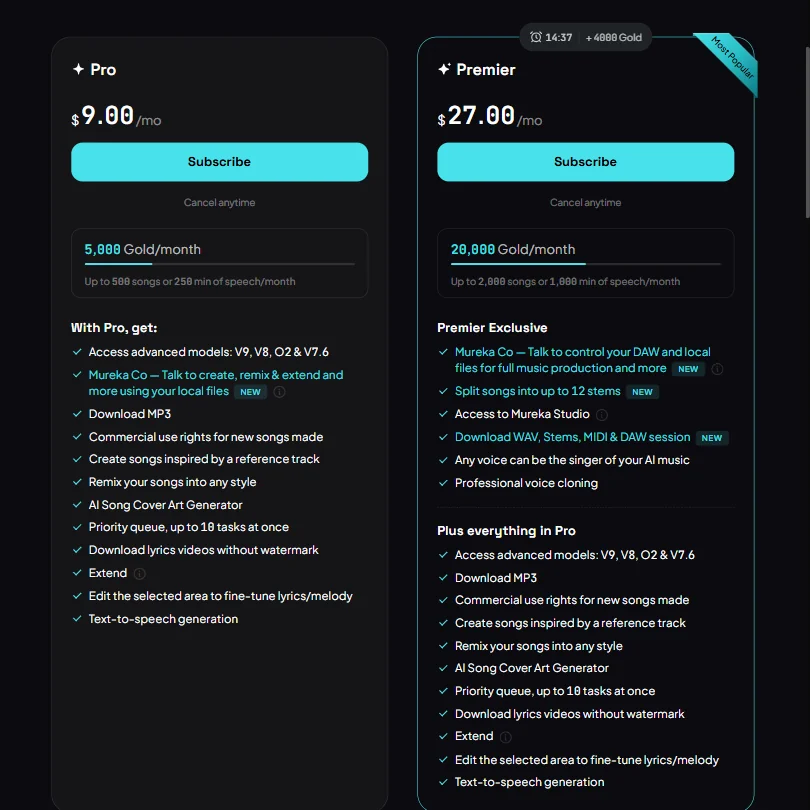
Mureka does have a public subscription page now, and the website lists paid plans with prices. A Pro plan at $9.00 per month gets you 5,000 Gold per month, which the pricing page translates to up to 500 songs or 250 minutes of speech. The Premier plan sits at $27.00 per month with 20,000 Gold monthly, up to 2,000 songs or 1,000 minutes of speech.
Premier adds a few things Pro doesn't have. DAW control through Mureka Co, split into up to 12 stems, and professional voice cloning are all listed as Premier-exclusive. Pro gets you the advanced models including V9, V8, and a couple of others, along with commercial use rights, MP3 download, and priority queue up to 18 tasks at once.
Worth noting separately: WAV, Stems, MIDI, and DAW session downloads are listed as Premier-only. If you're planning to bring Mureka output into a proper production environment, that tier difference matters.
Credit expiration and cancellation difficulty still come up on Trustpilot. The platform sits at approximately 1.5 out of 5 there across roughly 156 reviews, and that number can shift as new reviews come in. The complaints cluster around billing surprises, credits disappearing before they can be used, and support that's slow when things go wrong. The refund policy isn't publicly stated anywhere we could find.
We've seen worse. We've also seen much better. At that score across that many reviews, it's a pattern.
Mureka vs Suno AI: Which AI Audio Tool Wins?
Suno AI is the obvious comparison. Both generate full songs from text prompts. Both offer free tiers. The difference is in where each tool has invested its development effort.
Suno has built a larger community, better documentation, and a more transparent pricing model. Mureka has invested more in vocal customization controls and the reference track workflow. Real trade-off. Not a dismissal of either.
For users who care about vocal style control, Mureka's gender selection and Choir options give it an edge over Suno's current feature set. For users who care about reliable billing support when something breaks, Suno is easier to recommend right now.
Udio is in the same conversation. So are Beatoven.ai and Loudly for instrumental-first use cases. But Suno is the one most users are choosing between when they land on Mureka. Honestly, that comparison doesn't fully favor Mureka at this stage.
Who Should Use Mureka? (And Who Shouldn't)
Hobbyists and casual creators who want to experiment with AI song generation without needing deep documentation or billing clarity. That's the fit. The free credits get you started and the V9 model is genuinely capable of interesting outputs.
Musicians exploring AI as a creative tool might find the reference track feature worth the friction. More sophisticated starting point than a blank prompt.
Content creators who need commercial licensing clarity should wait. The commercial rights situation is listed as included in both paid plans, but the specifics of what that covers aren't documented clearly enough to rely on for client work or monetized content. If a YouTube ad or a client project is on the line, that uncertainty is a real risk. Murf AI handles commercial licensing more transparently for production-grade work.
Business users and anyone with a tight monthly budget should be cautious. The credit expiration complaints are consistent enough that we'd want to see them addressed before recommending Mureka to anyone with real money on the table.
Mureka Review Verdict
The technology is moving. V9 is a meaningful step forward. The reference track workflow and vocal controls are more thoughtful than what most direct competitors offer at comparable price points.
The Trustpilot signal isn't noise. At roughly 1.5 across 156 reviews, the billing and support complaints are the loudest data we have about what the post-signup experience actually looks like. A tool this capable of good outputs shouldn't be this hard to trust on the basics.
The Premier plan's feature set is genuinely interesting. DAW session export, 12-stem splitting, and the voice cloning feature (if it works as described) make a case for $27 per month that we can at least follow. But we'd want the voice cloning documented properly, and we'd want the credit expiration policy fixed, before telling most paying creators to commit. Right now, keep an eye on Mureka while using something else for anything that matters.
Frequently Asked Questions
Is Mureka free to use?
Mureka offers a free plan with limited credits on signup. Those credits expire, which multiple users have flagged as frustrating. Paid options include the Pro plan at $9.00 per month and the Premier plan at $27.00 per month. The subscription page is now public, so you can see the tier breakdown before committing, though the specific refund and cancellation terms aren't clearly documented in the public-facing materials we found.
How does Mureka compare to Suno AI for AI music generation?
Mureka offers more granular vocal controls, including gender selection and choir options, along with a reference track upload feature that Suno doesn't currently match. Suno has better community documentation and a longer track record of billing transparency. If vocal customization is the priority, Mureka is worth a look. If billing clarity matters more, Suno is easier to trust right now.
Does Mureka allow commercial use of generated songs?
Commercial use rights are listed on both the Pro and Premier plans. The specifics of what that licensing actually covers aren't documented clearly in the public-facing materials we reviewed. Creators planning to use generated tracks in client work or monetized content should clarify the exact terms directly with Mureka before committing, because the current documentation doesn't give you enough to go on.